1. Search Result
Search Result
Results for "

photoswitchable

" in MedChemExpress (MCE) Product Catalog:

24

Inhibitors & Agonists

1

Fluorescent Dyes

5

Natural
Products

Cat. No. Product Name Target Research Areas Chemical Structure
  • HY-W106234

    TRP Channel Others
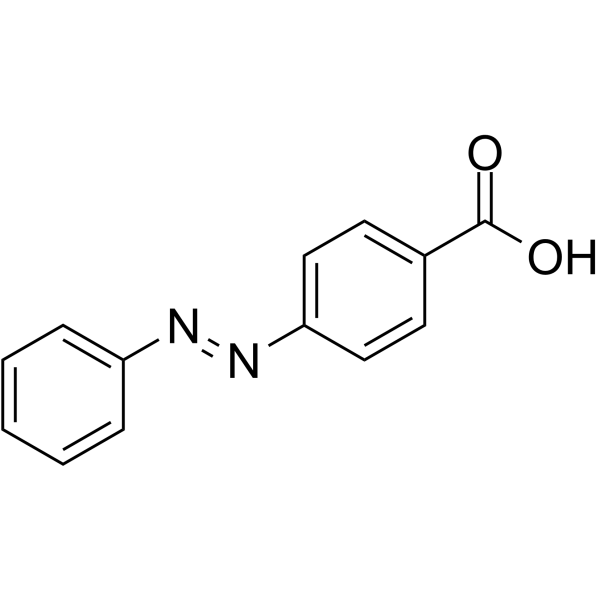
    4-(Phenyldiazenyl)benzoic acid is a photosensitive and photoswitchable TRPA1 agonist that can be used as pharmacological tools for study of pain signaling.
    4-(Phenyldiazenyl)benzoic acid
  • HY-163445

    NAMPT Cancer
    NAMPT activator-6 is a NAMPT activator, a regulatory molecule for the optical control system of NAMPT and NAD+. NAMPT activator-6 can be used to design efficient photoswitchable proteolysis-targeting chimeras (PS-PROTACs) to achieve up-down reversible regulation of NAMPT and NAD+ in a light-dependent manner and reduce the toxicity associated with inhibitor-based PS-PROTACs. PS-PROTAC can be used to achieve antitumor activity, NAMPT, and NAD+ modulation in vivo via optical manipulation .
    NAMPT activator-6
  • HY-161092A

    HCN Channel Potassium Channel Neurological Disease
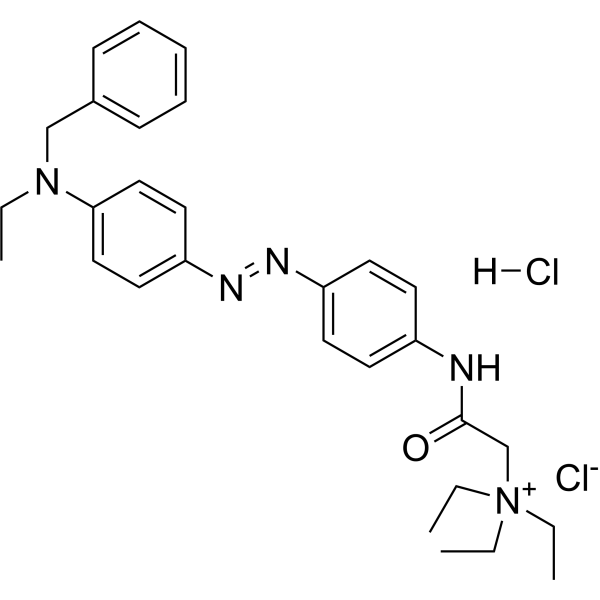
    KIO-301 chloride hydrochloride is an azobenzene photoswitchable compound that blocks voltage-gated ion channels, including hyperpolarization-activated cyclic nucleotide gating (HCN, during exposure to visible light) ) and voltage-gated potassium channels (voltage-gated potassium channels) .
    KIO-301 chloride hydrochloride
  • HY-110358

    Sodium Channel Inflammation/Immunology
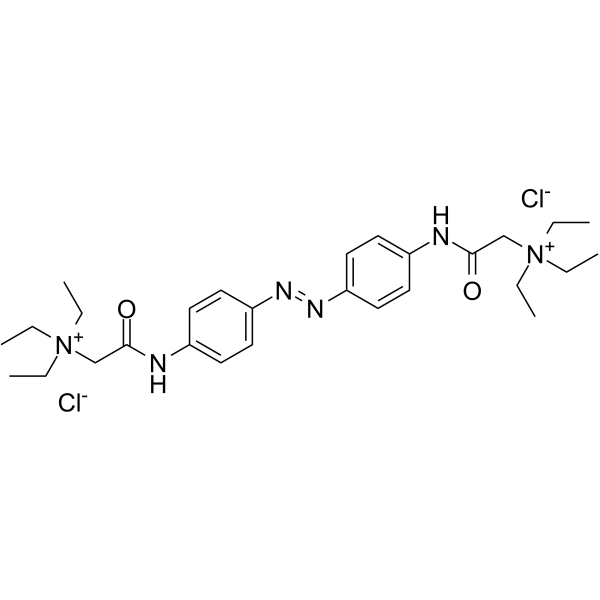
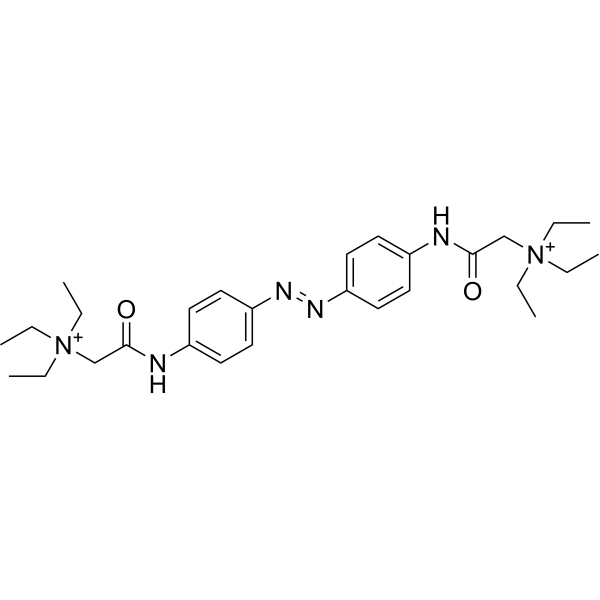
    QAQ dichloride, a photoswitchable voltage-gated Nav and Kv channels blocker, blocks channels in its trans form (of the azobenzene photoswitch), but not in its cis form. QAQ dichloride is membrane-impermeant and only infiltrates pain-sensing neurons that express endogenous import channels. QAQ dichloride acts as a light-sensitive analgesic and can be used for studying of signaling mechanisms in acute and chronic pain .
    QAQ dichloride
  • HY-N15794

    LPL Receptor Neurological Disease
    AzoLPA ammonium is a photoswitchable lipid that activates the Lysophosphatidic acid 1-5 (LPA1-5) receptors’ signaling .
    AzoLPA ammonium
  • HY-160209

    HCN Channel Cardiovascular Disease
    KIO-301 is a photoswitchable HCN channel blocker, and can be used as the vitreous “light switch” molecule that reactivates retinitis pigmentosa .
    KIO-301
  • HY-N15799

    Biochemical Assay Reagents Others
    trans-AzCA4 is a photoswitchable lipid .
    trans-AzCA4
  • HY-N15782

    TRP Channel Neurological Disease
    18:0-PhoDAG is a photoswitchable diacylglycerol (DAG) that allows rapid photoactivation of these DAG-sensitive TRP channels .
    18:0-PhoDAG
  • HY-110209

    TRP Channel Others
    AC4 is a trans antagonist upon voltageactivation of TRPV1 and as cis antagonist of TRPV1 currents upon stimulation with Capsaicin (HY-10448). AC4 demonstrates that a photoswitchable antagonist and an agonist can be used in concert .
    AC4
  • HY-126748

    Histamine Receptor Others
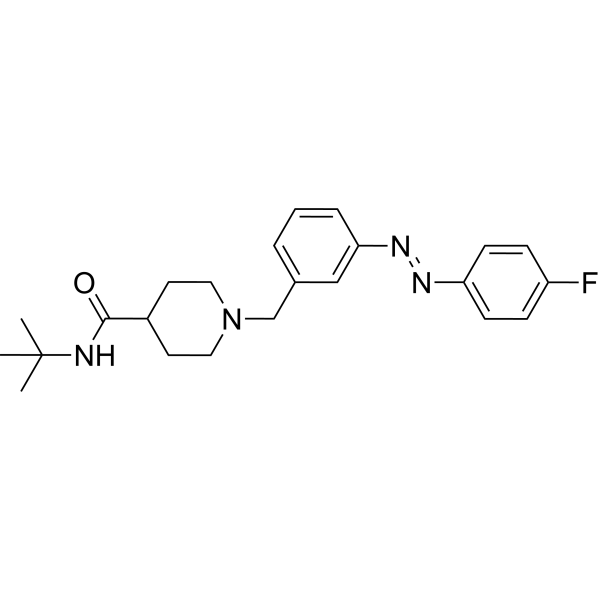
    VUF14862 is a stable and fatigue-resistant photoswitchable GPCR antagonist targeting the histamine H3 receptor (H3R) pathway. VUF14862 binds to H3R with >10-fold increased affinity upon 360 nm irradiation. VUF14862 can be used for spatiotemporal studies of H3R signaling .
    VUF14862
  • HY-139904

    TRP Channel Others
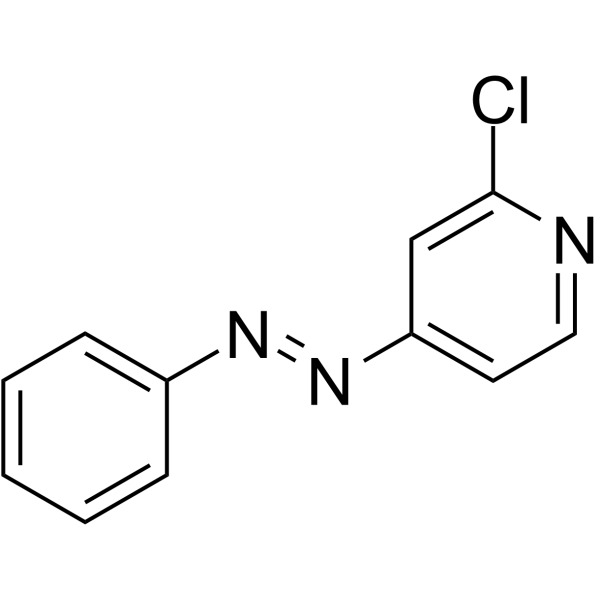
    TRPA1 Antagonist 3 is a photoswitchable TRPA1 agonist that enables optical control of the TRPA1 channel.
    TRPA1 Antagonist 3
  • HY-N15783

    Biochemical Assay Reagents Others
    Photoswitchable Sphingosine is a photoswitchable lipid. Photoswitchable sphingosine can be used to study the translation of optical stimuli into a reversible cellular response .
    Photoswitchable sphingosine
  • HY-126424

    Fluorescent Dye Others
    OptoDArG is a photoswitchable probe that has the activity to recognize lipid-gated pores by controlling TRPC3 channels and can be used as a tool to study the lipid sensing mechanism of TRPC channels.
    OptoDArG
  • HY-N15781

    Biochemical Assay Reagents Metabolic Disease
    Trans-FAAzo-4 is a photo-switchable fatty acid analogue used in photo-pharmacology. Trans-FAAzo-4 is able to alter membrane lateral pressure and thus control opening and closing of mechanosensitive ion channels .
    Trans-faazo-4
  • HY-161897

    Kinesin Cancer
    CENP-E-IN-2 (compound 3) is a photoswitchable CENP-E inhibitor, with the pIC50 of 6.82 without light illumination and 5.85 with 365 nm light illumination. CENP-E-IN-2 has antitumor activity .
    CENP-E-IN-2
  • HY-161414

    CXCR Others
    trans-VUF25471 (Compound trans-3e) is a photoswitchable ACKR3 agonist. trans-VUF25471 binds and activates ACKR3 at 10-fold lower concentrations compared to its cis-isomer .
    trans-VUF25471
  • HY-125667

    Photoamiloride-1

    Sodium Channel Metabolic Disease
    PA1 is a photoswitchable epithelial sodium channel (ENaC) blocker. PA1 can switch to cis-PA1 at 400nm and trans-PA1 at 500nm. PA1 inhibits δ/αENaC, αβγENaC, and δβγENaC, with IC50 values of 4.3nM, 90 nM, and 390 nM, respectively .
    PA1
  • HY-110358A

    Sodium Channel Inflammation/Immunology
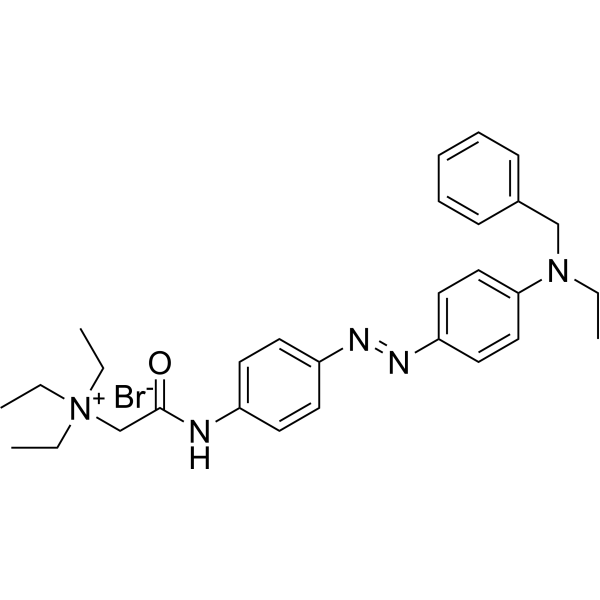
    QAQ dichloride dichloride, a photoswitchable voltage-gated Nav and Kv channels blocker, blocks channels in its trans form (of the azobenzene photoswitch), but not in its cis form. QAQ dichloride dichloride is membrane-impermeant and only infiltrates pain-sensing neurons that express endogenous import channels. QAQ dichloride dichloride acts as a light-sensitive analgesic and can be used for studying of signaling mechanisms in acute and chronic pain .
    QAQ
  • HY-D3438

    Photoswitchable PM8
  • HY-N16250

    Others Metabolic Disease
    Azo SM is a photoswitchable lipid.
    Azo SM
  • HY-B1255

    Cintramide

    Drug Intermediate Others
    Cintriamide (Cintramide) (Compound 5) is a key intermediate for the synthesis of photoswitchable epothilone-based microtubule stabiliser .
    Cintriamide
  • HY-182334

    Sodium Channel Cardiovascular Disease
    azo-Q2a is a photoswitchable NaV1.5 inhibitor. azo-Q2a exists as the trans isomer with low activity in the dark or under 480 nm illumination, and exists as the cis isomer with higher inhibitory potency under 365 nm illumination. azo-Q2a reduces the heart rate of living zebrafish larvae in a light-dependent manner. azo-Q2a can be used for the study of arrhythmias .
    azo-Q2a
  • HY-180983

    PROTACs Bcr-Abl Cancer
    Azo-PROTAC-4C-trans is a BCR-ABL PROTAC degrader that can efficiently degrade the BCR-ABL fusion protein and ABL protein. Azo-PROTAC-4C-trans exhibits potent selective anti-proliferative activity against K562 cells. Azo-PROTAC-4C-trans allows real-time, reversible regulation of its activity via UV (to inactivate it) /visible light (to activate it) irradiation. Azo-PROTAC-4C-trans can be used for the study of myeloid leukemia .
    Azo-PROTAC-4C-trans
  • HY-180985

    PROTACs Bcr-Abl Cancer
    Azo-PROTAC-4C-cis is a BCR-ABL PROTAC degrader, and its degradation efficiency of BCR-ABL is much lower than that of its trans isomer Azo-PROTAC-4C-trans (HY-180983). Azo-PROTAC-4C-cis is the product of the conformational transformation of Azo-PROTAC-4C-trans under ultraviolet (UV) light irradiation. Azo-PROTAC-4C-cis can be converted into highly active Azo-PROTAC-4C-trans under visible light, thereby initiating protein degradation. Azo-PROTAC-4C-cis can be used for the study of myeloid leukemia .
    Azo-PROTAC-4C-cis

Inquiry Online

Your information is safe with us. * Required Fields.

Salutation


Country or Region *

Applicant Name *


Organization Name *

Department *


Email Address *


Product Name *

Cat. No.


Requested quantity *

Phone Number *


Remarks

Inquiry Online

Inquiry Information

Product Name:
Cat. No.:
Quantity:
MCE Japan Authorized Agent:

