1. Search Result
Search Result
Results for "

reductive cleavage

" in MedChemExpress (MCE) Product Catalog:

8

Inhibitors & Agonists

1

Fluorescent Dye

2

Peptides

Cat. No. Product Name Target Research Areas Chemical Structure
  • HY-P2661

    Biochemical Assay Reagents Bacterial Infection
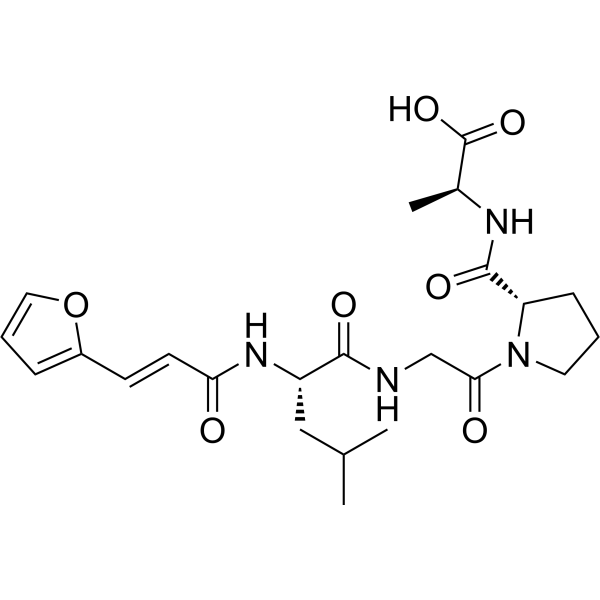
    FA-Leu-Gly-Pro-Ala-OH is a furylacryloyl-terminal tetrapeptide that serves as a substrate for bacterial collagenase and spirochete metalloendopeptidase. FA-Leu-Gly-Pro-Ala-OH is specifically hydrolyzed by spirochete collagenase only at the Leu-Gly bond. FA-Leu-Gly-Pro-Ala-OH can be used to determine the equilibrium constant of peptide bond hydrolysis, and also to detect collagenase-mediated cleavage reactions via turbidimetry based on absorbance reduction .
    FA-Leu-Gly-Pro-Ala-OH
  • HY-115590

    Pim Caspase Apoptosis Necroptosis PARP NF-κB Cancer
    JP-11646 is a pan-PIM inhibitor with increased potency against PIM2 (IC50 = 0.5 nM). JP11646 is freely reversible and ATP non-competitive. JP-11646 results in a decrease of PIM1, 2, and 3 mRNA. JP-11646 can effectively inhibit cell viability in small cell lung cancer (SCLC) and large cell neuroendocrine carcinomas of the lung (LCNEC). JP-11646 can cause a decrease in p-4EBP-1 protein, increasing the cleavage of caspases while decreasing caspase-3. JP-11646 induces apoptosis or necroptosis in cells. JP-11646 leads to reductions in MYC paralogs. JP-11646 can be used for the study of SCLC, LCNEC, human acute leukemia (AML), multiple myeloma (MM), and triple-negative breast cancer (TNBC) .
    JP-11646
  • HY-114095

    VU0285655-1

    Phospholipase TNF Receptor Interleukin Related Metabolic Disease Inflammation/Immunology Cancer
    BML-280 (VU0285655-1) is a potent and selective phospholipase D2 (PLD2) inhibitor. BML-280 has the ability to prevent caspase-3 cleavage and reduction in cell viability induced by high glucose. BML-280 can be used for rheumatoid arthritis research .
    BML-280
  • HY-174302

    Pim HDAC PARP Apoptosis Cancer
    PIM-1/HDAC-IN-2 is a robust PIM/HDAC inhibitor (IC50 = 0.11 μM in MV4-11cells), which exerts a synergistic antiproliferative effect through a dual mechanism of inhibiting PIM1 kinase and selectively inhibiting HDAC6. PIM-1/HDAC-IN-2 induces cell apoptosis. PIM-1/HDAC-IN-2 remarkably induces the cleavage of PARP, thereby initiating the arrest of the cell cycle in G1 phase and a reduction in S phase. PIM-1/HDAC-IN-2 demonstrates significant anticancer efficacyin the MV4-11 xenograft model without notable toxicity[1].
    PIM-1/HDAC-IN-2
  • HY-137802

    S-Adenosyl-L-homocysteine sulfone

    Amino Acid Derivatives Others
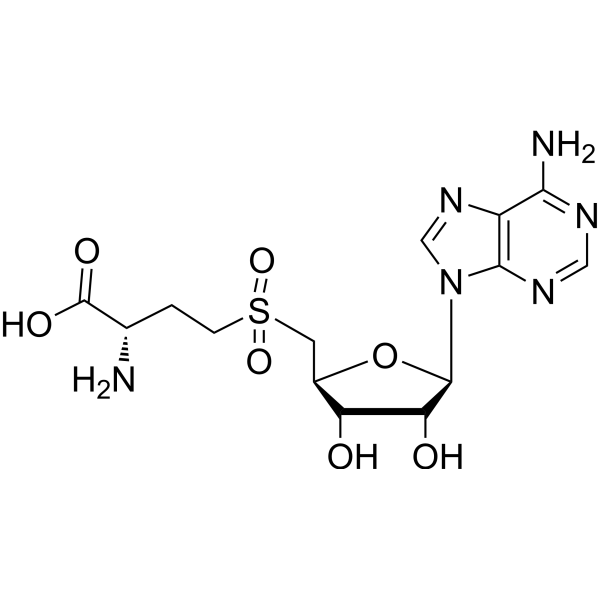
    SAHO2 is the sulfone form of the methyl donor S-(5'-adenosyl)-L-methionine chloride (SAM) and serves as a substrate for radical SAM enzymes .
    SAHO2
  • HY-W009458

    3-IP sodium

    Phosphatase Metabolic Disease
    3-Indoxyl phosphate (3-IP) is a chromogenic and electrochemical substrate for alkaline phosphatase. Upon enzymatic cleavage by alkaline phosphatase, 3-indoxyl is released and subsequently oxidized to produce water-insoluble indigo, which can be quantified by colorimetric detection at 660 nm as a measure of alkaline phosphatase activity. 3-Indoxyl phosphate can also be converted to water-soluble leucoindigo by reduction of indigo in alkaline solution by sodium dithionite, which can be quantified by colorimetric detection at 415 nm or voltametric detection as a measure of alkaline phosphatase activity.2 3-Indoxyl phosphate has been used in ELISAs.
    3-Indoxyl phosphate sodium
  • HY-W078592

    1,1-Bis(p-chlorophenyl)-2-chloroethane

    Drug Derivative Infection
    1-Chloro-4-benzene (1,1-Bis (p-chlorophenyl)-2-chloroethane) (Compound DDMS) is the dechlorination reduction product of DDT (insecticide) and DDD .
    1-Chloro-4-[2-chloro-1-(4-chlorophenyl)ethyl]benzene
  • HY-P2661A

    Biochemical Assay Reagents Bacterial Infection
    FA-Leu-Gly-Pro-Ala-OH TFA is a furylacryloyl-terminal tetrapeptide that serves as a substrate for bacterial collagenase and spirochete metalloendopeptidase. FA-Leu-Gly-Pro-Ala-OH TFA is specifically hydrolyzed by spirochete collagenase only at the Leu-Gly bond. FA-Leu-Gly-Pro-Ala-OH TFA can be used to determine the equilibrium constant of peptide bond hydrolysis, and also to detect collagenase-mediated cleavage reactions via turbidimetry based on absorbance reduction .
    FA-Leu-Gly-Pro-Ala-OH TFA

Inquiry Online

Your information is safe with us. * Required Fields.

Salutation


Country or Region *

Applicant Name *


Organization Name *

Department *


Email Address *


Product Name *

Cat. No.


Requested quantity *

Phone Number *


Remarks

Inquiry Online

Inquiry Information

Product Name:
Cat. No.:
Quantity:
MCE Japan Authorized Agent:

