1. Search Result
Search Result
Results for "

sprout inhibitor

" in MedChemExpress (MCE) Product Catalog:

11

Inhibitors & Agonists

2

Peptides

2

Natural
Products

Cat. No. Nombre del producto Target Áreas de investigación Chemical Structure
  • HY-135774

    Drug Metabolite Phosphatase Cardiovascular Disease
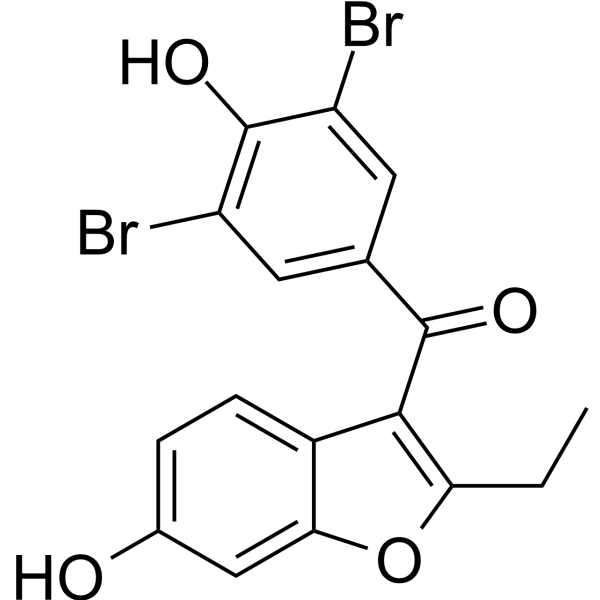
    6-Hydroxybenzbromarone is the major metabolite of Benzbromarone with a longer half-life and greater pharmacological potency than the parent compound. 6-Hydroxybenzbromarone is a protein Eyes Absent 3 (EYA3) inhibitor with an IC50 value of 21.5 μM. 6-Hydroxybenzbromarone is an anti-angiogenic agent, has strong inhibitory effects on cell migration, tubulogenesis, and angiogenic sprouting .
    6-Hydroxybenzbromarone
  • HY-P5982

    Phosphatase Neurological Disease
    PTPσ Inhibitor, ISP can bind to recombinant human PTPs and inhibits PTPσ signaling. PTPσ Inhibitor, ISP can penetrate the membrane and relieves the chondroitin sulfate proteoglycan (CSPG)-mediated axonal sprouting inhibition in spinal cord injury model. PTPσ Inhibitor, ISP enhances remyelination in LPC-induced demyelinated spinal cord. PTPσ Inhibitor, ISP also promotes oligodendrocyte progenitor cells (OPCs) migration, maturation, remyelination, and functional recovery in animal models of Multiple Sclerosis (MS) .
    PTPσ Inhibitor, ISP
  • HY-121935

    Environmental Pollutants Fungal Infection
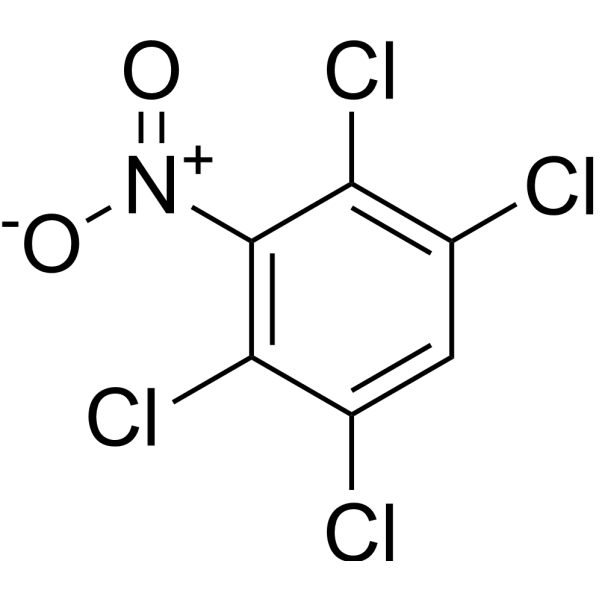
    Tecnazene is a dinitroaromatic fungicide and plant growth regulator. Tecnazene binds irreversibly to human skin tissues and exhibits acute toxicity in Rattus norvegicus (brown rat). Tecnazene exerts sprouting-inhibiting and antifungal activities by inhibiting the sprouting of potato tuber buds and blocking the growth and reproduction of fungi that cause dry rot. Tecnazene has significant antifungal and sprouting-inhibiting activities, and shows high toxicity to aquatic organisms such as freshwater fish and crustaceans. Tecnazene is used for sprouting inhibition and dry rot control during potato storage .
    Tecnazene
  • HY-P3318

    L-BOC2

    Leukotriene Receptor Inflammation/Immunology
    Boc-Phe-Leu-Phe-Leu-Phe (Boc-FLFLF) is a N-formyl peptide receptors (FPR) inhibitor. Boc-Phe-Leu-Phe-Leu-Phe abolishes the FMLP-induced release of peptide leukotrienes. Boc-Phe-Leu-Phe-Leu-Phe inhibits the sprouting of human umbilical vein endothelial cell (HUVEC) spheroids mediated by proliferative diabetic retinopathy (PDR) vitreous and vascular endothelial growth factor (VEGF) respectively in a three-dimensional fibrin gel. Boc-Phe-Leu-Phe-Leu-Phe inhibits the anti-inflammatory and antifibrotic effects of Ac2-26 (HY-P1098). Boc-Phe-Leu-Phe-Leu-Phe can be used for the study of immunology .
    Boc-Phe-Leu-Phe-Leu-Phe
  • HY-121935R

    Reference Standards Fungal Infection
    Tecnazene (Standard) is the analytical standard of Tecnazene. This product is intended for research and analytical applications. Tecnazene is a dinitroaromatic fungicide and plant growth regulator. Tecnazene binds irreversibly to human skin tissues and exhibits acute toxicity in Rattus norvegicus (brown rat). Tecnazene exerts sprouting-inhibiting and antifungal activities by inhibiting the sprouting of potato tuber buds and blocking the growth and reproduction of fungi that cause dry rot. Tecnazene has significant antifungal and sprouting-inhibiting activities, and shows high toxicity to aquatic organisms such as freshwater fish and crustaceans. Tecnazene is used for sprouting inhibition and dry rot control during potato storage .
    Tecnazene (Standard)
  • HY-W142437

    Phytohormone Others
    1,4-Dimethylnaphthalen is a non-competitive potato tuber sprouting inhibitor. 1,4-Dimethylnaphthalen blocks cell cycle progression (G1/S arrest) by inducing PP2A phosphatase and oxygen metabolism-related genes. 1,4-Dimethylnaphthalen is promising for research of fungistatic activity during potato storage and sprout control under abiotic stress .
    1,4-Dimethylnaphthalene
  • HY-110169

    Phosphatase Cardiovascular Disease Cancer
    (E/Z)-3PO is a potent PFKFB3 inhibitor. (E/Z)-3PO can inhibit the glycolysis process, reduce the extracellular acidification rate, and inhibit the capillary tube formation, migration of endothelial cells, and the formation of aortic sprouts, thereby suppressing angiogenesis. (E/Z)-3PO is promising for research of diseases such as cancer, acute lung injury, pulmonary fibrosis, and atherosclerosis .
    (E/Z)-3PO
  • HY-28099

    NSC 11435

    Endogenous Metabolite Cancer
    VEC6 (NSC 11435) is an inhibitor of VEZF1–DNA interaction and has the activity to recapitulate RhoB loss in ischemic retinopathy. VEC6 reduces pathological angiogenesis and promotes lymphangiogenesis. VEC6 plays a unique role in angiogenesis and lymphangiogenesis by regulating the expression of different sets of genes in endothelial cells. VEC6 has an inhibitory effect on VEZF1-mediated transcriptional activity, thereby affecting the proliferation and sprouting of endothelial cells .
    VEC6
  • HY-W328719

    Dec-3-en-2-one

    Drug Derivative Others
    3-Decen-2-one (Dec-3-en-2-one) is a ketone compound and is a sprout growth inhibitor. 3-Decen-2-one induces rapid necrosis of etiolated sprout tissue in potato tubers and suppresses subsequent sprout growth. 3-Decen-2-one can be used for the research of potato tuber sprout growth .
    3-Decen-2-one
  • HY-182372

    Epoxide Hydrolase Neurological Disease
    SH-11037 is a potent inhibitor of soluble epoxide hydrolase (sEH) and docks to the substrate binding cleft in the sEH hydrolase domain. SH-11037 dose-dependently suppresses angiogenesis in the choroidal sprouting assay ex vivo and inhibited ocular developmental angiogenesis in zebrafish larvae. SH-11037 reduces choroidal neovascularisation lesion volume in the laser-induced CNV mouse model. SH-11037 synergises with anti-VEGF treatments in vitro and in vivo. SH-11037 induces G2/M phase blockade and retains retinal endothelial cell viability at active concentrations without overt toxicity. SH-11037 can be used for the research of retinal neovascularization and ocular neovascularization .
    SH-11037
  • HY-N2423B

    (E/Z)-Allyl-glucosinolate free base; (E/Z)-2-Propenyl-glucosinolate free base

    NF-κB p38 MAPK Apoptosis Cardiovascular Disease Infection Inflammation/Immunology Cancer
    (E/Z)-Sinigrin ((E/Z)-Allyl-glucosinolate; (E/Z)-2-Propenyl-glucosinolate) free base is an orally active aliphatic thioglucoside anti-leukemia compound. Allyl isothiocyanate, produced by the hydrolysis of (E/Z)-sinigrin free base by myrosinase, has an IC50 of 2.71 μM against HL60 leukemia cells. The hydrolysis products of (E/Z)-sinigrin free base can further activate apoptosis pathways, inhibit NF-κB and MAPK signaling pathways, and induce phase II metabolic enzyme activity, thus exhibiting anti-cancer, anti-inflammatory, antibacterial, antioxidant, and wound healing activities. (E/Z)-Sinigrin free base can be used in research on cancer, inflammation-related diseases (such as atherosclerosis), and infectious diseases. (E/Z)-Sinigrin free base can be naturally extracted from the seeds of Brassica nigra, Brassica juncea, and other Brassicaceae plants such as broccoli and Brussels sprouts. Methyl pechueloate is a guaiane-type sesquiterpene ester compound and a potential precursor of xerantholide. It is useful in the structural elucidation and biosynthetic pathway studies of sesquiterpenoids. Methyl pechueloate can be naturally extracted from the aerial parts of Pechuel-Loeschea leibnitziae (Kuntze) O. Hoffm .
    (E/Z)-Sinigrin free base

Consulta en línea

Your information is safe with us. * Required Fields.

Saludo


Country or Region *

Nombre del solicitante *


Nombre de la Organizaciòn *

Department *


Direcciòn del E-mail *


Nombre del producto *

Cat. No.


Requested quantity *

Número de teléfono *


Observaciones

Consulta en línea

Inquiry Information

Nombre del producto:
Cat. No.:
Cantidad:
MCE Japan Authorized Agent:

