
1. Search Result
Search Result
Results for "

threonine residue

" in MedChemExpress (MCE) Product Catalog:

15

Inhibitors & Agonists

3

Bibliothèques de criblage

1

Fluorescent Dyes

1

Biochemical Assay Reagents

3

Peptides

1

Kits MCE

1

Isotope-Labeled Compounds

1

GMP Molecules

Cat. No. Nom du produit Target Áreas de investigación Chemical Structure
  • HY-10227
    Bortezomib
    245+ Cited Publications

    PS-341; LDP-341; NSC 681239

    Proteasome NF-κB Apoptosis Autophagy TREM receptor Cancer
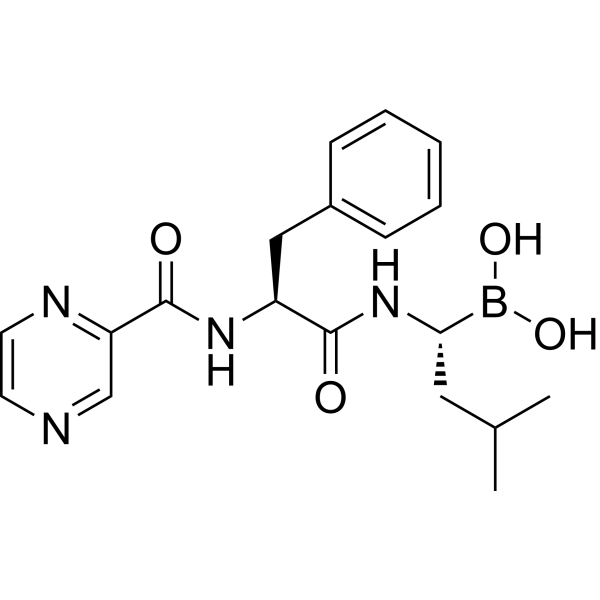
    Bortezomib (PS-341) is a reversible and selective proteasome inhibitor, and potently inhibits 20S proteasome (Ki=0.6 nM) by targeting a threonine residue. Bortezomib disrupts the cell cycle, induces apoptosis, and inhibits NF-κB. Bortezomib is the first proteasome inhibitor anticancer agent. Bortezomib can be used for the study of multiple myeloma (MM) . Bortezomib effectively inhibits TREM2 expression in tumor-associated macrophages (TAMs) .
    Bortezomib
  • HY-10227R

    PS-341 (Standard); LDP-341 (Standard); NSC 681239 (Standard)

    Reference Standards Proteasome NF-κB Apoptosis Autophagy TREM receptor Cancer
    Bortezomib (Standard) is the analytical standard of Bortezomib. This product is intended for research and analytical applications. Bortezomib (PS-341) is a reversible and selective proteasome inhibitor, and potently inhibits 20S proteasome (Ki=0.6 nM) by targeting a threonine residue. Bortezomib disrupts the cell cycle, induces apoptosis, and inhibits NF-κB. Bortezomib is the first proteasome inhibitor anticancer agent. Bortezomib can be used for the study of multiple myeloma (MM) . Bortezomib effectively inhibits TREM2 expression in tumor-associated macrophages (TAMs) .
    Bortezomib (Standard)
  • HY-P5979

    LRRK2 Neurological Disease
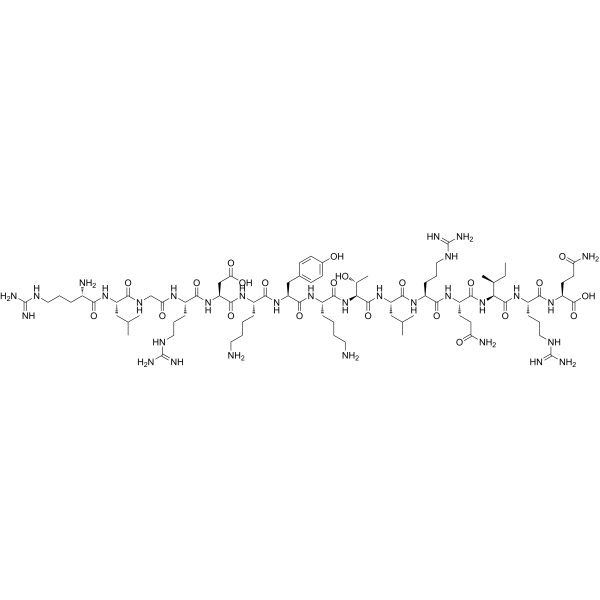
    LRRKtide is a polypeptide substrate. LRRKtide is a specific phosphorylation substrate of LRRK2, a kinase associated with Parkinson's disease, and its phosphorylation site is a threonine residue. LRRKtide can be used for characterization of the catalytic properties of LRRK2, as well as studies on kinase activity and inhibition. LRRKtide is applicable to research related to Parkinson's disease .
    LRRKtide
  • HY-10227S

    PS-341-d8; LDP-341-d8; NSC 681239-d8

    Isotope-Labeled Compounds Proteasome NF-κB Apoptosis Autophagy TREM receptor Cancer
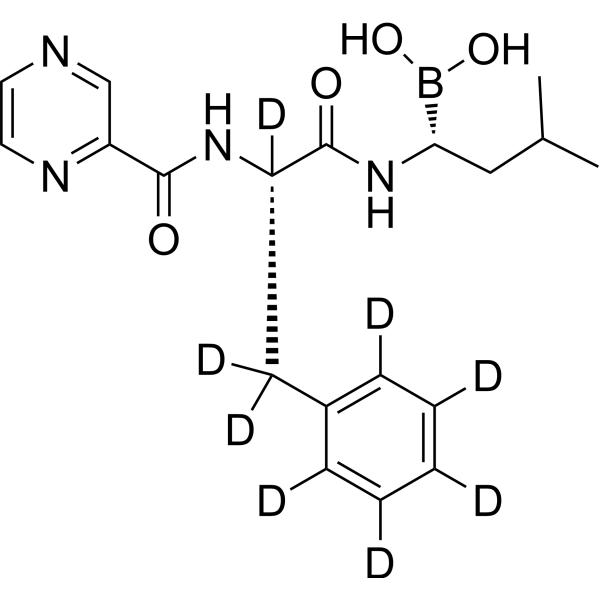
    Bortezomib-d8 is the deuterium labeled Bortezomib. Bortezomib (PS-341) is a reversible and selective proteasome inhibitor, and potently inhibits 20S proteasome (Ki=0.6 nM) by targeting a threonine residue. Bortezomib disrupts the cell cycle, induces apoptosis, and inhibits NF-κB. Bortezomib is the first proteasome inhibitor anticancer agent. Bortezomib can be used for the study of multiple myeloma (MM) . Bortezomib effectively inhibits TREM2 expression in tumor-associated macrophages (TAMs) .
    Bortezomib-d8
  • HY-E70290

    GALNT1

    Endogenous Metabolite β-catenin Wnt Cancer
    N-Acetylgalactosaminyltransferase 1 (GALNT1) is a glycosyltransferase that initiates mucin-type O-glycosylation by transferring α-GalNAc from UDP-GalNAc to serine (Ser) or threonine (Thr) residues in proteins. Overexpression of N-Acetylgalactosaminyltransferase 1 in gastric cancer can promote abnormal O-glycosylation of CD44, thereby activating the Wnt/β-catenin signaling pathway and regulating the malignant behavior of gastric cancer cells. Additionally, N-Acetylgalactosaminyltransferase 1 plays a crucial role in cancer growth and metastasis by modifying the O-glycosylation of various glycoproteins, such as mucin (MUC1), osteopontin (OPN), matrix metalloproteinase-14 (MMP14), and integrin α3 .
    N-Acetylgalactosaminyltransferase 1
  • HY-10227G

    PS-341; LDP-341; NSC 681239

    Proteasome NF-κB Apoptosis Autophagy TREM receptor Cancer
    Bortezomib (GMP) (PS-341 (GMP)) is Bortezomib (HY-10227) produced by using GMP guidelines. GMP small molecules works appropriately as an auxiliary reagent for cell therapy manufacture. Bortezomib (PS-341) is a reversible and selective proteasome inhibitor, and potently inhibits 20S proteasome (Ki=0.6 nM) by targeting a threonine residue. Bortezomib disrupts the cell cycle, induces apoptosis, and inhibits NF-κB. Bortezomib is the first proteasome inhibitor anticancer agent. Bortezomib can be used for the study of multiple myeloma (MM) . Bortezomib effectively inhibits TREM2 expression in tumor-associated macrophages (TAMs) .
    Bortezomib
  • HY-P5444

    Bacterial Others
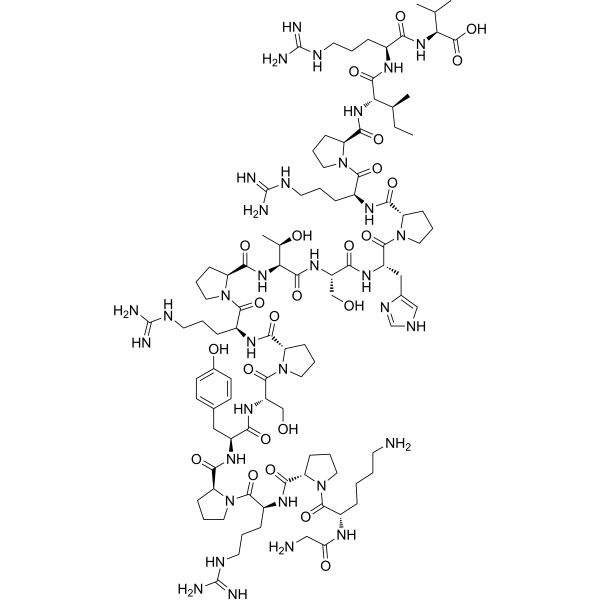
    Drosocin is a biological active peptide. (Drosocin is a 19-mer cationic antimicrobial peptide from Drosophila melanogaster. In Drosophila native drosocin carries a disaccharide moiety attached to a threonine residue in mid-chain position. This synthetic drosocin peptide of identical amino acid sequence without the disaccharide has an activity several times lower than the native compound.)
    Drosocin
  • HY-160478

    Bcr-Abl Cancer
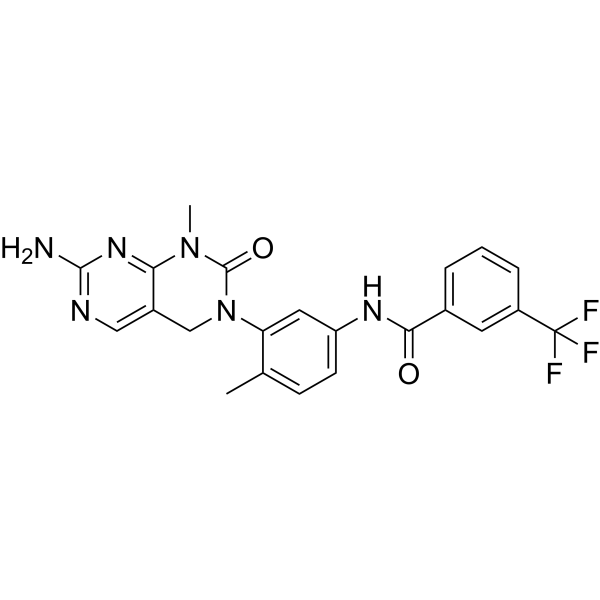
    GNF-6 (Compound 14) inhibits the gatekeeper threonine residue mutation of BCR-ABL-T315I with IC50s of 0.25 μM, 0.09 μM and 0.590 μM for c-ABL-T334I, BCR-ABL and BCR-ABL-T315I variants, respectively. GNF-6, an ATP competitive inhibitor, disrupts the assembly of the hydrophobic spine (a network of hydrophobic interactions), thereby locking the kinase in an inactive ‘DFG-out’ conformation .
    GNF-6
  • HY-P5954

    Calcium Channel Others
    PLTX-II is a calcium channel blocker. PLTX-II has a 44-residue peptide containing ten Cys residues and an O-palmitoylated threonine amide at the carboxy-terminus .
    PLTX-II
  • HY-E70691

    CDK Cancer
    CLK1 is one of the dual specificity kinases and is the founding member of the 'LAMMER' family of kinases. CLK1 activity is positively regulated by phosphorylation on either tyrosine residues or serine/threonine residues, and is negatively regulated by steric constraints mediated by the N-terminal domain, as well as, by phosphorylation on a subset of serine/threonine residues within the catalytic domain. CLK1 Recombinant Human Active Protein Kinase is a recombinant CLK1 protein that can be used to study CLK1-related functions .
    CLK1 Recombinant Human Active Protein Kinase
  • HY-E70568

    Ser/Thr Protease Others
    Protease (O-glycan Cleaving) is recombinantly expressed from E.coli and contains a His tag. Protease (O-glycan Cleaving) is an O-glycan-dependent protease that digests proteins carrying mucin-type O-glycans, including sialylated substrates, glycosylated Ser and Thr residues at the N terminus. Protease (O-glycan Cleaving) digests a variety of O-glycan structures, including sialylated glycosylated core 1 and core 2 structures and Tn antigen. Protease (O-glycan Cleaving) does not digest terminally modified serine or threonine residues, nor does it digest N-glycosylation sites on glycoproteins.
    Protease (O-glycan Cleaving)
  • HY-E70569

    Biochemical Assay Reagents Others
    α-N-acetylgalactosidase (EC 3.2.1.4) is a highly specific exoglycosidase that efficiently hydrolyzes α-N-acetylgalactosamine (GalNAc) linked to serine or threonine residues in glycoproteins (Tn antigen). α-N-acetylgalactosidase shows activity against α 1-3 linked terminal GalNAc . α-N-acetylgalactosidase is suitable for use in the pH range of 6.0-7.6 and does not require cofactors or special buffer systems.
    α-N-acetylgalactosidase
  • HY-E71300

    Biochemical Assay Reagents Others
    The acceptor for β-galactoside α-2,3-sialyltransferase (EC 2.4.99.4) is Galβ1,3GalNAc-R, where R is H, a threonine or serine residue in a glycoprotein, or a glycolipid. Lactose can also serve as an acceptor.
    β-Galactoside α-2,3-sialyltransferase
  • HY-E70949

    PKC Metabolic Disease
    Protein Kinase C,Rat (EC 2.7.1.37) is a family of protein kinase enzymes that are involved in controlling the function of other proteins through the phosphorylation of hydroxyl groups of serine and threonine amino acid residues on these proteins. Protein Kinase C in turn are activated by signals such as increases in the concentration of diacylglycerol (DAG) or calcium ions (Ca 2+).
    Protein Kinase C,Rat
  • HY-10654

    Ephrin Receptor Cancer
    EphB4-IN-2 is a tyrosine kinase inhibitor targeting the Eph family and Src family. EphB4-IN-2 binds to the ATP-binding site of the kinase domain of EphB4, and exhibits high affinity for tyrosine kinases with threonine as the gatekeeper residue, such as Abl, Lck and Src. EphB4-IN-2 can be used in research related to tumor-associated angiogenesis .
    EphB4-IN-2

Demande en ligne

Your information is safe with us. * Required Fields.

Civilité


Country or Region *

Nom du demandeur *


Nom de l'organisation *

Department *


Adresse e-mail *


Nom du produit *

Cat. No.


Requested quantity *

Numéro de téléphone *


Remarques

Demande en ligne

Inquiry Information

Nom du produit:
Cat. No.:
Quantité:
MCE Japan Authorized Agent:

