



Inulicin
Based on 1 publication(s) in Google Scholar
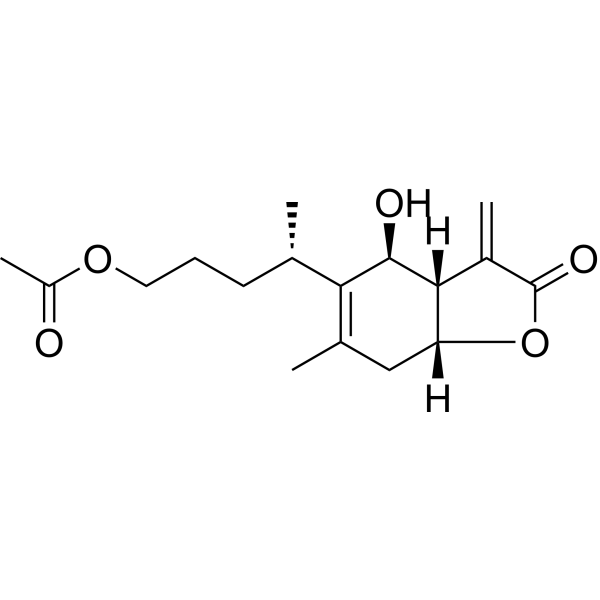
Inulicin (1-O-Acetylbritannilactone) is an active compound that inhibits VEGF-mediated activation of Src and FAK. Inulicin (1-O-Acetylbritannilactone) inhibits LPS-induced PGE2 production and COX-2 expression, and NF-κB activation and translocation.
For research use only. We do not sell to patients.
- Purity : 99.94%
- CAS No.: 33627-41-7
- Formula: C17H24O5
- Molecular Weight:308.37
-
Storage:
4°C, protect from light
* In solvent : -80°C, 6 months; -20°C, 1 month (protect from light)

To place orders, for customer services and technical support, please contact: MedChemExpress USA
Tel: 609-228-6898 E-mail: [email protected] [email protected]


-
 Biological Activity
-
Chemical Information
-
Solvent & Solubility
- Protocol
- Purity & Documentation
- References
-
 Help & FAQs




Publications Citing Use of MedChemExpress (MCE) Inulicin
More

Biological Activity
Description
|
NF-κB |
COX-2 |
Cellular Effect
|
Cell Line

|
Type | Value | Description | References |
|---|---|---|---|---|
| BV-2 | EC50 |
12.5 μM
Compound: 1; ABL
|
Inhibition of LPS-induced NO production in mouse BV-2 cells incubated for 24 hrs by Griess reagent based assay
Inhibition of LPS-induced NO production in mouse BV-2 cells incubated for 24 hrs by Griess reagent based assay
|
[PMID: 34315042] |
| HCT-116 | IC50 |
36.1 μM
Compound: 1, ABL
|
Cytotoxicity against human HCT116 cells assessed as reduction in cell viability incubated for 72 hrs by SRB assay
Cytotoxicity against human HCT116 cells assessed as reduction in cell viability incubated for 72 hrs by SRB assay
|
10.1039/C4MD00209A |
| HeLa | IC50 |
32.6 μM
Compound: 1, ABL
|
Cytotoxicity against human HeLa cells assessed as reduction in cell viability incubated for 72 hrs by SRB assay
Cytotoxicity against human HeLa cells assessed as reduction in cell viability incubated for 72 hrs by SRB assay
|
10.1039/C4MD00209A |
| SGC-7901 | IC50 |
47.8 μM
Compound: 1, ABL
|
Cytotoxicity against human SGC7901 cells assessed as reduction in cell viability incubated for 72 hrs by SRB assay
Cytotoxicity against human SGC7901 cells assessed as reduction in cell viability incubated for 72 hrs by SRB assay
|
10.1039/C4MD00209A |
In Vitro
Inulicin (1-O-Acetylbritannilactone) inhibits angiogenesis and lung cancer cell growth through regulating VEGF-Src-FAK signaling. Inulicin dose-dependently inhibits vascular endothelial growth factor (VEGF)-induced proliferation, migration, and capillary structure formation of cultured human umbilical vascular endothelial cells (HUVECs). Treatment of A549 NSCLC cells with Inulicin results in cell growth inhibition and Src-FAK in-activation. The potential effect of Inulicin is tested ton Src and FAK phosphorylation in A549 lung cancer cells. Significant high levels of Src and FAK phosphorylations are noticed a in A549 cells, which are both inhibited by treatment of Inulicin (5 μM and 10 μM). Src and FAK are both important for cancer cell proliferation. Thus, A549 cell growth, tested by MTT assay and clonogenicity assay,is remarkably inhibited by corresponding Inulicin treatment. The anti-A549 cell growth activity of Inulicin is again dose-dependent[1]. Inulicin (1-O-Acetylbritannilactone) isolated from Inula britannica-F., inhibits inflammatory responses in vascular smooth muscle cells (VSMCs). Inulicin (5, 10, 20 μM) has several concentration dependent effects, including inhibition of lipopolysaccharide (LPS)-induced PGE2 production and COX-2 expression, and blockade of NF-κB activation and translocation. In addition, Inulicin directly inhibits the binding of active NF-κB to specific DNA cis-element[2].
MedChemExpress (MCE) has not independently confirmed the accuracy of these methods. They are for reference only.
In Vivo
MedChemExpress (MCE) has not independently confirmed the accuracy of these methods. They are for reference only.


Chemical Information
-
CAS No. 33627-41-7
-
Appearance Solid
-
Molecular Weight 308.37
-
Formula C17H24O5
-
Color White to off-white
-
SMILES
O[C@H]1[C@@](C2=C)([H])[C@@](OC2=O)([H])CC(C)=C1[C@@H](C)CCCOC(C)=O
-
Synonyms
1-O-Acetylbritannilactone
-
Structure Classification
-
Initial Source
-
Shipping
Room temperature in continental US; may vary elsewhere.
-
Storage
4°C, protect from light
* In solvent : -80°C, 6 months; -20°C, 1 month (protect from light)


Publications (1)
-
Journal Impact Factor
-
Most Recent
-
Phytomedicine
Salvianolic acid B inhibits Ang II-induced VSMC proliferation in vitro and intimal hyperplasia in vivo by downregulating miR-146a expression. [Abstract]2019 May:58:152754. PMID: 31009837


Solvent & Solubility
In Vitro:
DMSO : 100 mg/mL (324.29 mM; Need ultrasonic; Hygroscopic DMSO has a significant impact on the solubility of product, please use newly opened DMSO)
Ethanol : 50 mg/mL (162.14 mM; Need ultrasonic)
Please refer to the solubility information to select the appropriate solvent. Once prepared, please aliquot and store the solution to prevent product inactivation from repeated freeze-thaw cycles.
Storage method and period of stock solution: -80°C, 6 months; -20°C, 1 month (protect from light). When stored at -80°C, please use it within 6 months. When stored at -20°C, please use it within 1 month.
Please refer to the solubility information to select the appropriate solvent. Once prepared, please aliquot and store the solution to prevent product inactivation from repeated freeze-thaw cycles.
Storage method and period of stock solution: -80°C, 6 months; -20°C, 1 month (protect from light). When stored at -80°C, please use it within 6 months. When stored at -20°C, please use it within 1 month.
Concentration (start) × Volume (start) = Concentration (final) × Volume (final)
In Vivo:
Select the appropriate dissolution method based on your experimental animal and administration route.
- For the following dissolution methods, please ensure to first prepare a clear stock solution using an In Vitro approach and then sequentially add co-solvents:
- To ensure reliable experimental results, the clarified stock solution can be appropriately stored based on storage conditions. As for the working solution for In Vivo experiments, it is recommended to prepare freshly and use it on the same day.
- The percentages shown for the solvents indicate their volumetric ratio in the final prepared solution. If precipitation or phase separation occurs during preparation, heat and/or sonication can be used to aid dissolution.
Add each solvent one by one: 10% DMSO 40% PEG300 5% Tween-80 45% Saline
Solubility: ≥ 2.5 mg/mL (8.11 mM); Clear solution
This protocol yields a clear solution of ≥ 2.5 mg/mL (saturation unknown).
Taking 1 mL working solution as an example, add 100 μL DMSO stock solution (25.0 mg/mL) to 400 μL PEG300, and mix evenly; then add 50 μL Tween-80 and mix evenly; then add 450 μL Saline to adjust the volume to 1 mL.
Preparation of Saline: Dissolve 0.9 g sodium chloride in ddH₂O and dilute to 100 mL to obtain a clear Saline solution.
Add each solvent one by one: 10% DMSO 90% (20% SBE-β-CD in Saline)
Solubility: ≥ 2.5 mg/mL (8.11 mM); Clear solution
This protocol yields a clear solution of ≥ 2.5 mg/mL (saturation unknown).
Taking 1 mL working solution as an example, add 100 μL DMSO stock solution (25.0 mg/mL) to 900 μL 20% SBE-β-CD in Saline, and mix evenly.
Preparation of 20% SBE-β-CD in Saline (4°C, storage for one week): 2 g SBE-β-CD powder is dissolved in 10 mL Saline, completely dissolve until clear.
Add each solvent one by one: 10% EtOH 40% PEG300 5% Tween-80 45% Saline
Solubility: ≥ 2.5 mg/mL (8.11 mM); Clear solution
This protocol yields a clear solution of ≥ 2.5 mg/mL (saturation unknown).
Taking 1 mL working solution as an example, add 100 μL EtOH stock solution (25.0 mg/mL) to 400 μL PEG300, and mix evenly; then add 50 μL Tween-80 and mix evenly; then add 450 μL Saline to adjust the volume to 1 mL.
Preparation of Saline: Dissolve 0.9 g sodium chloride in ddH₂O and dilute to 100 mL to obtain a clear Saline solution.
Add each solvent one by one: 10% EtOH 90% (20% SBE-β-CD in Saline)
Solubility: ≥ 2.5 mg/mL (8.11 mM); Clear solution
This protocol yields a clear solution of ≥ 2.5 mg/mL (saturation unknown).
Taking 1 mL working solution as an example, add 100 μL EtOH stock solution (25.0 mg/mL) to 900 μL 20% SBE-β-CD in Saline, and mix evenly.
Preparation of 20% SBE-β-CD in Saline (4°C, storage for one week): 2 g SBE-β-CD powder is dissolved in 10 mL Saline, completely dissolve until clear.
Add each solvent one by one: 10% EtOH 90% Corn Oil
Solubility: ≥ 2.5 mg/mL (8.11 mM); Clear solution
This protocol yields a clear solution of ≥ 2.5 mg/mL (saturation unknown). If the continuous dosing period exceeds half a month, please choose this protocol carefully.
Taking 1 mL working solution as an example, add 100 μL EtOH stock solution (25.0 mg/mL) to 900 μL Corn oil, and mix evenly.
In Vivo Dissolution Calculator
Please enter the basic information of animal experiments:
-
-
-
-
Recommended: Prepare an additional quantity of animals to account for potential losses during experiments.
Please enter your animal formula composition:
-
%DMSO +
Recommended: Keep the proportion of DMSO in working solution below 2% if your animal is weak.
-
%+
-
+%Tween-80 + +
-
%Saline +
The co-solvents required include: DMSO, . All of co-solvents are available by MedChemExpress (MCE). , Tween 80. All of co-solvents are available by MedChemExpress (MCE).
Working solution concentration: 0.22 mg/mL
Method for preparing stock solution: mg drug dissolved in μL DMSO. Stock solution concentration: mg/mL. * In solvent : -80°C, 6 months; -20°C, 1 month (protect from light)
1. Take μL DMSO stock solution;
2. Add μL .
μL , mix evenly;
3. Then add μL Tween 80, mix evenly;
4. Then add μL
Please ensure that the stock solution in the first step is dissolved to a clear state, and add co-solvents in sequence. You can use ultrasonic heating (ultrasonic cleaner, recommended frequency 20-40 kHz), vortexing, etc. to assist dissolution.

Protocol
Cell Assay[1]
HUVECs or A549 cells are plated in 60 mm plates (300 cells/plate). After overnight incubation, cells are treated with applied agents (e.g., Inulicin; 5 μM and 10 μM) for 24 h. Cells are then washed, and fresh media are added. After 10 days of incubation, surviving colonies are fixed, stained, and manually counted[1].
MedChemExpress (MCE) has not independently confirmed the accuracy of these methods. They are for reference only.
Animal Administration[1]
Mice[1]
Male nude mice (4-6weeks old, BALB/c) are used. A549 cells (five million cells in 0.1 mL of culture medium) are subcutaneously injected at the right thigh of nude mice, and treatment is started when the tumors reach an average volume about 100 mm3. Animals are randomized into two groups with 10 mice per group: (a) Vehicle; (b) 12 mg/kg of Inulicin. Inulicin is injected intraperitoneally (i.p.) daily. The mice are examined daily for toxicity/mortality relevant to treatment, and the tumor is measured with a caliper every two days. The tumor volume (in mm3) is calculated, and the tumor growth curve is presented. At the end of experiments, xenograft tumors are isolated through surgery and weighted[1].
MedChemExpress (MCE) has not independently confirmed the accuracy of these methods. They are for reference only.


Purity & Documentation
-
Data Sheet (277 KB)
-
SDS (392 KB)
- English - EN (392 KB)
- Français - FR (392 KB)
- Deutsch - DE (392 KB)
- Norwegian - NO (392 KB)
- Español - ES (392 KB)
- Swedish - SV (392 KB)
- Italian - IT (392 KB)
- Korean - KR (392 KB)
- Portuguese - PT (392 KB)
-
Handling Instructions (2659 KB)
References
[1]. Zhengfu H, et al. 1-o-acetylbritannilactone (ABL) inhibits angiogenesis and lung cancer cell growth through regulating VEGF-Src-FAK signaling. Biochem Biophys Res Commun. 2015 Aug 21;464(2):422-7. [Content Brief]
[2]. Liu YP, et al. Acetylbritannilactone suppresses lipopolysaccharide-induced vascular smooth muscle cell inflammatory response. Eur J Pharmacol. 2007 Dec 22;577(1-3):28-34. [Content Brief]


Complete Stock Solution Preparation Table
Please refer to the solubility information to select the appropriate solvent. Once prepared, please aliquot and store the solution to prevent product inactivation from repeated freeze-thaw cycles.
Storage method and period of stock solution: -80°C, 6 months; -20°C, 1 month (protect from light). When stored at -80°C, please use it within 6 months. When stored at -20°C, please use it within 1 month.
| Optional Solvent | Concentration Solvent Mass | 1 mg | 5 mg | 10 mg | 25 mg |
|---|---|---|---|---|---|
| Ethanol / DMSO | 1 mM | 3.2429 mL | 16.2143 mL | 32.4286 mL | 81.0714 mL |
| 5 mM | 0.6486 mL | 3.2429 mL | 6.4857 mL | 16.2143 mL | |
| 10 mM | 0.3243 mL | 1.6214 mL | 3.2429 mL | 8.1071 mL | |
| 15 mM | 0.2162 mL | 1.0810 mL | 2.1619 mL | 5.4048 mL | |
| 20 mM | 0.1621 mL | 0.8107 mL | 1.6214 mL | 4.0536 mL | |
| 25 mM | 0.1297 mL | 0.6486 mL | 1.2971 mL | 3.2429 mL | |
| 30 mM | 0.1081 mL | 0.5405 mL | 1.0810 mL | 2.7024 mL | |
| 40 mM | 0.0811 mL | 0.4054 mL | 0.8107 mL | 2.0268 mL | |
| 50 mM | 0.0649 mL | 0.3243 mL | 0.6486 mL | 1.6214 mL | |
| 60 mM | 0.0540 mL | 0.2702 mL | 0.5405 mL | 1.3512 mL | |
| 80 mM | 0.0405 mL | 0.2027 mL | 0.4054 mL | 1.0134 mL | |
| 100 mM | 0.0324 mL | 0.1621 mL | 0.3243 mL | 0.8107 mL |


Inulicin Related Classifications
HY-N0896 Related Classifications
 Powered by Bioz