



GLP-1(7-36), amide
Based on 11 publication(s) in Google Scholar
GLP-1(7-36), amide is a physiological incretin hormone that stimulates insulin secretion.
For research use only. We do not sell to patients.
- Purity : 99.02%
- CAS No.: 107444-51-9
- Formula: C149H226N40O45
- Molecular Weight:3297.68
-
Storage:
Sealed storage, away from moisture.
Powder -80°C, 2 years , -20°C, 1 year* In solvent : -80°C, 6 months; -20°C, 1 month (sealed storage, away from moisture)

To place orders, for customer services and technical support, please contact: MedChemExpress USA
Tel: 609-228-6898 E-mail: [email protected] [email protected]


-
 Biological Activity
-
Chemical Information
-
Solvent & Solubility
- Protocol
- Purity & Documentation
- References
-
 Help & FAQs




Publications Citing Use of MedChemExpress (MCE) GLP-1(7-36), amide
More- J Pharm Anal. 2024 Aug;14(8):100968. [Abstract]
- MAbs. 2021 Jan-Dec;13(1):1893425. [Abstract]
- Stem Cell Reports. 2026 Aug 11;21(8):103008.
- Int J Pept Res Ther. 2026 Mar 10;32(2):38.
- Int J Endocrinol. 2020 Jun 19:2020:1484321. [Abstract]
- bioRxiv. 2025 Nov 3.
- Research Square Preprint. 2024 Jan 9.
- Patent. US20230278991A1.
- Research Square Preprint. 2023 May 22.
- Patent. US20200283424A1.
- Patent. US20200283424A1.
 Customer Validation & Images

-
Bio/Physico-chemical Assay
-
Bio/Physico-chemical Assay
-
Flow Cytometry
-
Cell Proliferation/Viability Assay
-
Flow Cytometry


Biological Activity
Description
In Vitro
The sequence of Glucagon-Like Peptide after residue 7 shows similarities to glucagon and to other biologically active members of the secretin peptide family, particularly glucose-dependent insulinotropic peptide (GIP). This sequence has been especially well preserved, showing 66% nucleotide homology with GLP-1 in the proglucagon of the very primitive anglerfish. This 7-36 sequence of GLP-1 is a potent insulin-releasing peptide in vitro[1]. Glucagon-Like Peptide (GLP) I (7-36), amide is a product of the tissue-specific post-translational processing of the glucagon precursor. It is released postprandially from intestinal endocrine L cells and stimulates insulin secretion. DPP IV is the main degradation enzyme for GLP-l(7 - 36)amide in human serum. Dipeptidyl-peptidase IV can initiate the metabolism of GIP and GLP-1(7-36)amide in human serum[2].
MedChemExpress (MCE) has not independently confirmed the accuracy of these methods. They are for reference only.
In Vivo
MedChemExpress (MCE) has not independently confirmed the accuracy of these methods. They are for reference only.


Chemical Information
-
CAS No. 107444-51-9
-
Appearance Solid
-
Molecular Weight 3297.68
-
Formula C149H226N40O45
-
Color White to off-white
-
Synonyms
Glucagon-like peptide-1 (GLP-1)(7-36), amide; Human GLP-1 (7-36), amide
-
Sequence
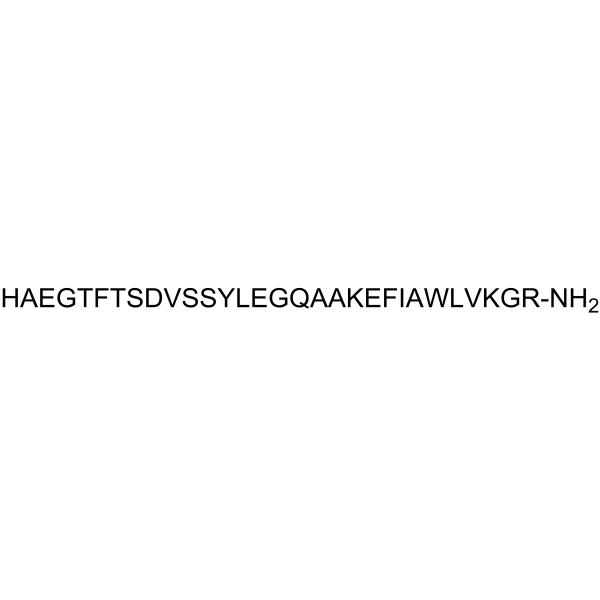
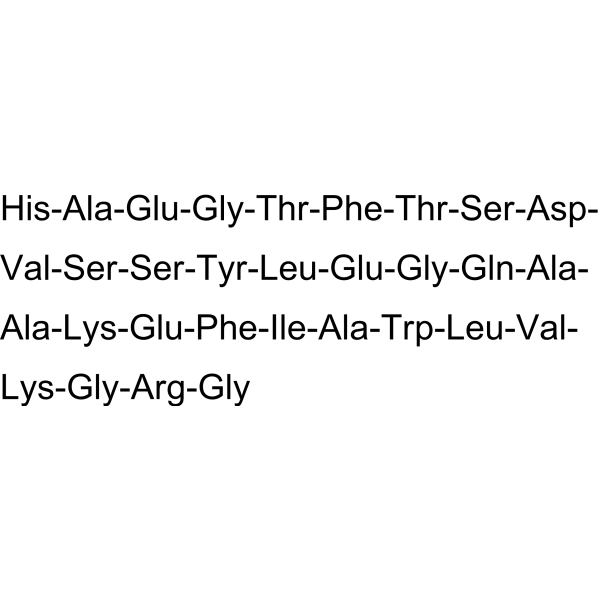
His-Ala-Glu-Gly-Thr-Phe-Thr-Ser-Asp-Val-Ser-Ser-Tyr-Leu-Glu-Gly-Gln-Ala-Ala-Lys-Glu-Phe-Ile-Ala-Trp-Leu-Val-Lys-Gly-Arg-NH2
-
Sequence Shortening
HAEGTFTSDVSSYLEGQAAKEFIAWLVKGR-NH2
-
Shipping
Room temperature in continental US; may vary elsewhere.
-
Storage
Sealed storage, away from moisture
Powder -80°C 2 years -20°C 1 year * In solvent : -80°C, 6 months; -20°C, 1 month (sealed storage, away from moisture)


Publications (11)
-
Journal Impact Factor
-
Most Recent
-
J Pharm Anal
Baicalein: A potential GLP-1R agonist improves cognitive disorder of diabetes through mitophagy enhancement. [Abstract]2024 Aug;14(8):100968. PMID: 39258173
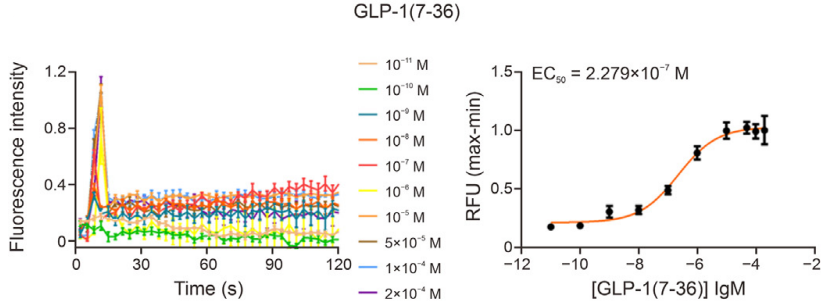
GLP-1(7-36), amide purchased from MedChemExpress. Usage Cited in: J Pharm Anal. 2024 Aug;14(8):100968. [Abstract]
GLP-1(7-36), amide acetate, as GLP-1 analogues, facilitated Ca2+ mobilization in a dose-dependent manner in GLP-1R-HEK293 cells.
-
MAbs
Functional GLP-1R antibodies identified from a synthetic GPCR-focused library demonstrate potent blood glucose control. [Abstract]2021 Jan-Dec;13(1):1893425. PMID: 33706686
GLP-1(7-36), amide purchased from MedChemExpress. Usage Cited in: MAbs. 2021 Jan-Dec;13(1):1893425. [Abstract]
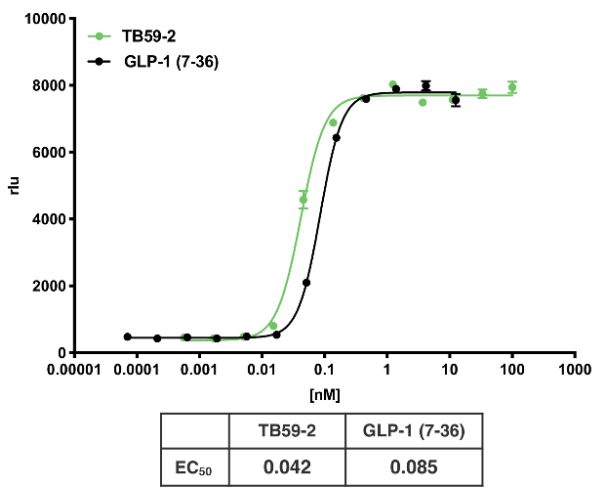
TB-59-2 is a potent agonist in the cAMP assay with a similar EC50 as the GLP-1(7-36), amide acetate (30 min) peptide.
GLP-1(7-36), amide purchased from MedChemExpress. Usage Cited in: MAbs. 2021 Jan-Dec;13(1):1893425. [Abstract]
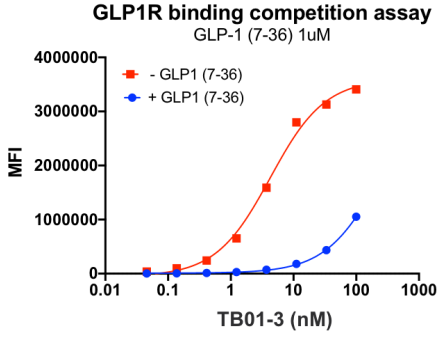
TB01-3 competed with GLP-1(7-36), amide acetate peptide for binding and inhibited the activities of TB01-3 binding in the absence and presence of GLP-1(7-36), amide acetate.
-
-
-
Int J Endocrinol
GLP-1/GLP-1R Signaling Regulates Ovarian PCOS-Associated Granulosa Cells Proliferation and Antiapoptosis by Modification of Forkhead Box Protein O1 Phosphorylation Sites. [Abstract]2020 Jun 19:2020:1484321. PMID: 32655632
GLP-1(7-36), amide purchased from MedChemExpress. Usage Cited in: Int J Endocrinol. 2020 Jun 19:2020:1484321. [Abstract]
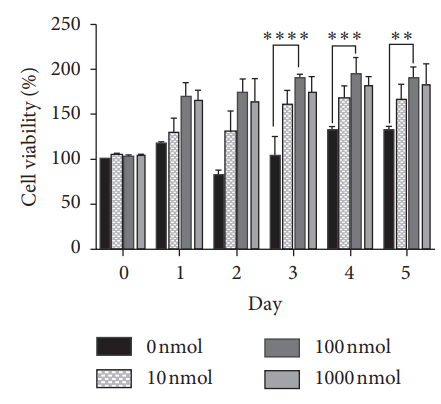
GCs were isolated from the ovaries of PCOS model mice (day 54 of life) and treated with increasing doses of GLP-1(7-36), amide acetate (10, 100, and 1000 nM; 24-120 h). Cell viability was measured by CCK-8 assay. The results showed that 100 nM GLP-1(7-36), amide acetate significantly enhanced the viability of MGCs compared with the blank control group.
GLP-1(7-36), amide purchased from MedChemExpress. Usage Cited in: Int J Endocrinol. 2020 Jun 19:2020:1484321. [Abstract]
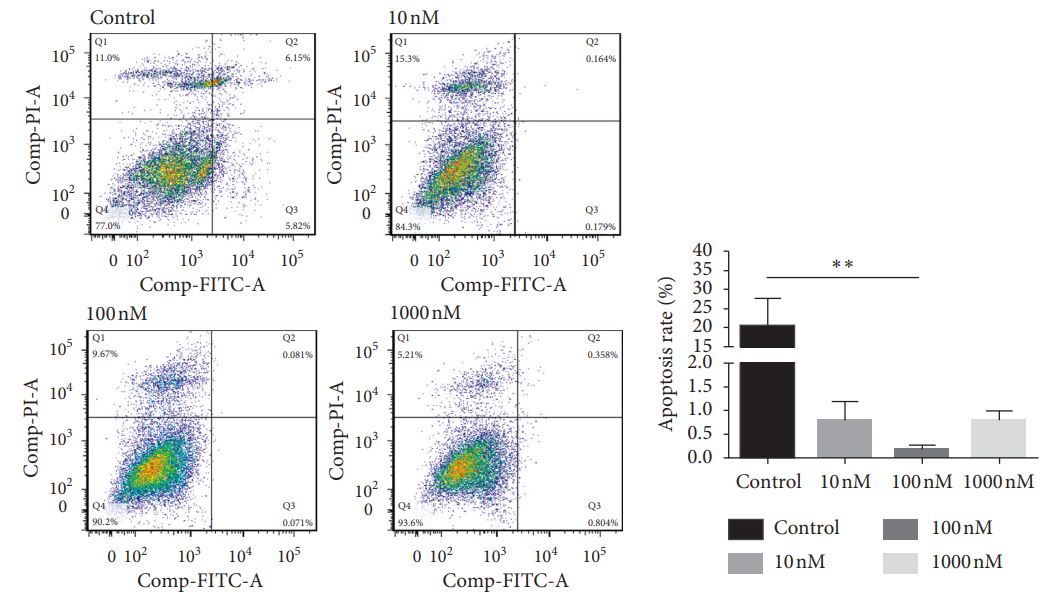
Flow cytometry Annexin V-FITC/PI double staining was used to detect the apoptotic rate of PCOS MGCs in control group and GLP-1(7-36), amide acetate (10 nM, 100 nM, and 1000 nM) treated for 48 hours. The results showed that different concentrations of GLP-1(7-36), amide acetate inhibited the apoptosis of PCOS-associated MGCs treated by DHEA. After being treated for 48 hours, the percentage of apoptotic and late-apoptotic cells was 11.97%, 0.343%, 0.152%, and 1.162%, corresponding to the concentration of GLP-1(7-36), amide acetate of 0, 10, 100, and 1000 nM.
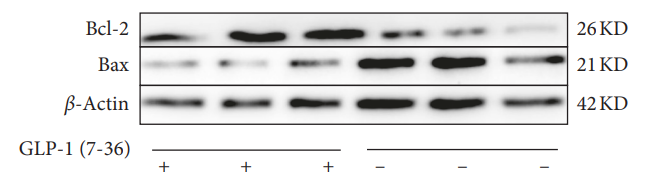
GLP-1(7-36), amide purchased from MedChemExpress. Usage Cited in: Int J Endocrinol. 2020 Jun 19:2020:1484321. [Abstract]
Bcl-2, bax, and beta-actin were detected using their specific antibodies by the Western blot analysis for the PCOS MGCs with or without 100 nM GLP-1(7-36), amide acetate interference for 48 hours. The results showed that the expression of bcl-2 protein increased significantly after GLP-1(7-36), amide acetate intervention, while the expression of Bax decreased.
-
-
-
-
-
-


Solvent & Solubility
In Vitro:
H2O : 100 mg/mL (30.32 mM; Need ultrasonic)
Please refer to the solubility information to select the appropriate solvent. Once prepared, please aliquot and store the solution to prevent product inactivation from repeated freeze-thaw cycles.
Storage method and period of stock solution: -80°C, 6 months; -20°C, 1 month (sealed storage, away from moisture). When stored at -80°C, please use it within 6 months. When stored at -20°C, please use it within 1 month.
* Note: If you choose water as the stock solution, please dilute it to the working solution, then filter and sterilize it with a 0.22 μm filter before use.
Please refer to the solubility information to select the appropriate solvent. Once prepared, please aliquot and store the solution to prevent product inactivation from repeated freeze-thaw cycles.
Storage method and period of stock solution: -80°C, 6 months; -20°C, 1 month (sealed storage, away from moisture). When stored at -80°C, please use it within 6 months. When stored at -20°C, please use it within 1 month.
* Note: If you choose water as the stock solution, please dilute it to the working solution, then filter and sterilize it with a 0.22 μm filter before use.
Concentration (start) × Volume (start) = Concentration (final) × Volume (final)

Protocol
Cell Assay[4]
To test whether there is GLP-1-degrading activity in the perfusion medium itself, synthetic Glucagon-Like Peptide (GLP) I (7-36), amide is incubated (30 min at 37°C) in vitro with medium collected from the arterial line (i.e. before it passed through the tissue) and from the venous line, and subjected to HPLC and RIA analysis [4].
MedChemExpress (MCE) has not independently confirmed the accuracy of these methods. They are for reference only.


Purity & Documentation
-
Data Sheet (273 KB)
-
SDS (252 KB)
- English - EN (252 KB)
- Français - FR (252 KB)
- Deutsch - DE (252 KB)
- Norwegian - NO (252 KB)
- Español - ES (252 KB)
- Swedish - SV (252 KB)
- Italian - IT (252 KB)
- Korean - KR (252 KB)
- Portuguese - PT (252 KB)
-
Handling Instructions (2659 KB)
References
[1]. Kreymann B, et al. Glucagon-like peptide-1 7-36: a physiological incretin in man. Lancet. 1987 Dec 5;2(8571):1300-4. [Content Brief]
[2]. Mentlein R, et al. Dipeptidyl-peptidase IV hydrolyses gastric inhibitory polypeptide, glucagon-like peptide-1(7-36)amide, peptide histidine methionine and is responsible for their degradation in human serum. Eur J Biochem. 1993 Jun 15;214(3):829-35. [Content Brief]
[3]. Nauck MA, et al. Normalization of fasting hyperglycaemia by exogenous glucagon-like peptide 1 (7-36 amide) in type 2 (non-insulin-dependent) diabetic patients. Diabetologia. 1993 Aug;36(8):741-4. [Content Brief]
[4]. Hansen L, et al. Glucagon-like peptide-1-(7-36)amide is transformed to glucagon-like peptide-1-(9-36)amide by dipeptidyl peptidase IV in the capillaries supplying the L cells of the porcine intestine. Endocrinology. 1999 Nov;140(11):5356-63. [Content Brief]


Complete Stock Solution Preparation Table
Please refer to the solubility information to select the appropriate solvent. Once prepared, please aliquot and store the solution to prevent product inactivation from repeated freeze-thaw cycles.
Storage method and period of stock solution: -80°C, 6 months; -20°C, 1 month (sealed storage, away from moisture). When stored at -80°C, please use it within 6 months. When stored at -20°C, please use it within 1 month.
| Optional Solvent | Concentration Solvent Mass | 1 mg | 5 mg | 10 mg | 25 mg |
|---|---|---|---|---|---|
| H2O | 1 mM | 0.3032 mL | 1.5162 mL | 3.0324 mL | 7.5811 mL |
| 5 mM | 0.0606 mL | 0.3032 mL | 0.6065 mL | 1.5162 mL | |
| 10 mM | 0.0303 mL | 0.1516 mL | 0.3032 mL | 0.7581 mL | |
| 15 mM | 0.0202 mL | 0.1011 mL | 0.2022 mL | 0.5054 mL | |
| 20 mM | 0.0152 mL | 0.0758 mL | 0.1516 mL | 0.3791 mL | |
| 25 mM | 0.0121 mL | 0.0606 mL | 0.1213 mL | 0.3032 mL | |
| 30 mM | 0.0101 mL | 0.0505 mL | 0.1011 mL | 0.2527 mL |
* Note: If you choose water as the stock solution, please dilute it to the working solution, then filter and sterilize it with a 0.22 μm filter before use.


GLP-1(7-36), amide Related Classifications
HY-P0054A Related Classifications
 Powered by Bioz