Infection
-
Infection Related Products (18677)
Related Products (18677)

-
Antibodies (22)
-
XZ426 (Standard)
 0 ImagesCat. No.: HY-108818RCAS No.: 1638504-52-5
-
Palmitanilide
 0 ImagesCat. No.: HY-W286362CAS No.: 6832-98-0Synonyms: Palmitic acid anilide
Palmitanilide (Palmitic acid anilide) is an antibacterial agent against Gram-positive bacteria. Palmitanilide can electrostatically bind to relevant components in the cell walls of Gram-positive bacteria (such as Bacillus cereus), alter the cell membrane structure, and affect the normal functions of the cells. Palmitanilide is promising for research of infectious diseases caused by Gram-positive bacteria.
-
Clofazimine (Standard)
 0 Images
Clofazimine (Standard) is the analytical standard of Clofazimine. This product is intended for research and analytical applications. Clofazimine is an orally-active anti-mycobacterial agent with a wide range of anti-mycobacterial activity including leprosy and tuberculosis. Clofazimine exerts anti-inflammatory activities and anti-tumor activities by interfering DNA replication and inhibiting IL2 (IC50 = 1.10 ± 0.26 μM, Jurkat T) production. Clofazimine can be used in mycobacterial and cancer research.
-
Anti-Mouse NKG2D/CD314 Antibody (HMG2D)
 0 ImagesCat. No.: HY-P990804
Anti-Mouse NKG2D/CD314 Antibody (HMG2D) is an Armenian hamster-derived IgG antibody inhibitor, targeting to mouse NKG2D/CD314. Anti-Mouse NKG2D/CD314 Antibody (HMG2D) can block NKG2D. Anti-Mouse NKG2D/CD314 Antibody (HMG2D) can be used for the researches of cancer, infection, inflammation and immunology, such as B16F10 tumor, colitis and L. major parasites and lymphocytic choriomeningitis virus (LCMV) co-infection.
-
ELQ-316
 0 ImagesCat. No.: HY-171190CAS No.: 1354745-69-9
ELQ-316 is an endochinlike quinolone compound and an anti-parasite agent. ELQ-316 demonstrates a great efficacy against acute and chronic experimental toxoplasmosis.
-
RK-1441A
 0 ImagesCat. No.: HY-123552CAS No.: 132035-29-1
RK-1441A is a pyrrolobenzodiazepine antibiotic with antibacteriophage activity.

-
(Rac)-LY 255262
 0 ImagesCat. No.: HY-120583CAS No.: 106892-82-4
(Rac)-LY 255262 is a pyrazolidinone-derivative that has antibacterial activity.
-
D4-Ribavirin
 0 ImagesCat. No.: HY-124224CAS No.: 131922-28-6
D4-Ribavirin (Compound 4) is a deoxygenated ribavirin analogue. D4-Ribavirin has antiviral property in vitro against the RNA-containing bunyaviruses–Rift Valley Fever () with an IC50 of 61 μg/mL.
-
3-O-α-L-Rhamnopyranosyl-(1→2)-α-L-arabinopyranosyl hederagenin28-O-β-D-xylopyranosyl-(1→6)-β-D-glucopyranosyl ester
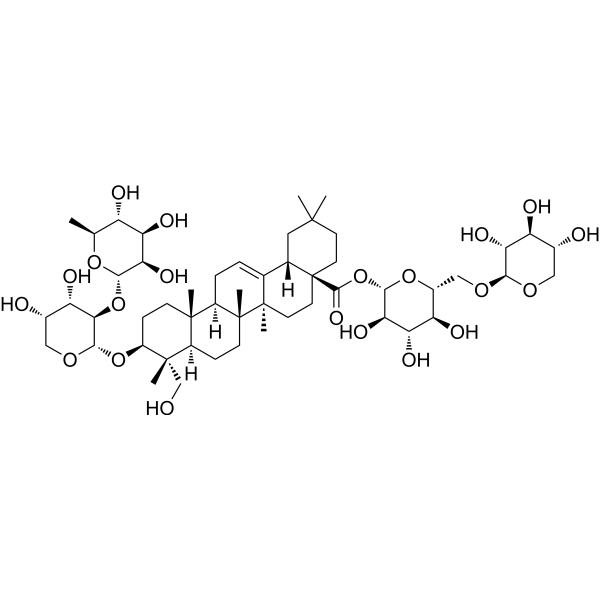 0 ImagesCat. No.: HY-N12017CAS No.: 128717-92-0
3-O-α-L-Rhamnopyranosyl-(1→2)-α-L-arabinopyranosyl hederagenin28-O-β-D-xylopyranosyl-(1→6)-β-D-glucopyranosyl ester is a hederagenin-type saponin with antitumor and anti-inflammatory properties.

-
Pristinamycin ⅡB
 0 ImagesCat. No.: HY-N15100CAS No.: 21102-49-8
Pristinamycin IIB is an ester peptide antibiotic with anti-Gram-positive bacteria effects.
-
Saquayamycin A1
 0 ImagesCat. No.: HY-N13870CAS No.: 99260-66-9
Saquayamycin A1 has antimicrobial effect, but it has weaker effect against Gram-negative bacteria. Saquayamycin A1 has inhibitory effect on leukemia P388 cells and Adriamycin-resistant P388 cells.
-
Enaminomycin C
 0 ImagesCat. No.: HY-N14154CAS No.: 68245-16-9
Enaminomycin C has weak activity against Gram-positive bacteria and negative bacteria.
-
3''-Deamino-3''-hydroxykanamycin B
 0 ImagesCat. No.: HY-180328CAS No.: 31077-70-0Synonyms: NK-1012-1
3''-Deamino-3''-hydroxykanamycin B (NK-1012-1) is a kanamycin antibiotic. 3''-Deamino-3''-hydroxykanamycin B can be produced by S. tenebrarius. 3''-Deamino-3''-hydroxykanamycin B is effective against E. coli ATCC 25922 and E. coli CCARM 1A020, with MIC values of 128 μg/mL.
-
Defucogilvocarcin V
 0 ImagesCat. No.: HY-N14819CAS No.: 80155-95-9
Defucogilvocarcin V is a gilvocarcin antibiotic with activity against Gram-positive bacteria.
-
Oxymatrine-d3
 0 ImagesCat. No.: HY-W750902CAS No.: 2714484-46-3
Oxymatrine-d3 is the deuterium labeled Oxymatrine (HY-N0158). Oxymatrine, an alkaloid from Sophora flavescens Alt. with anti-inflammatory, antifibrosis, and antitumor effects, inhibits the iNOS expression and TGF-β/Smad pathway. Oxymatrine inhibits bocavirus minute virus of canines (MVC) replication, reduces viral gene expression and decreases apoptosis induced by viral infection.
-
Enmetazobactam (Standard)
 0 ImagesCat. No.: HY-103095RCAS No.: 1001404-83-6Synonyms: AAI101 (Standard)
Enmetazobactam (Standard) is the analytical standard of Enmetazobactam (HY-103095). This product is intended for research and analytical applications. Enmetazobactam (AAI101) is an extended-spectrum β-lactamase inhibitor, against many resistant Gram-negative pathogens.
-
Omadacycline hydrochloride (Standard)
 0 ImagesCat. No.: HY-14865CRCAS No.: 1196800-39-1Synonyms: PTK0796 hydrochloride (Standard); Amadacycline hydrochloride (Standard)
Omadacycline (hydrochloride) (Standard) is the analytical standard of Omadacycline (hydrochloride). This product is intended for research and analytical applications. Omadacycline (PTK 0796) hydrochloride, a first-in-class orally active aminomethylcycline antibacterial, is a member of the tetracycline class of antibiotics. Omadacycline hydrochloride acts through the inhibition of bacterial protein synthesis by binding to the 30S ribosomal subunit. Omadacycline hydrochloride possesses broad-spectrum antibacterial activity against aerobic and anaerobic Gram-positive and Gram-negative bacteria, as well as atypical bacteria. Omadacycline hydrochloride can be used for the research of acute bacterial skin and skin-structure infections, community-acquired pneumonia, and urinary tract infections[1][2][3][4].
-
DL-threo-PPMP
 0 ImagesCat. No.: HY-116535BCAS No.: 149022-18-4
DL-threo-PPMP is an inhibitor of sphingosine synthetase in Plasmodium falciparum. DL-threo-PPMP inhibits the activity of sphingosine synthetase by mimicking the substrate sphingosine. This inhibition leads to a rapid decrease in the activity of sensitive sphingosine synthetase, selectively destroying the interconnected tubular network of TVMs in the host cell cytoplasm, and this inhibition also blocks the proliferation of Plasmodium falciparum. DL-threo-PPMP can be used for the study of Plasmodium biology and the search for new antimalarial strategies.