Others
-
Others Related Products (76565)
Related Products (76565)


-
3′-O-Azidomethyl-dCTP sodium,100 mM Solution
 0 ImagesCat. No.: HY-160079APurity: 99.11%
3′-O-Azidomethyl-dCTP sodium,100 mM Solution is a labeled modified deoxyoligonucleotide (dNTP) that can release pyrophosphate to produce fluorescence and has special applications in gene synthesis and sequencing.
-
(Z)-Hexadec-9-en-15-ynoicacid
 0 ImagesSynonyms: Palmitoleic acid alkyne
(Z)-Hexadec-9-en-15-ynoicacid (Palmitoleic acid alkyne) is an unsaturated alkynyl-palmitoleic acid alkyne used as alkynyl fatty acid probe.
-
MMA-NODAGA
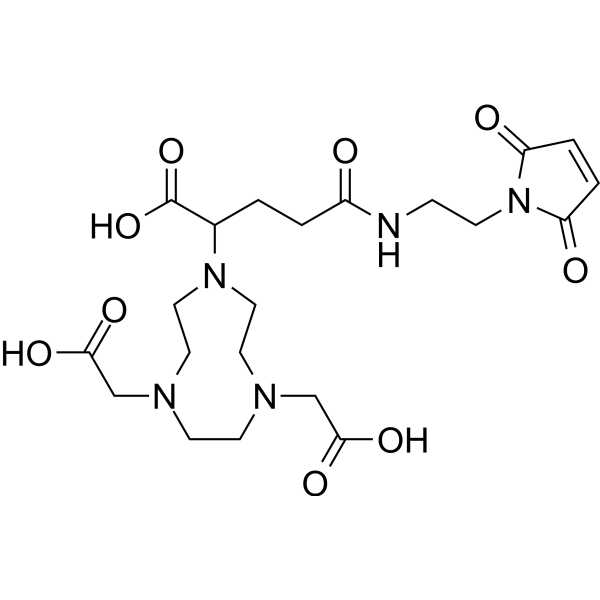 0 ImagesCat. No.: HY-160607CAS No.: 1440903-11-6
MMA-NODAGA is a chelator for site-specific labeling of targeting proteins containing unpaired cysteine. MMA-NODAGA can be used to conjugate with exosome and 64Cu in image with positron emission tomography (PET).
-
DBCO-C3-amide-PEG6-NHS ester
 0 ImagesCat. No.: HY-160773A
DBCO-C3-amide-PEG6-NHS ester is a click chemistry PEG reagent containing an NHS ester that reacts specifically with primary amines, such as side chains of lysine residues or aminosilane-coated surfaces, under neutral or slightly alkaline conditions. , efficient reaction to form covalent bonds. DBCO-C3-amide-PEG6-NHS ester also contains a DBCO group that can undergo strain-promoted alkyne-azide cycloaddition (SPAAC) with molecules containing Azide groups.
-
Lipid 88
 0 Images
Lipid 88 is an ionizable cationic lipid. Lipid 88 can be used to synthesize lipid nanoparticles and deliver mRNA.
-
Cap A (Acetonitrile/Acetic Anhydride, 80/20 v/v)
 0 ImagesCat. No.: HY-160957Purity: 99.97%
Cap A (Acetonitrile/Acetic Anhydride, 80/20 v/v) is a capping reagent that can be used in DNA/RNA synthesis.

-
Spire2-FMN2 PPI-IN-1
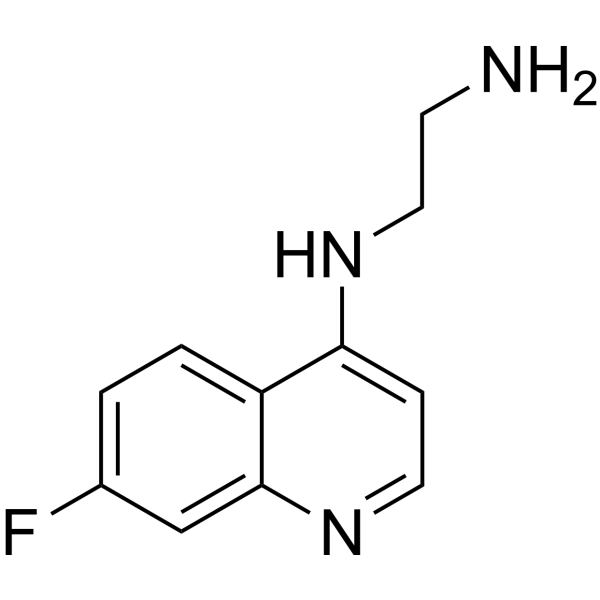 0 ImagesCat. No.: HY-161011CAS No.: 1557337-03-7
Spire2/FMN2 PPI-IN-1 (Compound 13) is a selective inhibitory fragment targeting the Spire2-FMN2 interaction, with an IC50 of 62 μM. Spire2/FMN2 PPI-IN-1 has affinity for KIND2, with a Kd of 87.7 μM, and does not inhibit KIND1. Spire2/FMN2 PPI-IN-1 can be used for the development of chemical probes for the Spire2-FMN2 interaction.
-
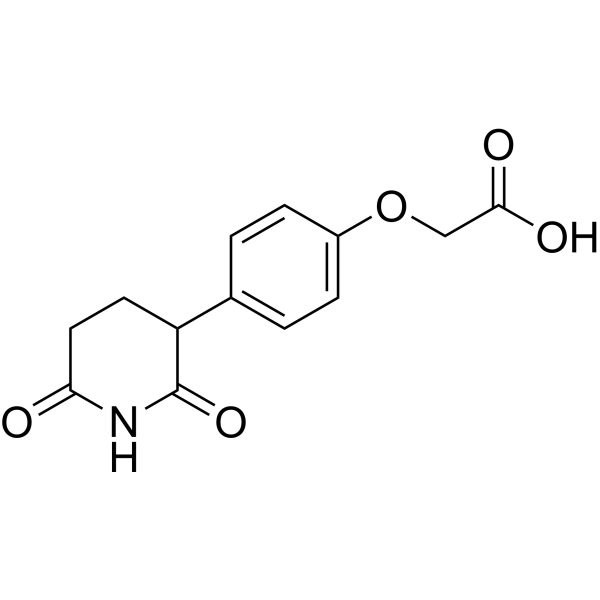
Spire2-FMN2 PPI-IN-1 dihydrochloride
 0 ImagesCat. No.: HY-161011APurity: 98.99%
Spire2/FMN2 PPI-IN-1 (Compound 13) dihydrochloride is a selective inhibitory fragment targeting the Spire2-FMN2 interaction, with an IC50 of 62 μM. Spire2/FMN2 PPI-IN-1 dihydrochloride has affinity for KIND2, with a Kd of 87.7 μM, and does not inhibit KIND1. Spire2/FMN2 PPI-IN-1 dihydrochloride can be used for the development of chemical probes for the Spire2-FMN2 interaction.
-
GDP-azido-fucose
 0 ImagesCat. No.: HY-164169CAS No.: 912921-33-6
GDP-azido-fucose is a glycoengineering tool. GDP-azido-fucose modifies complex glycans by adding an azido-fucose group. GDP-azido-fucose can install azido-fucose tags on antibody Fc glycans for site-specific payload conjugation, thereby forming antibody-drug conjugates with defined ratios.
-
Myristoleyl carnitine-d3
 0 Images
Myristoleyl carnitine-d3 is the deuterium labeled Myristoleyl carnitine.
-
m7(3'AcmG)(5')ppp(5')(2'OMeA)pG trisodium solution (100 mM)
 0 ImagesCat. No.: HY-164192APurity: 98.61%
-
UnyLinker 12
 0 ImagesCat. No.: HY-164247CAS No.: 852684-08-3
UnyLinker 12 is a universal linker that can be used for the synthesis of oligoribonucleotides.

-
Sphingomyelin (d18:1,C14:0)
 0 ImagesSynonyms: SM (d18:1/14:0)
Sphingomyelin (d18:1,C14:0), a major sphingolipid in mammalian cells, increases membrane molecular order.