



Cholinesterase (ChE)
Cholinesterase (ChE) is a family of enzymes present in the central nervous system, particularly in nervous tissue, muscle and red cells, which catalyze the hydrolysis of the neurotransmitter acetylcholine into choline and acetic acid, a reaction necessary to allow a cholinergic neuron to return to its resting state after activation. It is one of many important enzymes needed for the proper functioning of the nervous systems of humans.
There are two types: acetylcholinesterase (AChE, acetylcholine hydrolase) and butyrylcholinesterase (BChE, acylcholine acylhydrolase), also known as nonspecific cholinesterase or pseudocholinesterase. AChE is primarily found in the blood on red blood cell membranes, in neuromuscular junctions, and in neural synapses, while BChE is produced in the liver and found primarily in plasma. The difference between the two types of cholinesterase is their relative preferences for substrates: AChE hydrolyzes acetylcholine faster while BChE hydrolyzes butyrylcholine faster.
Cholinesterase (ChE) Isoform Specific Products
All Product Categories
-
Cholinesterase (ChE) Inhibitors
(913)
View all products
-
Cholinesterase (ChE) Agonists
(5)
View all products
-
Cholinesterase (ChE) Antagonists
(10)
View all products
-
Cholinesterase (ChE) Activators
(32)
View all products
-
Cholinesterase (ChE) Modulators
(10)
View all products
-
Cholinesterase (ChE) Chemical
(1)
View all products
-
Cholinesterase (ChE) Inducer
(1)
View all products
-
Cholinesterase (ChE) Controls
(6)
View all products
-
Cholinesterase (ChE) Substrates
(2)
View all products
-
Cholinesterase (ChE) Related Products (1062)
Related Products (1062)

-
Antibodies (2)
-
Cholinesterase (ChE) Isoform Comparison
-
Salvianolic acid H
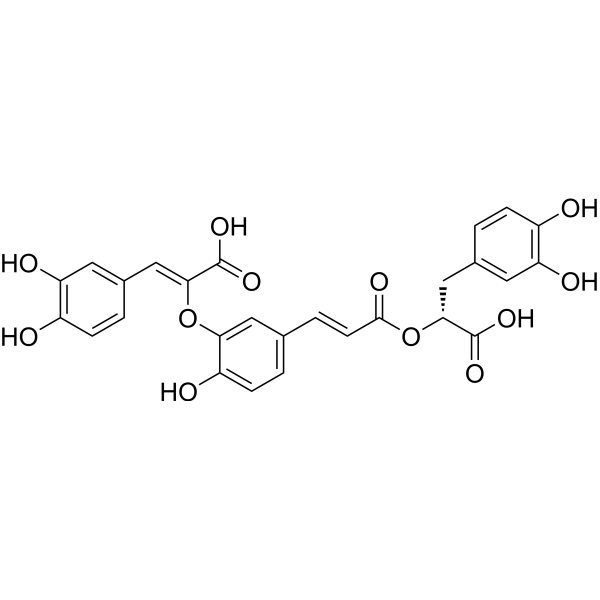 0 ImagesCat. No.: HY-W782096CAS No.: 444179-57-1Salvianolic acid H is a potent acetylcholinesterase (AChE) inhibitor.
-
D-Ribose-L-cysteine
 0 ImagesD-Ribose-L-cysteine is an orally active cysteine analog. D-Ribose-L-cysteine improves cellular antioxidant capacity by enhancing intracellular glutathione (GSH) biosynthesis. In addition, D-Ribose-L-cysteine has a memory-enhancing effect and can reverse Scopolamine (HY-N0296)-induced memory impairment by inhibiting oxidative stress and acetylcholinesterase (AChE) activity. D-Ribose-L-cysteine can be used in the study of neurodegenerative and cardiovascular diseases.
-
Itopride hydrochloride (Standard)
 0 ImagesSynonyms: HSR803 (Standard)Itopride (hydrochloride) (Standard) is the analytical standard of Itopride (hydrochloride). This product is intended for research and analytical applications. Itopride (HSR803) hydrochloride is a potent dopamine-2 antagonist and an acetylcholine esterase (AChE) inhibitor. Itopride hydrochloride enhances gastric motility through both antidopaminergic and anti-acetylcholinesterasic actions, can be used as a gastrointestinal prokinetic agent. Itopride can be used for researching gastro-esophageal reflux disease (GERD).

-
7-Methoxytacrine
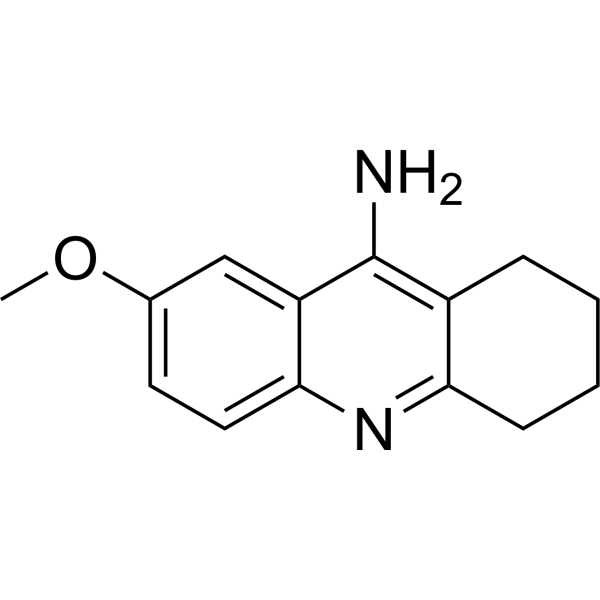 0 ImagesCat. No.: HY-W049312CAS No.: 5778-80-3Synonyms: 7-MEOTA7-Methoxytacrine (7-MEOTA) is an inhibitor of human acetylcholinesterase (hAChE) with an IC50 value of 10 μM, and can be used for the research of Alzheimer's disease (AD).
-
ZINC12613047
 0 ImagesCat. No.: HY-113905CAS No.: 1069521-64-7ZINC12613047 is a selective BChE inhibitor with an IC50 of 0.021 μM against huBChE. ZINC12613047 can be used for the research of Alzheimer's disease.
-
SMase-IN-1
 0 ImagesCat. No.: HY-170650CAS No.: 33017-85-5SMase-IN-1 (Compound 4) is a bacterial sphingomyelinase enzyme (SMase) inhibitor (IC50 value for B. cereus SMase is 6.43 µM). SMase-IN-1 also inhibits eqBuChE (59.50% inhibition rate at 50 µM concentration). SMase-IN-1 forms a complex with Cu2+ in biometal interactions. SMase-IN-1 reduces B. cereus-induced hemolysis on sheep erythrocytes.
-
Penconazole-d7
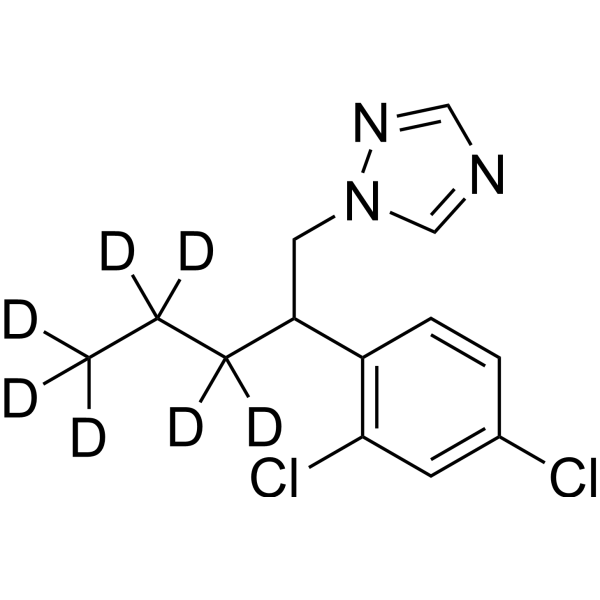 0 ImagesPenconazole-d7 is the deuterium labeled Penconazole. Penconazole is a typical triazole fungicide, and mainly applied on apples, grapes, and vegetables to control powdery mildew. Penconazole inhibits sterol biosynthesis in fungi. Penconazole decrease AChE activity in the cerebrum and cerebellum of rats.
-
Chlorpyrifos-oxon (Standard)
 0 ImagesChlorpyrifos-oxon (Standard) is the analytical standard of Chlorpyrifos-oxon. This product is intended for research and analytical applications. Chlorpyrifos-oxon, an active metabolite of Chlorpyrifos, is a potent phosphorylating agent that potently inhibits AChE. Chlorpyrifos-oxon can induce cross-linking between subunits of tubulin and disrupt microtubule function.
-
Trimyristin (Standard)
 0 ImagesTrimyristin (Standard) is the analytical standard of Trimyristin (HY-N2511). This product is intended for research and analytical applications. Trimyristin is an orally active compound. Trimyristin can be isolated from the seeds of nutmeg (Myristica fragrans). Trimyristin inhibits the activities of acetylcholinesterase (AChE), ACP and ALP, with IC50 values of 0.11, 0.16 and 0.18 mM, respectively. Trimyristin exerts competitive-noncompetitive inhibition on acetylcholinesterase, uncompetitive inhibition on ACP, and competitive/noncompetitive inhibition on ALP. Trimyristin restores the downregulated acetylcholinesterase concentration in the cerebral cortex of rats exposed to sodium arsenite. Trimyristin can be used in studies related to fascioliasis and neurotoxicity.
-
Demeton-S
 0 ImagesCat. No.: HY-W332450CAS No.: 126-75-0Demeton-S is an organophosphate insecticide. Demeton-S inhibits butyrylcholinesterase and acetylcholinesterase activity.
-
Tyrosinase-IN-47
 0 ImagesCat. No.: HY-180506Tyrosinase-IN-47 (compound 6a) is a potent competitive tyrosinase inhibitor with an IC50 of 1.43 µM and a Ki of 0.1142 μM. Tyrosinase-IN-47 also shows inhibition activity in α-Glucosidase (IC50 = 36.26 μM) and acetylcholinesterase (IC50 = 8.26 μM). Tyrosinase-IN-47 exhibits in vitro antioxidant activity, with good scavenging ability for DPPH (IC50 = 4.75 μM) and ABTS (IC50 = 0.04 μM). Tyrosinase-IN-47 displays anti-browning effect on freshly cut potatoes. Tyrosinase-IN-47 can be used for pharmaceutical research.
-
(S)-Rivastigmine-d4
 0 ImagesCat. No.: HY-W654336(S)-Rivastigmine-d4 is deuterium labeled Rivastigmine. Rivastigmine (ENA 713 free base) is an orally active and potent cholinesterase (ChE) inhibitor and inhibits butyrylcholinesterase (BChE) and acetylcholinesteras (AChE) with IC50s of 0.037 μM , 4.15 μM, respectively. Rivastigmine can pass the blood brain barrier (BBB). Rivastigmine is a parasympathomimetic or cholinergic agent used for the research of mild to moderate dementia of the Alzheimer's type and dementia due to Parkinson's disease.
-
4,4'-Dimethoxybenzil (Standard)
 0 ImagesCat. No.: HY-103610RCAS No.: 1226-42-2Synonyms: p-Anisil (Standard)4,4'-Dimethoxybenzil (Standard) is the analytical standard of 4,4'-Dimethoxybenzil (HY-103610). This product is intended for research and analytical applications. 4,4'-Dimethoxybenzil is a human intestinal carboxyl esterase (hiCE) inhibitor with Ki of 70 nM.
-
trans-3,5-Dimethoxystilbene (Standard)
 0 ImagesCat. No.: HY-W278867RCAS No.: 21956-56-9Synonyms: trans-Pinosylvin dimethyl ether (Standard)trans-3,5-Dimethoxystilbene (Standard) is the analytical standard of trans-3,5-Dimethoxystilbene (HY-W278867). This product is intended for research and analytical applications. trans-3,5-Dimethoxystilbene (trans-Pinosylvin dimethyl ether) is a natural stilbenoid metabolite. trans-3,5-Dimethoxystilbene acts as an acetylcholinesterase inhibitor with a IC50 of 9 μM against Electrophorus electricus acetylcholinesterase. trans-3,5-Dimethoxystilbene binds to acetylcholinesterase and blocks acetylcholine hydrolysis, thereby increasing acetylcholine levels in the cholinergic synaptic cleft. trans-,5-Dimethoxystilbene can be used in the research of neurodegenerative diseases such as Alzheimer's disease.
-
Propionylthiocholine iodide
 0 ImagesPropionylthiocholine iodide serves as a substrate for detecting the activities of acetylcholinesterase and pseudocholinesterase. Propionylthiocholine iodide acts as a substrate for intestinal epithelial cell-derived acetylcholinesterase and is resistant to hydrolysis by this enzyme.
-
HP 184
 0 ImagesCat. No.: HY-106016CAS No.: 119229-64-0HP 184 is an acetylcholine release (ChE) stimulator whose ADME properties can be altered by replacing hydrogen with deuterium.
-
Arisugacin E
 0 ImagesCat. No.: HY-N13925CAS No.: 261951-22-8Arisugacin E, a microbial metabolite, is a structural analog of Arisugacin A (HY-N13901). Arisugacin E shows no activity against AChE.
-
Trichlorfon ethyl
 0 ImagesTrichlorfon ethyl is an analog of Trichlorfon (HY-B1220), as well as an inhibitor of Butyrylcholinesterase and Bacillus subtilis Esterase. Trichlorfon ethyl acts as a prenatal brain growth inhibitor, causing mild reductions in total brain weight, medulla oblongata weight and tectum weight in newborn guinea pigs, without affecting cerebellar weight. Trichlorfon ethyl does not induce severe prenatal brain hypoplasia in guinea pig offspring. Trichlorfon ethyl can be used in studies related to brain hypoplasia.
-
Insecticidal agent 28
 0 ImagesCat. No.: HY-180778Insecticidal agent 28 (Compound 10) is an insecticide targeting the Culex pipiens. Insecticidal agent 28 exhibits LC₅₀ values for killing larvae and adults of 40.15 ppm and 55.02 ppm respectively. Insecticidal agent 28 inhibits the acetylcholinesterase (AchE) of the Anopheles gambiae. Insecticidal agent 28 shows lower cytotoxicity.




