



ATM/ATR
Ataxia telangiectasia mutated; ATM and RAD3 related
ATM/ATR, members of the phosphatidyl inositol 3-kinase-like family of serine/threonine protein kinases (PIKKs), are widely known as being central players in the mitotic DNA damage response (DDR), mounting responses to DNA double-strand breaks (DSBs) and single-stranded DNA (ssDNA) respectively. Activation of ATM by ionizing radiation results in the activation of signal transduction pathways that induce cell cycle arrest at G1/S, S and G2/M. ATR is required for cell cycle arrest in response to DNA-damaging agents such as ultraviolet radiation that cause bulky lesions.
Upon activation, ATM/ATR phosphorylate numerous targets to stabilize stalled replication forks, repair damaged DNA, and inhibit cell cycle progression to ensure survival of the cell and safeguard integrity of the genome. ATM and ATR are central players in activating cell cycle checkpoints and function as an active barrier against genome instability and tumorigenesis in replicating cells.
ATM/ATR Isoform Specific Products
All Product Categories
-
ATM/ATR Related Products (121)
Related Products (121)

-
Antibodies (7)
-
ATM/ATR Isoform Comparison
-
ATR-IN-18
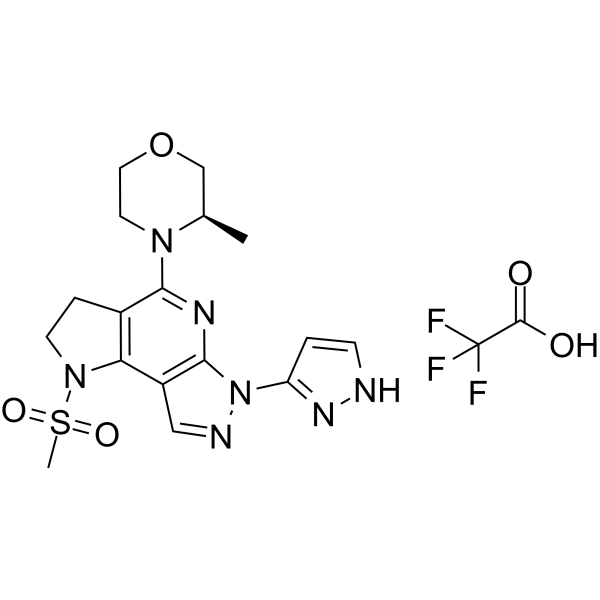 0 ImagesCat. No.: HY-147570CAS No.: 2766407-55-8ATR-IN-18 (compound 2) is an orally active and potent ATR kinase inhibitor, with an IC50 of 0.69 nM. ATR-IN-18 shows antiproliferative activity in LoVo cells, with an IC50 of 37.34 nM. ATR-IN-18 has anti-tumor activity.

-
ATR-IN-5
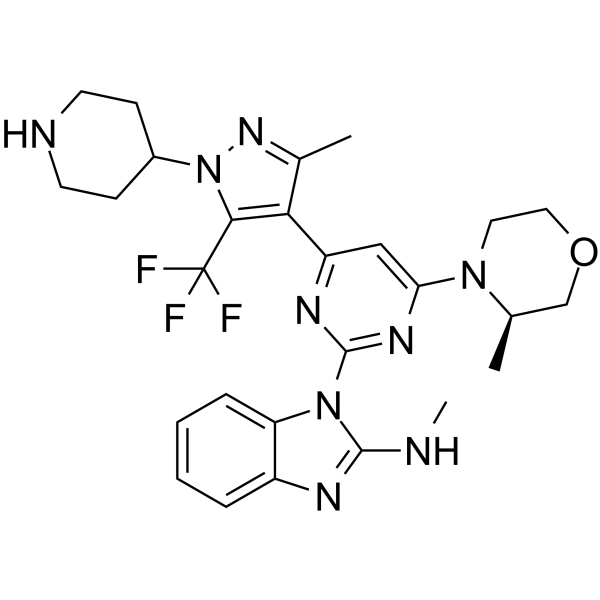 0 ImagesCat. No.: HY-142671CAS No.: 2601571-19-9ATR-IN-5 is a potent inhibitor of ATR. ATR is a class of protein kinases involved in genome stability and DNA damage repair, and is a member of the PIKK family. ATR-IN-5 has the potential for the research of ATR kinase-mediated diseases such as proliferative diseases and cancer (extracted from patent CN112047938A, compound D24).

-
ATR-IN-16
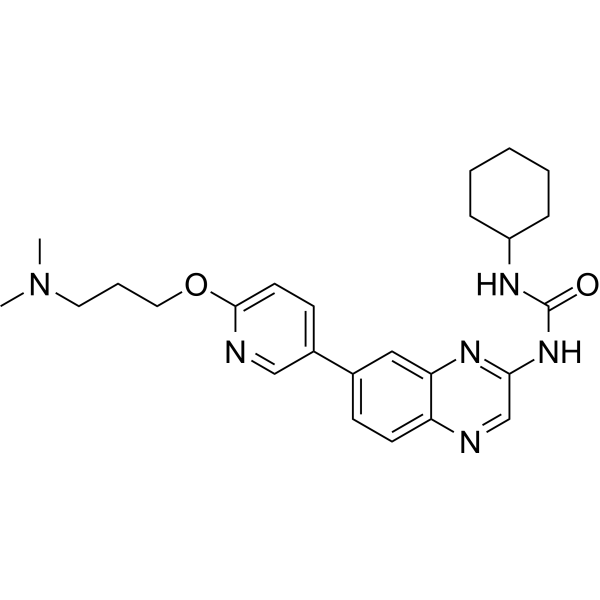
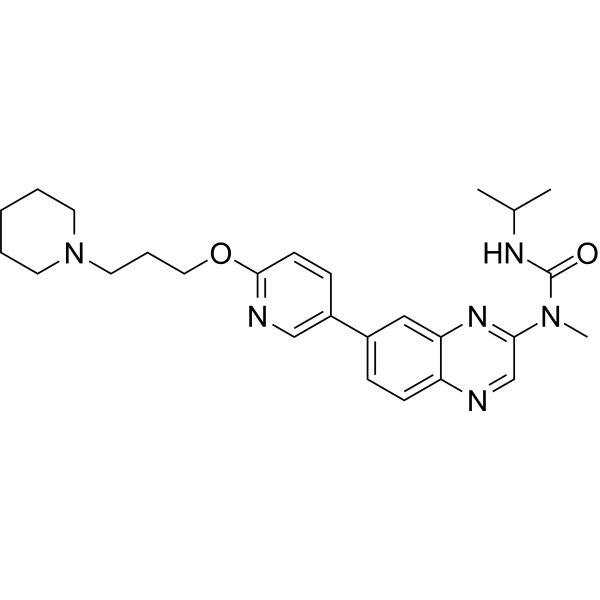
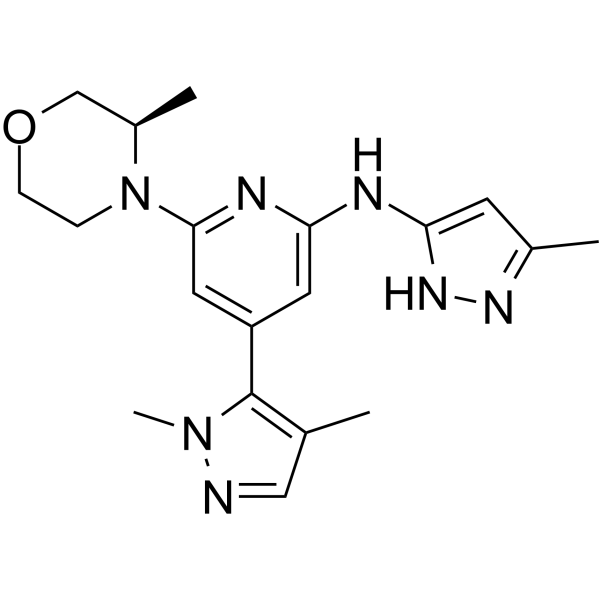 0 ImagesCat. No.: HY-147568CAS No.: 2756589-62-3ATR-IN-16 (compound 46) is a potent ATR kinase inhibitor. ATR-IN-16 shows good anticancer activity in LoVo cells, with an IC50 of 410 nM.
-
Decarbamoylmitomycin C
 0 ImagesCat. No.: HY-167635CAS No.: 26909-37-5Decarbamoylmitomycin C, an analog of Mitomycin C (MC), is an DNA-alkylating agent. Decarbamoylmitomycin C (DMC) activates p53-independent ataxia telangiectasia and rad3 related protein (ATR) chromatin eviction.
-
Elimusertib (Standard)
 0 ImagesSynonyms: BAY 1895344 (Standard)Elimusertib (Standard) is the analytical standard of Elimusertib (HY-101566). This product is intended for research and analytical applications. Elimusertib (BAY-1895344) is a potent, orally active and selective ATR inhibitor with an IC50 of 7 nM. Elimusertib has anti-tumor activity. Elimusertib can be used for the research of solid tumors and lymphomas.
-
AZD0156 (Standard)
 0 ImagesCat. No.: HY-100016RCAS No.: 1821428-35-6AZD0156 (Standard) is the analytical standard of AZD0156 (HY-100016). This product is intended for research and analytical applications. AZD0156 is a potent, selective and orally active ATM inhibitor with an IC50 of 0.58 nM. AZD0156 inhibits the ATM-mediated signaling, prevents DNA damage checkpoint activation, disrupts DNA damage repair, and induces tumor cell apoptosis.
-
Americanin A
 0 ImagesCat. No.: HY-N18301CAS No.: 69506-79-2Americanin A is a Neolignan. Americanin A can be isolated from the seeds of Phytolacca americana. Americanin A activates ATM and ATR, initiating the subsequent signal transduction cascades that include Chk1, Chk2, and tumor suppressor p53. Americanin A targets selectively Skp2 for degradation and thereby stabilizes p27. Americanin A suppresses the activity of Cyclin B1 and its partner cdc2 to prevent entry into Mitosis. Americanin A induces Apoptosis by producing excessive ROS. Americanin A has anti-cancer activity against colorectal cancer.
-
Ro 90-7501 (Standard)
 0 ImagesCat. No.: HY-103241RCAS No.: 293762-45-5Ro 90-7501 (Standard) is the analytical standard of Ro 90-7501 (HY-103241). This product is intended for research and analytical applications. Ro 90-7501 is an amyloid β42 (Aβ42) fibril assembly inhibitor that reduces Aβ42-induced cytotoxicity (EC50 of 2 μM). Ro 90-7501 inhibits ATM phosphorylation and DNA repair. RO 90-7501 selectively enhances toll-like receptor 3 (TLR3) and RIG-I-like receptor (RLR) ligand-induced IFN-β gene expression and antiviral response. Ro 90-7501 also inhibits protein phosphatase 5 (PP5) in a TPR-dependent manner. Ro 90-7501 has significant radiosensitizing effects on cervical cancer cells.
-
AZD-7648 (Standard)
 0 ImagesCat. No.: HY-111783RCAS No.: 2230820-11-6
-
Gavapsertib
 0 ImagesCat. No.: HY-181618CAS No.: 2758113-98-1Gavapsertib (compound A) is a ATR kinase inhibitor that can be used in tumor research.
-
Ceralasertib formate
 0 ImagesCat. No.: HY-123502CAS No.: 1352280-98-8Synonyms: AZD-6738 formateCeralasertib formate is a potent, selective and orally active ATR inhibitor with an IC50 value of 1 nM. Ceralasertib formate inhibits cell viability and induces DNA damage. Ceralasertib formate induces cell senescence. Ceralasertib formate shows antitumor activity.

-
CP-466722 (Standard)
 0 ImagesCat. No.: HY-11002RCAS No.: 1080622-86-1CP-466722 (Standard) is the analytical standard of CP-466722 (HY-11002). This product is intended for research and analytical applications. CP-466722 is a rapidly reversible inhibitor of ATM, with an IC50 of 0.41 μM, and has no effects on PI3K or closely related PI3K-like protein Kinase (PIKK) family members.
-
Tuvusertib (Standard)
 0 ImagesCat. No.: HY-111451RCAS No.: 1613200-51-3Synonyms: M1774 (Standard); ATR inhibitor 1 (Standard)Tuvusertib (Standard) is the analytical standard of Tuvusertib (HY-111451). This product is intended for research and analytical applications. Tuvusertib (M1774; ATR inhibitor 1) is a selective and orally active ATR inhibitor extracted from patent WO2015187451A1, compound I-l, with a Ki value below 1 μΜ.
-
Trrap Mouse Pre-designed siRNA Set A
 0 ImagesCat. No.: HY-RS22883
Trrap Mouse Pre-designed siRNA Set A contains three designed siRNAs for Trrap gene (Mouse), as well as a negative control, a positive control, and a FAM-labeled negative control.
Components
Trrap siRNA-1: 5 nmol (HPLC)
Trrap siRNA-2: 5 nmol (HPLC)
Trrap siRNA-3: 5 nmol (HPLC)
siRNA Negative Control: 5 nmol (HPLC)
FAM-labeled siRNA Negative Control: 5 nmol (HPLC)
GAPDH siRNA Positive Control: 5 nmol (HPLC)
-
Elrelesertib (Standard)
 0 ImagesCat. No.: HY-109566RCAS No.: 2089288-03-7Synonyms: AZD1390 (Standard)Elrelesertib (Standard) (AZD1390 (Standard)) is the analytical standard of Elrelesertib (AZD1390) (HY-109566). This product is intended for research and analytical applications. Elrelesertib (AZD1390) is an orally active, brain-penetrant ATM kinase inhibitor with IC50 values of 0.78 nM. Elrelesertib blocks ATM-dependent DNA damage response, inhibits ATM autophosphorylation and downstream Chk2, Rad50 phosphorylation, and accumulates at DNA breaks. Elrelesertib acts as a radiosensitizer, induces apoptosis, genomic instability, G2-M cell cycle arrest, ROS elevation, and mitochondrial membrane potential alteration. Elrelesertib has low efflux liability against P-gp and BCRP. Elrelesertib can be used for the research of central nervous system malignancies, glioblastoma multiforme, glioma, lung cancer brain metastases, and breast cancer.




