



Ceralasertib formate
Based on 71 publication(s) in Google Scholar
Ceralasertib formate is a potent, selective and orally active ATR inhibitor with an IC50 value of 1 nM. Ceralasertib formate inhibits cell viability and induces DNA damage. Ceralasertib formate induces cell senescence. Ceralasertib formate shows antitumor activity.
For research use only. We do not sell to patients.
- CAS No.: 1352280-98-8
- Formula: C20H24N6O2S.xCH2O2
- Molecular Weight:458.53
-
Storage:
Please store the product under the recommended conditions in the Certificate of Analysis.


To place orders, for customer services and technical support, please contact: MedChemExpress USA
Tel: 609-228-6898 E-mail: [email protected] [email protected]


-
 Biological Activity
-
Chemical Information
- Protocols
- Purity & Documentation
- References
-
 Help & FAQs


Publications Citing Use of MedChemExpress (MCE) Ceralasertib formate
More- Science. 2026 Feb 26;391(6788):eadz3121. [Abstract]
- Cancer Commun (Lond). 2025 Mar;45(3):218-244. [Abstract]
- Nat Commun. 2026 Feb 25;17(1):3142. [Abstract]
- Nat Commun. 2024 Feb 16;15(1):1446. [Abstract]
- Nat Commun. 2022 Aug 4;13(1):4520. [Abstract]
- Nat Commun. 2020 Jan 8;11(1):123. [Abstract]
- Redox Biol. 2023 Sep:65:102810. [Abstract]
- Mol Cell. 2025 Mar 6;85(5):894-912.e10. [Abstract]
- Mol Cell. 2024 Jun 6;84(11):2070-2086.e20. [Abstract]
- Nucleic Acids Res. 2026 Jun 8;54(11):gkag562. [Abstract]
- Nucleic Acids Res. 2024 Jan 11;52(1):204-222. [Abstract]
- J Exp Clin Cancer Res. 2025 Dec 6;45(1):12. [Abstract]
- J Exp Clin Cancer Res. 2023 Aug 21;42(1):214. [Abstract]
- J Exp Clin Cancer Res. 2022 Nov 16;41(1):323. [Abstract]
- Adv Sci (Weinh). 2025 Jul;12(25):e2501934. [Abstract]
- Cell Rep Med. 2026 May 19;7(5):102750. [Abstract]
- Sci Adv. 2026 Jun 26;12(26):eadz3351. [Abstract]
- Cardiovasc Res. 2026 May 22;122(7):935-952. [Abstract]
- Cell Death Dis. 2021 Jan 7;12(1):42. [Abstract]
- Cancer Lett. 2026 Feb 4;642:218300.
- Cancer Lett. 2026 Apr 1:642:218300. [Abstract]
- Hemasphere. 2024 Oct 8;8(10):e70016. [Abstract]
- Phytother Res. 2023 Apr;37(4):1260-1273. [Abstract]
- Br J Cancer. 2024 Jul;131(2):231-242. [Abstract]
- Cell Rep. 2022 Nov 29;41(9):111716. [Abstract]
- Cell Rep. 2020 Sep 1;32(9):108096. [Abstract]
- Cell Rep. 2020 Jan 14;30(2):497-509.e4. [Abstract]
- J Med Chem. 2024 May 9;67(9):7620-7634. [Abstract]
- J Med Chem. 2023 May 25;66(10):6922-6937. [Abstract]
- Sci Signal. 2024 Nov 12;17(862):eadl6445. [Abstract]
- Mol Cancer Ther. 2026 Jul 15:10.1158/1535-7163.MCT-26-0182.
- PLoS Biol. 2021 Mar 31;19(3):e3001176. [Abstract]
- JCI Insight. 2026 Mar 31:e196665. [Abstract]
- J Cell Biol. 2021 Feb 1;220(2):e201911025. [Abstract]
- J Am Heart Assoc. 2021 Aug 3;10(15):e021768. [Abstract]
- EMBO Rep. 2020 Aug 5;21(8):e48920. [Abstract]
- Oncogenesis. 2020 Feb 3;9(2):8. [Abstract]
- Mol Cancer Res. 2020 Jan;18(1):91-104. [Abstract]
- Inflammation. 2025 Feb 4. [Abstract]
- J Mol Med (Berl). 2019 Aug;97(8):1183-1193. [Abstract]
- Am J Pathol. 2026 Jun 10:S0002-9440(26)00163-X. [Abstract]
- Int J Cancer. 2025 Jan 15;156(2):417-430. [Abstract]
- Transl Oncol. 2021 Oct;14(10):101167. [Abstract]
- Cell Signal. 2025 Jul:131:111709. [Abstract]
- Oncol Rep. 2023 Mar;49(3):52. [Abstract]
- Neurooncol Adv. 2024 Nov 19;6(1):vdae187. [Abstract]
- J Biol Chem. 2026 Jun;302(6):111461. [Abstract]
- Biomed Res Int. 2023 Feb 6:2023:7891753. [Abstract]
- Discov Oncol. 2026 Jul 14. [Abstract]
- Mol Cell Biol. 2025;45(3):99-115. [Abstract]
- J Ocul Pharmacol Ther. 2025 Jun 27. [Abstract]
- Oncol Lett. 2025 Jan 7;29(3):128. [Abstract]
- University of Pavia. 2026.
- bioRxiv. 2026 May 1:2026.04.28.717272. [Abstract]
- bioRxiv. 2025 Dec 9.
- bioRxiv. 2025 Oct 15.
- bioRxiv. 2025 Oct 9:2025.10.08.680157. [Abstract]
- Res Sq. 2025 Oct 1.
- bioRxiv. 2025 Aug 31.
- bioRxiv. 2025 May 15:2025.05.13.652823. [Abstract]
- bioRxiv. 2025 April 17.
- bioRxiv. 2024 Nov 6:2024.11.04.621884. [Abstract]
- Norges teknisk-naturvitenskapelige universitet. 2024.
- biorxiv. 2024 Jun 03.
- bioRxiv. 2024 Apr 25.
- bioRxiv. 2024 Mar 28.
- SSRN. 2023 Aug 30.
- SSRN. 2023 Jul 24.
- Research Square Preprint. 2023 Jun 9.
- Technische Universitat Darmstadt. 2022 Aug.
- University of London. 2021 Sep.
 Customer Validation & Images

-
WB
-
IF
-
WB
-
In Vivo Efficacy Study
-
WB


Biological Activity
Description
In Vitro
Ceralasertib formate (0, 0.3, 1 μM; 48 h) induces cell senescence in A549 cells in a dose-dependent manner[1].
MedChemExpress (MCE) has not independently confirmed the accuracy of these methods. They are for reference only. Further protocols information, click here.


Chemical Information
-
CAS No. 1352280-98-8
-
Molecular Weight 458.53
-
Formula C20H24N6O2S.xCH2O2
-
SMILES
C[C@H]1N(CCOC1)C2=CC(C3(CC3)[S@@](=N)(C)=O)=NC(C4=C5C(NC=C5)=NC=C4)=N2.OC=O.[F,Cl,Br,I]
-
Synonyms
AZD-6738 formate
-
Shipping
Room temperature in continental US; may vary elsewhere.
-
Storage
Please store the product under the recommended conditions in the Certificate of Analysis.


Publications (71)
-
Journal Impact Factor
-
Most Recent
-
Science
Different repair pathways support intact or truncated insertions by R2 retrotransposon protein. [Abstract]2026 Feb 26;391(6788):eadz3121. PMID: 41231928 -
Cancer Commun (Lond)
Radiotherapy-resistant prostate cancer cells escape immune checkpoint blockade through the senescence-related ataxia telangiectasia and Rad3-related protein. [Abstract]2025 Mar;45(3):218-244. PMID: 39698847 -
Nat Commun
Targeting de novo pyrimidine synthesis confers vulnerability to copper-mediated ATR inactivation in PARP inhibitor-resistant ovarian cancer. [Abstract]2026 Feb 25;17(1):3142. PMID: 41735312 -
Nat Commun
PAF1c links S-phase progression to immune evasion and MYC function in pancreatic carcinoma. [Abstract]2024 Feb 16;15(1):1446. PMID: 38365788
Ceralasertib formate purchased from MedChemExpress. Usage Cited in: Nat Commun. 2024 Feb 16;15(1):1446. [Abstract]
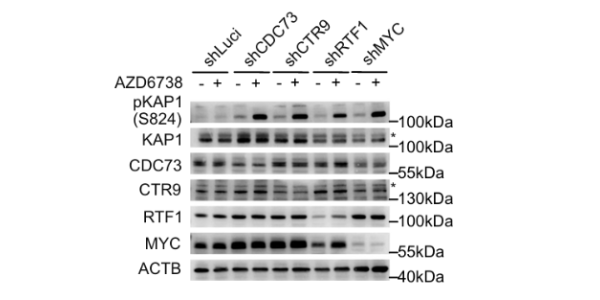
Immunoblot of KPC cells harboring doxycycline-inducible shRNA targeting luciferase, components of the PAF1c and MYC. Depletion was induced by doxycycline addition for 72 h and AZD6738 treatment for 72 h at 0.2 µM concentration. * refers to a non-specific band. Beta-actin was loading control (n=3).
Ceralasertib formate purchased from MedChemExpress. Usage Cited in: Nat Commun. 2024 Feb 16;15(1):1446. [Abstract]
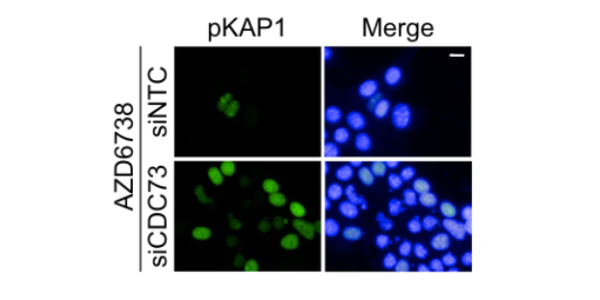
pKAP1(S824) intensity upon incubation with AZD6738 (0.1 µM; 24 h) (number of KPC cells plotted: siNTC: n=1654; siCDC73:n=1175).Scale bar: 10 µm. siRNA transfection was 48 h and EdU was added 30 minutes before fixation.
-
Nat Commun
TP53-dependent toxicity of CRISPR/Cas9 cuts is differential across genomic loci and can confound genetic screening. [Abstract]2022 Aug 4;13(1):4520. PMID: 35927263
Ceralasertib formate purchased from MedChemExpress. Usage Cited in: Nat Commun. 2022 Aug 4;13(1):4520. [Abstract]
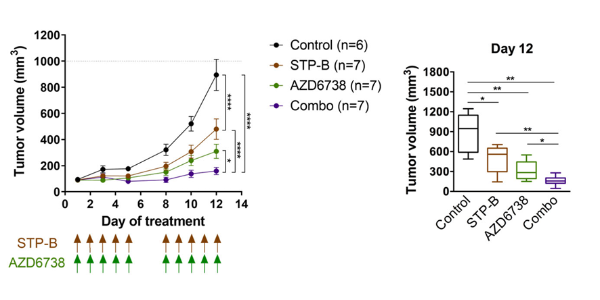
ATR inhibitor AZD6738 prevent NCI‐H929 TP53−/− cell growth in NSG mice. NSG mice were subcutaneously injected with 106 NCI‐H929 TP53−/− cells (left panel). After 1 week, mice with detectable tumors were randomly distributed into four groups of seven mice and treated with AZD6738 (25 mg/kg; i.g., 5 times a week for 2 weeks), as indicated by the arrows (middle panel). The graphs represent the tumor volume kinetics (mean±SD, middle panel) and the tumor volume on Day 12 (right panel).
-
Nat Commun
Treacle controls the nucleolar response to rDNA breaks via TOPBP1 recruitment and ATR activation. [Abstract]2020 Jan 8;11(1):123. PMID: 31913317 -
Redox Biol
Rapid phosphorylation of glucose-6-phosphate dehydrogenase by casein kinase 2 sustains redox homeostasis under ionizing radiation. [Abstract]2023 Sep:65:102810. PMID: 37478541 -
Mol Cell
2025 Mar 6;85(5):894-912.e10. PMID: 39909041 -
Mol Cell
The MYCN oncoprotein is an RNA-binding accessory factor of the nuclear exosome targeting complex. [Abstract]2024 Jun 6;84(11):2070-2086.e20. PMID: 38703770 -
Nucleic Acids Res
Human REV1 interacts with DHX36 to promote replication and tolerance of G-quadruplex DNA. [Abstract]2026 Jun 8;54(11):gkag562. PMID: 42258547 -
Nucleic Acids Res
ATR phosphorylates DHX9 at serine 321 to suppress R-loop accumulation upon genotoxic stress. [Abstract]2024 Jan 11;52(1):204-222. PMID: 37930853
Ceralasertib formate purchased from MedChemExpress. Usage Cited in: Nucleic Acids Res. 2024 Jan 11;52(1):204-222. [Abstract]
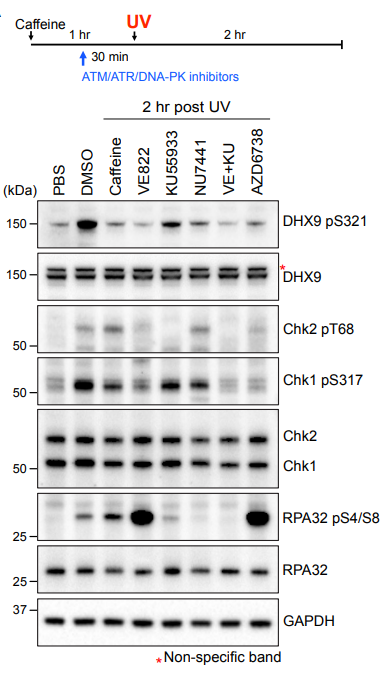
AZD6738 (1 μM) were administered for 30 minutes prior to UV irradiation (20 J/m2). HeLa cells were allowed to recover for 2 h after UV treatment, and phosphorylation of DHX9, Chk1, Chk2, and RPA32 was assessed by Western blot with indicated antibodies.
-
J Exp Clin Cancer Res
DNA damaging agents boost the transcription of endothelin A receptor in high-grade serous ovarian cancer. [Abstract]2025 Dec 6;45(1):12. PMID: 41350901 -
J Exp Clin Cancer Res
MYC up-regulation confers vulnerability to dual inhibition of CDK12 and CDK13 in high-risk Group 3 medulloblastoma. [Abstract]2023 Aug 21;42(1):214. PMID: 37599362 -
J Exp Clin Cancer Res
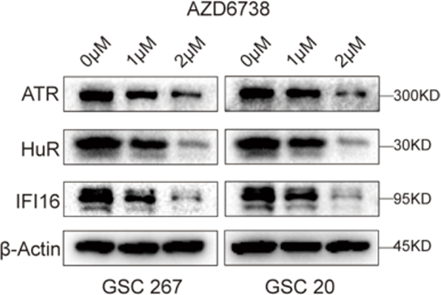
ARPC1B promotes mesenchymal phenotype maintenance and radiotherapy resistance by blocking TRIM21-mediated degradation of IFI16 and HuR in glioma stem cells. [Abstract]2022 Nov 16;41(1):323. PMID: 36380368
Ceralasertib formate purchased from MedChemExpress. Usage Cited in: J Exp Clin Cancer Res. 2022 Nov 16;41(1):323. [Abstract]
Ceralasertib (AZD6738; 1, 2 µM) signifcantly decreases the protein levels of ATR, IFI16 and HuR in a dose-dependent manner in GSC 267 and GSC 20 cells.
-
Adv Sci (Weinh)
EccDNA-Driven VPS41 Amplification Alleviates Genotoxic Stress via Lysosomal KAI1 Degradation. [Abstract]2025 Jul;12(25):e2501934. PMID: 40271553 -
Cell Rep Med
Targeting RNase H2: A dual-mechanism strategy to elevate replication stress, DNA damage, and antitumor immunity in TNBC. [Abstract]2026 May 19;7(5):102750. PMID: 42013846 -
Sci Adv
Patient-derived organoids across cancers reveal conserved tumor heterogeneity and actionable therapeutic vulnerabilities. [Abstract]2026 Jun 26;12(26):eadz3351. PMID: 42361179 -
Cardiovasc Res
Telomere recapping prevents pathogenic telomere-to-mitochondrial DNA communication in heart failure. [Abstract]2026 May 22;122(7):935-952. PMID: 41942104 -
Cell Death Dis
TRIB2 modulates proteasome function to reduce ubiquitin stability and protect liver cancer cells against oxidative stress. [Abstract]2021 Jan 7;12(1):42. PMID: 33414446 -
-
Cancer Lett
2026 Apr 1:642:218300. PMID: 41651400 -
Hemasphere
Combined inhibition of CTPS1 and ATR is a metabolic vulnerability in p53-deficient myeloma cells. [Abstract]2024 Oct 8;8(10):e70016. PMID: 39380841 -
Phytother Res
Lutein inhibits tumor progression through the ATR/Chk1/p53 signaling pathway in non-small cell lung cancer. [Abstract]2023 Apr;37(4):1260-1273. PMID: 37041670 -
Br J Cancer
PARP inhibition leads to synthetic lethality with key splicing-factor mutations in myelodysplastic syndromes. [Abstract]2024 Jul;131(2):231-242. PMID: 38806724 -
Cell Rep
POLθ processes ssDNA gaps and promotes replication fork progression in BRCA1-deficient cells. [Abstract]2022 Nov 29;41(9):111716. PMID: 36400033 -
Cell Rep
2020 Sep 1;32(9):108096. PMID: 32877678 -
Cell Rep
2020 Jan 14;30(2):497-509.e4. PMID: 31940492 -
J Med Chem
Discovery of a Meisoindigo-Derived PROTAC as the ATM Degrader: Revolutionizing Colorectal Cancer Therapy via Synthetic Lethality with ATR Inhibitors. [Abstract]2024 May 9;67(9):7620-7634. PMID: 38634707 -
J Med Chem
Discovery of Ruthenium(II) Metallocompound and Olaparib Synergy for Cancer Combination Therapy. [Abstract]2023 May 25;66(10):6922-6937. PMID: 37185020 -
Sci Signal
Metabolically inducing defects in DNA repair sensitizes BRCA-wild-type cancer cells to replication stress. [Abstract]2024 Nov 12;17(862):eadl6445. PMID: 39531517 -
-
PLoS Biol
Loss of the abasic site sensor HMCES is synthetic lethal with the activity of the APOBEC3A cytosine deaminase in cancer cells. [Abstract]2021 Mar 31;19(3):e3001176. PMID: 33788831 -
JCI Insight
AURKA inhibitor VIC-1911 induces mitotic defects and functional BRCAness, sensitizing prostate cancer to PARP inhibition. [Abstract]2026 Mar 31:e196665. PMID: 41915443 -
J Cell Biol
2021 Feb 1;220(2):e201911025. PMID: 33404607 -
J Am Heart Assoc
2021 Aug 3;10(15):e021768. PMID: 34323119 -
EMBO Rep
CDC7 kinase promotes MRE11 fork processing, modulating fork speed and chromosomal breakage. [Abstract]2020 Aug 5;21(8):e48920. PMID: 32496651 -
Oncogenesis
SCFβ-TrCP-mediated degradation of TOP2β promotes cancer cell survival in response to chemotherapeutic drugs targeting topoisomerase II. [Abstract]2020 Feb 3;9(2):8. PMID: 32015321 -
Mol Cancer Res
Inhibition of the ATR-CHK1 Pathway in Ewing Sarcoma Cells Causes DNA Damage and Apoptosis via the CDK2-Mediated Degradation of RRM2. [Abstract]2020 Jan;18(1):91-104. PMID: 31649026 -
Inflammation
AZD6738 Attenuates LPS-Induced Corneal Inflammation and Fibrosis by Modulating Macrophage Function and Polarization. [Abstract]2025 Feb 4. PMID: 39903421 -
J Mol Med (Berl)
2019 Aug;97(8):1183-1193. PMID: 31201471 -
Am J Pathol
Low-Dose Radiotherapy Attenuates Pulmonary Granulomas Involving Ataxia-Telangiectasia Mutated-Dependent Modulation of the Interferon-β Response: A Host-Directed Therapeutic Strategy for Tuberculosis. [Abstract]2026 Jun 10:S0002-9440(26)00163-X. PMID: 42270072 -
Int J Cancer
Enhanced pharmacological activities of AKR1C3-activated prodrug AST-3424 in cancer cells with defective DNA repair. [Abstract]2025 Jan 15;156(2):417-430. PMID: 39243400 -
Transl Oncol
MTA2 sensitizes gastric cancer cells to PARP inhibition by induction of DNA replication stress. [Abstract]2021 Oct;14(10):101167. PMID: 34280886 -
Cell Signal
2025 Jul:131:111709. PMID: 40037423 -
Oncol Rep
AZD6738 promotes the tumor suppressive effects of trifluridine in colorectal cancer cells. [Abstract]2023 Mar;49(3):52. PMID: 36734271 -
Neurooncol Adv
Ion channel modulator DPI-201-106 significantly enhances antitumor activity of DNA damage response inhibitors in glioblastoma. [Abstract]2024 Nov 19;6(1):vdae187. PMID: 39659830 -
J Biol Chem
2026 Jun;302(6):111461. PMID: 41999888 -
Biomed Res Int
ATR Inhibitor Synergizes PARP Inhibitor Cytotoxicity in Homologous Recombination Repair Deficiency TK6 Cell Lines. [Abstract]2023 Feb 6:2023:7891753. PMID: 36794257 -
Discov Oncol
Chk1 inhibition emerges as the most effective partner for PARP inhibition in BRCA-proficient pancreatic cancer. [Abstract]2026 Jul 14. PMID: 42446852 -
Mol Cell Biol
Kinase Inhibitor-Induced Cell-Type Specific Vacuole Formation in the Absence of Canonical ATG5-Dependent Autophagy Initiation Pathway. [Abstract]2025;45(3):99-115. PMID: 39895059 -
J Ocul Pharmacol Ther
Exploring the Efficacy of AZD6738 in Corneal Neovascularization: Autophagy Enhancement and Angiogenesis Inhibition. [Abstract]2025 Jun 27. PMID: 40576624 -
Oncol Lett
DNA damage response mutations enhance the antitumor efficacy of ATR and PARP inhibitors in cholangiocarcinoma cell lines. [Abstract]2025 Jan 7;29(3):128. PMID: 39822940 -
-
bioRxiv
2026 May 1:2026.04.28.717272. PMID: 42094395 -
-
-
bioRxiv
2025 Oct 9:2025.10.08.680157. PMID: 41279244 -
-
-
bioRxiv
2025 May 15:2025.05.13.652823. PMID: 40462982 -
-
bioRxiv
PAIRWISE: Deep Learning-based Prediction of Effective Personalized Drug Combinations in Cancer. [Abstract]2024 Nov 6:2024.11.04.621884. PMID: 39574568 -
-
-
-
-
-
-
-
-

Protocols
-
Cell Cytotoxicity Assay
Cytotoxicity assays are usually based on the assessment of cell membrane damage, which can also be indirectly detected by measuring cell viability. Detection methods include MTT assay, CKK-8 assay, LDH assay and ATP assay, etc.
-
Mammalian live/dead viability and cytotoxicity staining
Live/dead viability and cytotoxicity staining assays are based on the simultaneous detection of intracellular esterase activity in metabolically active (viable) cells and membrane integrity loss in non-viable cells. In commonly used dual-staining approaches, membrane-permeant fluorogenic substrates are converted by intracellular esterases into fluorescent products in live cells, while impermeant DNA-binding dyes selectively enter cells with compromised plasma membranes and label nucleic acids in dead or dying cells, enabling discrimination between viable and non-viable populations by fluorescence microscopy or flow cytometry.
-
CCK-8/WST-8 Cell Proliferation Assay
The CCK-8/WST-8 assay is based on the reduction of the water-soluble tetrazolium salt WST-8 to a water-soluble formazan product by cellular dehydrogenases in metabolically active cells, where the generated formazan amount is proportional to the number of living cells and is quantified by measuring absorbance in the visible range, providing a colorimetric readout for cell viability and proliferation assessment. This class of tetrazolium-based assays improves upon earlier MTT-based systems by producing a water-soluble formazan, eliminating the need for organic solubilization steps and enabling direct spectrophotometric measurement in culture medium.
-
MTT Cell Proliferation Assay
The MTT assay is a colorimetric endpoint assay for estimating viable cell number, cell growth, cytotoxicity, or cell activation in cultured mammalian cells. Living cells reduce the yellow tetrazolium salt MTT into purple/blue formazan, while dead cells do not generate the same signal; the resulting color can be quantified with a multiwell spectrophotometer. MTT reduction is commonly interpreted as a readout of metabolic activity that often correlates with viable cell number, but it should not be treated as a direct cell-counting method unless the assay is optimized for the cell type and experimental condition. Studies show that MTT reduction can involve mitochondrial and non-mitochondrial reducing systems, and formazan may accumulate in intracellular lipid droplets rather than simply marking mitochondria.
-
Subcutaneous Cell-Line-Derived Xenograft
Subcutaneous cell-line-derived xenograft (CDX) models are established by implanting cultured human cancer cell lines into immunodeficient mice, where the injected cells form localized tumors that can be monitored in vivo as a measure of tumorigenic potential, growth kinetics, and treatment response. These models are widely used in oncology research because they allow reproducible tumor formation and enable comparative assessment of tumor growth between different cell lines or genetic manipulations in a controlled in vivo microenvironment. Subcutaneous implantation of cancer cells in immunodeficient mice is a standard approach for evaluating tumor growth behavior and therapeutic response across multiple cancer types, including prostate, esophageal, pancreatic, and colon cancer models.
-
Genotoxicity/Mutagenicity Study
The bacterial reverse mutation assay detects point mutations that restore amino-acid prototrophy in auxotrophic Salmonella typhimurium or Escherichia coli tester strains; after exposure to a test article, mutagenic activity is read out as an increased number of revertant colonies on minimal agar compared with the vehicle control. The assay uses tester strains with different mutation targets so that base-substitution and frameshift mutagens can be detected, and testing is performed with and without exogenous mammalian metabolic activation because some chemicals require biotransformation to become mutagenic.
-
Senescence-associated β-galactosidase staining
Senescence-associated β-galactosidase staining detects β-galactosidase activity that is histochemically visible at pH 6. 0 in senescent cells, where X-gal cleavage produces an insoluble blue precipitate observable by bright-field microscopy. This activity reflects increased lysosomal β-galactosidase/lysosomal mass rather than a senescence-essential enzyme, because GLB1 depletion or genetic lysosomal β-galactosidase deficiency can abolish SA-β-gal staining while cells still undergo senescence. SA-β-gal was originally reported in senescent but not presenescent fibroblasts and keratinocytes, absent from quiescent fibroblasts and terminally differentiated keratinocytes, and increased with donor age in human skin samples. Because SA-β-gal can also appear in some non-senescent or tissue-specific contexts, interpretation should be paired with experimental controls and, when possible, independent senescence markers.
-
Cell Viability Determination by MTT Colorimetric Assay
The following protocol uses the MTT colorimetric assay as a classic literature-established method for assessing cell viability/metabolic activity in cultured mammalian cells. MTT[3-(4,5-dimethylthiazol-2-yl)-2,5-diphenyltetrazolium bromide] is reduced by metabolically active cells to a colored formazan product; the amount of formazan is quantified spectrophotometrically and provides an indirect measure of metabolically active viable cells. Importantly, MTT reduction reflects cellular oxidoreductase/metabolic activity rather than an absolute direct count of living cells, so changes in cellular metabolism can alter the signal independently of cell number.


Purity & Documentation
References
[1]. Vendetti FP, et al. The orally active and bioavailable ATR kinase inhibitor AZD6738 potentiates the anti-tumor effects of cisplatin to resolve ATM-deficient non-small cell lung cancer in vivo. Oncotarget. 2015 Dec 29;6(42):44289-305. [Content Brief]
[2]. Kim HJ, et al. Anti-tumor activity of the ATR inhibitor AZD6738 in HER2 positive breast cancer cells. Int J Cancer. 2017 Jan 1;140(1):109-119. [Content Brief]

Calculators
Concentration (start) × Volume (start) = Concentration (final) × Volume (final)


Ceralasertib formate Related Classifications
HY-123502 Related Classifications
 Powered by Bioz