



FXR
FXR; NR1H4
Farnesoid X receptor (FXR) is a ligand-activated transcription factor belonging to the nuclear receptor superfamily. FXR regulates the expression of various genes by binding to DNA either as a monomer or a heterodimer with the common partner for NRs, retinoid x receptor (RXR), to FXR response elements. Two known FXR genes exist, the FXRα and FXRβ.
FXR is mainly expressed in liver and small intestine, where it plays an important role in bile acid, lipid, and glucose metabolism. FXR affects several metabolic pathways through its specific target genes, regulating bile acid (BA) synthesis and homeostasis, glucose and lipid metabolism, also exhibiting a crucial role in intestinal bacterial growth and liver regeneration.
All Product Categories
-
FXR Related Products (182)
Related Products (182)

-
Antibodies (2)
-
Guggulsterone (Standard)
 0 ImagesSynonyms: Z/E-Guggulsterone (Standard)Guggulsterone (Standard) is the analytical standard of Guggulsterone (HY-107738). This product is intended for research and analytical applications. Guggulsterone is a plant sterol derived from the gum resin of the tree Commiphora wightii. Guggulsterone inhibits the growth of a wide variety of tumor cells and induces apoptosis through down regulation of antiapoptotic gene products (IAP1, xIAP, Bfl-1/A1, Bcl-2, cFLIP and survivin), modulation of cell cycle proteins (cyclin D1 and c-Myc), activation of caspases and JNK, inhibition of Akt. Guggulsterone, a farnesoid X receptor (FXR) antagonist, with IC50s of 24.06 μM and 39.05 μM for (-)-(E)-Guggulsterone (HY-N7781) and (Z)-Guggulsterone (HY-110066), respectively.
-
5β-Cholane
 0 ImagesCat. No.: HY-133969CAS No.: 80373-86-05β-Cholane is a farnesoid X receptor (FXR) activator. 5β-Cholane can be used for the research of cholesterol and lipid-related diseases.
-
Tauro-obeticholic acid sodium
 0 ImagesCat. No.: HY-135399ACAS No.: 2278141-79-8Tauro-obeticholic acid sodium is an active metabolite of Obeticholic acid (HY-12222). Obeticholic acid is a potent, selective and orally active FXR agonist.
-
LY2562175 (Standard)
 0 ImagesCat. No.: HY-103704RCAS No.: 1103500-20-4LY2562175 (Standard) is the analytical standard of LY2562175 (HY-103704). This product is intended for research and analytical applications. LY2562175 is a potent and selective FXR agonist, with an EC50 of 193 nM.
-
Tropifexor (Standard)
 0 ImagesCat. No.: HY-107418RCAS No.: 1383816-29-2Synonyms: LJN452 (Standard)Tropifexor (Standard) is the analytical standard of Tropifexor (HY-107418). This product is intended for research and analytical applications. Tropifexor (LJN452) is a highly potent agonist of FXR with an EC50 of 0.2 nM.
-
Teduglutide-Ala(13C3,15N) sodium
 0 ImagesCat. No.: HY-P1624SSynonyms: ALX-0600-Ala(13C3,15N) sodiumTeduglutide-Ala(13C3,15N) (ALX-0600-Ala(13C3,15N)) sodium is the 13C- and 15N-labeled Teduglutide (HY-P1624). Teduglutide (ALX-0600) is an analog of human glucagon like peptide-2 (GLP-2). Teduglutide can activate the expression of nuclear receptor subfamily 4 group a member 1 (NR4a1)/nur77 and intestinal FXR signaling in human hepatic stellate cells, thereby improving liver inflammation and fibrosis in mice with sclerosing cholangitis. Teduglutide can alleviate intestinal dysfunction in mice, improve lung injury, alleviate obesity related neuroinflammation and cell apoptosis.
-
Chenodeoxycholic acid-d2
 0 ImagesCat. No.: HY-76847S4CAS No.: 57770-00-0Synonyms: CDCA-d2Chenodeoxycholic acid-d2 (CDCA-d2) is deuterium labeled Chenodeoxycholic Acid. Chenodeoxycholic Acid is a hydrophobic primary bile acid that activates nuclear receptors (FXR) involved in cholesterol metabolism.
-
Cilofexor (Standard)
 0 ImagesCat. No.: HY-109083RCAS No.: 1418274-28-8Synonyms: GS-9674 (Standard)Cilofexor (Standard) is the analytical standard of Cilofexor (HY-109083). This product is intended for research and analytical applications. Cilofexor (GS-9674) is a potent, selective and orally active nonsteroidal FXR agonist with an EC50 of 43 nM. Cilofexor has anti-inflammatory and antifibrotic effects. Cilofexor has the potential for primary sclerosing cholangitis (PSC) and nonalcoholic steatohepatitis (NASH) research.
-
Tauro-α-muricholic acid-d4 sodium
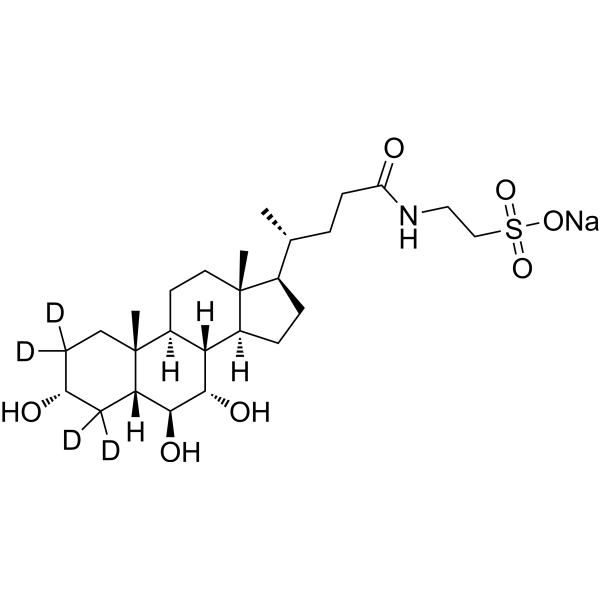 0 ImagesCat. No.: HY-133890ASSynonyms: T-α-MCA-d4 sodiumTauro-α-muricholic acid-d4 (sodium) is the deuterium labeled Tauro-α-muricholic acid sodium (HY-133890A). Tauro-α-muricholic acid sodium (T-α-MCA sodium) is a Taurine (HY-B0351)-conjugated primary Bile acid. Tauro-α-muricholic acid sodium is a FXR antagonist with an IC50 of 28 µM. Tauro-α-muricholic acid sodium attenuates other bile acid-activated FXR signaling. Tauro-α-muricholic acid sodium can be used in the research of Alzheimer's disease, glucose metabolism, and lipid metabolism.
-
DY268 (Standard)
 0 ImagesCat. No.: HY-110267RCAS No.: 1609564-75-1DY268 (Standard) is the analytical standard of DY268 (HY-110267). This product is intended for research and analytical applications. DY268 is a farnesoid X receptor (FXR) antagonist (IC50=7.5 nM). It inhibits FXR transactivation in a cell-based assay with an IC50 value of 468 nM. DY268 can be used in the study of drug-induced liver injury (DILI).
-
Vonafexor (Standard)
 0 ImagesCat. No.: HY-109197RCAS No.: 1192171-69-9Synonyms: EYP001 (Standard)Vonafexor (Standard) is the analytical standard of Vonafexor (HY-109197). This product is intended for research and analytical applications. Vonafexor (EYP001) is an orally active, non-steroidal and selective FXR agonist. Vonafexor shows significant HBsAg reduction when combined with Peg-IFNα. Vonafexor can be used for anti-HBV research.
-
T0901317 (Standard)
 0 ImagesT0901317 (Standard) is the analytical standard of T0901317. This product is intended for research and analytical applications. T0901317 is an orally active and highly selective LXR agonist with an EC50 of 20 nM for LXRα. T0901317 activates FXR with an EC50 of 5 μM. T0901317 is RORα and RORγ dual inverse agonist with Ki values of 132 nM and 51 nM, respectively. T0901317 induces apoptosis and inhibits the development of atherosclerosis in low-density lipoprotein (LDL) receptor-deficient mice.
-
Tauro-β-muricholic acid-d4-1 sodium
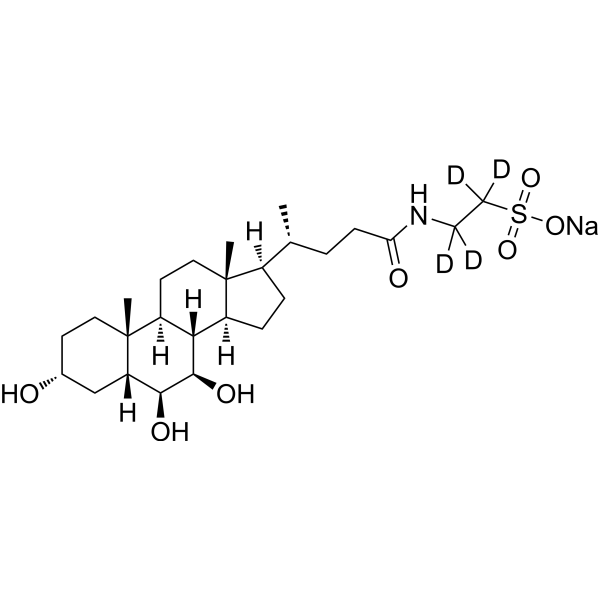 0 ImagesCat. No.: HY-N9933SSynonyms: T-βMCA-d4-1 sodiumTauro-β-muricholic acid-d4-1 (T-βMCA-d4-1) sodium is the deuterium labeled Tauro-β-muricholic acid (HY-N9933).
-
Altenusin
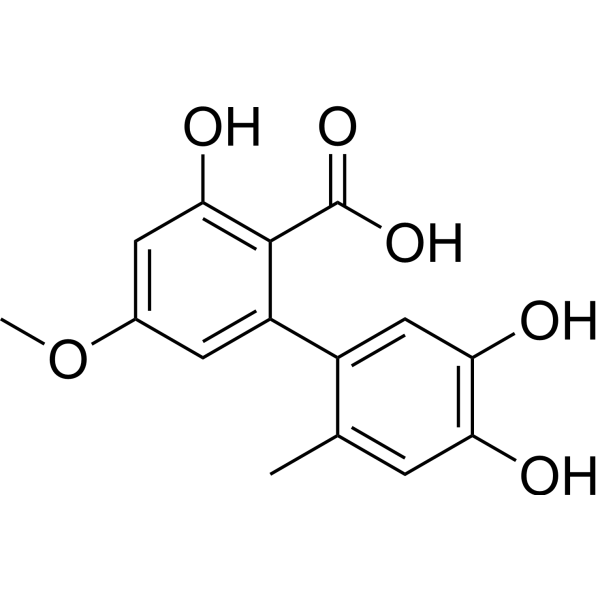 0 ImagesCat. No.: HY-121153CAS No.: 31186-12-6Synonyms: AlutenusinAltenusin shows markedly DPPH radical scavenging activities.
-
Rebaudioside D (Standard)
 0 ImagesCat. No.: HY-N0468RCAS No.: 63279-13-0Rebaudioside D (Standard) is the analytical standard of Rebaudioside D. This product is intended for research and analytical applications. Rebaudioside D is an orally active sweetener that targets and activates FXR, modulates Acetyl-CoA Carboxylase, and inhibits 3-hydroxy-3-methylglutaryl-CoA reductase. Rebaudioside D regulates bile acid homeostasis and lipid metabolism, reduces the synthesis rates of fatty acids and cholesterol, and exerts multiple effects including anti-adipogenesis, hepatoprotection, anti-steatosis, gut microbiota modulation, enhancement of secondary bile acid metabolism, anti-endotoxin activity, regulation of bile acid transport, and inhibition of bile acid efflux. Rebaudioside D also reduces body weight gain, visceral fat accumulation, hepatic triglyceride and cholesterol accumulation, hepatic lipid peroxidation, and decreases the circulating level of lipopolysaccharide-binding protein. Rebaudioside D additionally enhances the secondary bile acid metabolic pathway of intestinal bacteria, upregulates the gene expression of ileal organic solute transporter α, and downregulates the gene expression of hepatic bile salt export pump. Rebaudioside D does not affect glucose homeostasis, alter total caloric intake or fecal energy excretion, induce weight gain, exacerbate obesity, promote hepatic steatosis, impair brown adipose tissue function, nor change skeletal muscle metabolism-related proteins. Rebaudioside D can be used in diet-induced obesity and obesity-related research.
-
Tauro-obeticholic acid-d5
 0 ImagesCat. No.: HY-12365S2Tauro-obeticholic acid-d5 is deuterium labeled Tauro-obeticholic acid (HY-135399). Tauro-obeticholic acid is an active metabolite of Obeticholic acid. Obeticholic acid is an orally bioavailable farnesoid-X receptor (FXR) agonist.
-
Turofexorate isopropyl (Standard)
 0 ImagesSynonyms: FXR-450 (Standard); XL335 (Standard); WAY-362450 (Standard)Turofexorate isopropyl (Standard) is the analytical standard of Turofexorate isopropyl. This product is intended for research and analytical applications. Turofexorate isopropyl (FXR-450) is a potent, selective, and orally bioavailable FXR agonist with EC50 of 4 nM.
-
DM175
 0 ImagesCat. No.: HY-182395CAS No.: 832119-34-3
-
FXR agonist 9
 0 ImagesCat. No.: HY-168629CAS No.: 2982502-32-7FXR agonist 9 (compound 26) is an oral active and selectivity FXR partial agonist with the EC50 of 0.09 µM (75.13 % maximum efficacy). FXR agonist 9 ameliorates pathological features in HFD and CCl4(HY-Y0298)-induced metabolic dysfunction-associated steatohepatitis mice.
-
Fexaramine (Standard)
 0 ImagesFexaramine (Standard) is the analytical standard of Fexaramine. This product is intended for research and analytical applications. Fexaramine is a potent and selective FXR agonist with an EC50 of 25 nM. Fexaramine has no activity against hRXRα, hPPARαγδ, mPXR, hPXR, hLXRα, hTRβ, hRARβ, mCAR, mERRγ, and hVDR receptors.




