



Fungal
An antifungal agent is a drug that selectively eliminates fungal pathogens from a host with minimal toxicity to the host.
Classes: 1. Polyene Antifungal Drugs: Amphotericin, nystatin, and pimaricin interact with sterols in the cell membrane (ergosterol in fungi, cholesterol in humans) to form channels through which small molecules leak from the inside of the fungal cell to the outside. 2. Azole Antifungal Drugs: Fluconazole, itraconazole, and ketoconazole inhibit cytochrome P450-dependent enzymes (particularly C14-demethylase) involved in the biosynthesis of ergosterol, which is required for fungal cell membrane structure and function. 3. Allylamine and Morpholine Antifungal Drugs: lylamines (naftifine, terbinafine) inhibit ergosterol biosynthesis at the level of squalene epoxidase. The morpholine drug, amorolfine, inhibits the same pathway at a later step. 4. Antimetabolite Antifungal Drugs: 5-Fluorocytosine acts as an inhibitor of both DNA and RNA synthesis via the intracytoplasmic conversion of 5-fluorocytosine to 5-fluorouracil.
All Product Categories
-
Fungal Related Products (2716)
Related Products (2716)

-
Antibodies (1)
-
Related Compound Screening Libraries (1)
-
5-Bromo-5-nitro-1,3-dioxane (Standard)
 0 ImagesCat. No.: HY-W014316RCAS No.: 30007-47-75-Bromo-5-nitro-1,3-dioxane (Standard) is the analytical standard of 5-Bromo-5-nitro-1,3-dioxane (HY-W014316). This product is intended for research and analytical applications. 5-Bromo-5-nitro-1,3-dioxane is a broad-spectrum antimicrobial agent active against Gram-positive bacteria, Gram-negative bacteria and fungi. 5-Bromo-5-nitro-1,3-dioxane oxidizes free thiol groups to their corresponding disulfides. 5-Bromo-5-nitro-1,3-dioxane induces intracellular substance leakage in Escherichia coli and Staphylococcus aureus. 5-Bromo-5-nitro-1,3-dioxane modulates the oxygen consumption of Escherichia coli and Staphylococcus aureus.
-
7-Demethylpiericidin A1
 0 ImagesCat. No.: HY-N14731CAS No.: 155148-30-47-Demethylpiericidin A1 is a pierceridin antibiotic. 7-Demethylpiericidin A1 has antifungal and Gram-negative bacteria activity.
-
Isoprothiolane-d4
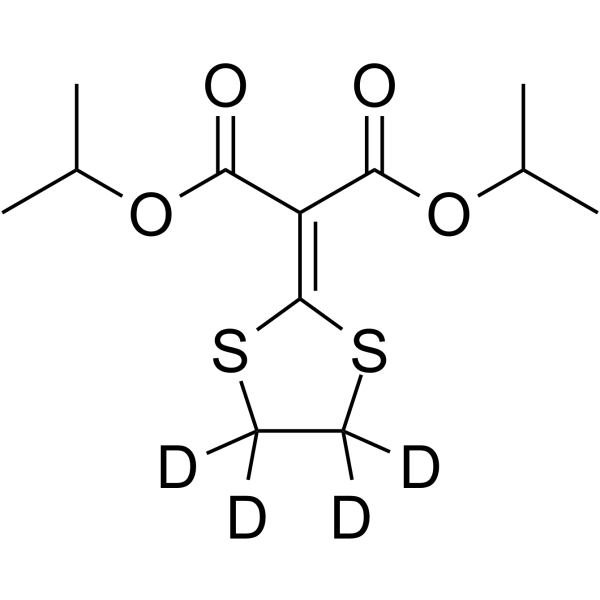 0 ImagesCat. No.: HY-B1858SCAS No.: 1715020-82-8Isoprothiolane-d4 is the deuterium labeled Isoprothiolane (HY-B1858). Isoprothiolane is a blast fungicide with antifungal, anti-inflammatory and insecticidal activities. Isoprothiolane primarily acts on fungi during the penetration and growth stages of infecting hyphae. Isoprothiolane can be used as an insecticide, pesticide, etc. In addition, Isoprothiolane can reduce serum phospholipid and total lipid concentrations, regulating lipid metabolism. Isoprothiolane is also used in the research of fatty liver.
-
Alliacol A
 0 ImagesCat. No.: HY-N13905CAS No.: 79232-29-4Alliacol A is an antibiotic shows weak antibacterial and antifungal activity. Alliacol A inhibits DNA synthesis in cells of the ascitic form of Ehrlich carcinoma.
-
Cladosporide A
 0 ImagesCat. No.: HY-N14121CAS No.: 310897-84-8Cladosporide A is found in the strain of Cladosporium sp. IFM 49189. Cladosporide A inhibits Aspergillus fumigatus with IC50 of 0.5-4.0 μg/mL, but it has no effect on other filamentous fungi.
-
Succinate dehydrogenase-IN-7
 0 ImagesCat. No.: HY-173021Succinate dehydrogenase-IN-7 (Compound 2f) is a Succinate dehydrogenase inhibitor (IC50 = 2.51 μM). Succinate dehydrogenase-IN-7 has fungicidal activity.

-
Piperazinomycin
 0 ImagesCat. No.: HY-N14690CAS No.: 83858-82-6Piperazinomycin is an antifungal and antibacterial antibiotic. Piperazinomycin is isolated from the culture broth of Streptoverticillium olivoreticuli subsp. neoenacticus. Piperazinomycin inhibits the growth of fungi, yeasts and some Mycobacterium species. Piperazinomycin exhibits inhibitory activity against Trichophyton species.
-
Phaseollidin hydrate
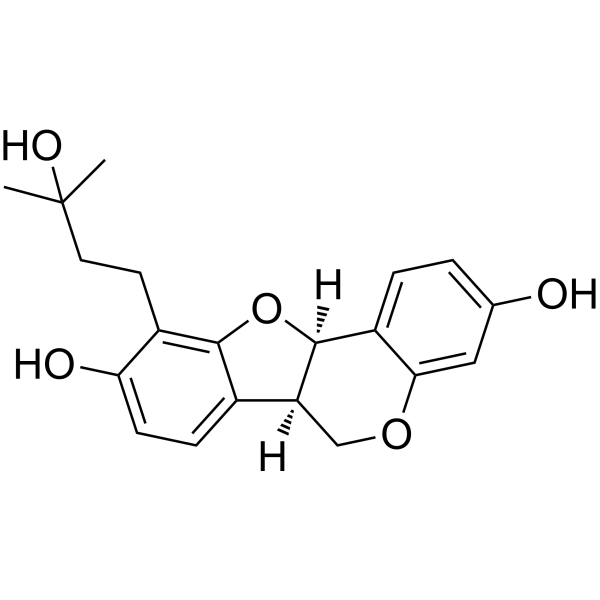 0 ImagesCat. No.: HY-N3088CAS No.: 76122-57-1Phaseollidin hydrate is the hydrate form of the antimicrobial phytoalexin Phaseollidin, which has lower antifungal activity than the original Phaseollidin.
-
Chlorphenesin (Standard)
 0 ImagesChlorphenesin (Standard) is the analytical standard of Chlorphenesin. This product is intended for research and analytical applications. Chlorphenesin is a reversible antigen-associated immunosuppressant. Chlorphenesin is an antibacterial and antifungal agent used in numerous eye care cosmetics.
-
SDH-IN-20
 0 ImagesCat. No.: HY-170974SDH-IN-20 (compound A19) is an antifungal agent. SDH-IN-20 against Verticillium dahlia, R. solani with EC50s of less than 3.0 μg/mL, 2.87 μg/mL. SDH-IN-20 exerts its highly antifungal effects by acting as an effective succinate dehydrogenase (SDH) inhibitor with an IC50 of 29.33 μM. SDH-IN-20 adversely impacts the integrity of cell membranes and mycelial morphologies of R. solani.
-
Pyrifenox (Standard)
 0 ImagesCat. No.: HY-123002RCAS No.: 88283-41-4Pyrifenox (Standard) is the analytical standard of Pyrifenox. This product is intended for research and analytical applications. Pyrifenox is a fungicide, which is used in fruits, ornamentals, and vegetables. Pyrifenox can be utilized as one of the assessment criteria for environmental and food safety.
-
Decyl gallate
 0 ImagesCat. No.: HY-182586CAS No.: 19198-75-5Decyl gallate is an antifungal (fungal) agent. Decyl gallate downregulates the expression of the pro-apoptotic (apoptosis) protein Bak, upregulates the expression of the anti-apoptotic protein Bcl-2, and inhibits DNA damage. Decyl gallate disrupts ALG12-mediated N-glycosylation, overactivates the UPR pathway, and simultaneously reduces fungal cell wall enzyme activity, chitin levels, mitochondrial activity, budding ability, cell viability, and host cell adhesion capacity. Decyl gallate reduces inflammatory responses induced by fungal infection and disrupts fungal membrane structure. Decyl gallate can be used in studies related to paracoccidioidomycosis and invasive fungal infections.
-
Liranaftate (Standard)
 0 ImagesSynonyms: Piritetrate (Standard); M-732 (Standard)Liranaftate (Standard) is the analytical standard of Liranaftate. This product is intended for research and analytical applications. Liranaftate (Piritetrate) is a squalene epoxidase inhibitor with anti-fungicidal activities. Liranaftate can be used for the research of dermatophytes. Liranaftate also suppresses fungal element-promoted production of IL-8 and experimental inflammation.
-
Diclobutrazol (Standard)
 0 ImagesCat. No.: HY-W019803RCAS No.: 75736-33-3Diclobutrazol (Standard) is the analytical standard of Diclobutrazol. This product is intended for research and analytical applications. Diclobutrazol, a systemic fungicide, is highly active against rusts, powdery mildews, and other fungal phytopathogens. Diclobutrazol can be used as a pesticide to control of various crop diseases.
-
Queenslandon
 0 ImagesCat. No.: HY-N14509CAS No.: 481694-30-8Queenslandon has moderate anti-streptomyces, penicillium, Penicillium, Aspergillus fumigatus, aspergillus flavus and other fungal activities. And it has no effect on bacteria.
-
BMS-181184
 0 ImagesCat. No.: HY-106923CAS No.: 139272-69-8BMS-181184 is a new Pradimicin derivative and fungicide. BMS-181184 exhibits fungicidal activity against yeasts, dermatophytes, and most Aspergillus fumigatus strains. BMS-181184 is active against Sporothrix schenckii, dematiaceous fungi, and some members of the non-Aspergillus hyaline hyphomycetes.
-
Acibenzolar-S-methyl (Standard)
 0 ImagesCat. No.: HY-116541RCAS No.: 135158-54-2Synonyms: ASM (Standard)Acibenzolar-S-methyl (Standard) is the analytical standard of Acibenzolar-S-methyl. This product is intended for research and analytical applications. Acibenzolar-S-methyl (ASM) is a plant resistance inducer that mimics pathogen-host interactions and leads to systemic acquired resistance in plants. Acibenzolar-S-methyl helps reduce the use of pesticides and can be used in research to prevent plant diseases.
-
Iprobenfos (Standard)
 0 ImagesCat. No.: HY-B1863RCAS No.: 26087-47-8Iprobenfos (Standard) is the analytical standard of Iprobenfos (HY-B1863). This product is intended for research and analytical applications. Iprobenfos is an organophosphorus fungicide and is widely used to control the rice blast fungus. Iprobenfos can phosphorylate the -OH group on the serine residue in the active (esteratic) site of ChEs and so inhibit both AChE and BChE activity.
-
Fenticonazole Nitrate (Standard)
 0 ImagesSynonyms: REC 15-1476 (Standard)Fenticonazole (Nitrate) (Standard) is the analytical standard of Fenticonazole (Nitrate). This product is intended for research and analytical applications. Fenticonazole Nitrate is an antifungal imidazole ring derivative. Fenticonazole Nitrate operates via hindering ergosterol integration, and sequentially destructing the cytoplasmatic outer membrane. Fenticonazole Nitrate is effective against Gram-positive bacteria, mycoses, and vaginal candidiasis.




