



Glycosidase
Glycosidase
Glycosidase are a class of enzymes which catalyze the hydrolysis of glycosidic bonds. In living organisms, Glycosidase are involved in carbohydrate metabolism. They can degrade polysaccharides such as starch and glycogen into monosaccharides, providing energy for cells. Glycosidase also participate in the synthesis and modification of biological macromolecules such as glycoproteins and glycolipids, playing a crucial role in cell recognition and signal transduction. Additionally, in plants and microorganisms, Glycosidase are involved in the metabolism of cell wall polysaccharide components, affecting cell growth, differentiation, and morphogenesis. Gene mutations of Glycosidase can trigger genetic diseases, leading to abnormal metabolism in the body and damage to organ functions. Changes in their activity are associated with various diseases such as diabetes, infectious diseases, and tumors, and can influence the occurrence and development of diseases[1][2].
References:
- [1]. Wang X, et al. Metabolites extracted from microorganisms as potential inhibitors of glycosidases (α-glucosidase and α-amylase): A review. Front Microbiol. 2022 Nov 17;13:1050869.
- [2]. Ohtsubo K, et al. Glycosylation in cellular mechanisms of health and disease. Cell. 2006 Sep 8;126(5):855-67. [Content Brief]
All Product Categories
-
Glycosidase Inhibitors
(456)
View all products
-
Glycosidase Antagonist
(1)
View all products
-
Glycosidase Activators
(20)
View all products
-
Glycosidase Modulators
(8)
View all products
-
Glycosidase Chemical
(1)
View all products
-
Glycosidase Inducers
(2)
View all products
-
Glycosidase Degrader
(1)
View all products
-
Glycosidase Controls
(6)
View all products
-
Glycosidase Substrates
(25)
View all products
-
Glycosidase Ligands
(3)
View all products
-
Glycosidase Related Products (697)
Related Products (697)

-
Antibodies (3)
-
Glycosidase-IN-2
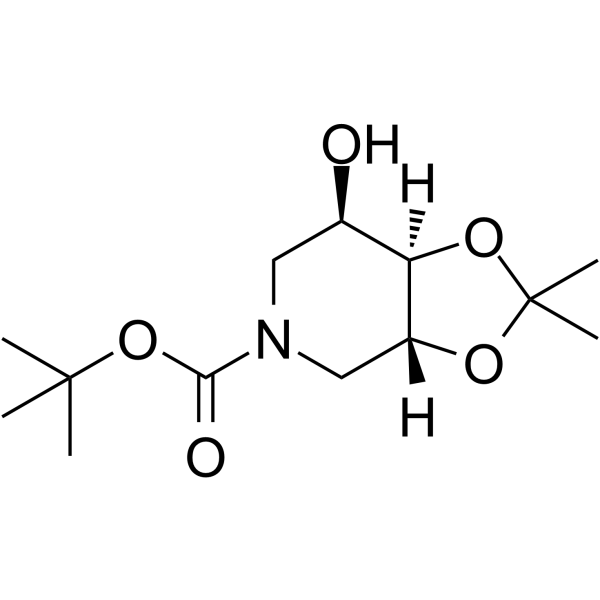 0 ImagesCat. No.: HY-135670BCAS No.: 476310-39-1Glycosidase-IN-2 (Compound 20) is an azasugar class of glycosidase inhibitor. Glycosidase-IN-2 has hypoglycemic activity.
-
C2 Adamantanyl glucosylceramide (d18:1/2:0)
 0 ImagesCat. No.: HY-181469Synonyms: Adamantanyl GluCer (d18:1/2:0); Adamantanyl glucosylceramide (d18:1/2:0); AdaGluCer (d18:1/2:0)C2 Adamantanyl glucosylceramide (d18:1/2:0) (Adamantanyl GluCer (d18:1/2:0)) is an inhibitor of glucocerebrosidase (GCC) and LacCer synthase. At low doses, C2 Adamantanyl glucosylceramide (d18:1/2:0) increases intracellular glycolipid levels by inhibiting glucocerebrosidase. C2 Adamantanyl glucosylceramide (d18:1/2:0) alters glycolipid metabolism. C2 Adamantanyl glucosylceramide (d18:1/2:0) can be used for the research of Gaucher disease and Fabry disease.
-
1,6-α-L-Fucosidase
 0 ImagesCat. No.: HY-E711691,6-α-L-Fucosidase (EC 3.2.1.127) belongs to the family of hydrolases, specifically those glycosidases that hydrolyse O- and S-glycosyl compounds.
-
Migalastat hydrochloride-15N
 0 ImagesCat. No.: HY-W740650CAS No.: 1219134-37-8Synonyms: GR181413A-15NMigalastat hydrochloride-15N (GR181413A-15N) is the 15N-labeled Migalastat hydrochloride (HY-14929A). Migalastat (GR181413A free base) hydrochloride is an orally active α-galactosidase A molecular chaperone, with an IC50 value of 0.04 μM for human α-Gal A. Migalastat binds to the active site of certain unstable mutant forms of α-galactosidase A, facilitating their transport to the lysosome. After dissociation in the acidic environment, Migalastat enables the mutant α-galactosidase A to exhibit biological activity.
-
Eleuthoside B
 0 ImagesCat. No.: HY-N19811CAS No.: 194851-33-7Eleuthoside B is a naphthyl gentiobioside identified from the bulbs of Eleutherine americana. Eleuthoside B has an IC50 >1.00 mM against α-glucosidase, and it is not the main contributor to the antidiabetic (hypoglycemic) activity exhibited by the plant extract.
-
α-Amylase/α-Glucosidase-IN-20
 0 ImagesCat. No.: HY-174319α-Amylase/α-Glucosidase-IN-20 (Compound 6b) is a dual inhibitor of α-Amylase and α-Glucosidase with IC50s of 414.57 and 924.15 μM for α-Amylase and α-Glucosidase, respectively. α-Amylase/α-Glucosidase-IN-20 shows a potent anti-diabetic activity, promising for diabetes research.
-
α-Glucosidase-IN-25
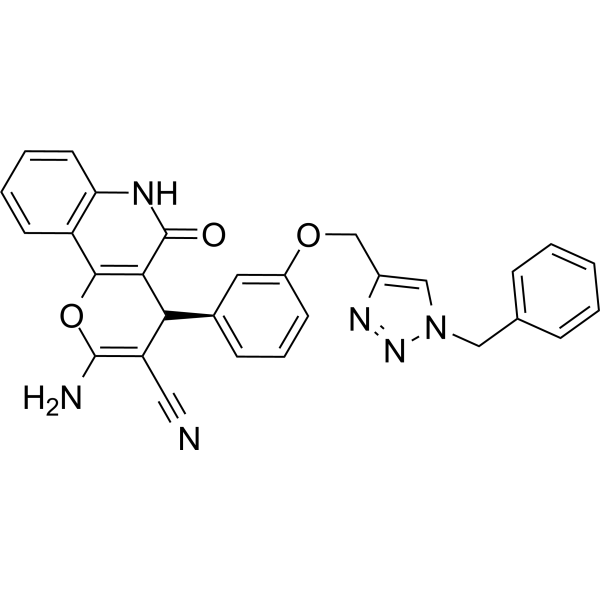 0 ImagesCat. No.: HY-155030CAS No.: 2941473-92-1α-Glucosidase-IN-25 (Compound (R)-8k) is a competitive inhibitor of α-glucosidase, with an IC50 of 1.19μM and can be used for anti-diabetic research.
-
Glycosidase-IN-3
 0 ImagesCat. No.: HY-178216CAS No.: 2648408-08-4Glycosidase-IN-3 (example 92) is a pyrimidine compound targeting beta-glucocerebrosidase, which can be used in the research of related diseases such as Gaucher's disease and Parkinson's disease.
-
α-Glucosidase-IN-71
 0 ImagesCat. No.: HY-163907α-Glucosidase-IN-71 (Compound 7h) is a competitive α-glucosidase inhibitor (IC50: 98.0 µM). α-Glucosidase-IN-71 can be used for research of carbohydrate-related diseases, especially type 2 diabetes mellitus.
-
Penpaxilloids A
 0 ImagesCat. No.: HY-N12761Penpaxilloids A (Compound 1) is a non-competitive inhibitor of protein tyrosine phosphatase 1B (PTP1B) with an IC50 value of 8.60 μM. Penpaxilloids A can be isolated from the fungus Penicillium sp. ZYX-Z-143. Penpaxilloids A is also an α-glucosidase (α-glucosidase) inhibitor with anti-inflammatory activity.
-
NIR-BG2
 0 ImagesCat. No.: HY-165424CAS No.: 3036456-18-2NIR-BG2 is a fluorescent indicator targeting senescence-associated β-galactosidase (SA-β-Gal). NIR-BG2 contains a hemicyanine fluorophore caged by SA-β-Gal; cleavage of its β-galactosyl group by SA-β-Gal generates an electrophilic quinone methide, which can form covalent bonds with adjacent proteins to achieve long-term signal retention. NIR-BG2 activates a near-infrared fluorescent signal upon recognition of SA-β-Gal. NIR-BG2 can be used for non-invasive in vivo imaging of cellular senescence in mouse xenograft models. The excitation/emission wavelengths are 675/708 nm.
-
α-Glucosidase-IN-14
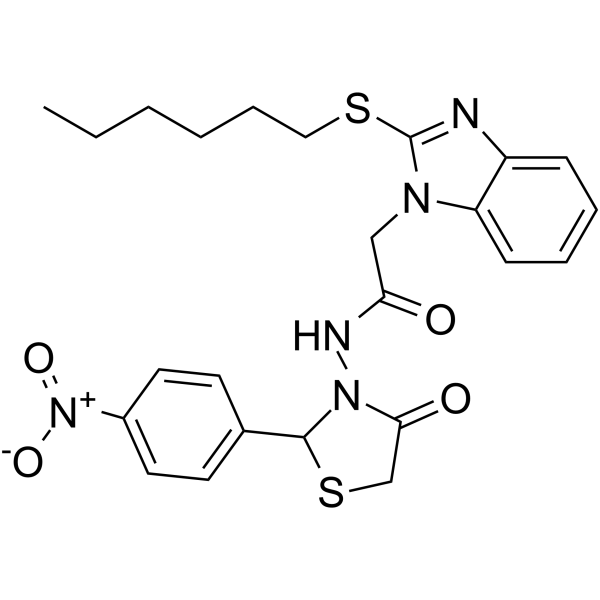 0 ImagesCat. No.: HY-150961CAS No.: 2816072-15-6α-Glucosidase-IN-14 (compound 5) is a potent α-glucosidase inhibitor, with an IC50 of 5.22 μM.
-
α-Glucosidase-IN-119
 0 ImagesCat. No.: HY-184701α-Glucosidase-IN-119 is an α-glucosidase inhibitor with an IC50 of 3.32 μM and oral effectiveness. α-Glucosidase-IN-119 acts as an antihyperglycemic agent, reduces blood glucose levels, restores normal levels of alkaline phosphatase, aspartate transaminase, alanine transaminase, urea, blood urea nitrogen, and total protein, and exhibits antioxidant activity. α-Glucosidase-IN-119 can be used for the research of type 2 diabetes mellitus.
-
β-Galactosidase 42A, Bifidobacterium longum
 0 ImagesCat. No.: HY-E71299β-Galactosidase 42A, Bifidobacterium longum (EC 3.2.1.23) is a hydrolase enzyme that catalyzes the hydrolysis of β-galactosides into monosaccharides. Substrates of different β-galactosidases include ganglioside GM1, lactosylceramides, lactose, and various glycoproteins.
-
β-Glucosidase, Rhizobium etli
 0 ImagesCat. No.: HY-P2775Bβ-Glucosidase, Rhizobium etli (EC 3.2.1.21), is a glucosidase that acts on the β1→4 glycosidic bond connecting two glucose molecules or glucose-substituted molecules (e.g., disaccharide cellobiose). β-Glucosidase is an exonuclease specific for a variety of β-D-glycosidic substrates. β-Glucosidase catalyzes the hydrolysis of the terminal non-reducing residues of β-D-glucosides, releasing glucose.
-
β-Mannanase 76A, Bacteroides thetaiotaomicron
 0 ImagesCat. No.: HY-E71316β-Mannanase 76A, Bacteroides thetaiotaomicron (EC 3.2.1.78) is an enzyme with system name 4-beta-D-mannan mannanohydrolase. This enzyme catalyses the following chemical reaction: Random hydrolysis of (1->4)-beta-D-mannosidic linkages in mannans, galactomannans and glucomannans.

-
(3R,5S)-5'-Methoxyoctahydrocurcumin
 0 ImagesCat. No.: HY-N16668CAS No.: 718638-77-8(3R,5S)-5'-Methoxyoctahydrocurcumin (Compound 4) is a diarylheptanoidfound in Curcuma comosa. (3R,5S)-5'-Methoxyoctahydrocurcumin exhibits strong antiallergic activity by inhibiting β-hexosaminidase release and the degranulation of mast cells. (3R,5S)-5'-Methoxyoctahydrocurcumin can be used for the research of immunology, such as asthma.
-
N-(E)-Caffeoyldopamine
 0 ImagesCat. No.: HY-W127945CAS No.: 103188-49-4N-(E)-Caffeoyldopamine is an inhibitor of α-glucosidase that can be purified from Clerodendranthus Spicatus. N-(E)-Caffeoyldopamine shows a 53.73% inhibitory activity againstα-glucosidase. N-(E)-Caffeoyldopamine can be studied in diabetes research.
-
β-Glucosidase 1A, Thermobifida fusca
 0 ImagesCat. No.: HY-E71305Iβ-Glucosidase 1A, Thermobifida fusca (EC 3.2.1.21) is a glucosidase enzyme that acts upon β1->4 bonds linking two glucose or glucose-substituted molecules (i.e., the disaccharide cellobiose) . β-Glucosidase is one of the cellulases, enzymes involved in the decomposition of cellulose and related polysaccharides; more specifically, an exocellulase with specificity for a variety of beta-D-glycoside substrates. It catalyzes the hydrolysis of terminal non-reducing residues in beta-D-glucosides with release of glucose.




