



HBV
Hepatitis B virus
HBV (Hepatitis B virus), abbreviated HBV, is a species of the genus Orthohepadnavirus, which is likewise a part of the Hepadnaviridae family of viruses. HBV causes the disease hepatitis B. The hepatitis B virus is classified as the type species of the Orthohepadnavirus, which contains three other species: the Ground squirrel hepatitis virus, Woodchuck hepatitis virus, and theWoolly monkey hepatitis B virus. The genus is classified as part of the Hepadnaviridae family. HBV is divided into four major serotypes (adr, adw, ayr, ayw) based on antigenic epitopes present on its envelope proteins, and into eight genotypes (A–H) according to overall nucleotide sequence variation of the genome. The genotypes have a distinct geographical distribution and are used in tracing the evolution and transmission of the virus. Differences between genotypes affect the disease severity, course and likelihood of complications, and response to treatment and possibly vaccination.
All Product Categories
-
HBV Related Products (384)
Related Products (384)

-
Antibodies (2)
-
HBV-IN-54
 0 ImagesCat. No.: HY-179393HBV-IN-54 is a selective and orally active HBV inhibitor. HBV-IN-54 exhibits anti-HBV activity in both HepAD38 cells (EC50 = 0.020 μM, CC50 > 100 μM) and HLCZ01 cells (EC50 = 0.024 μM, CC50 > 100 μM). HBV-IN-54 inhibits viral replication in vivo. HBV-IN-54 displays favorable physicochemical properties and high plasma stability. HBV-IN-54 can be used for research on Hepatitis B (HBV).
-
BAY39-5493
 0 ImagesCat. No.: HY-117999CAS No.: 247037-81-6
-
Famciclovir (Standard)
 0 ImagesSynonyms: BRL 42810 (Standard)Famciclovir (Standard) is the analytical standard of Famciclovir. This product is intended for research and analytical applications. Famciclovir (BRL 42810) is an orally active nucleoside analogue. Famciclovir is an antiviral agent with potent activities against HBV, HSV and VZV. Famciclovir can be used for the research of herpesvirus infection.
-
BAY38-7690
 0 ImagesCat. No.: HY-116607CAS No.: 246872-58-2
-
HBF-0259 (Standard)
 0 ImagesHBF-0259 (Standard) is the analytical standard of HBF-0259. This product is intended for research and analytical applications. HBF-0259 is a potent and selective inhibitor of hepatitis B virus (HBV) surface antigen (HBsAg) secretion, with an EC50 of 1.5 μM in HepG2.2.15 cells. HBF-0259 has no effect on HBV DNA synthesis.
-
Daphnoretin (Standard)
 0 ImagesDaphnoretin (Dephnoretin; Thymelol) (Standard) is the analytical standard of Daphnoretin (HY-N0699). This product is used for research and analytical applications. Daphnoretin is a protein kinase C (PKC) activator that can inhibit the expression of hepatitis B virus (HBV) surface antigen (HBsAg) and has antiviral activity. Daphnoretin exerts its anti-tumor effect by inhibiting the activation of the PI3K/AKT signaling pathway, triggering the mitochondrial apoptosis pathway. Daphnoretin alleviates chondrocyte apoptosis and inflammatory responses by inhibiting endoplasmic reticulum stress and the activation of the NLRP3 inflammasome. Daphnoretin can regulate the differentiation and maturation of dendritic cells, by down-regulating the phosphorylation level of JNK, inhibiting its immune stimulating function, thereby playing a protective role in skin transplant rejection reactions.
-
Tenofovir maleate
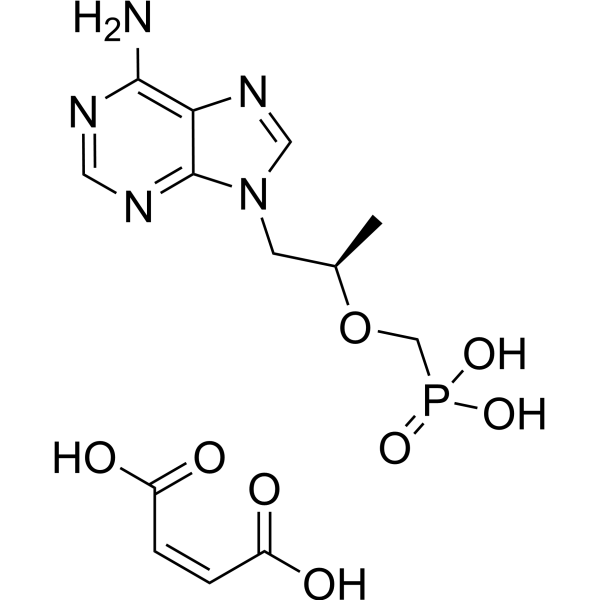 0 ImagesCat. No.: HY-13910BCAS No.: 1236287-04-9Synonyms: GS 1278 maleate; PMPA maleateTenofovir maleate (GS 1278 maleate; PMPA maleate) is a nucleotide reverse transcriptase inhibitor to treat HIV and chronic Hepatitis B (HBV).
-
KR-26556
 0 ImagesCat. No.: HY-136111CAS No.: 2411762-66-6KR-26556 is a sulfonamide type hepatitis B virus (HBV) capsid assembly regulator. KR-26556 exhibits anti-HBV activity with an EC50 of 0.04 μM. KR-26556 has favorable safety characteristics. KR-26556 can be used for research on chronic hepatitis B.
-
Tenofovir exalidex (Standard)
 0 ImagesCat. No.: HY-109014RCAS No.: 911208-73-6Synonyms: CMX-157 (Standard)Tenofovir exalidex (Standard) is the analytical standard of Tenofovir exalidex. This product is intended for research and analytical applications. Tenofovir exalidex (CMX157) is a lipid conjugate of the acyclic nucleotide analog Tenofovir with activity against both wild-type and antiretroviral drug-resistant HIV strains, including multidrug nucleoside/nucleotide analog-resistant viruses. Tenofovir exalidex is active against all major subtypes of HIV-1 and HIV-2 in fresh human PBMCs and against all HIV-1 strains evaluated in monocyte-derived macrophages, with EC50s ranging between 0.2 and 7.2 nM. CMX157 is orally available and has no apparent toxicity. Tenofovir exalidex also shows antiviral activity against HBV.
-
Personalised postprandial-targeting
 0 ImagesCat. No.: HY-117925CAS No.: 1529779-90-5Personalised postprandial-targeting is a way to modulate water-heme interactions with activity against low-spin P450 complexes. Personalised postprandial-targeting is able to maintain the axial water ligands of CYP2C9 even in the presence of inhibitors. Personalised postprandial-targeting also allows the hydrogen atoms of the axial water ligands to be observed by EPR spectroscopy, providing insights into the enzyme active site.

-
GS-8873 TFA
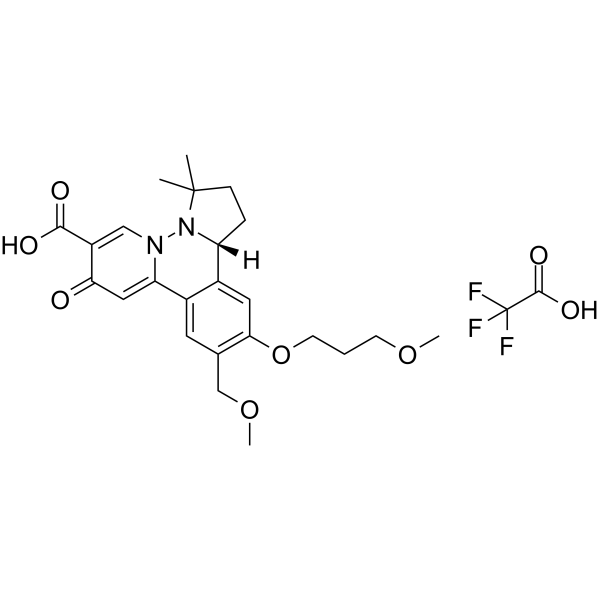 0 ImagesCat. No.: HY-145713ACAS No.: 2241575-60-8Synonyms: HBV-IN-19 TFAGS-8873 TFA is the TFA salt form of GS-8873 (HY-145713). GS-8873 TFA is an orally active inhibitor for the production of hepatitis B virus (HBV) surface antigen (HBsAg) with an EC50 of 4 nM. GS-8873 TFA exhibits good pharmacokinetic characters in rats and metabolic stability in human hepatocytes. GS-8873 TFA causes neurofunctional deficits in rats and cynomolgus monkeys.
-
Vebicorvir (Standard)
 0 ImagesCat. No.: HY-109195RCAS No.: 2090064-66-5Synonyms: ABI-H0731 (Standard)Vebicorvir (Standard) is the analytical standard of Vebicorvir (HY-109195). This product is intended for research and analytical applications. Vebicorvir (ABI-H0731) is a first-generation hepatitis B virus (HBV) core protein inhibitor. Vebicorvir (ABI-H0731) suppresses covalently closed circular DNA (cccDNA) formation in two de novo infection models with EC50s from 1.84 μM to 7.3 μM.
-
Dimethyl biphenyl-4,4'-dicarboxylate (Standard)
 0 ImagesCat. No.: HY-128854RCAS No.: 792-74-5Dimethyl biphenyl-4,4'-dicarboxylate (Standard) is the analytical standard of Dimethyl biphenyl-4,4'-dicarboxylate (HY-128854). This product is intended for research and analytical applications. Dimethyl biphenyl-4,4'-dicarboxylate (Biphenyl dimethyl dicarboxylate) is a hepatoprotective agent. Dimethyl biphenyl-4,4'-dicarboxylate stimulates the Jak/Stat signaling pathway and induces the expression of IFN-α-stimulated genes, particularly 6-16 and ISG12. Dimethyl biphenyl-4,4'-dicarboxylate inhibits the replication of pregenomic RNA and HBeAg. Polymer micelles loaded with Dimethyl biphenyl-4,4'-dicarboxylate can serve as carriers for the compound. Dimethyl biphenyl-4,4'-dicarboxylate can be used as an auxiliary improving agent for chronic hepatitis. Dimethyl biphenyl-4,4'-dicarboxylate is applicable to research related to chronic hepatitis B.
-
Bay 41-4109 (Standard)
 0 ImagesCat. No.: HY-100029RCAS No.: 298708-81-3Bay 41-4109 (Standard) is the analytical standard of Bay 41-4109 (HY-100029). This product is intended for research and analytical applications. BAY 41-4109 is a potent inhibitor of human hepatitis B virus (HBV) with an IC50 of 53 nM.
-
TLR7/8 agonist 13
 0 ImagesCat. No.: HY-177300CAS No.: 1402802-45-2TLR7/8 agonist 13 is an orally active dual agonist of TLR7 (lowest effective concentrations (LEC) [hTLR7] = 1.6 μM) and TLR8 (LEC [hTLR8] = 1.6 μM). TLR7/8 agonist 13 exhibits agonistic activity against human peripheral blood mononuclear cells (hPBMCs) (LEC [hPBMC] = 0.5 μM). TLR7/8 agonist 13 induces endogenous IFNα, activating myeloid dendritic cells and monocytes toward a TH1 phenotype in mice and cynomolgus monkeys. TLR7/8 agonist 13 reduces viral load and HBV surface antigen expression in a mouse model of chronic AAV-HBV infection. TLR7/8 agonist 13 has the potential to indirectly induce IFNγ, which may promote HBV antigen-specific CD8 T cell-mediated responses. TLR7/8 agonist 13 can be used to study hepatitis B virus.
-
Taurolithocholic Acid-d5 sodium
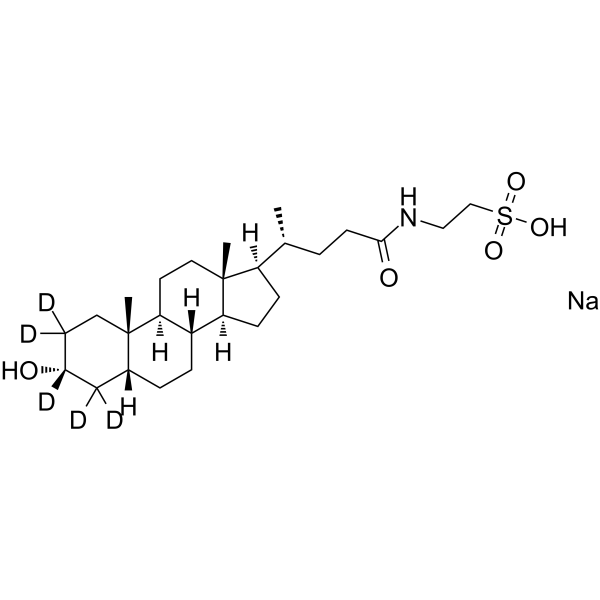 0 ImagesCat. No.: HY-113308AS1CAS No.: 1265476-97-8Taurolithocholic Acid-d5 (sodium) is the deuterium labeled Taurolithocholic acid sodium salt. Taurolithocholic Acid sodium salt is an orally active bile acid and antiviral agent. Taurolithocholic Acid sodium salt upregulates FADS2 by activating the TGR5-PI3K/AKT-SREBP2 signaling axis, inhibits SFTSV-induced ferroptosis, viral replication and viral entry of HBV/HDV, while reducing the release of IL-1β, lipid ROS and LDH. While exerting antiviral protective effects, Taurolithocholic Acid sodium salt also stimulates the recycling of hepatocellular membrane transporters, impairs canalicular bile acid secretion function, and induces hepatocyte cholestasis, apoptosis and acute hepatocellular injury. Taurolithocholic Acid sodium salt serves as an experimental model compound for hepatocellular cholestasis. At concentrations ≤200 μM, Taurolithocholic Acid sodium salt shows no cytotoxicity and does not activate the interferon pathway. Taurolithocholic Acid sodium salt not only protects mice from lethal SFTSV infection but also is suitable for studies related to severe fever with thrombocytopenia syndrome and cholestasis.

-
Besifovir Dipivoxil
 0 ImagesCat. No.: HY-113586CAS No.: 441785-26-8Synonyms: LB-80380Besifovir Dipivoxil (LB-80380), an analog of guanosine monophosphate, is an acyclic nucleotide phosphonate with antiviral effect. Besifovir Dipivoxil is rapidly converted by the liver and intestine to the intermediate metabolite LB80331 via the esterification process, subsequently phosphorylated into the di- and triphosphate forms, which act as antiviral DNA synthesis inhibitors. Besifovir Dipivoxil is promising for research of chronic hepatitis B.
-
RIG-1 modulator 1 (Standard)
 0 ImagesCat. No.: HY-107902RCAS No.: 1428729-63-8RIG-1 modulator 1 (Standard) is the analytical standard of RIG-1 modulator 1 (HY-107902). This product is intended for research and analytical applications. RIG-1 modulator 1 (Compound of claim 13) is an anti-viral compound which can be used against viral infections including influenza virus, HBV, HCV and HIV.




