



Endogenous Metabolite
Endogenous metabolites refer to the collective set of small-molecule chemical substances present within organelles, cells, organs, biological fluids, or entire organisms; their molecular weights are typically less than 1500 Da. These endogenous metabolites—including lipids, amino acids, short peptides, nucleic acids, carbohydrates, alcohols, and organic acids—not only participate in signal transduction governing genomic function but also receive upstream signals from the environment, thereby bridging the interrelationships among genotype, environment, and phenotype.
Based on their biological functions, microbial endogenous metabolites can be broadly classified into two categories: primary metabolites and secondary metabolites. Primary metabolites are the core molecules essential for supporting microbial growth and proliferation; they serve to provide energy to the microbes or act as precursors and cofactors for the synthesis of biological macromolecules. In contrast, microbial secondary metabolites are a class of low-molecular-weight products that are not strictly essential for microbial growth. Nevertheless, microbial secondary metabolites include numerous substances—such as antibiotics, anti-tumor agents, and cholesterol-lowering agents—that are of critical importance to human health[1][2][3]. Furthermore, the metabolome of a biological organism is influenced by a variety of endogenous factors, including age, sex, body composition, genetic background, and underlying pathological states. The small-molecule metabolites within an organism are diverse and highly distinct; their levels are typically subject to the synergistic regulation of a vast array of enzymes and transport proteins, undergoing processes of synthesis, transformation, degradation, and compartmentalized distribution. Metabolomics research based on endogenous metabolites has been widely applied in the fields of metabolic disorders, neurodegenerative diseases, cancer, cardiovascular diseases, and infectious diseases, where these metabolites hold potential utility as biomarkers or therapeutic targets[1][2][3].
References:
- [1]. Seyedsayamdost MR. Toward a global picture of bacterial secondary metabolism. J Ind Microbiol Biotechnol. 2019 Mar;46(3-4):301-311. [Content Brief]
- [2]. Ruiz B, et al. Production of microbial secondary metabolites: regulation by the carbon source. Crit Rev Microbiol. 2010 May;36(2):146-67. [Content Brief]
- [3]. Wishart DS. Metabolomics for Investigating Physiological and Pathophysiological Processes. Physiol Rev. 2019 Oct 1;99(4):1819-1875. [Content Brief]
Endogenous Metabolite Isoform Specific Products
All Product Categories
-
Endogenous Metabolite Related Products (8420)
Related Products (8420)

-
Antibodies (477)
-
Endogenous Metabolite Isoform Comparison
-
Inositol 1,3,4,5-tetraphosphate
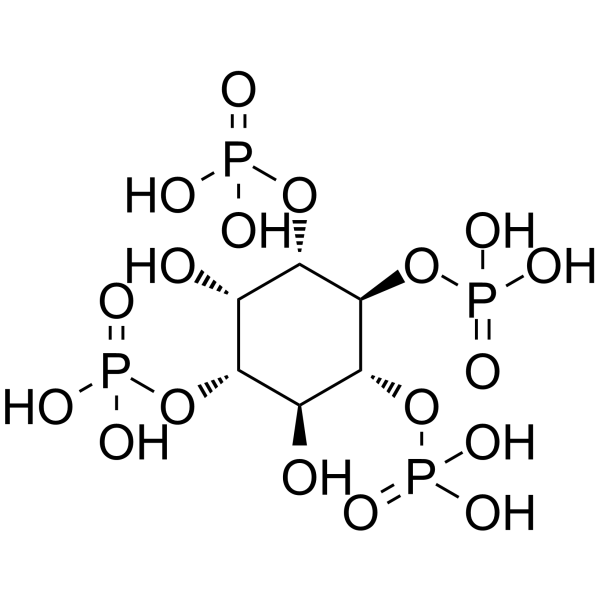 0 ImagesCat. No.: HY-W127317CAS No.: 102850-29-3Inositol 1,3,4,5-tetraphosphate is an inositol tetraphosphate. Inositol 1,3,4,5-tetraphosphate is metabolically produced from Ins (1,4,5) P3 via 3-kinase, participates in intracellular signal transduction systems, and elevates intracellular calcium concentrations when present.
-
Stewart-Grubbs catalyst
 0 ImagesCat. No.: HY-W034392CAS No.: 927429-61-6Stewart-Grubbs catalyst is an effective catalyst for the cross-metathesis of olefins with a large number of allylic substituents. In addition, ChemBeads are chemically coated glass beads that improve flowability and chemical homogeneity, making them ideal for automated solid dispensing and high-throughput experiments. Notably, the manufacture of ChemBeads does not require additional chemicals or surfactants, allowing for precise dispensing of sub-milligram amounts of catalyst.
-
Nε,Nε,Nε-Trimethyllysine chloride (Standard)
 0 ImagesCat. No.: HY-N7404RCAS No.: 55528-53-5Synonyms: Ne-(Trimethyl)-L-lysine chloride (Standard); H-Lys(Me)3-OH chloride (Standard)Nε,Nε,Nε-Trimethyllysine chloride serves as a precursor for gut flora-dependent formation of N,N,N-trimethyl-5-aminovaleric acid (TMAVA).
-
Tetraphenyldibenzoperiflanthene
 0 ImagesCat. No.: HY-W243879CAS No.: 175606-05-0Synonyms: DBPTetraphenyldibenzoperiflanthene (DBP) is an organic semiconductor material with excellent electronic conduction activity. Tetraphenyldibenzoperiflanthene exhibits high mobility in organic field effect transistors (OFETs), improving device performance. Tetraphenyldibenzoperiflanthene is widely used in organic photovoltaic (OPV) materials to enhance photoelectric conversion efficiency.
-
4-Acetaminophen sulfate-d4
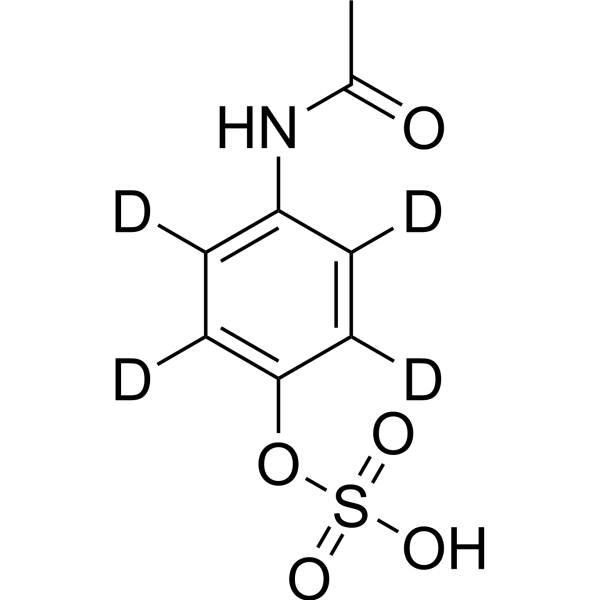 0 ImagesCat. No.: HY-66006S1CAS No.: 1261397-46-94-Acetaminophen sulfate-d4 is deuterated labeled 4-Acetaminophen sulfate.
-
3-Benzylidenecamphor
 0 ImagesCat. No.: HY-W585837CAS No.: 15087-24-83-Benzylidenecamphor is a UV absorber with excellent photostability and antioxidant activity. 3-Benzylidenecamphor is widely used in sunscreen products to protect the skin from UV damage. 3-Benzylidenecamphor can also be used in cosmetics to improve the shelf life and safety of the product.
-
Oleic acid triethanolamine
 0 ImagesSynonyms: 9-cis-Octadecenoic acid triethanolamine; 9Z-Octadecenoic acid triethanolamineOleic acid triethanolamine (9-cis-Octadecenoic acid triethanolamine) is the most common monounsaturated fatty acid found in human adipocytes and other tissues. Oleic acid triethanolamine is a Na+/K+ ATPase activator.
-
SK-J014-1n
 0 ImagesCat. No.: HY-W075747CAS No.: 2049086-37-3SK-J014-1n is a nickel catalyst with high cross-coupling activity. SK-J014-1n can effectively promote organic synthesis reactions and increase reaction rate and selectivity. SK-J014-1n exhibits good catalytic performance in the synthesis of complex organic molecules.
-
(E)-Methyl isoferulate
 0 ImagesCat. No.: HY-N7423ACAS No.: 97966-29-5Synonyms: (E)-Isoferulic acid methyl ester(E)-Methyl isoferulate ((E)-Isoferulic acid methyl ester) is a derivative of Cinnamic acid (HY-N0610A) and NO inhibitor, with an IC50 > 100 μM against nitric oxide production. (E)-Methyl isoferulate is isolable from the solid cultures of the edible mushroom Neolentinus lepideus. (E)-Methyl isoferulate exerts mild anticancer effects against liver cancer and leukemia.

-
Cyclo(his-pro) TFA (Standard)
 0 ImagesCat. No.: HY-101402ARCAS No.: 936749-56-3Synonyms: Cyclohistidyl-proline TFA (Standard); Histidylproline diketopiperazine TFA (Standard)Cyclo(his-pro) (TFA) (Standard) is the analytical standard of Cyclo(his-pro) (TFA). This product is intended for research and analytical applications. Cyclo(his-pro) TFA (Cyclo(histidyl-proline) TFA) is an orally active cyclic dipeptide structurally related to tyreotropin-releasing hormone. Cyclo(his-pro) TFA could inhibit NF-κB nuclear accumulation. Cyclo(his-pro) TFA can cross the brain-blood-barrier and affect diverse inflammatory and stress responses.
-
L-Indole-3-lactic acid
 0 ImagesL-Indole-3-lactic acid is an L (-)-tryptophan metabolite found in strains of Bifidobacterium, Lactobacillus plantarum and Lactobacillus paraplantarum, and also an indole-based antioxidant. L-Indole-3-lactic acid is produced via the pathway that converts tryptophan into indole-3-pyruvic acid. L-Indole-3-lactic acid acts as a free radical scavenger to eliminate DPPH free radicals. L-Indole-3-lactic acid can be used in antioxidant and metabolism-related research.
-
Sandosaponin A
 0 ImagesCat. No.: HY-107302CAS No.: 135272-91-2Synonyms: Soyasaponin BdSandosaponin A (Soyasaponin Bd) is a saponin with inhibitory activity against human recombinant aldehyde reductase (hAKR1B1). Sandosaponin A can inhibit the reduction of l-idose and 4-hydroxynonenal to varying degrees. The presence of Sandosaponin A reveals the challenges posed by the masking effect of conventional aldehyde reductase inhibitors in mixtures when exploring differential aldehyde reductase inhibitors. The inhibitory mechanism of Sandosaponin A may be related to its mode of action on different substrates.
-
1-(2-Amino-3-hydroxyphenyl)ethanone (Standard)
 0 ImagesCat. No.: HY-109690RCAS No.: 4502-10-71-(2-Amino-3-hydroxyphenyl)ethanone (Standard) is the analytical standard of 1-(2-Amino-3-hydroxyphenyl)ethanone (HY-109690). This product is intended for research and analytical applications. 1-(2-Amino-3-hydroxyphenyl)ethanone is the kynuridine metabolite, which could be extracted from rat liver mitochondrium. 1-(2-Amino-3-hydroxyphenyl)ethanone is associated with tryptophan metabolism disturbances, and can be used in bladder cancer, leukemia and anemia researches.
-
Phenylpropiolic acid (Standard)
 0 ImagesPhenylpropiolic acid (Standard) is the analytical standard of Phenylpropiolic acid (HY-W007319). This product is intended for research and analytical applications. Phenylpropiolic acid is an Antibacterial agent. Phenylpropiolic acid is identified from the intracellular extract of Proteus mirabilis DMTMMR-11. Phenylpropiolic acid disrupts biofilm formation by reducing pathogen adhesion and enhancing biofilm clearance ability. Phenylpropiolic acid inhibits the growth of Yersinia enterocolitica, disrupts its cell membrane integrity, and increases the survival rate of infected Caenorhabditis elegans. Phenylpropiolic acid can be used in studies related to yersiniosis and gastroenteritis.
-
Finasteride carboxaldehyde
 0 ImagesCat. No.: HY-139349CAS No.: 154387-61-8Finasteride carboxaldehyde (Compound M2) is the metabolite of 5α-reductase inhibitor Finasteride (HY-13635) in human bile and urine.
-
Deoxythymidine-5'-triphosphate sodium hydrate
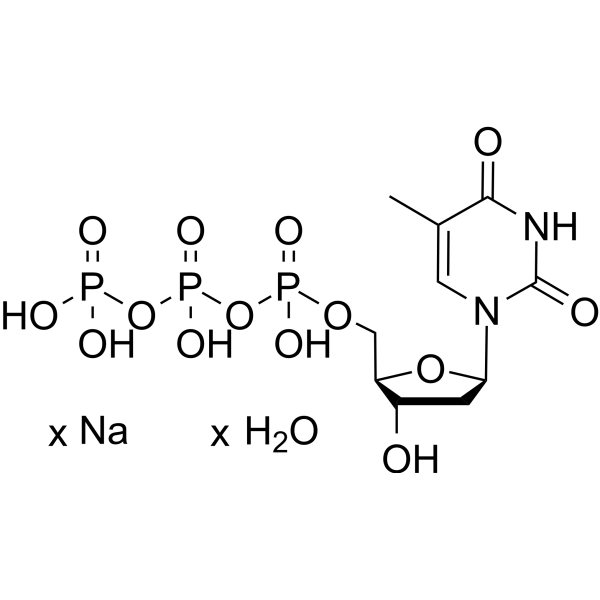 0 ImagesCat. No.: HY-138615ASynonyms: dTTP sodium hydrateDeoxythymidine-5'-triphosphate sodium hydrate (dTTP sodium hydrate) is a deoxyribonucleoside triphosphate and a thymidine analog, which serves as a direct precursor for DNA synthesis. Deoxythymidine-5'-triphosphate sodium hydrate can be used for DNA amplification in the DNA polymerase chain reaction (PCR). Deoxythymidine-5'-triphosphate sodium hydrate is also applicable to research related to diseases such as leukemia.
-
5-Methoxytryptamine (Standard)
 0 ImagesSynonyms: O-Methylserotonin (Standard)5-Methoxytryptamine (Standard) is the analytical standard of 5-Methoxytryptamine (HY-W015169). This product is intended for research and analytical applications. 5-Methoxytryptamine, a metabolite of Melatonin, is a nonselective 5-HT receptor agonist. 5-Methoxytryptamine has no affinity for the 5-HT3 receptor. 5-Methoxytryptamine is also a potent antioxidant and has radioprotective action.
-
10(R)-PAHSA
 0 ImagesCat. No.: HY-158625CAS No.: 2270844-02-310(R)-PAHSA is a stereoisomer of 10-PAHSA, an endogenous lipid that belongs to a collection of branched fatty acid esters of hydroxy fatty acids (FAHFAs).
-
Mitoxantrone (Standard)
 0 ImagesSynonyms: Mitozantrone (Standard); NSC 301739 (Standard)Mitoxantrone (Standard) is the analytical standard of Mitoxantrone. This product is intended for research and analytical applications. Mitoxantrone is a potent topoisomerase II inhibitor. Mitoxantrone also inhibits protein kinase C (PKC) activity with an IC50 of 8.5 μM. Mitoxantrone induces apoptosis of B-CLL (B-chronic lymphocytic leukaemia) cells. Mitoxantrone shows antitumor activity. Mitoxantrone also has anti-orthopoxvirus activity with EC50s of 0.25 μM and and 0.8 μM for cowpox and monkeypox, respectively.




