



Proteasome
Proteasomes are very large protein complexes inside all eukaryotes and archaea, and in some bacteria. In eukaryotes, they are located in the nucleus and the cytoplasm. The main function of the proteasome is to degrade unneeded or damaged proteins by proteolysis, a chemical reaction that breaks peptide bonds. Enzymes that carry out such reactions are called proteases. Proteasomes are part of a major mechanism by which cells regulate the concentration of particular proteins and degrade misfolded proteins. The degradation process yields peptides of about seven to eight amino acids long, which can then be further degraded into amino acids and used in synthesizing new proteins. Proteins are tagged for degradation with a small protein called ubiquitin. The tagging reaction is catalyzed by enzymes called ubiquitin ligases. Once a protein is tagged with a single ubiquitin molecule, this is a signal to other ligases to attach additional ubiquitin molecules. The result is a polyubiquitin chain that is bound by the proteasome, allowing it to degrade the tagged protein.
All Product Categories
-
Proteasome Inhibitors
(224)
View all products
-
Proteasome Activators
(10)
View all products
-
Proteasome Modulator
(1)
View all products
-
Proteasome Degraders
(3)
View all products
-
Proteasome Controls
(3)
View all products
-
Proteasome Substrates
(6)
View all products
-
Proteasome Ligands
(7)
View all products
-
Proteasome Related Products (292)
Related Products (292)

-
Antibodies (22)
-
20S Proteasome-IN-6
 0 ImagesCat. No.: HY-18925620S Proteasome-IN-6 is a species-selective inhibitor of the Mycobacterium tuberculosis 20S proteasome. 20S Proteasome-IN-6 penetrates the Mycobacterium tuberculosis bacilli, sensitizes the bacteria to nitrosative stress, and reduces the bacterial burden of live Mycobacterium tuberculosis within infected macrophages. 20S Proteasome-IN-6 can be used for tuberculosis research.
-
RA183
 0 ImagesCat. No.: HY-181523CAS No.: 2649154-64-1RA183 is a proteasome ligand that can be used to synthesize CAP-TAC (proteasome cap-targeted chimera), such as RAPRMT5 (HY-181521).
-
Calpain Inhibitor XI
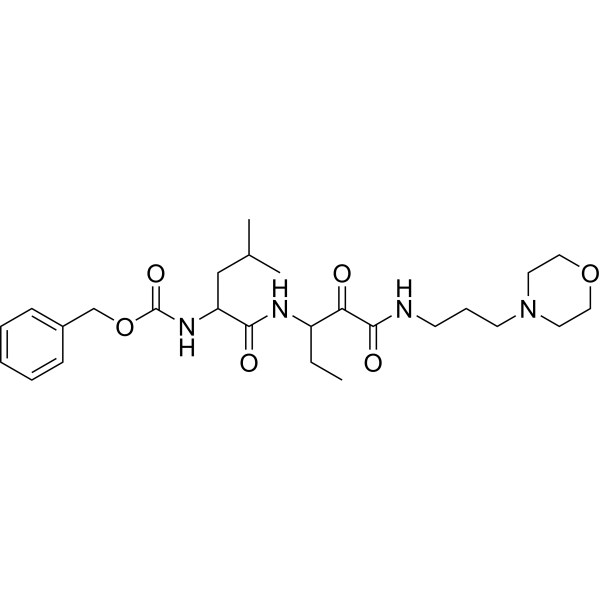 0 ImagesCat. No.: HY-148535CAS No.: 145731-49-3Calpain Inhibitor XI is a reversible covalent inhibitor of calpain-1. Calpain Inhibitor XI can be used for the research of neurodegenerative disorders.
-
FV-162
 0 ImagesCat. No.: HY-117520CAS No.: 1565822-28-7FV-162 is a potent, orally active and irreversible proteasome inhibitor. FV-162 exhibits cytotoxic to human myeloma cell lines and primary myeloma cells. FV-162 inhibits tumor growth in a myeloma xenograft mouse model. FV-162 can be used for myeloma research.
-
Antitrypanosomal agent 15
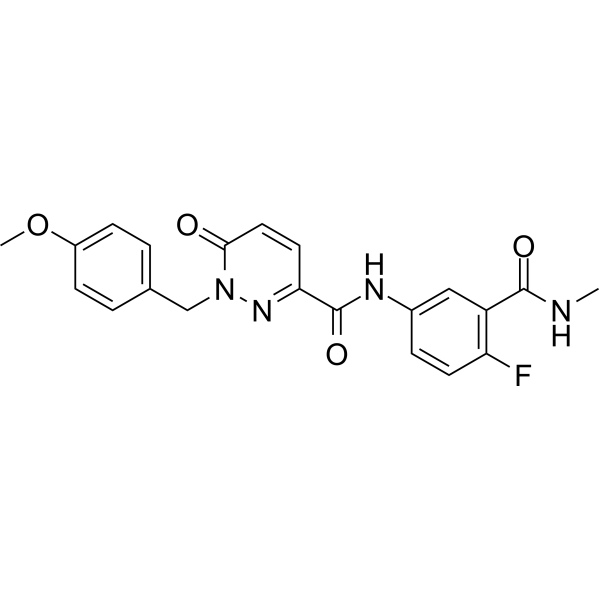 0 ImagesCat. No.: HY-155103CAS No.: 2961381-94-0Antitrypanosomal agent 15 (compound 26) is an orally active, brain-penetrant, selective inhibitor against Trypanosoma cruzi proteasome, with an pIC50 of 7.4 and <4 for T. cruzi and human proteasome, respectively. Antitrypanosomal agent 15 has favorable ADME properties and can be used for Chagas disease study.

-
Acetyl-Calpastatin(184-210)(human), Negative Control
 0 ImagesCat. No.: HY-P10169Acetyl-Calpastatin(184-210)(human), Negative Control is a control scramble peptide of Acetyl-Calpastatin(184-210)(human) (HY-P1081). Acetyl-Calpastatin(184-210)(human) is a potent, selective and reversible calpain inhibitor.
-
Bortezomib analog
 0 ImagesCat. No.: HY-169144Bortezomib analog (Compound 13), an analog of Bortezomib (HY-10227), is an active control of 20S proteasome subunit β5 ligand.
-
Anticancer agent 114
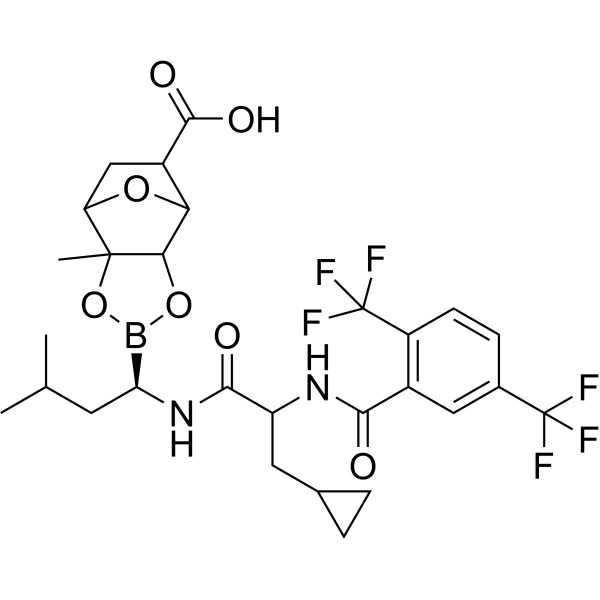 0 ImagesCat. No.: HY-149832Anticancer agent 114 is a potent and orally active dipeptide boronic acid ester proteasome inhibitor with an IC50 value of 2.2 nM. Anticancer agent 114 has antiproliferative activity against the RPMI-8226 cells. Anticancer agent 114 can be used in research of multiple myeloma.
-
20S Proteasome-IN-4
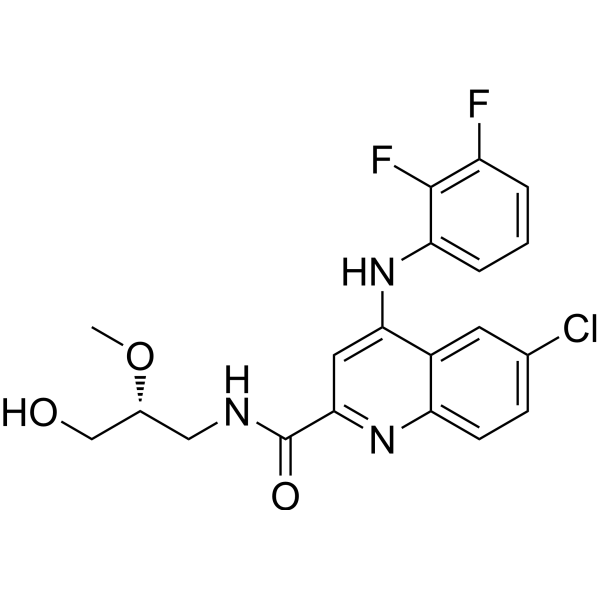 0 ImagesCat. No.: HY-151195CAS No.: 2827061-47-020S Proteasome-IN-4 (Compound 7) is a brain-penetrant, parasite-selective, orally active 20S proteasome inhibitor with an IC50 of 6.3 nM against T. b. brucei 20S proteasome. 20S Proteasome-IN-4 can be used for the research of human African trypanosomiasis (HAT).
-
AK 275
 0 ImagesCat. No.: HY-119131CAS No.: 158798-83-5AK 275, a calpain inhibitor, exhibits neuroprotection activity. AK 275 can be used in the study for central nervous system trauma and ischemia.
-
Cadmium pyrithione
 0 ImagesCat. No.: HY-164689CAS No.: 18897-36-4Cadmium pyrithione is a metal compound that inhibits protein deubiquitinase activity. Cadmium pyrithione treatment results in significant accumulation of ubiquitinated proteins in cancer cells and primary leukemia cells. Cadmium pyrithione strongly inhibits the activity of proteasome deubiquitinase (such as USP14 and UCHL5), but has a smaller inhibitory effect on 20S proteasome activity. The anticancer activity of Cadmium pyrithione is associated with the induction of apoptosis through caspase activation. Furthermore, Cadmium pyrithione inhibition inhibited proteasome function and suppressed tumor growth in animal xenograft models.
-
18α-Glycyrrhetinic acid (Standard)
 0 Images18α-Glycyrrhetinic acid (Standard) is the analytical standard of 18α-Glycyrrhetinic acid. This product is intended for research and analytical applications. 18α-Glycyrrhetinic acid, a diet-derived compound, is an inhibitor of NF-kB and an activator of proteasome, which serves as pro-longevity and anti-aggregation factor in a multicellular organism. 18α-Glycyrrhetinic acid induces apoptosis.
-
LU-002i TFA
 0 ImagesCat. No.: HY-157034ALU-002i TFA is a subunit-selective human proteasome β2c and β2i inhibitor with an IC50 value of 220 nM for β2i.
-
Sadopeptins B
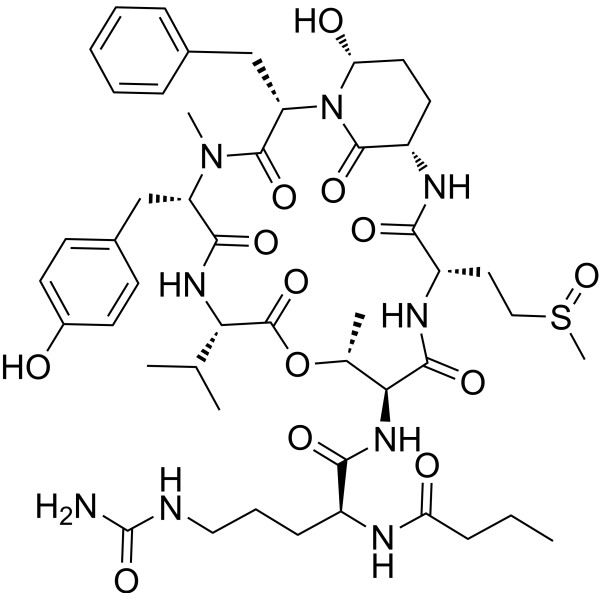 0 ImagesCat. No.: HY-N11621Sadopeptins B is a nature product that could be isolated from Streptomyces sp. Sadopeptins B is a potent proteasome inhibitor.
-
TP-110
 0 ImagesCat. No.: HY-118522CAS No.: 688737-95-3TP-110 is a proteasome inhibitor. TP-110 specifically inhibits the protease-like activity of the 20S proteasome, but does not affect the trypsin-like or peptidyl-glutamyl peptide hydrolysis activity. TP-110 inhibits the NF-κB pathway, activates caspase-8, -9, and -3, and causes PARP cleavage, significantly reducing the levels of cIAP-1 and XIAP. TP-110 causes cell cycle arrest at the G2/M phase and promotes apoptosis of cancer cells. TP-110 can be used in cancer research of prostate cancer and multiple myeloma, etc.
-
Acetyl-Calpastatin(184-210)(human) TFA
 0 ImagesCat. No.: HY-P1081AAcetyl-Calpastatin(184-210)(human) TFA is a potent, selective and reversible calpain inhibitor with Ki values of 0.2 nM and 6 μM for µ-calpain and cathepsin L, respectively.
-
VR23-d8
 0 ImagesCat. No.: HY-W720448CAS No.: 2733154-83-9
-
PROTAC 20S proteasome subunit β5 degrader 1
 0 ImagesCat. No.: HY-169134PROTAC 20S proteasome subunit β5 degrader 1 is a PROTAC degrader targeting the 20S proteasome subunit β5, with a DC50 of 0.11 μM. PROTAC 20S proteasome subunit β5 degrader 1 forms a ternary complex with the CRBN E3 ligase, induces ubiquitination of the 20S proteasome subunit β5, and promotes its degradation via the proteasomal pathway. PROTAC 20S proteasome subunit β5 degrader 1 disrupts cell cycle progression, promotes apoptosis, and inhibits cell proliferation and migration. PROTAC 20S proteasome subunit β5 degrader 1 exhibits significant proliferation-inhibitory activity against various tumor cells, suppresses tumor growth in in vivo xenograft models, and overcomes the resistance of multiple myeloma cells to Bortezomib (HY-10227). PROTAC 20S proteasome subunit β5 degrader 1 can be used in studies related to pharyngeal cancer and drug-resistant multiple myeloma.
-
TCL1
 0 ImagesCat. No.: HY-159808CAS No.: 875165-39-2TCL1 is a selective non-covalent inhibitor targeting the Pru domain of the Rpn-13 subunit in the 19S regulatory particle (19S RP) of the proteasome with an IC50 value of approximately 26 μM. TCL1 interferes with the recognition and transport of ubiquitinated proteins by Rpn-13, inhibits the degradation of proteins by the proteasome, and thus affects the balance of intracellular protein metabolism. TCL1 is promising for research of hematological malignancies.




