



Exosomes
Exosomes are nanoscale extracellular vesicles, typically ranging in diameter from approximately 40 to 160 nm; originating from the endosomal pathway, they mediate intercellular communication by transferring proteins, lipids, DNA, mRNA, microRNA, and other bioactive substances between donor and recipient cells. Exosomes possess a unique combination of attributes-including natural targeting capabilities, low immunogenicity, biocompatibility, a long circulatory half-life, and the ability to traverse biological barriers (including the blood-brain barrier)-making them a highly attractive platform for applications in cancer therapy, regenerative medicine, disease diagnosis, and drug delivery. Mechanistically, tumor-derived exosomes regulate tumor progression through intercellular signaling; by delivering oncogenic miRNAs, proteins, and signaling mediators to stromal and immune cells, they promote angiogenesis, epithelial-mesenchymal transition (EMT), immune evasion, tumor metastasis, and the formation of a pre-metastatic niche. Furthermore, exosomes can induce and exacerbate chemotherapy resistance by shielding tumor cells from cytotoxic drugs and by transferring drug-resistance traits to neighboring cells.
In the field of drug development, engineered exosomes are being utilized as nanocarriers for the delivery of chemotherapeutic agents, siRNAs, miRNAs, lncRNAs, CRISPR payloads, and immunomodulators. In disease models involving breast cancer, lung cancer, glioma, colorectal cancer, and hepatocellular carcinoma, this strategy has effectively reduced systemic toxicity while simultaneously enhancing tumor-targeting specificity. Moreover, exosomes are being applied in tissue repair, the modulation of inflammatory diseases, the treatment of neurodegenerative disorders, and precision diagnostics based on "liquid biopsy" technologies; the biomarkers carried within circulating exosomes facilitate the early screening of diseases and the real-time monitoring of therapeutic efficacy.
In the field of drug development, engineered exosomes are being utilized as nanocarriers for the delivery of chemotherapeutic agents, siRNAs, miRNAs, lncRNAs, CRISPR payloads, and immunomodulators. In disease models involving breast cancer, lung cancer, glioma, colorectal cancer, and hepatocellular carcinoma, this strategy has effectively reduced systemic toxicity while simultaneously enhancing tumor-targeting specificity. Moreover, exosomes are being applied in tissue repair, the modulation of inflammatory diseases, the treatment of neurodegenerative disorders, and precision diagnostics based on "liquid biopsy" technologies; the biomarkers carried within circulating exosomes facilitate the early screening of diseases and the real-time monitoring of therapeutic efficacy.
References:
- [1]. Exosome Overview. Medicine and Dentistry. Sciencedirect.
- [2]. Chen Q, et al. Exosomes as Novel Delivery Systems for Application in Traditional Chinese Medicine. Molecules. 2022 Nov 12;27(22):7789. [Content Brief]
- [3]. Nafar S, et al. Exosome as a target for cancer treatment. J Investig Med. 2022 Jun;70(5):1212-1218. [Content Brief]
- [4]. Petersen D, et al. Binding and intracellular transport of 25-hydroxycholesterol by Niemann-Pick C2 protein. Biochim Biophys Acta Biomembr. 2020 Feb 1;1862(2):183063. [Content Brief]
- [5]. Basyoni AE, et al. Harnessing exosomes for targeted drug delivery systems to combat brain cancer. Cancer Cell Int. 2025 Apr 15;25(1):150. [Content Brief]
- [6]. Aghebati-Maleki A, et al. Implications of exosomes as diagnostic and therapeutic strategies in cancer. J Cell Physiol. 2019 Dec;234(12):21694-21706. [Content Brief]
- [7]. Mousavi S, et al. Tumor-derived exosomes: Potential biomarkers and therapeutic target in the treatment of colorectal cancer. J Cell Physiol. 2019 Aug;234(8):12422-12432. [Content Brief]
- [8]. Panigrahi AR, et al. Exosomes: Insights and therapeutic applications in cancer. Transl Oncol. 2022 Jul;21:101439. [Content Brief]
- [9]. Mirgh D,et al. Landscape of exosomes to modified exosomes: a state of the art in cancer therapy. RSC Adv. 2024 Sep 26;14(42):30807-30829. [Content Brief]
- [10]. Xiao Q, Tan M, Yan G, Peng L. Revolutionizing lung cancer treatment: harnessing exosomes as early diagnostic biomarkers, therapeutics and nano-delivery platforms. J Nanobiotechnology. 2025 Mar 21;23(1):232. [Content Brief]
- [11]. Sarkar S, et al. Exosomes in Hepatocellular Carcinoma: A Comprehensive Review of Current Research and Future Directions. J Cell Mol Med. 2025 Jul;29(14):e70723. [Content Brief]
- [12]. Luo X, et al. Mechanistic Insights into the Anti-Glioma Effects of Exosome-Like Nanoparticles Derived from Garcinia Mangostana L.: A Metabolomics, Network Pharmacology, and Experimental Study. Int J Nanomedicine. 2025 Apr 27;20:5407-5427. [Content Brief]
- [13]. Feng P, et al. The Roles of Exosomes in Anti-Cancer Drugs. Cancer Med. 2025 May;14(9):e70897. [Content Brief]
- [14]. Zhao B, et al Exosome-like nanoparticles derived from fruits, vegetables, and herbs: innovative strategies of therapeutic and drug delivery. Theranostics. 2024 Aug 1;14(12):4598-4621. [Content Brief]
All Product Categories
-
Exosomes Related Products (67)
Related Products (67)

-
Ahx-GALA-Cys
 0 ImagesCat. No.: HY-P5423DAhx-GALA-Cys is a GALA peptide (HY-P5423) derivative with an N-terminal 6-aminohexanoic acid (Ahx) linker and a C-terminal cysteine residue. Ahx-GALA-Cys possesses strong covalent coupling capacity, which can be used to conjugate fluorophores and targeting ligands for investigating the surface functionalization of small extracellular vesicles (sEV) and lysosomal escape.
-
Esomeprazole sodium (Standard)
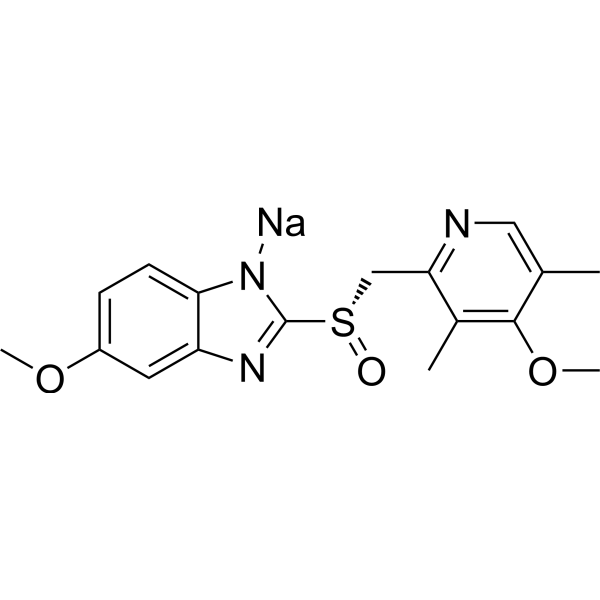 0 ImagesSynonyms: (S)-Omeprazole sodium (Standard); (-)-Omeprazole sodium (Standard)Esomeprazole (sodium) (Standard) is the analytical standard of Esomeprazole (sodium). This product is intended for research and analytical applications. Esomeprazole sodium ((S)-Omeprazole sodium) is a potent and orally active proton pump inhibitor. Esomeprazole reduces acid secretion through inhibition of the H+, K+-ATPase in gastric parietal cells. Esomeprazole acts as an exosome inhibitor by blocking the exosome release via the inhibition of V-H+-ATPases. Esomeprazole has the potential for symptomatic gastroesophageal reflux disease research.
-
DPTIP hydrochloride
 0 ImagesCat. No.: HY-131002ACAS No.: 2361799-64-4DPTIP hydrochloride is a potent brain penetrant neutral sphingomyelinase 2 (N-SMase 2) inhibitor (exosome inhibitor), with an IC50 of 30 nM.
-
Dexamethasone-d5-1
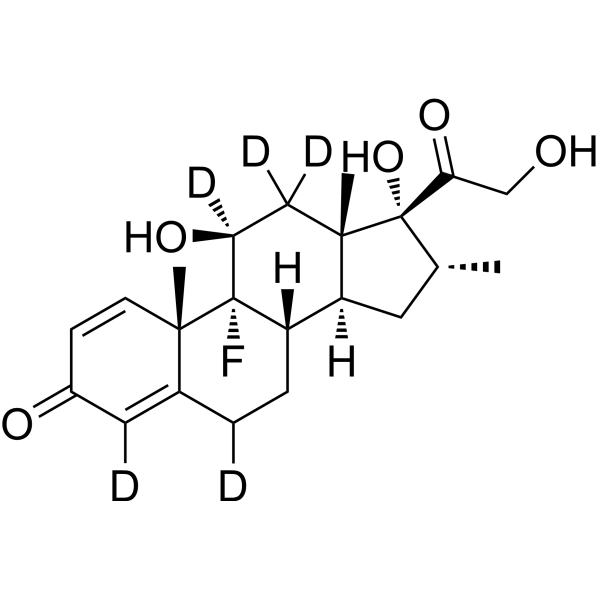 0 ImagesCat. No.: HY-14648S1Synonyms: Hexadecadrol-d5-1; Prednisolone F-d5-1Dexamethasone-d5-1 is deuterium labeled Dexamethasone. Dexamethasone (Hexadecadrol) is a glucocorticoid receptor agonist. Dexamethasone also significantly decreases CD11b, CD18, and CD62L expression on neutrophils, and CD11b and CD18 expression on monocytes. Dexamethasone is highly effective in the control of COVID-19 infection. Dexamethasone inhibits production of exosomes containing inflammatory microRNA-155 in lipopolysaccharide-induced macrophage inflammatory responses.
-
MMA-NODAGA TFA
 0 ImagesCat. No.: HY-160607APurity: 98.02%MMA-NODAGA TFA is a chelator for site-specific labeling of targeting proteins containing unpaired cysteine. MMA-NODAGA TFA can be used to conjugate with exosome and 64Cu in image with positron emission tomography (PET).
-
Cambinol (Standard)
 0 ImagesCambinol (Standard) is the analytical standard of Cambinol. This product is intended for research and analytical applications. Cambinol is a SIRT1 and SIRT2 inhibitor with IC50 values of 56 μM and 59 μM, respectively. Cambinol is a potent brain penetrant neutral sphingomyelinase (N-SMase) inhibitor (exosome inhibitor).
-
(R)-Lansoprazole (Standard)
 0 ImagesSynonyms: Dexlansoprazole (Standard)(R)-Lansoprazole (Standard) is the analytical standard of (R)-Lansoprazole. This product is intended for research and analytical applications. (R)-Lansoprazole is the R enantiomer of Lansoprazole, Lansoprazole (AG 1749) is an orally active proton pump inhibitor which prevents the stomach from producing acid. Lansoprazole (AG 1749) is a potent brain penetrant neutral sphingomyelinase (N-SMase) inhibitor (exosome inhibitor).



