



Fluorescent Dye
Fluorescence is a phenomenon of photoluminescence in luminescence. When an atom is irradiated by light, some electrons around the nucleus jump from their original orbitals to higher energy orbitals under the influence of light energy, i.e., from the ground state to the first or second excited single-line state, etc. Due to the instability of the first or second excited singlet state, the electron returns from the excited singlet state to the ground state accompanied by released energy, resulting in fluorescence.
Fluorescent dyes can be covalently bound or physically adsorbed in the structure of the substance. The fluorescence properties allow for the characterization, localization and quantitative analysis of the labeled object. Fluorescent dyes have shown great potential for the detection of proteins, nucleic acids, cells, and immunoassays, attributed to the advantages in non-radioactive contamination, simple experimental operation and easy observation.
Fluorescent dyes have penetrated many fields such as pharmacology, physiology, environmental science, and information science, as well as functional studies of proteins and drug screening.
All Product Categories
-
Fluorescent Dye Related Products (4889)
Related Products (4889)

-
Antibodies (4)
-
L-Biotin-NH-5MP
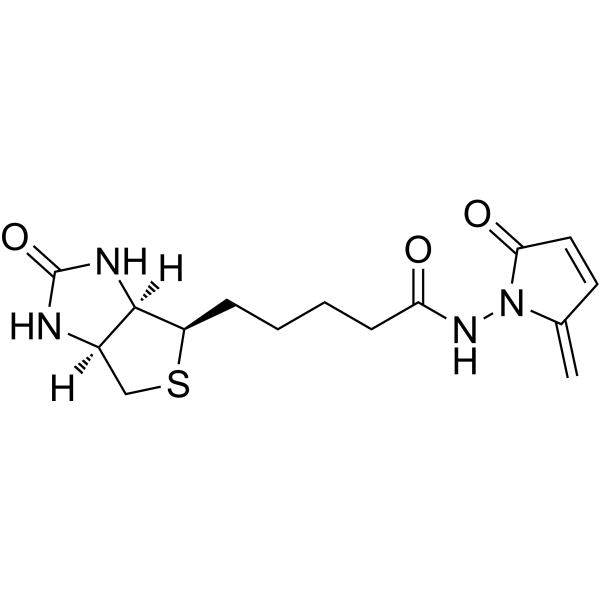 0 ImagesCat. No.: HY-D1403CAS No.: 2100288-18-2L-Biotin-NH-5MP is a biotin-conjugated 5-Methylene pyrrolone (5MP). 5-Methylene pyrrolones (5MPs) are thiol-specific, reversible bioconjugation reagents for cysteine-specific protein modification, that are commonly used for protein bioconjugation.
-
Sulfo-Cy3-Methyltetrazine
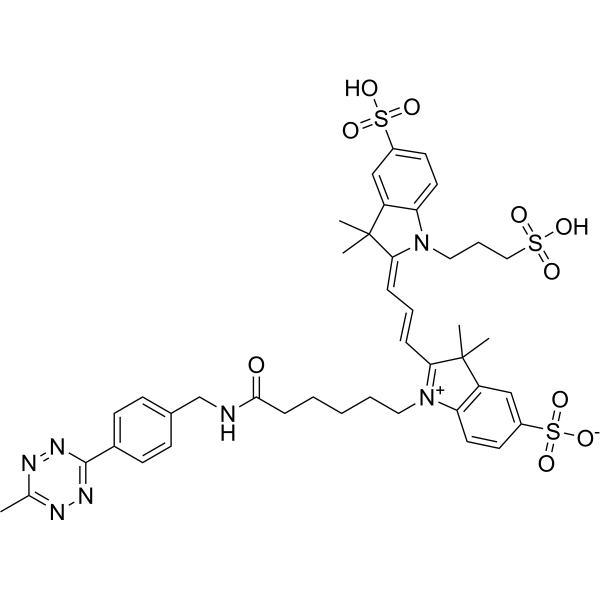 0 ImagesCat. No.: HY-151713CAS No.: 1801924-47-9Sulfo-Cy3-Methyltetrazine (figure 7 compound 5) is a click chemistry reagent containing methyltetrazine and a water-soluble dye. Sulfo-Cy3-Methyltetrazine shows good stability at physiological pH. Sulfo-Cy3-Methyltetrazine can be coupled to trans-cyclooctene and is also highly reactive towards cyclooctene.
-
Wheat germ agglutinin-AF350
 0 ImagesCat. No.: HY-NP163Synonyms: WGA-AF350Wheat germ agglutinin-AF350 (WGA-AF350) is a plant lectin that contains the fluorescent dye AF350, which can be used to identify carbohydrate chains. Wheat germ agglutinin-AF350 can be used to assess abnormal glycosylation levels in the body. The specific glycosylation detection sites of Wheat germ agglutinin is bis-GlcNAc, SA.

-
FAM labled Aprinocarsen sodium
 0 ImagesCat. No.: HY-148413BFAM labled Aprinocarsen sodiumis a FAM labled Aprinocarsen sodium.
-
Human Serum Albumin-FITC
 0 ImagesCat. No.: HY-D3025Synonyms: HSA-FITCHuman Serum Albumin-FITC (HSA-FITC) is a green fluorescent probe prepared by covalent conjugation of FITC with human serum albumin (HSA), with excitation/emission wavelengths of 488/505-550 nm. Human Serum Albumin-FITC (HSA-FITC) can be used to track nanotube conjugates taken up via caveolae-mediated endocytosis initiated by Gp60 receptor binding, and can also non-covalently adsorb to oxidized multi-walled carbon nanotubes. Human Serum Albumin-FITC (HSA-FITC) is widely applied in macrophage imaging, scavenger receptor targeting, and hepatoma cell imaging.

-
4-(Phenylazo)diphenylamine
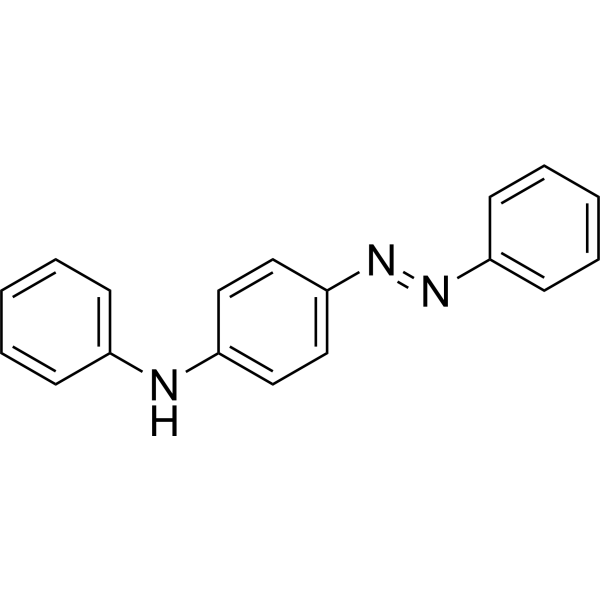 0 ImagesCat. No.: HY-W142631CAS No.: 101-75-74-(Phenylazo)diphenylamine is an excellent colorimetric indicator for the accurate determination of the concentration for a variety of strong bases, Lewis acids, and hydride reducing agents.
-
5(6)-Rhodamine 6G maleimide
 0 ImagesCat. No.: HY-D30565(6)-Rhodamine 6G maleimide is a maleimide-based fluorescent reagent based on Rhodamine 6G (HY-D0309). Maleimide can be labeled by forming a stable thioester structure through an affinity addition reaction with a thiol group (-SH) (Ex/Em = 526/547 nm).
-
FAM labled ASO 556089 sodium
 0 ImagesCat. No.: HY-148688DFAM labled ASO 556089 sodiumis a FAM labled ASO 556089 sodium.
-
FITC-HA (MW 5000)
 0 ImagesCat. No.: HY-D2836ISynonyms: FITC-Hyaluronate (MW 5000)FITC-HA (MW 5000) is hyaluronic acid (HA) (HY-B0633A) labeled with FITC (HY-66019). FITC-HA retains the ability of HA to bind to receptors (such as CD44) and form extracellular matrices, while it can be detected by fluorescence microscopy or flow cytometry for tracing the localization, binding, internalization and metabolic pathways of HA in cells, tissues or living organisms (Ex/Em ≈ 490/520 nM).
-
Cy3 labled ASO 556089 sodium
 0 ImagesCat. No.: HY-148688ECy3 labled ASO 556089 sodium is a Cy3 labled ASO 556089 sodium.
-
FAM labled Cobomarsen sodium
 0 ImagesCat. No.: HY-132601DFAM labled Cobomarsen sodiumis a FAM labled Cobomarsen sodium.
-
Cy5-PEG5000-DSPE
 0 ImagesCat. No.: HY-D2544Cy5-PEG5000-DSPE is a PEG phospholipid with Cy5 (HY-D0821) dye used in protein/nucelic acid labeling and fluorescence microscopy. Cy5-PEG5000-DSPE can self-assemble in aqueous solution to form micelles/lipid bilayer and used to prepare liposomes or nanoparticles for nutrients delivery such as mRNA or DNA vaccine.
-
5MP-Fluorescein
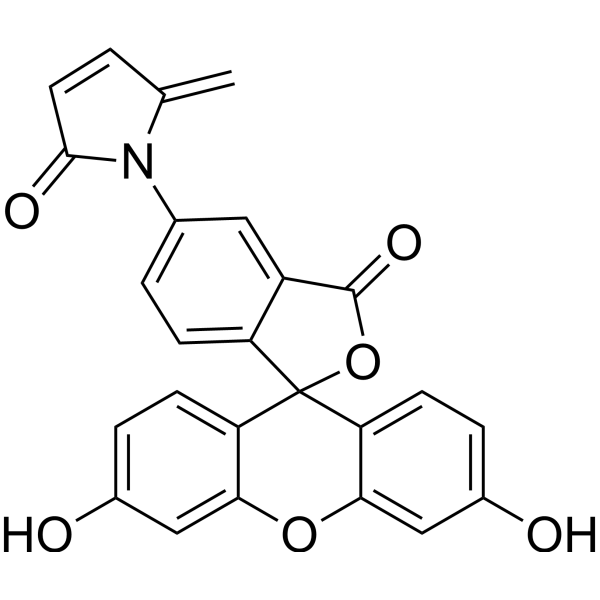 0 ImagesCat. No.: HY-D1402CAS No.: 2100282-58-25MP-Fluorescein (compound 3e) is a fluorescein dye base on 5-Methylene pyrrolone (5MP).5-Methylene pyrrolones are highly thiol-specific and tracelessly removable bioconjugation tools.

-
ERNT
 0 ImagesCat. No.: HY-D3104CAS No.: 2767443-23-0ERNT is a fluorescent probe for monitoring endoplasmic reticulum (ER) polarity and detecting endoplasmic reticulum stress (ERS) during the progression of dynamic liver injury. ERNT functions based on a donor-π-acceptor (D-π-A) structure with an intramolecular charge transfer (ICT) effect. ERNT has multiple excitation/emission pairs: for in vitro cell imaging, the green channel has Ex/Em = 488/500-550 nm, and the red channel has Ex/Em = 488/570-620 nm; for in vivo liver imaging, Ex/Em = 520/620 nm; for solvent optical tests, Ex = 470 nm, with the maximum emission peak at 548 nm in low-polarity toluene and 668 nm in high-polarity DMSO. ERNT can evaluate the efficacy of hepatoprotective interventions by detecting changes in ER polarity, and also exhibits excellent photostability and low cytotoxicity.
-
NerveGreen C3
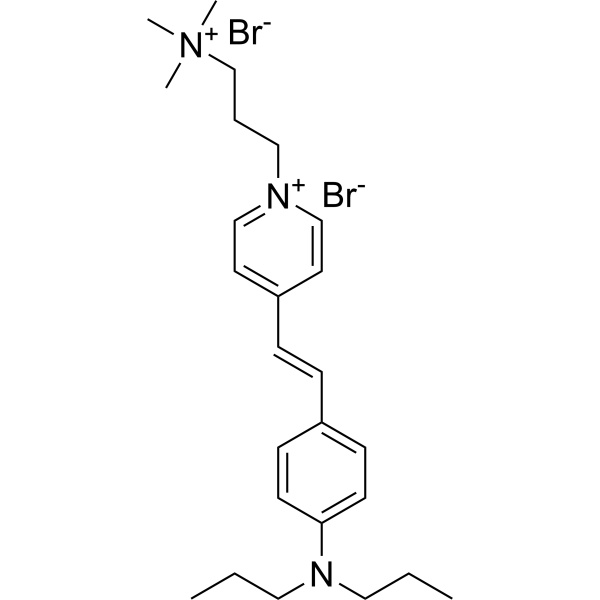 0 ImagesCat. No.: HY-D1516CAS No.: 1331918-65-0NerveGreen C3 is a cationic styrene based fluorescent dye. NerveGreen C3 can be used to track synaptic activity at neuromuscular junctions or synapses.




