



iGluR
Ionotropic glutamate receptors
iGluR (ionotropic glutamate receptor) is a ligand-gated ion channel that is activated by the neurotransmitter glutamate. iGluR are integral membrane proteins compose of four large subunits that form a central ion channel pore. Sequence similarity among all known glutamate receptor subunits, including the AMPA, kainate, NMDA, and δ receptors.
AMPA receptors are the main charge carriers during basal transmission, permitting influx of sodium ions to depolarise the postsynaptic membrane. NMDA receptors are blocked by magnesium ions and therefore only permit ion flux following prior depolarisation. This enables them to act as coincidence detectors for synaptic plasticity. Calcium influx through NMDA receptors leads to persistent modifications in the strength of synaptic transmission.
iGluR Isoform Specific Products
All Product Categories
-
iGluR Inhibitors
(130)
View all products
-
iGluR Agonists
(131)
View all products
-
iGluR Antagonists
(347)
View all products
-
iGluR Activators
(35)
View all products
-
iGluR Modulators
(93)
View all products
-
iGluR MDM2 Inhibitor
(1)
View all products
-
iGluR Controls
(5)
View all products
-
iGluR Ligands
(3)
View all products
-
iGluR Related Products (828)
Related Products (828)

-
Antibodies (11)
-
iGluR Isoform Comparison
-
Antidepressant agent 8
 0 ImagesCat. No.: HY-170898CAS No.: 3066104-04-6Antidepressant agent 8 (Compound 1f) is a selective antagonist for the NMDA receptor GluN1/2A with an IC50 of 2.94 μmol/L. Antidepressant agent 8 exhibits antidepressant-like effects in Hydrocortisone (HY-N0583)-induced zebrafish depression model. Antidepressant agent 8 can cross blood-brain barrier.
-
UBP684
 0 ImagesCat. No.: HY-116205CAS No.: 1357838-47-1UBP684 is a novel positive allosteric modulator of NMDA receptors (NMDARs) that enhances receptor function by stabilizing the ligand-binding domains in a closed conformation, resulting in potentiated whole-cell currents and increased mean open time.
-
LY-466195
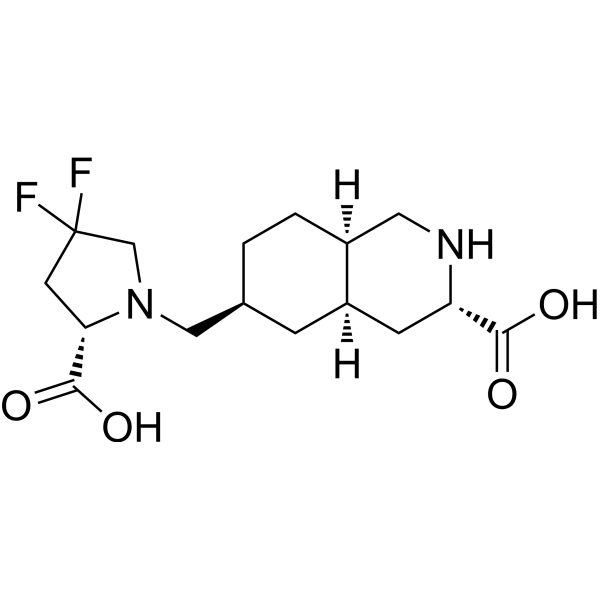 0 ImagesCat. No.: HY-19858CAS No.: 317844-33-0LY-466195 is a selective and competitive GLUK5 receptor antagonist. LY-466195 antagonizes Kainate-induced currents with an IC50 value of 0.045 μM in rat dorsal root ganglion neurons. In HEK293 cells transfected with GLUK5, GLUK2/GLUK5, or GLUK5/GLUK66 receptors, LY466195 produces IC50 values of 0.08 μM, 0.34 μM, and 0.07 μM, respectively.
-
Caged MK801
 0 ImagesCat. No.: HY-164264CAS No.: 217176-91-5Caged MK801 (cMK801) is a selective, non-competitive, irreversible NMDA receptor open-channel blocker. NVOC cages are neuro pharmocologically compatible.
-
Nelonemdaz potassium (Standard)
 0 ImagesCat. No.: HY-106408ARCAS No.: 916214-57-8Synonyms: Salfaprodil (Standard); Neu2000 potassium (Standard)Nelonemdaz potassium (Standard) is the analytical standard of Nelonemdaz potassium (HY-106408A). This product is intended for research and analytical applications. Nelonemdaz (Salfaprodil) potassium is an NR2B-selective and uncompetitive antagonist of N-methyl-D-aspartate (NMDA). Nelonemdaz potassium is also a free radical scavenger. Nelonemdaz potassium has excellent neuroprotection against NMDA- and free radical-induced cell death.
-
Lanicemine dihydrochloride (Standard)
 0 ImagesSynonyms: AZD6765 dihydrochloride (Standard); ARL 15896AR (Standard)Lanicemine dihydrochloride (Standard) is the analytical standard of Lanicemine (dihydrochloride) (HY-108235A). This product is intended for research and analytical applications. Lanicemine (AZD6765) dihydrochloride is a low-trapping NMDA channel blocker (Ki of 0.56-2.1 μM for NMDA receptor; IC50s of 4-7 μM and 6.4 μM in CHO and Xenopus oocyte cells, respectively). Antidepressant effects.
-
Aniracetam (Standard)
 0 ImagesSynonyms: Ro 13-5057 (Standard)Aniracetam (Standard) is the analytical standard of Aniracetam. This product is intended for research and analytical applications. Aniracetam (Ro 13-5057) is an orally active neuroprotective agent, possessing nootropics effects. Aniracetam potentiates the ionotropic quisqualate (iQA) responses in the CA1 region of rat hippocampal slices. Aniracetam also potentiates the excitatory post synaptic potentials (EPSPs) in Schaffer collateral-commissural synapses. Aniracetam can prevents the CO2-induced impairment of acquisition in hypercapnia model rats. Aniracetam can be used to research cerebral dysfunctional disorders.
-
7-Chlorokynurenic acid sodium salt (Standard)
 0 ImagesSynonyms: 7-CKA sodium salt (Standard)7-Chlorokynurenic acid (sodium salt) (Standard) is the analytical standard of 7-Chlorokynurenic acid (sodium salt). This product is intended for research and analytical applications. 7-Chlorokynurenic acid sodium salt (7-CKA sodium salt) is a potent and selective antagonist of the glycine B coagonist site of the N-methyl-D-aspartate (NMDA) receptor (IC50=0.56 μM). 7-Chlorokynurenic acid sodium salt is also a potent inhibitor of the reuptake of glutamate into synaptic vesicles with a Ki of 0.59 μM. 7-Chlorokynurenic acid sodium salt has potent antinociceptive actions after neuraxial delivery.
-
24-Hydroxycholesterol (Standard)
 0 ImagesCat. No.: HY-N2370RCAS No.: 30271-38-624-Hydroxycholesterol is a natural sterol, which serves as a positive allosteric modulator of N-Methyl-d-Aspartate (NMDA) receptorsR, and a potent activator of the transcription factors LXR.
-
UBP714
 0 ImagesCat. No.: HY-129517CAS No.: 773109-55-0UBP714 exhibts agonistic activity for recombinant GluN1/GluN2 receptor by binding to the positive allosteric site (PAM) of NMDARs. UBP714 enhances NMDAR-mediated field excitatory postsynaptic potentials (f-EPSPs) in Xenopus oocytes .
-
Felbamate hydrate
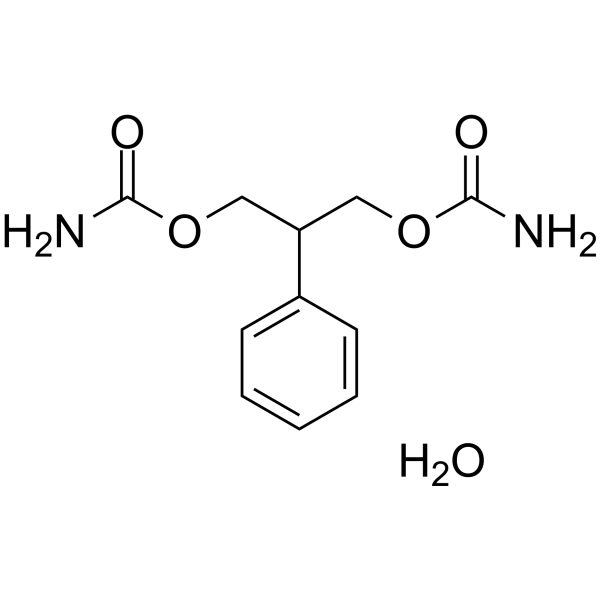 0 ImagesCat. No.: HY-B0184ACAS No.: 1177501-39-1Synonyms: W-554 hydrate; ADD-03055 hydrateFelbamate hydrate (W-554 hydrate) is a potent nonsedative anticonvulsant whose clinical effect may be related to the inhibition of N-methyl-D-aspartate (NMDA) .
-
N-Methyl-DL-aspartic acid (Standard)
 0 ImagesN-Methyl-DL-aspartic acid is a glutamate analogue and a NMDA receptor agonist and can be used for neurological diseases research.
-
NMDAR modulator 2
 0 ImagesCat. No.: HY-204630CAS No.: 2311911-06-3NMDAR modulator 2 (comound 9062) is a NMDA receptor modulator that is modulator of NMDA receptor function. NMDAR modulator 2 can be used for the study of psychiatric disorders in which glutamatergic transmission is pathologically increased (e.g., treatment resistant depression).
-
Tianeptine-d12
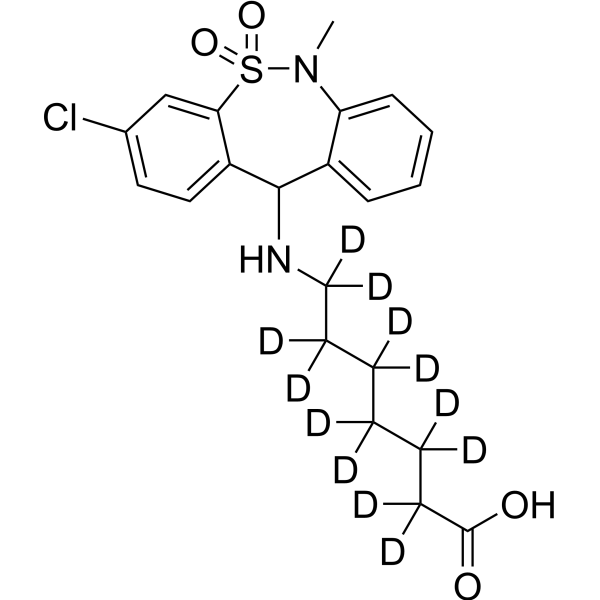 0 ImagesCat. No.: HY-90003SCAS No.: 1189870-26-5Tianeptine-d12 is a deuterated analog of Tianeptine (HY-90003).Tianeptine is an atypical antidepressant. Tianeptine is a moderate-intensity agonist of the μ-opioid receptor (MOR), and to a lesser extent, is an agonist of the δ-opioid receptor (DOR). Tianeptine is a glutamate modulator that can enhance AMPA receptor and antagonize NMDA receptor. Tianeptine increases sensitivity of the α1 adrenergic receptor, which only manifests in chronic treatment. Tianeptine exerts neuroprotective effects under stress/inflammation-induced conditions, exhibiting anti-inflammatory and antioxidant properties. Tianeptine inhibits MMP-9 by suppressing the PI3K/Akt-mediated NF-κB pathway. Tianeptine can be used to alleviate symptoms of depression and anxiety, but does not cause sedative effects.
-
Traxoprodil (Standard)
 0 ImagesCat. No.: HY-W018061RCAS No.: 134234-12-1Synonyms: CP101,606 (Standard)Traxoprodil (CP101,606) is a potent and selective NMDA antagonist and protect hippocampal neurons with an IC50 of 10 nM.
-
DL-AP5 lithium
 0 ImagesCat. No.: HY-100714DCAS No.: 125229-62-1Synonyms: 2-APV lithium; DL-2-Amino-5-phosphonovaleric acid lithiumDL-AP5 (2-APV) lithium is a competitive NMDA (N-methyl-D-aspartate) receptor antagonist. DL-AP5 lithium shows significantly antinociceptive activity. DL-AP5 lithium specifically blocks on channels in the rabbit retina.
-
JNJ-61432059 (Standard)
 0 ImagesCat. No.: HY-111751RCAS No.: 2035814-50-5JNJ-61432059 (Standard) is the analytical standard of JNJ-61432059 (HY-111751). This product is intended for research and analytical applications. JNJ-61432059 is a blood-brain barrier-permeable, orally active TARP γ-8-associated AMPAR modulator with anticonvulsant activity. JNJ-61432059 negatively regulates GluA1 and positively modulates GluA2-containing AMPARs. JNJ-61432059 exerts potent protective effects in rodent epilepsy models without impairing motor function. JNJ-61432059 is applicable for epilepsy-related research.
-
UBP618
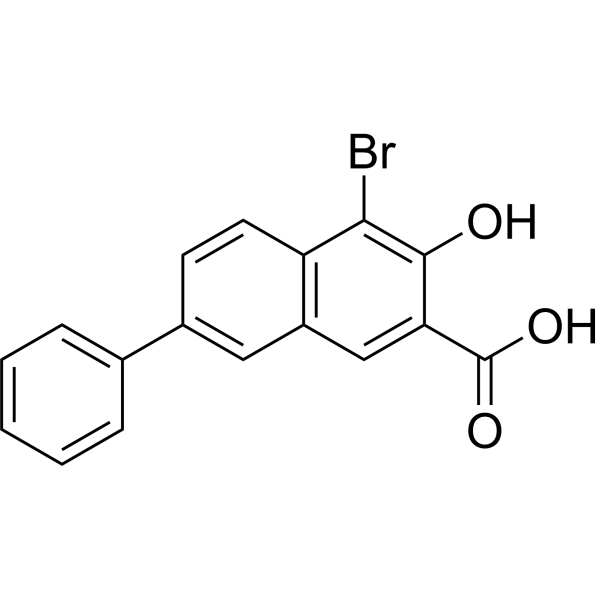 0 ImagesCat. No.: HY-119776CAS No.: 1333110-86-3UBP618 is a non-selective N-methyl-D-aspartate inhibitor.
-
Budipine (Standard)
 0 ImagesCat. No.: HY-W001601RCAS No.: 57982-78-2Budipine (Standard) is the analytical standard of Budipine. This product is intended for research and analytical applications. Budipine is an anti-parkinson agent. Budipine also is a substrate of P-glycoprotein (P-gp), is mediated the uptake into the brain by P-gp. Budipine also is N-methyl-d-aspartate (NMDA) antagonist, and has indirect dopaminergic effects through an improved dopamine release, the inhibition of monoamine oxidase type B (MAO-B). Budipine can be used for the research of CNS disorders include Parkinson disease.
-
Acamprosate calcium (Standard)
 0 ImagesSynonyms: Calcium N-acetylhomotaurinate (Standard)Acamprosate (calcium) (Standard) is the analytical standard of Acamprosate (calcium). This product is intended for research and analytical applications.




