



Isotope-Labeled Compounds
Isotope-labeled compounds are chemical substances in which some atoms in their molecules are replaced by isotope atoms. The range of stable isotope products can cover from gases to complex molecules. Isotope-labeled compounds could provide a site-specific investigation of structures, making molecules easily detectable by mass spectrometry and NMR, and maintaining the physico-chemical properties of the target molecule at the same time.
MCE isotope-labeled compounds are all stable isotope-labeled compounds and are non-radioactive labeled substances. MCE isotope-labeled compounds are unique tools for identifying and understanding biological and chemical processes. Stable isotope-labeled products are now getting more and more popular among scientists. The scope of application is gradually penetrating into various scientific fields, such as life sciences, food and medicine, agriculture, environment, geology, etc. Stable isotope-labeled compounds have a wide range of applications in the Life Science areas, such as Metabolomics, Proteomics, Clinical studies, Deuterium drugs, etc.
All Product Categories
-
Isotope-Labeled Compounds Related Products (11098)
Related Products (11098)

-
1-?(3,4-?Dimethoxy-d6-benzoyl)?piperidine
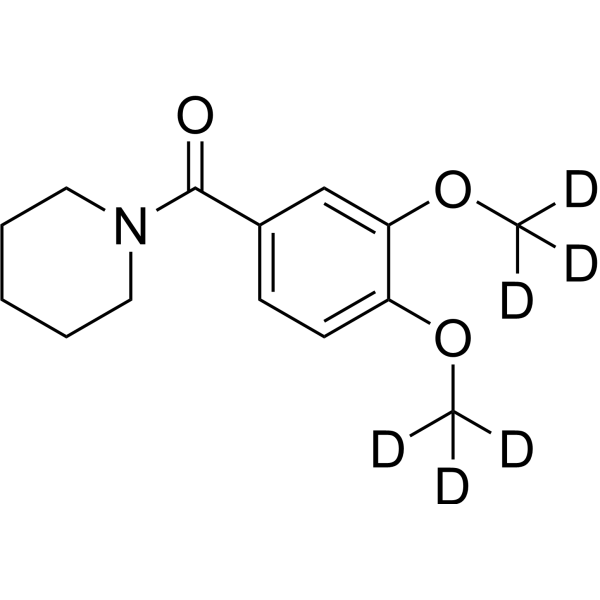 0 ImagesCat. No.: HY-150666S1-(3,4- Dimethoxy-d6-benzoyl) piperidine is the deuterium labeled 1-(3,4- Dimethoxy-benzoyl) piperidine.
-
2,4,7,9-Tetramethyl-5-decyne-4,7-diol-d10
 0 ImagesCat. No.: HY-W742030CAS No.: 2469555-45-92,4,7,9-Tetramethyl-5-decyne-4,7-diol-d10 is the deuterium labeled 2,4,7,9-Tetramethyldec-5-yne-4,7-diol (HY-W068811).
-
D-Myo-phosphatidylinositol 4-phosphate diC16-d5
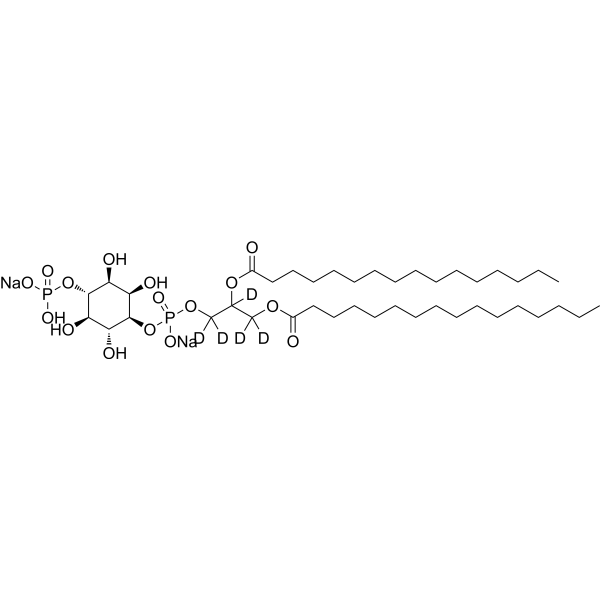 0 ImagesCat. No.: HY-146947SD-Myo-phosphatidylinositol 4-phosphate diC16-d5 is deuterium labeled D-Myo-phosphatidylinositol 4-phosphate diC16.
-
(22R)-Budesonide-d8
 0 ImagesCat. No.: HY-166480SCAS No.: 85128-75-2Synonyms: (22R)-BUD-d8(22R)-Budesonide-d8 ((22R)-BUD-d8) is the deuterium labeled (22R)-Budesonide. (22R)-Budesonide ((22R)-BUD) is the (22R)-enantiomer of Budesonide (HY-13580). (22R)-Budesonide is a non-halogenated glucocorticoid with high local anti-inflammatory activity.
-
N6-(4-Hydroxybenzoyl)-L-lysine-d4
 0 ImagesCat. No.: HY-W1145302SN6-(4-Hydroxybenzoyl)-L-lysine-d4 is the deuterium labeled N6-(4-Hydroxybenzoyl)-L-lysine.

-
1-(4-Chlorophenyl)-2-methylpropan-2-ol-d6
 0 ImagesCat. No.: HY-W101971SSynonyms: 1-(4-Chlorophenyl)-2-methyl-2-propanol-d61-(4-Chlorophenyl)-2-methylpropan-2-ol-d6 (1-(4-Chlorophenyl)-2-methyl-2-propanol-d6) is the deuterium labeled 1-(4-Chlorophenyl)-2-methylpropan-2-ol (HY-W101971).
-
Propoxyphenyl-thiohydroxyhomosildenafil-d4
 0 ImagesCat. No.: HY-144853SPropoxyphenyl-thiohydroxyhomosildenafil-d4 is the deuterium labeled Propoxyphenyl-thiohydroxyhomosildenafil (HY-W588226).
-
Fluconazole-13C2,15N
 0 ImagesCat. No.: HY-B0101S1CAS No.: 1309935-84-9Synonyms: UK-49858-13C2,15NFluconazole-13C2,15N (UK-49858-13C2,15N) is the 13C and 15N labeled isotope of Fluconazole (HY-B0101). Fluconazole (UK-49858) is a triazole antifungal agent with excellent activities against a broad range of fungi, especially against Candida albicans. Fluconazole inhibits C. albicans and Candida kefyr with IC99s range from 0.20 μg/mL to 0.39 μg/mL.
-
Vandetanib-d6
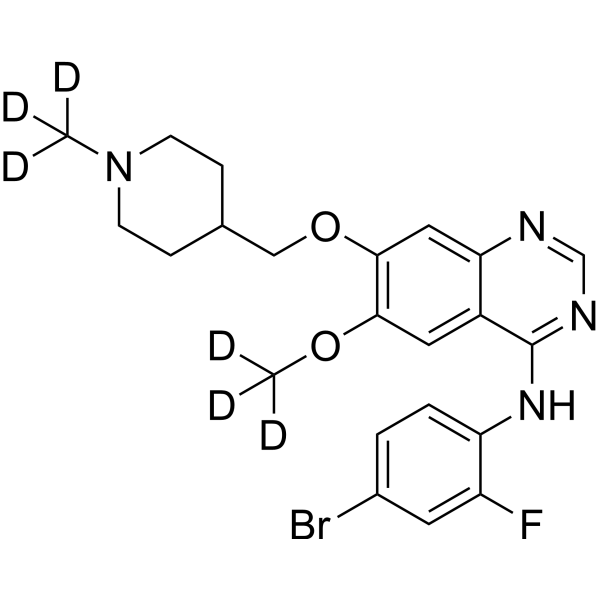 0 ImagesCat. No.: HY-10260SCAS No.: 1174683-49-8Synonyms: ZD6474-d6Vandetanib-d6 is the deuterium labeled Vandetanib. Vandetanib (D6474) is a potent, orally active inhibitor of VEGFR2/KDR tyrosine kinase activity (IC50=40 nM). Vandetanib also has activity versus the tyrosine kinase activity of VEGFR3/FLT4 (IC50=110 nM) and EGFR/HER1 (IC50=500 nM).
-
Methylacifluorfen-d3
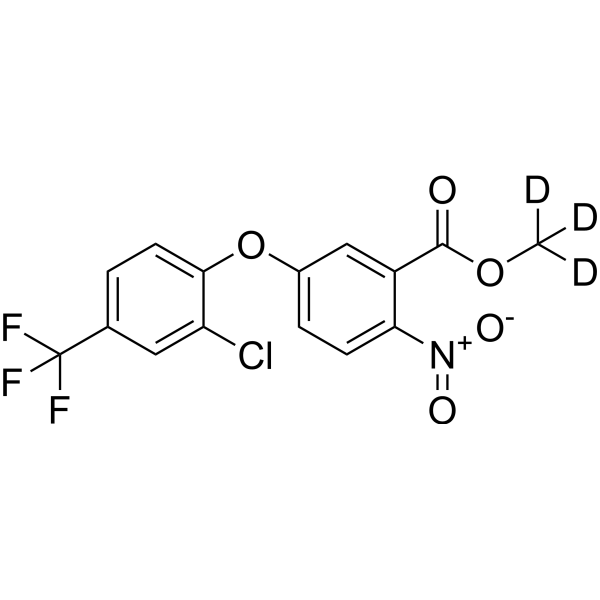 0 ImagesCat. No.: HY-144174SMethylacifluorfen-d3 is the deuterium labeled Methylacifluorfen.
-
(2S,6S)-2,6-Diaminoheptanedioic acid-13C7,15N2
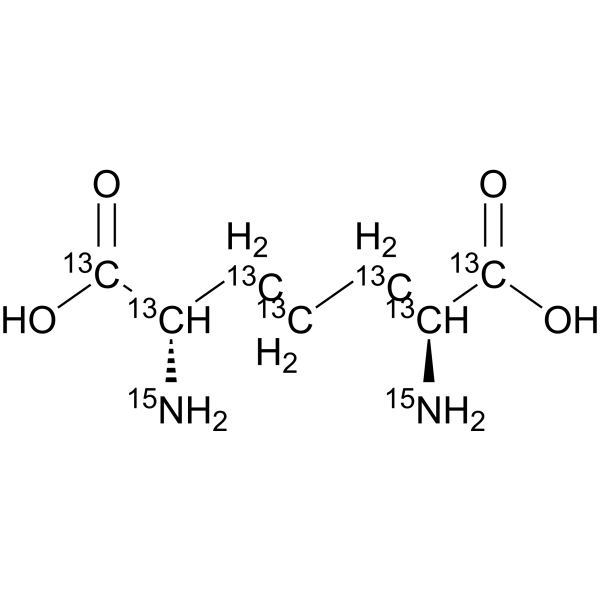 0 ImagesCat. No.: HY-W334800SCAS No.: 1334376-68-9Synonyms: L-threo-2,6-Diaminopimelic acid-13C7,15N2(2S,6S)-2,6-Diaminoheptanedioic acid-13C7,15N2 (L-threo-2,6-Diaminopimelic acid-13C7,15N2) is 13C and 15N-labeled (2S,6S)-2,6-diaminoheptanedioic acid (HY-W334800).
-
Tilmicosin-d3
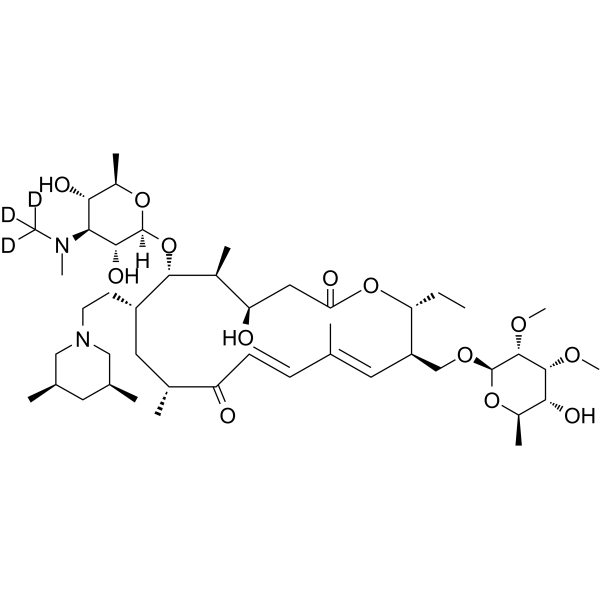 0 ImagesCat. No.: HY-B0905SCAS No.: 2714486-61-8Synonyms: LY-177370-d3; EL-870-d3Tilmicosin-d3 is the deuterium labeled Tilmicosin. Tilmicosin (LY-177370) is an orally active calcium channel antagonist and macrolide antibiotic with antimicrobial activity. Tilmicosin mainly acts on the 50S subunit of bacterial ribosomes, inhibiting protein synthesis. Tilmicosin is effective in the treatment of respiratory diseases in livestock such as cattle, sheep and pigs. In addition, Tilmicosin has immunomodulatory and anti-inflammatory effects.
-
5-(Methoxy-d3)-1H-benzo[d]imidazole-2-thiol
![5-(Methoxy-d3)-1H-benzo[d]imidazole-2-thiol](https://file.medchemexpress.com/product_pic/hy-w699846.gif "Click to View 5-(Methoxy-d3)-1H-benzo[d]imidazole-2-thiol Product Detail") 0 ImagesCat. No.: HY-W699846CAS No.: 922730-86-75-(Methoxy-d3)-1H-benzo[d]imidazole-2-thiol is the deuterium labeled 5-Methoxy-2-benzimidazolethiol (HY-W008378). 5-Methoxy-2-benzimidazolethiol is a benzimidazole. The iodimetric determination of 5-Methoxy-2-benzimidazolethiol in alkaline media is studied.
0 ImagesCat. No.: HY-W699846CAS No.: 922730-86-75-(Methoxy-d3)-1H-benzo[d]imidazole-2-thiol is the deuterium labeled 5-Methoxy-2-benzimidazolethiol (HY-W008378). 5-Methoxy-2-benzimidazolethiol is a benzimidazole. The iodimetric determination of 5-Methoxy-2-benzimidazolethiol in alkaline media is studied.
-
Meclizine-d8
 0 ImagesCat. No.: HY-B0349SCAS No.: 1246816-06-7Synonyms: Meclozine-d8Meclizine-d8 is a deuterium labeled Meclizine. Meclizine is a histamine H1 receptor antagonist and has the potential to treat nausea and motion sickness. Meclizine is an agonist ligand for mouse constitutive androstane receptor (CAR) and an inverse agonist for Human CAR.
-
1-Methyladenosine-d3 hydroiodide
 0 ImagesCat. No.: HY-W151136S1Synonyms: N1-Methyladenosine-d3 hydroiodide1-Methyladenosine-d3 hydroiodide (N1-Methyladenosine-d3 hydroiodide) is the deuterium labeled 1-Methyladenosine (hydroiodide).
-
Bepotastine-d6 besylate
 0 ImagesCat. No.: HY-A0015SBepotastine-d6(besylate) is deuterium labeled Bepotastine (besilate). Bepotastine besilate is a selective and orally active second-generation histamine H1 receptor antagonist, can suppress the expression of nerve growth factor (NGF). Bepotastine besilate has the potential for allergic rhinitis, allergic conjunctivitis and urticaria/pruritus research.
-
Palmitoylethanolamide-d4-1
 0 ImagesCat. No.: HY-W709998CAS No.: 946524-34-1Palmitoylethanolamide-d4-1 is a deuterated labeled Palmitoylethanolamide.



