



Liposome
Liposomes (NPs typically 100–500 nm in diameter) are fabricated from the self-assembly of phospholipids, which consist of a polar phosphate head group and hydrophobic lipid tails. In aqueous environments, the hydrophobic tails self-orient, resulting in a spherical structure comprised of an aqueous core surrounded by a lipophilic bilayer membrane. Liposomes are both biocompatible and biodegradable (e.g., at certain pH and temperature), which can be controlled by modifying the lipid composition. Furthermore, liposomes are amenable to various modifications that improve their efficacy as drug delivery carriers.
All Product Categories
-
Liposome Related Products (1266)
Related Products (1266)

-
DMG-PEG(2k)-DBCO
 0 ImagesDMG-PEG(2k)-DBCO is a Clickable PEG lipid containing a DBCO group. DSPE-PEG8-DBCO can be used to prepare lipid nanoparticles for drug delivery.
-
DMG-PEG2000-Mal-Cys-penetratin
 0 ImagesCat. No.: HY-186175DMG-PEG2000-Mal-Cys-penetratin is a conjugate composed of dimyristoylglycerol (DMG), a PEG chain, and terminal maleimide (Mal). DMG-PEG2000-Mal-Cys-penetratin combines the membrane compatibility of lipids, the specific Michael addition reaction with thiol-containing (-SH) biomolecules (such as peptides, antibodies, and aptamers) by maleimide, and cell-penetrating peptides, making it suitable for research on biomaterial construction and drug delivery to cells.
-
Cholesterol (synthetic)
 0 ImagesCholesterol (synthetic) is the major sterol in mammals. It is making up 20-25% of structural component of the plasma membrane. Plasma membranes are highly permeable to water but relatively impermeable to ions and protons. Cholesterol (synthetic) plays an important role in determining the fluidity and permeability characteristics of the membrane as well as the function of both the transporters and signaling proteins. Cholesterol (synthetic) is also an endogenous estrogen-related receptor α (ERRα) agonist.
-
Cholesterol-PEG2000-amine
 0 ImagesCat. No.: HY-W440690
-
Lipid 6
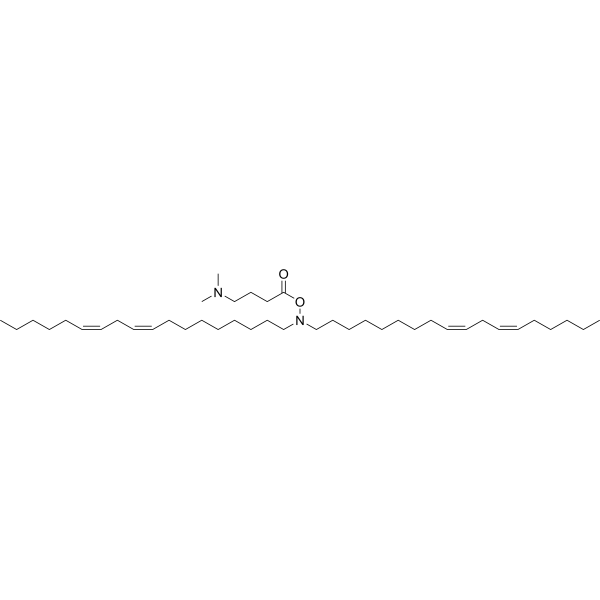 0 ImagesLipid 6 is an ionizable amino lipid. Lipid 6 can be used to synthesize lipid nanoparticles. Lipid 6 can be used in RNA delivery research.
-
16-((2-(2-(2-Azidoethoxy)ethoxy)ethyl)amino)-16-oxohexadecanoic acid
 0 ImagesAzide-PEG2-amide-C14-COOH (Compound LP-379-p) is a lipid-containing compound. Azide-PEG2-amide-C14-COOH facilitates the delivery of oligonucleotide-based reagents to certain cell types or adipose tissue.
-
DSPE-PEG2000-PDP
 0 ImagesCat. No.: HY-144000ACAS No.: 474922-24-2DSPE-PEG2000-PDP is a phospholipid PEG conjugate that can be used in drug delivery applications.
-
C23 Phytoceramide
 0 ImagesC23 Phytoceramide is a long-chain sphingolipid, which is found in C. sinensis.
-
Stearic acid-PEG3400-FITC
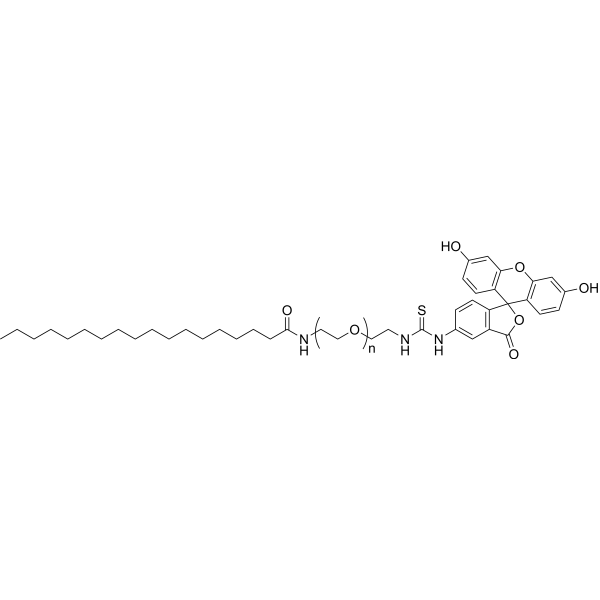 0 ImagesCat. No.: HY-W440939Stearic acid-PEG3400-FITC is a PEG lipid which forms micelles in water and can be used for drug delivery applications. The FITC fluorescent can be easily traced by miscroscopy. FITC is a green dye with peak absorption at 494 nm and maximum emission at 520 nm and can be used for staining biological samples or nanoparticles. FITC can be easily traced by fluorescence microscopy.
-
1,2-Diarachidoyl-sn-glycero-3-phosphocholine
 0 ImagesSynonyms: Phosphatidylcholine Diarachidoyl; 1,2-DAPC; L-α-Diarachidonoyl lecithin1,2-Diarachidoyl-sn-glycero-3-phosphocholine (1,2-DAPC) is a phospholipid containing the saturated long-chain (20:0) arachidic acid inserted at the sn-1 and sn-2 positions. It can be used in the generation of micelles, liposomes, and other types of artificial membranes.
-
L202
 0 ImagesL202 is an ionizable cationic lipid (pKa=6.04) that can be used for the study of mRNA and lipid nanoparticles.
-
Lipid 88
 0 ImagesLipid 88 is an ionizable cationic lipid. Lipid 88 can be used to synthesize lipid nanoparticles and deliver mRNA.
-
23:2 Diyne PE [DC(8,9)PE]
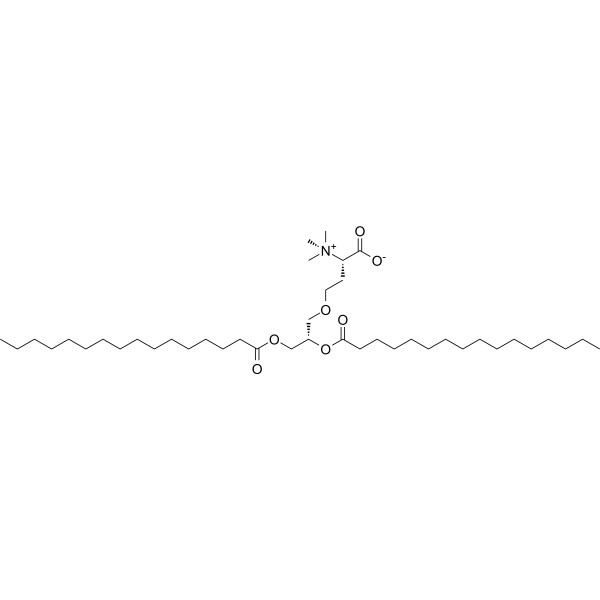
![23:2 Diyne PE [DC(8,9)PE]](https://file.medchemexpress.com/product_pic/hy-w800784.gif "Click to View 23:2 Diyne PE [DC(8,9)PE] Product Detail") 0 Images23:2 Diyne PE [DC(8,9)PE] is a phospholipase-mediated hydrolyzed phosphocoline with palmitic acid (16:0) and Pentacosa-10,12-diynoic acid for tails.
0 Images23:2 Diyne PE [DC(8,9)PE] is a phospholipase-mediated hydrolyzed phosphocoline with palmitic acid (16:0) and Pentacosa-10,12-diynoic acid for tails.
-
2,3-Dipalmitoyl-sn-glycero-1-phosphocholine, 95%
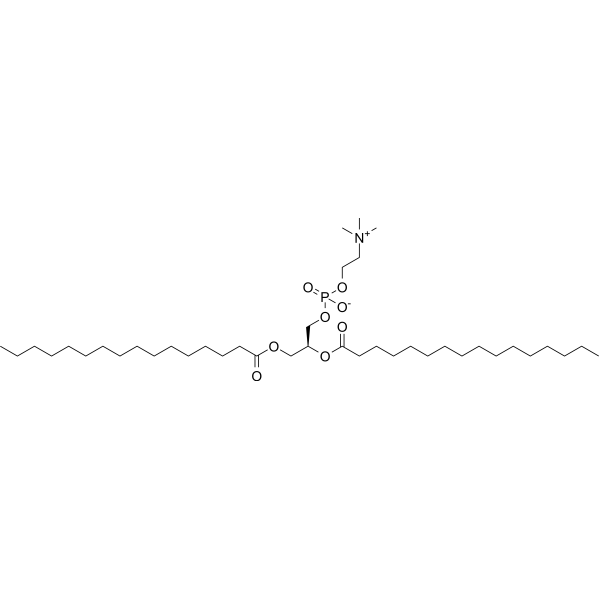 0 ImagesSynonyms: D-DPPC, 95%2,3-Dipalmitoyl-sn-glycero-1-phosphocholine, 95% (D-DPPC, 95%) is a chiral phospholipid that serves as a membrane-forming lipid component for bicelle assembly. 2,3-Dipalmitoyl-sn-glycero-1-phosphocholine, 95% can form bicelle assemblies with DHPC, which induce an induced circular dichroism (ICD) signal in the chiral probe DPH, with a polarity opposite to that induced by chiral L-DPPC/DHPC bicelles.
-
mPEG-DSPE (MW 5000) sodium
 0 ImagesmPEG-DSPE (MW 5000) sodium is a PEG lipid that can improve the delivery efficiency and tissue specificity of poorly soluble drugs. mPEG-DSPE (MW 5000) sodium can be used in drug delivery research.
-
Anionic Liposomes (DOPG:DOPC (90:10 molar ratio, 10mM))
 0 ImagesCat. No.: HY-185587Anionic Liposomes (DOPG:DOPC (90:10 molar ratio, 10 mM)) is a type of artificial lipid vesicle with strong negative charge (Liposome), composed of 90% DOPG (HY-142980) and 10% DOPC. DOPG is a phosphatidylglycerol composed of unsaturated fatty acids (oleoyl groups), providing negative charges and membrane fluidity. DOPC acts as a neutral matrix lipid, mainly used to maintain the integrity and appropriate fluidity of the lipid bilayer, and does not change the net charge itself.
-
DSPC-d83
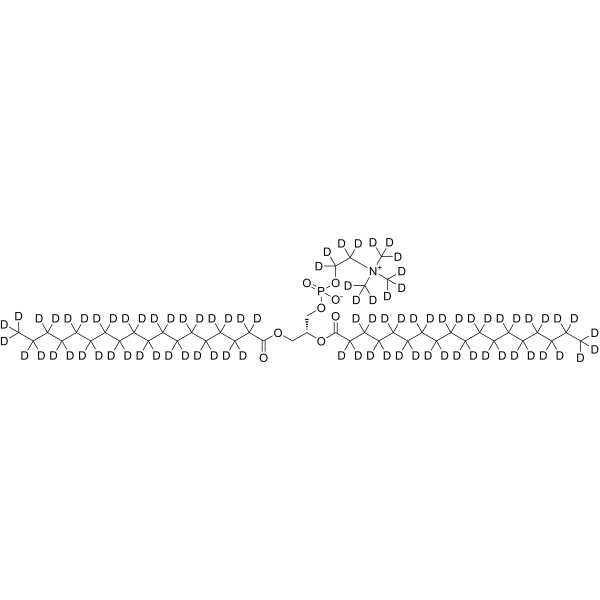 0 ImagesCat. No.: HY-W040193S3CAS No.: 326495-40-3Synonyms: 1,2-Distearoyl-sn-glycero-3-PC-d83; 1,2-Distearoyl-sn-glycero-3-phosphorylcholine-d83DSPC-d83 (1,2-Distearoyl-sn-glycero-3-phosphorylcholine-d83) is the deuterium labeled DSPC (HY-W040193). DSPC is a cylindrical-shaped lipid. 1,2-Distearoyl-sn-glycero-3-phosphorylcholine is used to synthesize liposomes, and is the lipid component in the lipid nanoparticle (LNP) system.
-
DSPE-PEG(2000) Succinyl ammonium
 0 ImagesDSPE-PEG(2000) Succinyl ammonium is functionalized PEG lipid that can be used to synthesize lipid nanoparticles for drug delivery.
-
DSPE-PEG2000-Mal-Cys-penetratin
 0 ImagesCat. No.: HY-186176DSPE-PEG2000-Mal-Cys-penetratin is a conjugate composed of DSPE, a PEG chain, and terminal maleimide (Mal). DSPE-PEG2000-Mal-Cys-penetratin combines the membrane compatibility of lipids, the ability to undergo specific Michael addition reactions with thiol-containing (-SH) biomolecules (such as peptides, antibodies, and aptamers), and the ability to penetrate cell membranes, making it suitable for research on biomaterial construction and drug delivery to cells.



