



PDI
Protein Disulfide Isomerases
PDI (Protein disulfide isomerases) is a 55-kDa protein and consists of four domains namely a, b, b', a'. PDI is an abundant enzyme in the endoplasmic reticulum (ER). PDI, a prototypic thiol isomerase, is an important oxidase, reductase, isomerase and molecular chaperone. It can distinguish between partially folded, unfolded, and properly folded protein substrates, and catalyze the formation and cleavage of thiol-disulfide bonds during protein folding in the ER. PDI can also maintain active conformation of the β subunit of collagen prolyl 4-hydroxylase and stabilization of the major histocompatibility complex's (MHC) class 1 peptide loading complex (PLC). PDI expression is up-regulated in select types of cancers[1][2].
References:
- [1]. Xu S, et al. Protein disulfide isomerase: a promising target for cancer therapy. Drug Discov Today. 2014 Mar;19(3):222-40. [Content Brief]
- [2]. Ali Khan H, et al. Protein disulfide isomerase a multifunctional protein with multiple physiological roles. Front Chem. 2014 Aug 26;2:70. [Content Brief]
- [3]. Parakh S, et al. Novel roles for protein disulphide isomerase in disease states: a double edged sword? Front Cell Dev Biol. 2015 May 21;3:30. [Content Brief]
All Product Categories
-
PDI Related Products (38)
Related Products (38)

-
Antibodies (3)
- 1
- 2
-
Ribostamycin
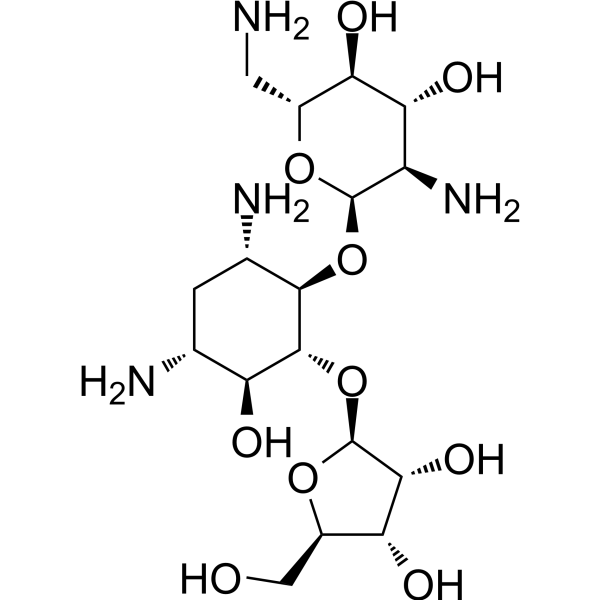 0 ImagesSynonyms: Vistamycin; SF-733Ribostamycin (Vistamycin) is a broad-spectrum aminoglycoside antibiotic. Ribostamycin is effective against Gram-Negative and Gram-Positive bacterial infection. Ribostamycin also inhibits the chaperone activity of PDI.
-
PDI-IN-1
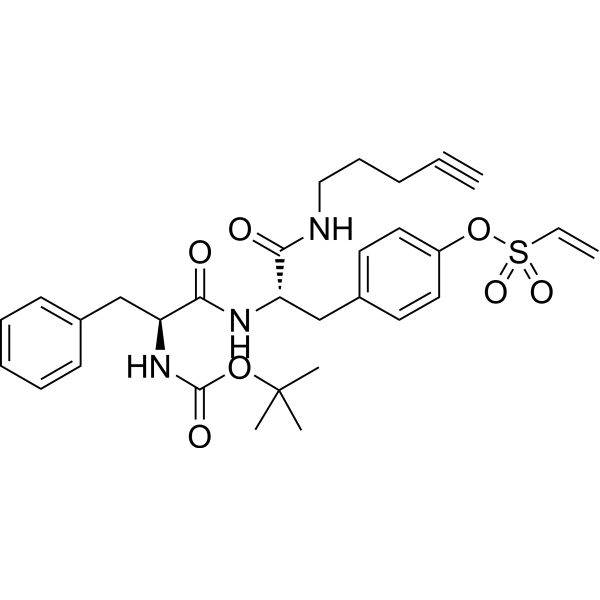 0 ImagesPDI-IN-1 is a cell-permeable PDI covalent inhibitor with an IC50 of 1.7 μM against bovine PDI. PDI-IN-1 specifically modifies the Cys397 residue at the active site of human PDI, selectively labels endogenous PDI in living mammalian cancer cells, and effectively inhibits PDI-mediated insulin aggregation in vitro. PDI-IN-1 exhibits significant anti-tumor activity and inhibits the growth of various cancer cell lines.
-
Phenylpyruvic acid sodium
 0 ImagesSynonyms: Sodium phenylpyruvatePhenylpyruvic acid sodium is a endogenous metabolite that participates in the synthesis of 3-phenyllactic acid (PLA) by lactate dehydrogenase. Phenylpyruvic acid is a precursor of the antifungal compound phenyllactic acid. Phenylpyruvic acid can improve the antifungal activity of eight lactic acid bacterial strains through the addition into a dedined growth medium. Phenylpyruvic acid demonstrates improved inhibitory activity against fungal bread contaminants Aspergillus niger and Penicillium roqueforti. Phenylpyruvic acid affects enzyme activity of the pentose phosphate pathway involved in the oxidative phase in rat brain homogenates. Phenylpyruvic acid can reduce glucose-6-phosphate dehydrogenase activity.
-
3-N-Propylphenol
 0 Images3-N-Propylphenol is a small phenolic derivative containing a hydroxyl aryl group that competitively inhibits the binding of the peptide to pancreatic-specific protein disulfide isomerase (PDIp). 3-Propylphenol can be used for research on pancreatic-related diseases.
-
2,6-Dibromo-4-(hydroxymethyl)phenol
 0 ImagesCat. No.: HY-W248922CAS No.: 2316-62-32,6-Dibromo-4-(hydroxymethyl) phenol (Compound 5) acts as a selective inhibitor of Saccharomyces cerevisiae glucose-6-phosphate dehydrogenase, with an IC50 value of 50.2 μM, and shows no activity against Leuconostoc mesenteroides glucose-6-phosphate dehydrogenase.
-
PDI-IN-5
 0 ImagesCat. No.: HY-181574CAS No.: 3097563-91-9PDI-IN-5 (compound 30z) is an allosteric-covalent inhibitor targeting protein disulfide isomerase (PDI) with a 2-chloro-pyrrolopyrimidin-4-one scaffold, with an IC50 of 0.4 μM. PDI-IN-5 exhibits selectivity for ERp57 and GPX4, and inhibits glioblastoma. PDI-IN-5 can be used in glioblastoma-related research.
-
Protein disulfide isomerase
 0 ImagesCat. No.: HY-P2927CAS No.: 37318-49-3Protein disulfide isomerase is a prototypic thiol isomerase that catalyzes the formation and cleavage of thiol-disulfide bonds during protein folding in the endoplasmic reticulum (ER). Protein disulfide isomerase can be used for the study of cardiovascular diseases.
-
(±)-trans-1,2-Bis(2-mercaptoacetamido)cyclohexane
 0 ImagesCat. No.: HY-116748CAS No.: 257641-01-3(±)-trans-1,2-Bis(2-mercaptoacetamido)cyclohexane is a small-molecule dithiol catalyst with a low thiol pKa value (8.3) and high reduction potential (-0.24 V), capable of mimicking PDI activity. It catalyzes the activation of scrambled ribonuclease A (scrambled ribonuclease A) and promotes the formation of native disulfide bonds, thereby significantly enhancing protein folding efficiency. Adding (±)-trans-1,2-Bis(2-mercaptoacetamido)cyclohexane to the culture medium of Saccharomyces cerevisiae can increase the secretion of exogenously expressed Schizosaccharomyces pombe acid phosphatase by more than threefold. (±)-trans-1,2-Bis(2-mercaptoacetamido)cyclohexane holds great potential for applications in protein production and secretion research.
-
TC8026
 0 ImagesCat. No.: HY-181573TC8026 is an allosteric-covalent inhibitor targeting protein disulfide isomerase (PDI), with an IC50 of 7 μM against human PDI. TC8026 induces endoplasmic reticulum stress-mediated apoptosis. TC8026 is a hit compound with PDI inhibitory activity identified via high-throughput screening, and it can be used for the research of glioblastoma.
-
PDI-IN-4
 0 ImagesCat. No.: HY-170655CAS No.: 3104129-77-0PDI-IN-4 is a highly selective inhibitor of human PDI (IC50=0.48 μM) with no significant cytotoxicity. PDI-IN-4 binds to PDI in a reversible manner, not only forming a covalent bond with the Cys400 residue but also engaging in hydrophobic interactions with other residues. By inhibiting the activation of GPIIb/IIIa, PDI-IN-4 effectively blocks platelet aggregation and thrombus formation. PDI-IN-4 can serve as an important tool reagent for thrombosis-related research.
-
BAP2
 0 ImagesCat. No.: HY-W851050ACAS No.: 2284589-16-6BAP2 is an allosteric protein disulfide isomerase (PDI) inhibitor with a IC50 of 0.85 μM. BAP2 binds to His256 in the b′ domain of PDI and exerts inhibitory effects through allosteric binding to the b′ domain. BAP2 upregulates GRP78. BAP2 inhibits the growth of glioblastoma cells. BAP2 can be used in studies related to glioblastoma.
-
PROTAC PDIA1 degrader 1
 0 ImagesCat. No.: HY-178118CAS No.: 3024292-21-2PROTAC PDIA1 degrader 1 is a PDIA1 PROTAC degrader with a DC50 of 29.71 μM. PROTAC PDIA1 degrader 1 induces proteasome-dependent PDIA1 degradation via recruiting E3 ligase, ubiquitination and proteasomal degradation processes. PROTAC PDIA1 degrader 1 exhibits anticancer activity against breast cancer and epidermoid carcinoma. PROTAC PDIA1 degrader 1 can be used for the research of breast cancer and epidermoid carcinoma.
-
4-Hydroxyestrone-13C6
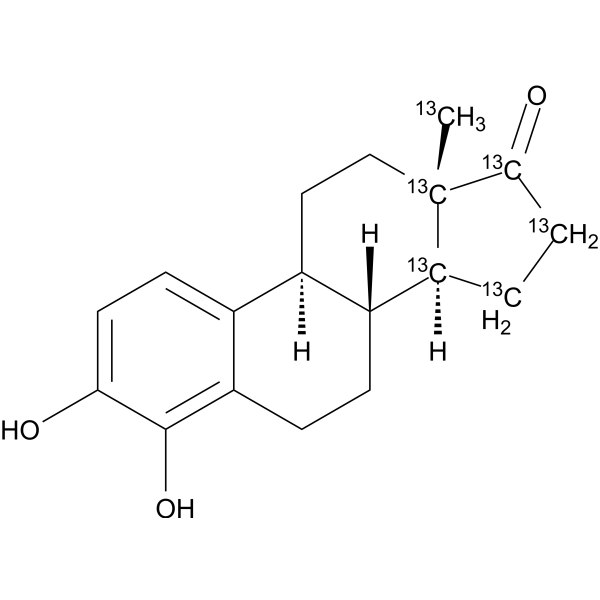 0 ImagesCat. No.: HY-W009300S1Synonyms: 4-OHE1-13C64-Hydroxyestrone (4-OHE1)-13C6 is a 13C-labeled 4-Hydroxyestrone (HY-W009300). 4-Hydroxyestrone is a brain-penetrant estrogen metabolite. 4-Hydroxyestrone shows neuroprotective effects involving increased cytoplasmic localization of p53 resulting from SIRT1-mediated p53 deacetylation. 4-Hydroxyestrone relies on PDI to mediate its protective effect against chemically induced ferroptosis in estrogen receptor-negative cancer cells. 4-Hydroxyestrone inhibits lipid peroxidation and lipid-ROS accumulation. 4-Hydroxyestrone blocks preovulatory luteinizing hormone surges in Rattus norvegicus. 4-Hydroxyestrone can be used for the researches of neurodegeneration, breast cancer and endocrine disease.
-
CCF642 (Standard)
 0 ImagesCat. No.: HY-100430RCAS No.: 346640-08-2CCF642 (Standard) is the analytical standard of CCF642 (HY-100430). This product is intended for research and analytical applications. CCF642 is a potent protein disulfide isomerases (PDI) inhibitor with an IC50 of 2.9 μM. CCF642 causes acute endoplasmic reticulum (ER) stress in multiple myeloma cells accompanied by apoptosis-inducing calcium release. CCF642 has broad anti-multiple myeloma activity.
-
LOC14 (Standard)
 0 ImagesLOC14 (Standard) is the analytical standard of LOC14 (HY-100432). This product is intended for research and analytical applications. LOC14 is a potent Protein disulfide isomerase (PDI) inhibitor with EC50 and Kd values of 500 nM and 62 nM, respectively. LOC14 exhibits high stability in mouse liver microsomes and blood plasma, low intrinsic microsome clearance, and low plasma-protein binding. LOC14 inhibits PDIA3 activity, decreases intramolecular disulfide bonds and subsequent oligomerization (maturation) of HA in lung epithelial cells.
-
Bepristat 1a
 0 ImagesCat. No.: HY-138934CAS No.: 1642375-66-3Bepristat 1a is a reversible, selective protein disulfide isomerase (PDI) inhibitor with an IC50 of 0.7 μM. Bepristat 1a inhibits platelet aggregation in laser-injured mouse arterioles. Bepristat 1a is applicable for research related to thrombosis.
-
PACMA 31 (Standard)
 0 ImagesPACMA 31 (Standard) is the analytical standard of PACMA 31 (HY-100433). This product is intended for research and analytical applications. PACMA 31 is an irreversible, orally active protein disulfide isomerase (PDI) inhibitor with an IC50 of 10 μM. PACMA 31 forms a covalent bond with the active site cysteines of PDI. PACMA 31 shows tumor targeting ability and significantly suppresses ovarian tumor growth without causing toxicity to normal tissues. PACMA 31 is a click chemistry reagent, it contains an Alkyne group and can undergo copper-catalyzed azide-alkyne cycloaddition (CuAAc) with molecules containing Azide groups.
-
3-Methyltoxoflavin (Standard)
 0 ImagesCat. No.: HY-111117RCAS No.: 32502-62-83-Methyltoxoflavin (Standard) is the analytical standard of 3-Methyltoxoflavin (HY-111117). This product is intended for research and analytical applications. 3-Methyltoxoflavin is a potent Protein disulfide isomerase (PDI) inhibitor, with an IC50 of 170 nM.
- 1
- 2




