



Thyroxine sulfate
Based on 5 publication(s) in Google Scholar
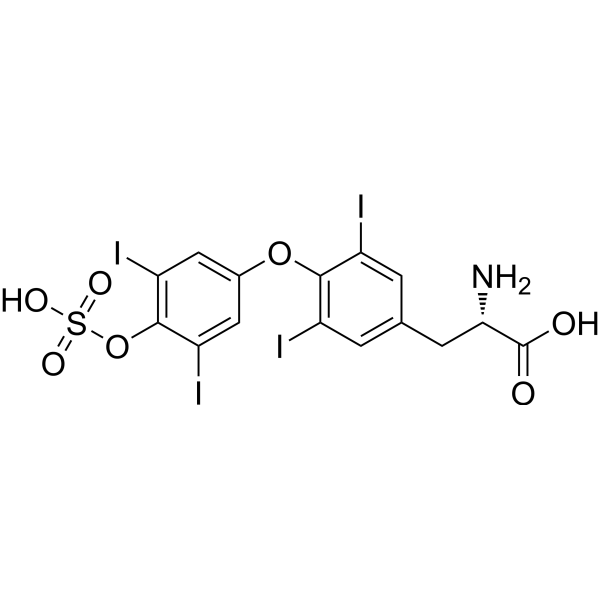
Thyroxine sulfate is a thyroid hormone metabolite.
For research use only. We do not sell to patients.
- Purity : 98.49%
- CAS No.: 77074-49-8
- Formula: C15H11I4NO7S
- Molecular Weight:856.93
-
Storage:
-20°C, sealed storage, away from moisture
* In solvent : -80°C, 6 months; -20°C, 1 month (sealed storage, away from moisture)

To place orders, for customer services and technical support, please contact: MedChemExpress USA
Tel: 609-228-6898 E-mail: [email protected] [email protected]


-
 Biological Activity
-
Chemical Information
-
Solvent & Solubility
- Protocols
- Purity & Documentation
- References
-
 Help & FAQs


-
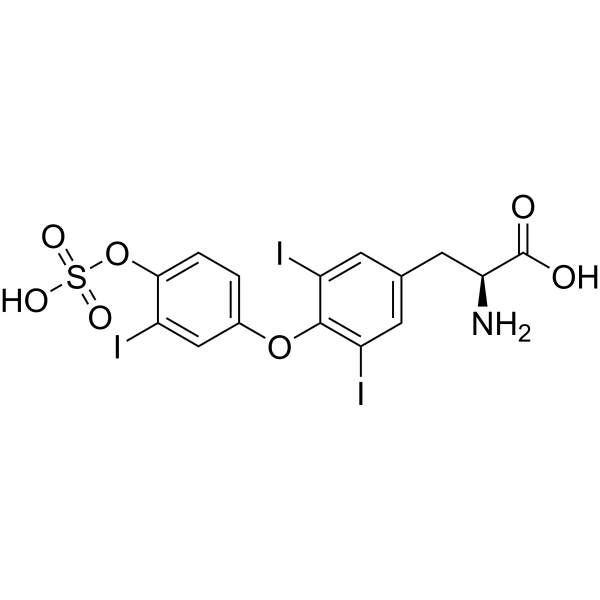
HY-126996
Triiodothyronine sulfateMetabolite of T3 -
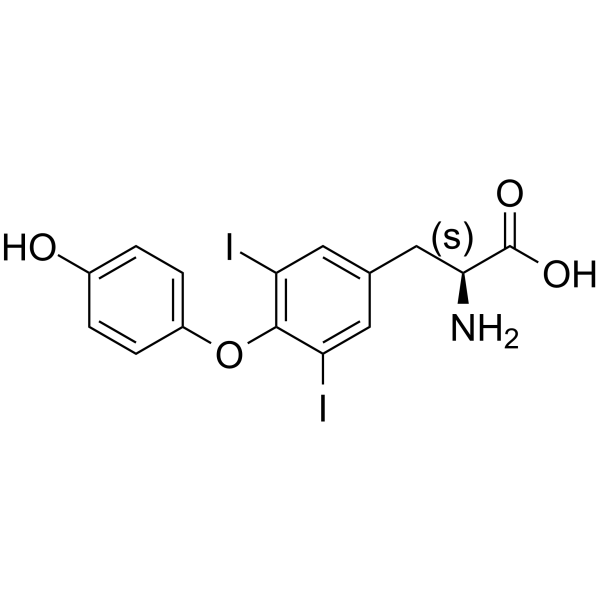
HY-114557
NSC 90469Thyroid Hormone Derivative -
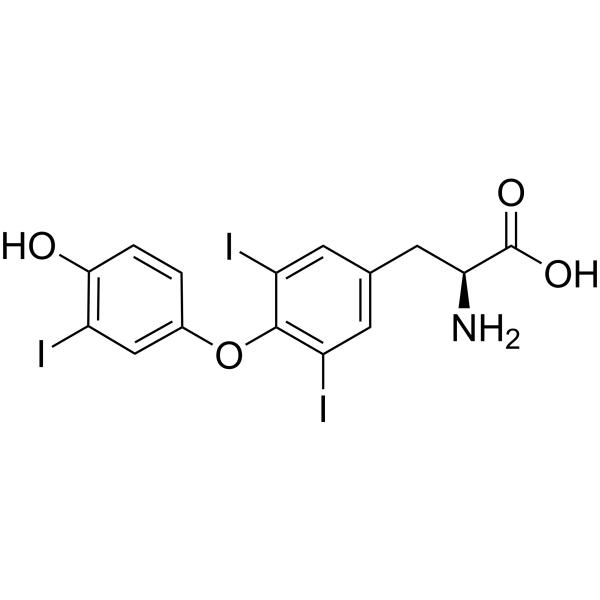
HY-A0070A
LiothyronineTIGIT/PVR Blocker -

HY-101406R
Thyroxine sulfate (Standard)Thyroid Hormone Metabolite -
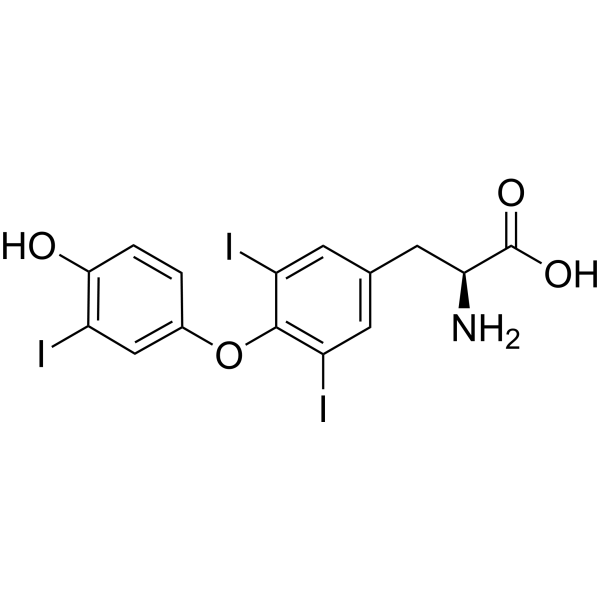
HY-A0070AG
Liothyronine (GMP)TRα/TRβ Agonist (GMP) -
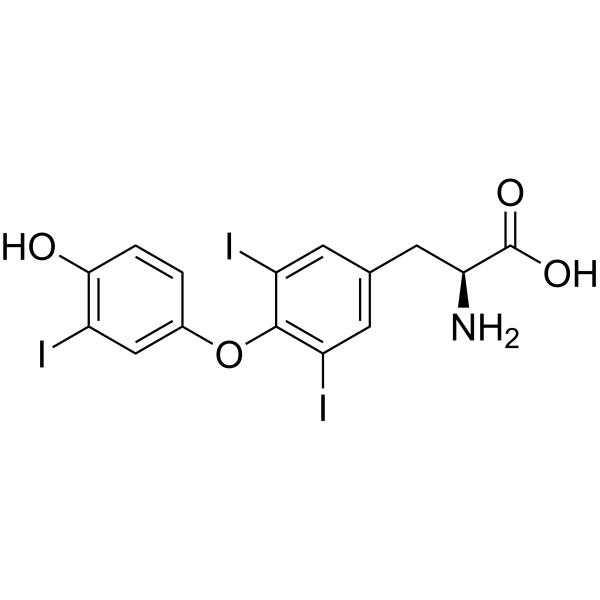
HY-A0070AR
Liothyronine (Standard)TRα/TRβ Agonist -

HY-114557R
NSC 90469 (Standard)Endogenous Metabolite -
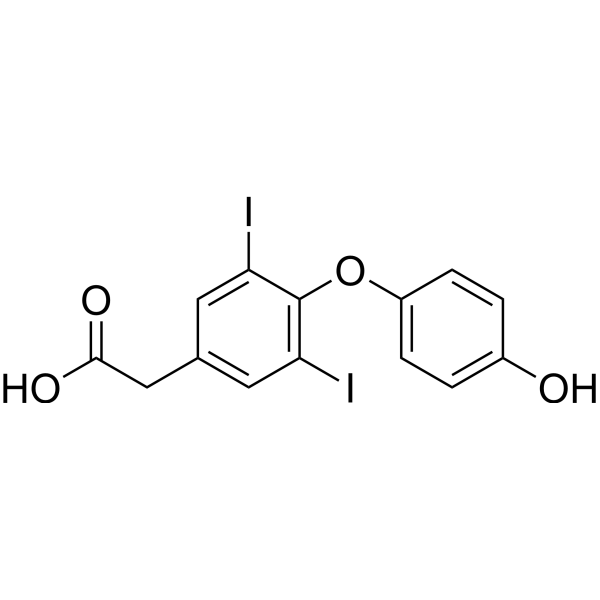
HY-115434
3,5-Diiodothyroacetic acidThyroid Hormone Analog
Publications Citing Use of MedChemExpress (MCE) Thyroxine sulfate
MoreAll Endogenous Metabolite Isoforms
More

Biological Activity
Description
IC50 & Target
|
Human Endogenous Metabolite |
In Vitro
Thyroxine sulfate (T4S) is a normal component of human serum and amniotic fluid, and it is mostly derived from thyroxine peripherally and accumulates when type I 5-monodeiodinating activity is low in fetuses or inhibited by drugs, such as ipodate[1].
MedChemExpress (MCE) has not independently confirmed the accuracy of these methods. They are for reference only.
In Vivo
MedChemExpress (MCE) has not independently confirmed the accuracy of these methods. They are for reference only.


Chemical Information
-
CAS No. 77074-49-8
-
Appearance Solid
-
Molecular Weight 856.93
-
Formula C15H11I4NO7S
-
Color White to off-white
-
SMILES
N[C@@H](CC1=CC(I)=C(C(I)=C1)OC2=CC(I)=C(OS(=O)(O)=O)C(I)=C2)C(O)=O
-
Synonyms
T4 Sulfate
-
Structure Classification
-
Shipping
Room temperature in continental US; may vary elsewhere.
-
Storage
-20°C, sealed storage, away from moisture
* In solvent : -80°C, 6 months; -20°C, 1 month (sealed storage, away from moisture)


Publications (5)
-
Journal Impact Factor
-
Most Recent
-
Nat Commun
2025 Aug 30;16(1):8124. PMID: 40885756 -
Int J Biol Macromol
Molecular basis of BACE1 modulation revealed by machine learning, molecular simulations, and experimental validation. [Abstract]2026 May 6:152409. PMID: 42103119 -
Int J Biol Macromol
Structural and dynamic characterization of papain-like protease ligand recognition using integrated computational and biochemical approaches. [Abstract]2026 Mar 18:355:151493. PMID: 41861871 -
Toxicology
The effects of hexabromocyclododecane on the transcriptome and hepatic enzyme activity in three human HepaRG-based models. [Abstract]2023 Feb:485:153411. PMID: 36572169 -


Solvent & Solubility
In Vitro:
DMSO : 140 mg/mL (163.37 mM; Need ultrasonic; Hygroscopic DMSO has a significant impact on the solubility of product, please use newly opened DMSO)
Please refer to the solubility information to select the appropriate solvent. Once prepared, please aliquot and store the solution to prevent product inactivation from repeated freeze-thaw cycles.
Storage method and period of stock solution: -80°C, 6 months; -20°C, 1 month (sealed storage, away from moisture). When stored at -80°C, please use it within 6 months. When stored at -20°C, please use it within 1 month.
Please refer to the solubility information to select the appropriate solvent. Once prepared, please aliquot and store the solution to prevent product inactivation from repeated freeze-thaw cycles.
Storage method and period of stock solution: -80°C, 6 months; -20°C, 1 month (sealed storage, away from moisture). When stored at -80°C, please use it within 6 months. When stored at -20°C, please use it within 1 month.
Concentration (start) × Volume (start) = Concentration (final) × Volume (final)
In Vivo:
Select the appropriate dissolution method based on your experimental animal and administration route.
- For the following dissolution methods, please ensure to first prepare a clear stock solution using an In Vitro approach and then sequentially add co-solvents:
- To ensure reliable experimental results, the clarified stock solution can be appropriately stored based on storage conditions. As for the working solution for In Vivo experiments, it is recommended to prepare freshly and use it on the same day.
- The percentages shown for the solvents indicate their volumetric ratio in the final prepared solution. If precipitation or phase separation occurs during preparation, heat and/or sonication can be used to aid dissolution.
Add each solvent one by one: 10% DMSO 40% PEG300 5% Tween-80 45% Saline
Solubility: ≥ 5.75 mg/mL (6.71 mM); Clear solution
This protocol yields a clear solution of ≥ 5.75 mg/mL (saturation unknown).
Taking 1 mL working solution as an example, add 100 μL DMSO stock solution (57.5 mg/mL) to 400 μL PEG300, and mix evenly; then add 50 μL Tween-80 and mix evenly; then add 450 μL Saline to adjust the volume to 1 mL.
Preparation of Saline: Dissolve 0.9 g sodium chloride in ddH₂O and dilute to 100 mL to obtain a clear Saline solution.
Add each solvent one by one: 10% DMSO 90% (20% SBE-β-CD in Saline)
Solubility: ≥ 2.58 mg/mL (3.01 mM); Clear solution
This protocol yields a clear solution of ≥ 2.58 mg/mL (saturation unknown).
Taking 1 mL working solution as an example, add 100 μL DMSO stock solution (25.8 mg/mL) to 900 μL 20% SBE-β-CD in Saline, and mix evenly.
Preparation of 20% SBE-β-CD in Saline (4°C, storage for one week): 2 g SBE-β-CD powder is dissolved in 10 mL Saline, completely dissolve until clear.
In Vivo Dissolution Calculator
Please enter the basic information of animal experiments:
-
-
-
-
Recommended: Prepare an additional quantity of animals to account for potential losses during experiments.
Please enter your animal formula composition:
-
%DMSO +
Recommended: Keep the proportion of DMSO in working solution below 2% if your animal is weak.
-
%+
-
+%Tween-80 + +
-
%Saline +
The co-solvents required include: DMSO, . All of co-solvents are available by MedChemExpress (MCE). , Tween 80. All of co-solvents are available by MedChemExpress (MCE).
Working solution concentration: 0.22 mg/mL
Method for preparing stock solution: mg drug dissolved in μL DMSO. Stock solution concentration: mg/mL. * In solvent : -80°C, 6 months; -20°C, 1 month (sealed storage, away from moisture)
1. Take μL DMSO stock solution;
2. Add μL .
μL , mix evenly;
3. Then add μL Tween 80, mix evenly;
4. Then add μL
Please ensure that the stock solution in the first step is dissolved to a clear state, and add co-solvents in sequence. You can use ultrasonic heating (ultrasonic cleaner, recommended frequency 20-40 kHz), vortexing, etc. to assist dissolution.


Purity & Documentation
-
Data Sheet (274 KB)
-
SDS (252 KB)
- English - EN (252 KB)
- Français - FR (252 KB)
- Deutsch - DE (252 KB)
- Norwegian - NO (252 KB)
- Español - ES (252 KB)
- Swedish - SV (252 KB)
- Italian - IT (252 KB)
- Korean - KR (252 KB)
- Portuguese - PT (252 KB)
-
Handling Instructions (2659 KB)
References
[1]. Wu SY, et al. Identification of thyroxine-sulfate (T4S) in human serum and amniotic fluid by a novel T4S radioimmunoassay. Thyroid. 1992 Summer;2(2):101-5. [Content Brief]
[2]. Rutgers M, et al. Effects of propylthiouracil on the biliary clearance of thyroxine (T4) in rats: decreased excretion of 3,5,3'-triiodothyronine glucuronide and increased excretion of 3,3',5'-triiodothyronine glucuronide and T4 sulfate. Endocrinology. 1989 Oct;125(4):2175-86. [Content Brief]
[3]. Peeters RP, et al. Increased thyroxine sulfate levels in critically ill patients as a result of a decreased hepatic type Ideiodinase activity. J Clin Endocrinol Metab. 2005 Dec;90(12):6460-5. [Content Brief]


Complete Stock Solution Preparation Table
Please refer to the solubility information to select the appropriate solvent. Once prepared, please aliquot and store the solution to prevent product inactivation from repeated freeze-thaw cycles.
Storage method and period of stock solution: -80°C, 6 months; -20°C, 1 month (sealed storage, away from moisture). When stored at -80°C, please use it within 6 months. When stored at -20°C, please use it within 1 month.
| Optional Solvent | Concentration Solvent Mass | 1 mg | 5 mg | 10 mg | 25 mg |
|---|---|---|---|---|---|
| DMSO | 1 mM | 1.1670 mL | 5.8348 mL | 11.6696 mL | 29.1739 mL |
| 5 mM | 0.2334 mL | 1.1670 mL | 2.3339 mL | 5.8348 mL | |
| 10 mM | 0.1167 mL | 0.5835 mL | 1.1670 mL | 2.9174 mL | |
| 15 mM | 0.0778 mL | 0.3890 mL | 0.7780 mL | 1.9449 mL | |
| 20 mM | 0.0583 mL | 0.2917 mL | 0.5835 mL | 1.4587 mL | |
| 25 mM | 0.0467 mL | 0.2334 mL | 0.4668 mL | 1.1670 mL | |
| 30 mM | 0.0389 mL | 0.1945 mL | 0.3890 mL | 0.9725 mL | |
| 40 mM | 0.0292 mL | 0.1459 mL | 0.2917 mL | 0.7293 mL | |
| 50 mM | 0.0233 mL | 0.1167 mL | 0.2334 mL | 0.5835 mL | |
| 60 mM | 0.0194 mL | 0.0972 mL | 0.1945 mL | 0.4862 mL | |
| 80 mM | 0.0146 mL | 0.0729 mL | 0.1459 mL | 0.3647 mL | |
| 100 mM | 0.0117 mL | 0.0583 mL | 0.1167 mL | 0.2917 mL |


Thyroxine sulfate Related Classifications
HY-101406 Related Classifications
 Powered by Bioz