



FOXM1 Antibody (YA1112)
(Synonyms: FOXM1; FKHL16, HFH11, MPP2, WIN; Forkhead box protein M1; Forkhead-related protein FKHL16; Hepatocyte nuclear factor 3 forkhead homolog 11 (HFH-11; HNF-3/fork-head homolog 11); M-phase phosphoprotein 2; MPM-2 reactive phosphoprotein 2; Transcription factor Trident; Winged-helix factor from INS-1 cells)
Based on 1 Customer Validation
FOXM1 Antibody (YA1112) is a Rabbit-derived and non-conjugated IgG monoclonal antibody, targeting to FOXM1.
-
Host:
Rabbit
-
Isotype:
IgG
-
Application:
IHC-P, ICC/IF
-
Reactivity :
Human, Mouse
-
Formulation:
Supplied in PBS (pH7.4), 0.1% BSA, 40% Glycerol. Preservative: 0.05% Sodium Azide.
-
Conjugation:
Non-conjugated


To place orders, for customer services and technical support, please contact: MedChemExpress USA
Tel: 609-228-6898 E-mail: [email protected] [email protected]





Applications
| Application |
IHC-P

IHC-P: Immunohistochemistry-Paraffin
|
ICC/IF
ICC/IF: Immunocytochemistry/
Immunofluorescence |
|---|---|---|
| Dilution Ratio | 1:1000 | 1:100 |


Product Details
FOXM1 Antibody (YA1112) is a Rabbit-derived and non-conjugated IgG monoclonal antibody, targeting to FOXM1.
-
Host Rabbit

-
Clonality Recombinant,Monoclonal

-
Species ReactivityHuman, Mouse
-
Observed Molecular WeightObserved band size: 110 kDa
Note: Due to possible protein modifications or aggregation, the molecular weight should be confirmed by actual measurement, and the predicted value is for reference only.

-
Calculated Molecular Weight Predicted band size: 84 kDa

Recombinant protein within human FOXM1 aa 1-400.
Endogenous
Affinity Purified
Non-conjugated
Unmodified
IgG


Product Properties
-
Appearance
Solution
-
Formulation
Supplied in PBS (pH7.4), 0.1% BSA, 40% Glycerol. Preservative: 0.05% Sodium Azide.
-
Concentration
Batch-dependent, Please check the COA for the concentration of each lot. Check Lot Concentration
-
Storage & Stability
Stored at -20°C for 1 year. Avoid repeated freeze / thaw cycles.
-
Shipping
Shipping with blue ice.


Verification Images
-
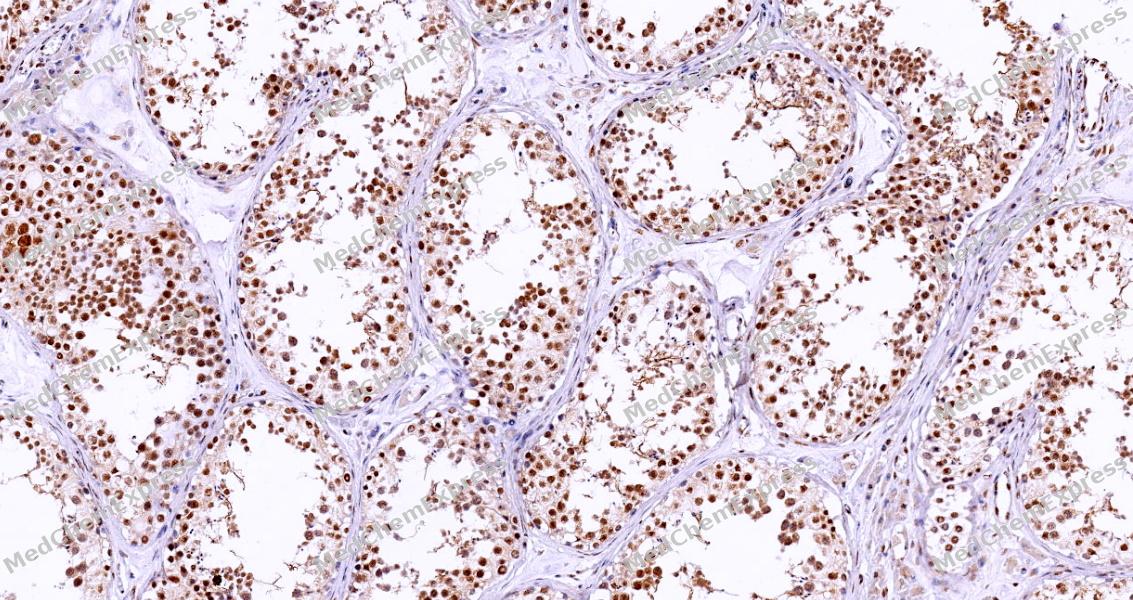 Immunohistochemical analysis of paraffin-embedded human testis tissue using FOXM1 Antibody (HY-P81367,1/1000). The section was pretreated using heat mediated antigen retrieval with sodium citrate buffer (pH 6.0) for 8 minutes. The tissues were blocked with quick block buffer for 0.5 hours at room temperature, washed with PBS and PBST, and then incubated with the primary antibody overnight at 4℃. The detection was performed using an HRP conjugated compact polymer system. DAB was used as the chromogen. Tissues were counterstained with hematoxylin and mounted with DPX.
 -
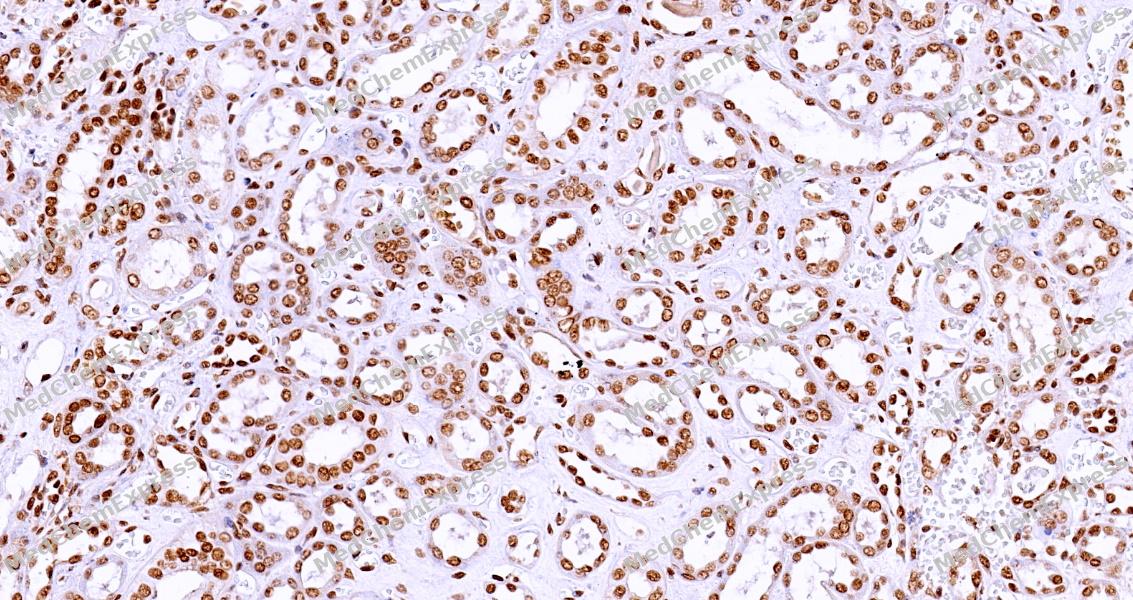 Immunohistochemical analysis of paraffin-embedded human kidney tissue using FOXM1 Antibody (HY-P81367,1/1000). The section was pretreated using heat mediated antigen retrieval with sodium citrate buffer (pH 6.0) for 8 minutes. The tissues were blocked with quick block buffer for 0.5 hours at room temperature, washed with PBS and PBST, and then incubated with the primary antibody overnight at 4℃. The detection was performed using an HRP conjugated compact polymer system. DAB was used as the chromogen. Tissues were counterstained with hematoxylin and mounted with DPX.
 -
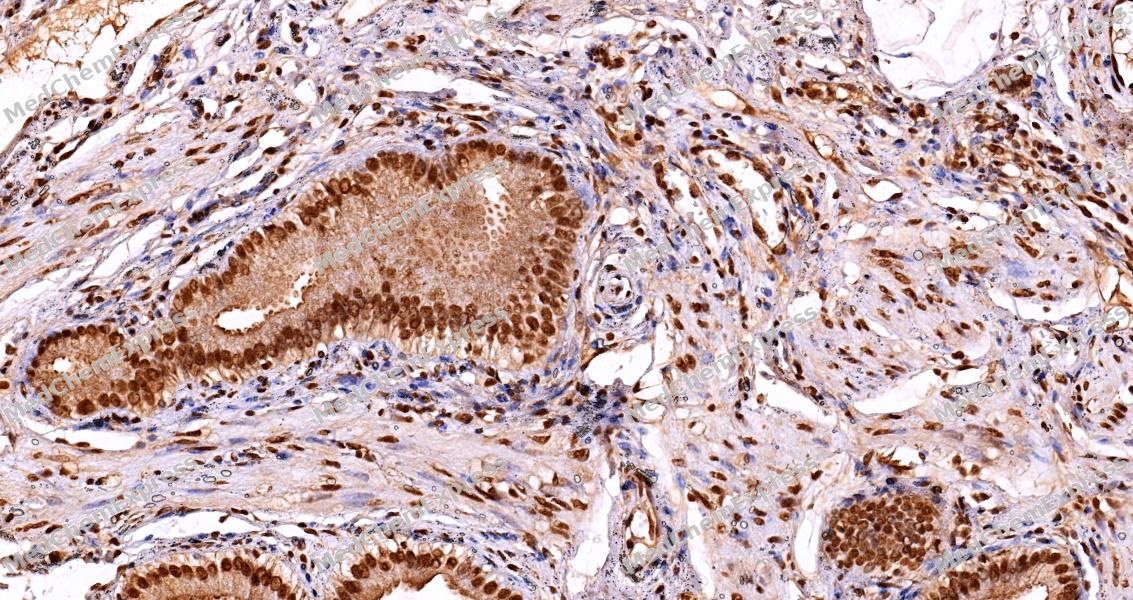 Immunohistochemical analysis of paraffin-embedded human gallbladder tissue using FOXM1 Antibody (HY-P81367,1/1000). The section was pretreated using heat mediated antigen retrieval with sodium citrate buffer (pH 6.0) for 8 minutes. The tissues were blocked with quick block buffer for 0.5 hours at room temperature, washed with PBS and PBST, and then incubated with the primary antibody overnight at 4℃. The detection was performed using an HRP conjugated compact polymer system. DAB was used as the chromogen. Tissues were counterstained with hematoxylin and mounted with DPX.
 -
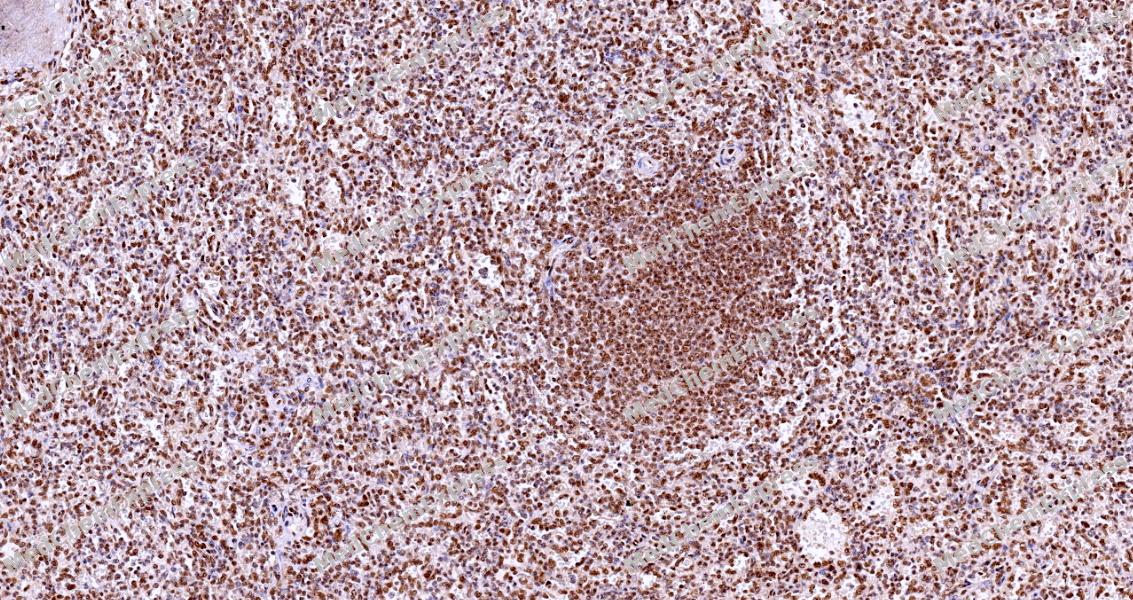 Immunohistochemical analysis of paraffin-embedded human spleen tissue using FOXM1 Antibody (HY-P81367,1/1000). The section was pretreated using heat mediated antigen retrieval with sodium citrate buffer (pH 6.0) for 8 minutes. The tissues were blocked with quick block buffer for 0.5 hours at room temperature, washed with PBS and PBST, and then incubated with the primary antibody overnight at 4℃. The detection was performed using an HRP conjugated compact polymer system. DAB was used as the chromogen. Tissues were counterstained with hematoxylin and mounted with DPX.
 -
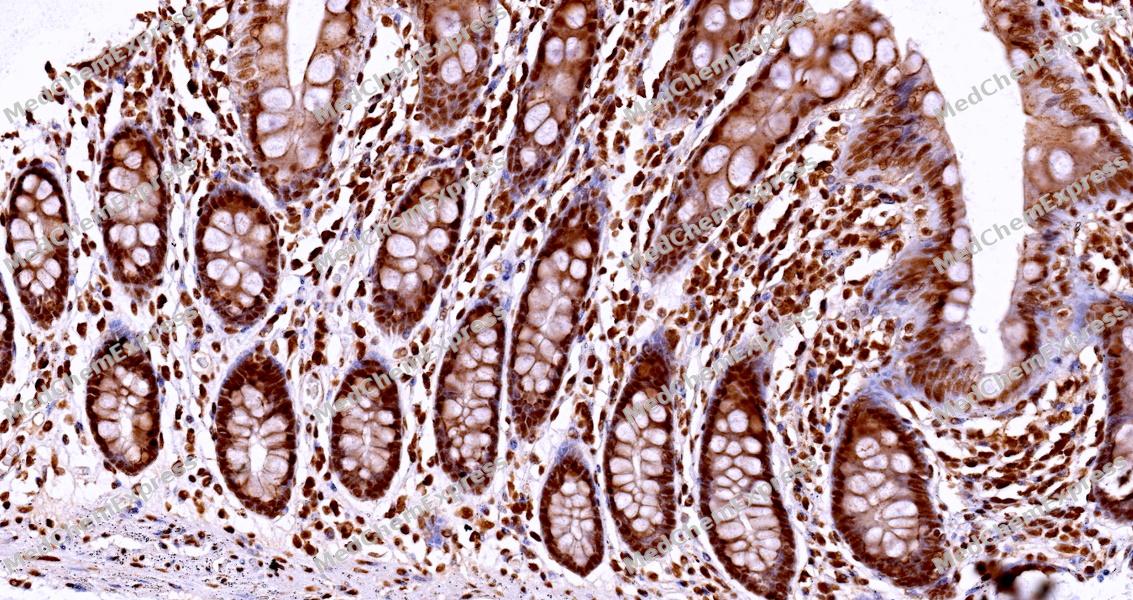 Immunohistochemical analysis of paraffin-embedded human colon tissue using FOXM1 Antibody (HY-P81367,1/1000). The section was pretreated using heat mediated antigen retrieval with sodium citrate buffer (pH 6.0) for 8 minutes. The tissues were blocked with quick block buffer for 0.5 hours at room temperature, washed with PBS and PBST, and then incubated with the primary antibody overnight at 4℃. The detection was performed using an HRP conjugated compact polymer system. DAB was used as the chromogen. Tissues were counterstained with hematoxylin and mounted with DPX.
 -
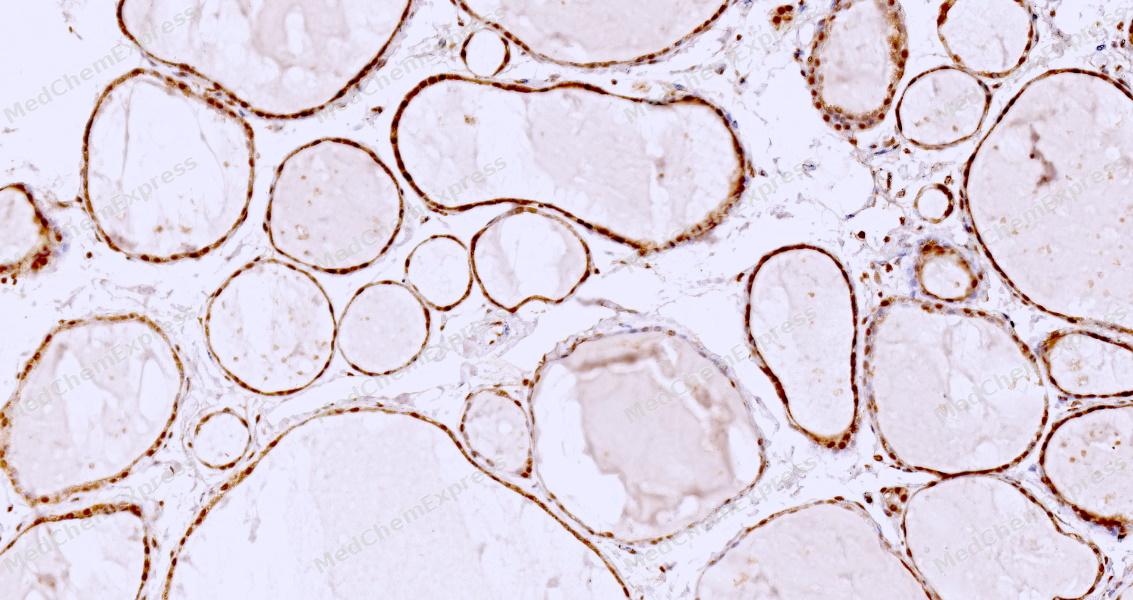 Immunohistochemical analysis of paraffin-embedded human thyroid gland tissue using FOXM1 Antibody (HY-P81367,1/1000). The section was pretreated using heat mediated antigen retrieval with sodium citrate buffer (pH 6.0) for 8 minutes. The tissues were blocked with quick block buffer for 0.5 hours at room temperature, washed with PBS and PBST, and then incubated with the primary antibody overnight at 4℃. The detection was performed using an HRP conjugated compact polymer system. DAB was used as the chromogen. Tissues were counterstained with hematoxylin and mounted with DPX.
 -
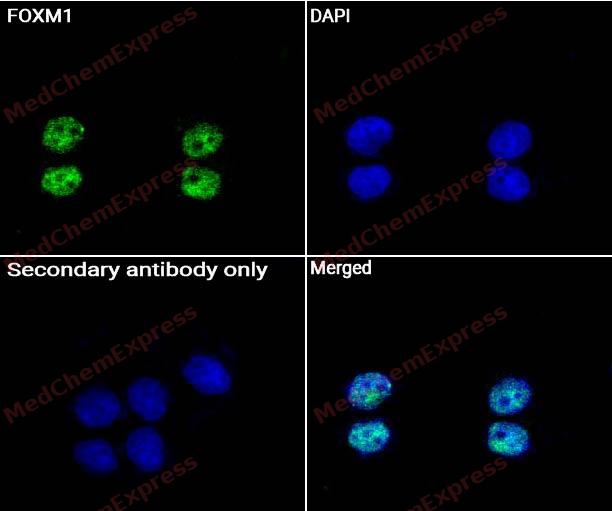 Immunocytochemistry analysis of Hela cells labeling FOXM1 Antibody (HY-P80467) at 1/50 dilution. Cells were fixed in 4% paraformaldehyde for 15 minutes at room temperature, permeabilized with 0.1% Triton X-100 for 10 minutes at room temperature, then blocked with BSA for Immunol Staining for 10 min at room temperature. Cells were then incubated with FOXM1 Antibody (HY-P80467) at 1/50 dilution in BSA for Immunol Staining at 4 ℃ Overnight. AF488-conjugated AffiniPure Goat Anti-Rabbit IgG H&L(HY-P8002, Green) was used as the secondary antibody at 1/1,000 dilution. PBS instead of the primary antibody was used as the secondary antibody only control. The Nuclear counterstain was DAPI (Blue).
 -
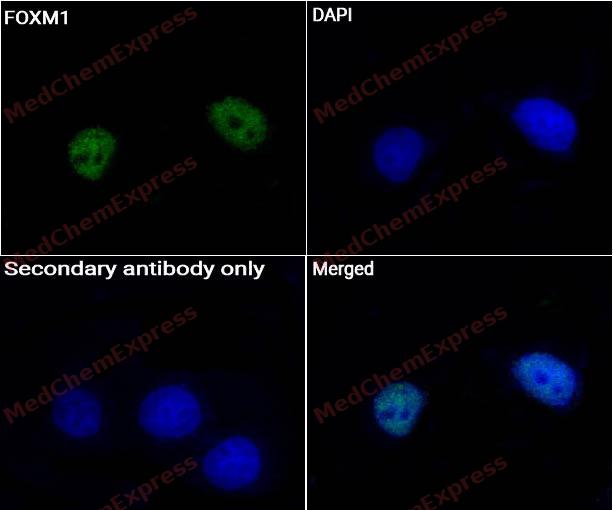 Immunocytochemistry analysis of Hela cells labeling FOXM1 Antibody (HY-P80467) at 1/200 dilution. Cells were fixed in 4% paraformaldehyde for 15 minutes at room temperature, permeabilized with 0.1% Triton X-100 for 10 minutes at room temperature, then blocked with BSA for Immunol Staining for 10 min at room temperature. Cells were then incubated with FOXM1 Antibody (HY-P80467) at 1/50 dilution in BSA for Immunol Staining at 4 ℃ Overnight. AF488-conjugated AffiniPure Goat Anti-Rabbit IgG H&L(HY-P8002, Green) was used as the secondary antibody at 1/1,000 dilution. PBS instead of the primary antibody was used as the secondary antibody only control. The Nuclear counterstain was DAPI (Blue).


Background
-
Function
Forkhead box protein M1 (FOXM1, also known as Trident, WIN, HFH-11, and MPP2; 27-30) is a member of the FOX family of transcription factors. The expression and activity of FoxM1 is important for the correct coupling of DNA synthesis to mitosis. FOXM1 is ubiquitously expressed in all proliferating mammalian cells, with its expression levels rising at the start of DNA synthesis and persisting until the end of mitosis. In M-phase, FOXM1 is phosphorylated and degraded before M-phase exit. FOXM1 has been suggested to play a role in normal coupling of S-phase to M-phase during cell cycle progression. FOXM1 enhances tumor metastasis in lung carcinoma, breast adenocarcinoma, pancreatic carcinoma, prostate carcinoma, colorectal cancer, ovarian carcinoma, cervical and nasopharyngeal carcinoma, ESCC and glioma[1][2].
-
Subcellular Localization
Nucleus
-
Expression
Tissue_specificity:This gene is expressed in the thymus, testes, small intestine, colon, and ovary. It appears to be expressed only in adult organs containing proliferating/cycled cells, or in response to growth factor stimulation. It is also expressed in tumor-derived epithelial cell lines. It is not expressed in quiescent cells. Isomer 2 is highly expressed in the testes.
Induction:Induced during liver regeneration and oxidative stress
Positive sample: Human colon tissue, human colon cancer tissue, HeLa, MEF. -
Isoforms & Post-Translational Modification
Q08050 has 3 isomers: Q08050-1: 84283 Da (predicted); Q08050-2: 82685 Da (predicted); Q08050-3: 88596 Da (predicted).
Phosphorylated in M (mitotic) phase (PubMed:17101782, PubMed:19160488, PubMed:30139873). Phosphorylation by the checkpoint kinase CHEK2 in response to DNA damage increases the FOXM1 protein stability probably stimulating the transcription of genes involved in DNA repair (PubMed:17101782). Phosphorylated by CDK1 in late S and G2 phases, creating docking sites for the POLO box domains of PLK1 (PubMed:19160488, PubMed:30139873). Subsequently, PLK1 binds and phosphorylates FOXM1, leading to activation of transcriptional activity and subsequent enhanced expression of key mitotic regulators (PubMed:19160488). Phosphorylated by GSK3B leading to ubiquitination and proteasomal degradation (PubMed:26912724);Ubiquitinated in a FBXW7-dependent manner leading to proteasomal degradation -
Subunit
Interacts with PINT87aa which is encoded by the circular form of the long non-coding RNA LINC-PINT; the interaction inhibits FOXM1-mediated transcription of PHB2
-
SwissProt ID
-
Synonyms
FOXM1; FKHL16, HFH11, MPP2, WIN; Forkhead box protein M1; Forkhead-related protein FKHL16; Hepatocyte nuclear factor 3 forkhead homolog 11 (HFH-11; HNF-3/fork-head homolog 11); M-phase phosphoprotein 2; MPM-2 reactive phosphoprotein 2; Transcription factor Trident; Winged-helix factor from INS-1 cells
-
Research Field
Epigenetics and Nuclear Signaling


Documentation
-
Data Sheet (261 KB)
-
SDS (252 KB)
- English - EN (252 KB)
- Français - FR (252 KB)
- Deutsch - DE (252 KB)
- Norwegian - NO (252 KB)
- Español - ES (252 KB)
- Swedish - SV (252 KB)
- Italian - IT (252 KB)
- Korean - KR (252 KB)
- Portuguese - PT (252 KB)
-
User Guide for Antibodies (1077 KB)
References
[1]. Bicknell KA. Forkhead (FOX) transcription factors and the cell cycle: measurement of DNA binding by FoxO and FoxM transcription factors. Methods Mol Biol. 2005;296:247-62. [Content Brief]
[2]. Cheng L, et al. FOXM 1 induces Vasculogenic mimicry in esophageal cancer through β-catenin /Tcf4 signaling. Diagn Pathol. 2020 Feb 8;15(1):14. [Content Brief]

 Powered by Bioz
