



Toll-Like Receptor 4 Antibody
(Synonyms: TLR4; Toll-like receptor 4; hToll; CD antigen CD284)Based on 1 Customer Validation
Toll-Like Receptor 4 Antibody is a Rabbit-derived and non-conjugated IgG polyclonal antibody, targeting to Toll-Like Receptor 4.
-
Host:
Rabbit
-
Isotype:
IgG
-
Application:
WB, FC
-
Reactivity :
Human
-
Formulation:
Supplied in 1*PBS (pH 7.3). Preservative: 0.09% sodium azide or 0.01M TBS (pH7.4) with 1% BSA, 0.02% Proclin300 and 50% Glycerol.
-
Conjugation:
Non-conjugated


To place orders, for customer services and technical support, please contact: MedChemExpress USA
Tel: 609-228-6898 E-mail: [email protected] [email protected]





Applications
| Application |
WB

WB: Western Blot
|
FC
FC: Flow Cytometry
|
|---|---|---|
| Dilution Ratio | 1:500-1:1000 | 1:50-1:100 |


Product Details
Toll-Like Receptor 4 Antibody is a Rabbit-derived and non-conjugated IgG polyclonal antibody, targeting to Toll-Like Receptor 4.
-
Host Rabbit

-
Clonality Polyclonal

-
Species ReactivityHuman
-
Observed Molecular WeightObserved band size: 96-130 kDa
Note: Due to possible protein modifications or aggregation, the molecular weight should be confirmed by actual measurement, and the predicted value is for reference only.

-
Calculated Molecular Weight Predicted band size: 96 kDa

KLH conjugated synthetic peptide derived from human TLR4: 121-698/839.
Endogenous
affinity purified
Non-conjugated
Unmodified
IgG


Product Properties
-
Appearance
Solution
-
Formulation
Supplied in 1*PBS (pH 7.3). Preservative: 0.09% sodium azide or 0.01M TBS (pH7.4) with 1% BSA, 0.02% Proclin300 and 50% Glycerol.
-
Concentration
Batch-dependent, Please check the COA for the concentration of each lot. Check Lot Concentration
-
Storage & Stability
Stored at -20°C for 1 year. Avoid repeated freeze / thaw cycles.
-
Shipping
Shipping with blue ice.


Verification Images
-
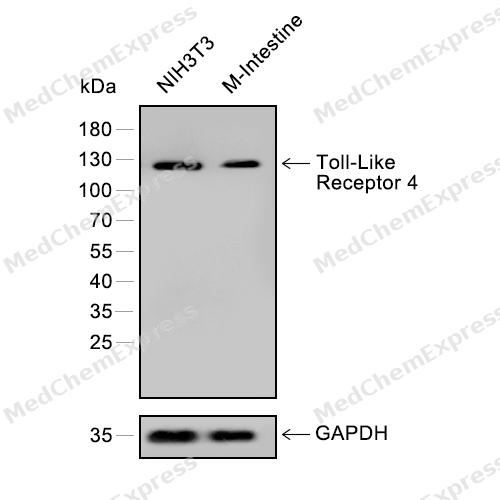 Western blot analysis of extracts from 3T3 (lane 1) and Intestine (lane 2) using Toll-like receptor 4 antibody. Proteins were transferred to a PVDF membrane and blocked with 5% nonfat powdered milk in PBST for 2 hour at room temperature. The primary antibody (1/2000) and Loading control antibody (GAPDH, 1/3000) was diluted with 5% nonfat powdered milk in PBST at 4°C overnight. Goat Anti-Rabbit IgG-HRP Secondary Antibody (1/8,000) was incubated for 45min at room temperature.
 -
 Flow cytometric analysis of 1X10⁶ THP-1 cells labeling Toll-Like Receptor 4 Antibody (HY-P80918, red). Cells were stained with the primary antibody at 1/50 dilution for an hour at 4℃. AF488-conjugated Goat Anti-Rabbit IgG H&L (HY-P8002) was used as the secondary antibody at 1/1,000 dilution for 30 minutes at 4℃. Rabbit IgG Isotype Control (HY-P80879, blue) was used as the isotype control, cells without incubation with primary antibody were used as the unlabeled control (black).
 -
 Flow cytometric analysis of 1X10⁶ THP-1 cells labeling Toll-Like Receptor 4 Antibody (HY-P80918, red). Cells were stained with the primary antibody at 1/50 dilution for an hour at 4℃. AF488-conjugated Goat Anti-Rabbit IgG H&L (HY-P8002) was used as the secondary antibody at 1/1,000 dilution for 30 minutes at 4℃. Rabbit IgG Isotype Control (HY-P80879, blue) was used as the isotype control, cells without incubation with primary antibody were used as the unlabeled control (black).


Background
-
Function
Toll-Like Receptor 4 is a Transmembrane receptor that functions as a pattern recognition receptor recognizing pathogen- and damage-associated molecular patterns (PAMPs and DAMPs) to induce innate immune responses via downstream signaling pathways. At the plasma membrane, cooperates with LY96 to mediate the innate immune response to bacterial lipopolysaccharide (LPS). Also involved in LPS-independent inflammatory responses triggered by free fatty acids, such as palmitate, and Ni(2+). Mechanistically, acts via MYD88, TIRAP and TRAF6, leading to NF-kappa-B activation, cytokine secretion and the inflammatory response. Alternatively, CD14-mediated TLR4 internalization via endocytosis is associated with the initiation of a MYD88-independent signaling via the TICAM1-TBK1-IRF3 axis leading to type I interferon production. In addition to the secretion of proinflammatory cytokines, initiates the activation of NLRP3 inflammasome and formation of a positive feedback loop between autophagy and NF-kappa-B signaling cascade. In complex with TLR6, promotes inflammation in monocytes/macrophages by associating with TLR6 and the receptor CD86. Upon ligand binding, such as oxLDL or amyloid-beta 42, the TLR4:TLR6 complex is internalized and triggers inflammatory response, leading to NF-kappa-B-dependent production of CXCL1, CXCL2 and CCL9 cytokines, via MYD88 signaling pathway, and CCL5 cytokine, via TICAM1 signaling pathway. In myeloid dendritic cells, vesicular stomatitis virus glycoprotein G but not LPS promotes the activation of IRF7, leading to type I IFN production in a CD14-dependent manner. Required for the migration-promoting effects of ZG16B/PAUF on pancreatic cancer cells[1][2][3][4][5][6][7][8][9][10][11][12][13][14][15][16][17].
-
Subcellular Localization
Cell membrane; Single-pass type I membrane protein; Early endosome; Cell projection, ruffle
-
Expression
Tissue_specificity:It is highly expressed in the placenta, spleen, and peripheral blood leukocytes (PubMed:9237759, PubMed:9435236) . It can also be detected in monocytes, macrophages, dendritic cells, and various T cells (PubMed:27022195, PubMed:9237759) . It is expressed in pancreatic cancer cells but not in normal pancreatic cells (protein level) (PubMed:36232715) .
Induction:By LPS in plasmacytoid dendritic cells -
Isoforms & Post-Translational Modification
O00206 has 3 isomers: O00206-1: 95680 Da (predicted); O00206-2: 91296 Da (predicted); O00206-3: 73301 Da (predicted).
N-Glycosylation of Asn-526 and Asn-575 by STT3A-containing OST-A complex is necessary for the expression of TLR4 on the cell surface and the LPS-response (PubMed:11706042, PubMed:38670073). Likewise, mutants lacking two or more of the other N-glycosylation sites were deficient in interaction with LPS (PubMed:11706042, PubMed:38670073);Phosphorylated on tyrosine residues by LYN after binding lipopolysaccharide;Ubiquitinated by RNF128 via 'Lys-28'-linked polyubiquitin chains, leading to proteasomal degradation -
Subunit
Belongs to the lipopolysaccharide (LPS) receptor, a multi-protein complex containing at least CD14, LY96 and TLR4 (PubMed:11274165). Binding to bacterial LPS leads to homodimerization. Interacts with LY96 via the extracellular domain (PubMed:17803912, PubMed:19252480). Interacts with MYD88 (PubMed:36232715). Interacts (via TIR domains) with TIRAP (By similarity). Interacts with TICAM2 (PubMed:14519765, PubMed:25736436). Interacts with NOX4 (PubMed:15356101). Interacts with CNPY3 (By similarity). Interacts with HSP90B1. The interaction with both CNPY3 and HSP90B1 is required for proper folding in the endoplasmic reticulum. Interacts with MAP3K21; this interaction leads to negative regulation of TLR4 signaling (PubMed:21602844). Interacts with CD36, following CD36 stimulation by oxLDL or amyloid-beta 42, and forms a heterodimer with TLR6 (PubMed:20037584). The trimeric complex is internalized and triggers inflammatory response. LYN kinase activity facilitates TLR4-TLR6 heterodimerization and signal initiation. Interacts with TICAM1 in response to LPS in a WDFY1-dependent manner (PubMed:25736436, PubMed:36232715). Interacts with WDFY1 in response to LPS (By similarity). Interacts with SMPDL3B (By similarity). Interacts with CEACAM1; upon lipopolysaccharide stimulation, forms a complex including TLR4 and the phosphorylated form of SYK and CEACAM1, which in turn, recruits PTPN6 that dephosphorylates SYK, reducing the production of reactive oxygen species (ROS) and lysosome disruption, which in turn, reduces the activity of the inflammasome (By similarity). Interacts with RFTN1; the interaction occurs in response to lipopolysaccharide stimulation (PubMed:27022195). Interacts with SCIMP; the interaction occurs in response to lipopolysaccharide stimulation and is enhanced by phosphorylation of SCIMP by LYN (By similarity). This interaction facilitates the phosphorylation of TLR4 by LYN which elicits a selective cytokine response in macrophages (By similarity). Interacts with TRAF3IP3 (PubMed:30573680). Interacts with TREM1; this interaction enhances TLR4-mediated inflammatory response (PubMed:17098818, PubMed:21393102). Interacts with ZG16B/PAUF (PubMed:36232715). Interacts with CD82; this interaction inhibits TLR4-mediated signaling pathway (PubMed:36945827). Interacts with neutrophil recruitment protein from Aedes aegypti saliva; the interaction probably promotes activation of canonical NF-kappa-B signaling in skin-resident macrophages and subsequent expression of neutrophil chemoattractants (PubMed:38378891)
-
SwissProt ID
-
Synonyms
TLR4; Toll-like receptor 4; hToll; CD antigen CD284
-
Research Field
Immunology


Documentation
-
Data Sheet (264 KB)
-
SDS (251 KB)
- English - EN (251 KB)
- Français - FR (251 KB)
- Deutsch - DE (251 KB)
- Norwegian - NO (251 KB)
- Español - ES (251 KB)
- Swedish - SV (251 KB)
- Italian - IT (251 KB)
- Korean - KR (251 KB)
- Portuguese - PT (251 KB)
-
User Guide for Antibodies (1077 KB)
References
[1]. Arbour NC, et al. TLR4 mutations are associated with endotoxin hyporesponsiveness in humans. Nat Genet. 2000 Jun;25(2):187-91. [Content Brief]
[2]. Bulut Y, et al. Mycobacterium tuberculosis heat shock proteins use diverse Toll-like receptor pathways to activate pro-inflammatory signals. J Biol Chem. 2005 Jun 3;280(22):20961-7. [Content Brief]
[3]. Jung SB, et al. The mycobacterial 38-kilodalton glycolipoprotein antigen activates the mitogen-activated protein kinase pathway and release of proinflammatory cytokines through Toll-like receptors 2 and 4 in human monocytes. Infect Immun. 2006 May;74(5):2686-96. [Content Brief]
[4]. Georgel P, et al. Vesicular stomatitis virus glycoprotein G activates a specific antiviral Toll-like receptor 4-dependent pathway. Virology. 2007 Jun 5;362(2):304-13. [Content Brief]
[5]. Kim F, et al. Toll-like receptor-4 mediates vascular inflammation and insulin resistance in diet-induced obesity. Circ Res. 2007 Jun 8;100(11):1589-96. [Content Brief]
[6]. Stewart CR, et al. CD36 ligands promote sterile inflammation through assembly of a Toll-like receptor 4 and 6 heterodimer. Nat Immunol. 2010 Feb;11(2):155-61. [Content Brief]
[7]. Schmidt M, et al. Crucial role for human Toll-like receptor 4 in the development of contact allergy to nickel. Nat Immunol. 2010 Sep;11(9):814-9. [Content Brief]
[8]. Estruch M, et al. CD14 and TLR4 mediate cytokine release promoted by electronegative LDL in monocytes. Atherosclerosis. 2013 Aug;229(2):356-62. [Content Brief]
[9]. Tatematsu M, et al. Raftlin Controls Lipopolysaccharide-Induced TLR4 Internalization and TICAM-1 Signaling in a Cell Type-Specific Manner. J Immunol. 2016 May 1;196(9):3865-76. [Content Brief]
[10]. Xiahou Z, et al. NMI and IFP35 serve as proinflammatory DAMPs during cellular infection and injury. Nat Commun. 2017 Oct 16;8(1):950. [Content Brief]
[11]. Kim HM, et al. Crystal structure of the TLR4-MD-2 complex with bound endotoxin antagonist Eritoran. Cell. 2007 Sep 7;130(5):906-17. [Content Brief]
[12]. Arts RJ, et al. TREM-1 interaction with the LPS/TLR4 receptor complex. Eur Cytokine Netw. 2011 Mar;22(1):11-4. [Content Brief]
[13]. Lee H, et al. Recombinant human KAI1/CD82 attenuates M1 macrophage polarization on LPS-stimulated RAW264.7 cells via blocking TLR4/JNK/NF-κB signal pathway. BMB Rep. 2023 Jun;56(6):359-364. [Content Brief]
[14]. Medzhitov R, et al. A human homologue of the Drosophila Toll protein signals activation of adaptive immunity. Nature. 1997 Jul 24;388(6640):394-7. [Content Brief]
[15]. Fitzgerald KA, et al. LPS-TLR4 signaling to IRF-3/7 and NF-kappaB involves the toll adapters TRAM and TRIF. J Exp Med. 2003 Oct 6;198(7):1043-55. [Content Brief]
[16]. Luo H, et al. Mycoplasma pneumoniae lipids license TLR-4 for activation of NLRP3 inflammasome and autophagy to evoke a proinflammatory response. Clin Exp Immunol. 2021 Jan;203(1):66-79. [Content Brief]
[17]. Dai J, et al. Regulation of IFN regulatory factor-7 and IFN-alpha production by enveloped virus and lipopolysaccharide in human plasmacytoid dendritic cells. J Immunol. 2004 Aug 1;173(3):1535-48. [Content Brief]

 Powered by Bioz
