



Aspergillus Infection
-
Aspergillus Infection (20)

- 1
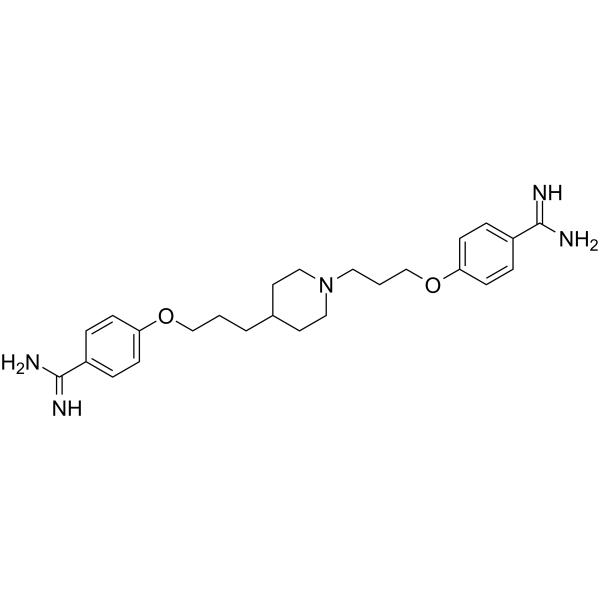
- Formula: C25H35N5O2
- Molecular Weight: 437.58
T-2307 is an antifungal agent with blood-brain barrier penetration. T-2307 exhibits broad-spectrum antifungal activity against Candida species, including echinocandin-resistant strains, Cryptococcus neoformans, Cryptococcus gattii, and some Aspergillus species. T-2307 selectively targets fungal mitochondrial respiratory chain complexes III and IV, causing collapse of the fungal mitochondrial membrane potential and exerting fungicidal or fungistatic effects. T-2307 can be used in research related to fungal infections such as invasive candidiasis, cryptococcosis, and aspergillosis.

- Formula: C8H14O
- Molecular Weight: 126.20
(E)-2-Octenal is an Antifungal agent. (E)-2-Octenal disrupts cell membrane integrity and causes ROS accumulation. (E)-2-Octenal decreases the activities of phosphofructokinase and pyruvate kinase. (E)-2-Octenal inhibits Neofusicoccum parvum growth by disrupting mitochondrial energy metabolism. (E)-2-Octenal suppresses the growth of a Prochloraz (HY-B0845)-resistant Penicillium italicum strain. (E)-2-octenal exerts a broad-spectrum and potent inhibitory effect on various fungi, including Sclerotium rolfsii, Metarhizium anisopliae sensu lato, and Aspergillus flavus, etc. (E)-2-Octenal can be used for the research of citrus blue mold and mango stem-end rot.

- Formula: C6H5N3O6S
- Molecular Weight: 247.18
2,4-Dinitrobenzenesulfonamide (Compound 2d) is an antibacterial and antifungal agent. 2,4-Dinitrobenzenesulfonamide interacts with dihydrofolate synthetase. 2,4-Dinitrobenzenesulfonamide shows inhibitory effect against A. niger, C. albicans, B. subtilis, and S. aureus.

- Formula: C16H10O7
- Molecular Weight: 314.25
Endocrocin is an anthraquinone fungal secondary metabolite. Endocrocin inhibits the recruitment and migration of neutrophils, and enhances the pathogenicity and virulence of Fumagillin (HY-B0751) in Drosophila. Endocrocin can be used in research related to invasive aspergillosis, viral infections and liver diseases.

- Formula: C20H16O7
- Molecular Weight: 368.34
Versicolorone is an anthraquinone-type aflatoxin biosynthetic intermediate that serves as a substrate for VHA reductase in the aflatoxin metabolic network and is enzymatically converted to sterigmatocystin acetate, elucidating the aflatoxin biotransformation pathway. Versicolorone can be used in studies on the toxicity and carcinogenic mechanisms associated with aflatoxin contamination.


- Formula: C52H81N7O16
- Molecular Weight: 1060.24
Echinocandin B (purity>85%) (SL 7810 (purity>85%)) is a lipopeptide antifungal antibiotic. Echinocandin B (purity>85%) is produced by Aspergillus nidulans. Echinocandin B (purity>85%) inhibits β-1,3-glucan activity, thereby blocking the biosynthesis of fungal cell walls. Echinocandin B (purity>85%) exhibits activity against a variety of Aspergillus species.
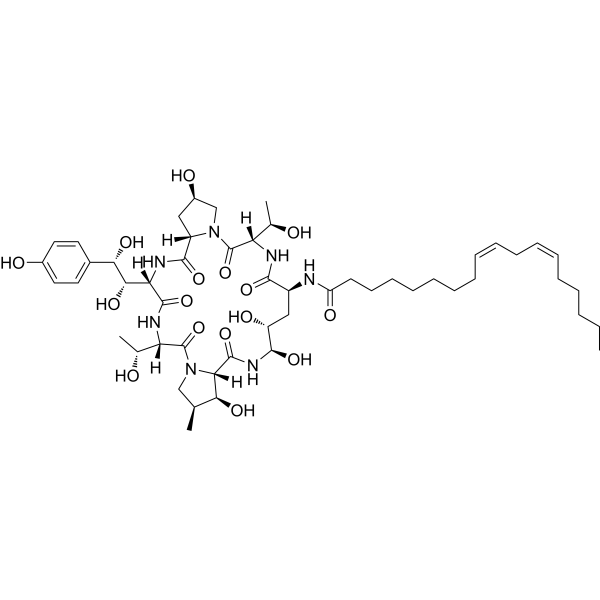
- Formula: C52H81N7O16
- Molecular Weight: 1060.24
Echinocandin B (SL 7810) is a lipopeptide antifungal antibiotic. Echinocandin B is produced by Aspergillus nidulans. Echinocandin B inhibits β-1,3-glucan activity, thereby blocking the biosynthesis of fungal cell walls. Echinocandin B exhibits activity against a variety of Aspergillus species.

- Formula: C52H81N7O16
- Molecular Weight: 1060.24
Echinocandin B (purity>65%) (SL 7810 (purity>65%)) is a lipopeptide antifungal antibiotic. Echinocandin B (purity>65%) is produced by Aspergillus nidulans. Echinocandin B (purity>65%) inhibits β-1,3-glucan activity, thereby blocking the biosynthesis of fungal cell walls. Echinocandin B (purity>65%) exhibits activity against a variety of Aspergillus species.

- Formula: C25H26O7
- Molecular Weight: 438.47
MBL-1 is an orally active anti-inflammatory agent. MBL-1 can be isolated from the fermentation broth of Aspergillus sp. derived from gorgonians. MBL-1 inhibits the activity of the hCOX-2 protein with an IC50 of 5.77 μM. MBL-1 reduces the production of key pro-inflammatory mediators such as NO, ROS, IL-1β and IL-18 by inhibiting the MAPK/NF-κB and NLRP3 signaling pathways. MBL-1 exerts a protective effect against DSS-induced colitis. MBL-1 can be used for the research of ulcerative colitis.

- Formula: C54H87NaO26S
- Molecular Weight: 1207.31
Echinoside A is a saponin. Echinoside A can be isolated from sea cucumber. Echinoside A inhibits the catalytic activity of Top2α, reduces the noncovalent binding of Top2α to DNA. Echinoside A activates Caspase-3 and induces PARP cleavage. Echinoside A induces Apoptosis. Echinoside A has anticancer activity against prostate cancer, hepatocellular carcinoma, and S-180 sarcoma. Echinoside A exhibits antifungal activity against a variety of fungi, with a minimum growth inhibitory concentration range of 3.12 to 50.0 μg/mL, including potent activity against Aspergillus and Penicillium species.

- Formula: C24H22F3N4O8P
- Molecular Weight: 582.42
Fosmanogepix TFA (APX001 TFA) is an orally active APX001A (HY-18233) prodrug and antifungal agent. Fosmanogepix TFA is effective against Cryptococcus neoformans, Fluconazole (HY-B0101)-resistant C. auris. Fosmanogepix TFA is effective in the treatment of invasive pulmonary aspergillosis and pulmonary murine mucormycosis.

- Formula: C10H14O2
- Molecular Weight: 166.22
Antifungal agent 158 is an α-pyrone derivative that can be found in Trichoderma harzianum, exhibiting antifungal activity against select plant-pathogenic fungi, including Chaetomium spp., Curvularia lunata, and Aspergillus flavus. Antifungal agent 158 is non-toxic to greenhouse-grown bean, corn, and tobacco plants. Antifungal agent 158 can be used for research on Aspergillus flavus infection.

- Formula: C11H6ClFN4
- Molecular Weight: 248.64
5CF2PB is an antibacterial and antifungal agent. 5CF2PB targets 5O4L. 5CF2PB exhibits potent antibacterial and antifungal activities, particularly against Pseudomonas aeruginosa and Aspergillusniger.

- Formula: C27H36O5
- Molecular Weight: 440.58
Cladobotric acid H is a polyketide antifungal agent found in the mycoparasitic fungus Hypomyces pseudocorticicola FKA-73. Cladobotric acid H inhibits growth of azole-sensitive and azole-resistant Candida auris, Aspergillus fumigatus, Aspergillus udagawae, Aspergillus felis, and Aspergillus lentulus. Cladobotric acid H can be used for the research of aspergillosis, candidiasis.

- Formula: C10H14O
- Molecular Weight: 150.22
4-Isopropyl-3-methylphenol acts as a biofilm inhibitor, Antibacterial agent, Antifungal agent, and Acaricide. 4-Isopropyl-3-methylphenol reduces the expression levels of biofilm-associated gtfB, gtfD, and gtfC genes. 4-Isopropyl-3-methylphenol disrupts ion and redox homeostasis in fungal cells, and its combination with Octylgallate enhances antifungal activity. 4-Isopropyl-3-methylphenol exhibits fumigant toxicity and direct contact toxicity against Dermatophagoides farinae and Dermatophagoides pteronyssinus. 4-Isopropyl-3-methylphenol is applicable to research related to dental caries and Aspergillus infections/contamination.

- Formula: C21H21F3N4O
- Molecular Weight: 402.42
Antifungal agent-162 (Compound 1c) is an Antifungal agent. Antifungal agent-162 exhibits potent in vitro antifungal activity against Candida albicans, Cryptococcus neoformans, Candida parapsilosis, Candida tropicalis, Candida krusei, and Microsporum gypseum (with MIC80 values ranging from 0.0156 to 0.25 μg/mL), while shows no activity against Aspergillus fumigatus.

- Formula: C11H22O2
- Molecular Weight: 186.29
Isobutyl heptanoate is a valine derivative analog. Isobutyl heptanoate can be isolated from the volatile metabolites of Aspergillus clavatus NRRL1.

- Formula: C23H16BrNO3
- Molecular Weight: 434.28
Antifungal agent 144 (Compound 3f) is a highly selective antifungal agent against Aspergillus niger, with an MIC of 7.5 μg/mL. Antifungal agent 144 simultaneously inhibits chitin deacetylase AngCDA and 1,3-β-glucan synthase. Antifungal agent 144 functions by disrupting the integrity of the fungal cell wall and does not bind to Ergosterol (HY-N0181). Antifungal agent 144 can be used for research on Aspergillus niger infections.

- Formula: C52H85N9O17
- Molecular Weight: 1108.28
L-705589 is a semi-synthetic penicillin-type antifungal agent. L-705589 exerts its antifungal effect by inhibiting the 1,3-β-D-glucan synthase in the fungal cell wall. L-705589 exhibits potent bactericidal activity against various Candida species (such as Candida albicans, Candida glabrata, Candida krusei, etc.) (MFC: 0.06 - 8 μg/mL), but has relatively weak activity against Cryptococcus neoformans (MFC: 32 - 64 μg/mL). L-705589 remains active against drug-resistant Candida strains and is not prone to inducing drug resistance. L-705589 significantly improves survival rates in the model of minor invasive aspergillosis.
- 1



