



Animal-Free IL-4 Protein, Mouse (His)
Based on 1 Customer Validation
Interleukin 4 (IL-4) Protein is a pleiotropic cytokine secreted primarily by mast cells, T-cells, eosinophils, and basophils that plays a role in regulating antibody production, hematopoiesis and inflammation, and the development of effector T-cell responses.IL-4 participates in STAT6 signaling and regulates the expression of MHC II, IgE, IgG1 amd CD23.Animal-Free IL-4 Protein, Mouse (His) is the recombinant mouse-derived animal-FreeIL-4 protein, expressed by E.coli , with C-His labeled tag.This product is for cell culture use only.
- Species: Mouse
- Source: E. coli
-
Storage:Stored at -20°C for 2 years from date of receipt. After reconstitution, it is stable at 4°C for 1 week or -20°C for longer (with carrier protein). It is recommended to freeze aliquots at -20°C or -80°C for extended storage.


To place orders, for customer services and technical support, please contact: MedChemExpress USA
Tel: 609-228-6898 E-mail: [email protected] [email protected]


-
 Biological Activity
-
Technical Parameters
-
Product Properties
- Documentation
- Help & FAQs




Biological Activity
Description
Interleukin 4 (IL-4) Protein is a pleiotropic cytokine secreted primarily by mast cells, T-cells, eosinophils, and basophils that plays a role in regulating antibody production, hematopoiesis and inflammation, and the development of effector T-cell responses.IL-4 participates in STAT6 signaling and regulates the expression of MHC II, IgE, IgG1 amd CD23.Animal-Free IL-4 Protein, Mouse (His) is the recombinant mouse-derived animal-FreeIL-4 protein, expressed by E.coli , with C-His labeled tag.This product is for cell culture use only.
Background
Interleukin 4 (IL-4) Protein is a pleiotropic cytokine secreted primarily by mast cells, T-cells, eosinophils, and basophils that plays a role in regulating antibody production, hematopoiesis and inflammation, and the development of effector T-cell responses. IL-4 gene encodes two distinct isoforms through alternatively spliced transcription.
IL-4 is a ligand for interleukin 4 receptor (IL4R). IL4R also binds to IL-13, which may contribute to many overlapping functions of IL-4 and IL-13. Upon binding to IL4, IL4R receptor dimerizes either with the common IL2R gamma chain (IL2RG) to produce the type 1 signaling complex, located mainly on hematopoietic cells, or with the IL13RA1 to produce the type 2 complex, which is expressed also on nonhematopoietic cells. Engagement of both types of receptors initiates JAK3 and to a lower extend JAK1 phosphorylation leading to activation of the signal transducer and activator of transcription 6 (STAT6).
IL4 is considered an important cytokine for tissue repair, counterbalancing the effects of proinflammatory type 1 cytokines, IL-4 also promotes allergic airway inflammation. Moreover, IL-4, a type 2 cytokine, mediates and regulates a variety of human host responses such as allergic, anti-parasitic, wound healing, and acute inflammation. IL-4 induces the expression of class II MHC molecules on resting B-cells, enhances both secretion and cell surface expression of IgE and IgG1 and regulates the expression of low affinity Fc receptor for IgE (CD23) on both lymphocytes and monocytes. IL-4 has been reported to promote resolution of neutrophil-mediated acute lung injury as well as positively regulates IL31RA expression in macrophages and stimulates autophagy in dendritic cells by interfering with mTORC1 signaling and through the induction of RUFY4. In addition, IL-4 plays a critical role in higher functions of the normal brain, such as memory and learning.
IL-4 is implicated in several diseases, including asthma (multiple); autoimmune disease (multiple); hepatitis B; hepatitis C; and pancreatic cancer (multiple)[1][2][3][4][5][6].
Verified Bioactivity
1.Measure by its ability to induce HT-2 cells proliferation. The ED50 for this effect is <1 ng/mL. The specific activity of recombinant mouse IL-4 is approximately >1x10 6 IU/mg.
2.Measured in a cell proliferation assay using HT-2 mouse cells. The ED50 for this effect is 0.46 ng/mL, corresponding to a specific activity is 2.17×10 6 units/mg.
MCE Validation Data
-
Purity - SDS-PAGE
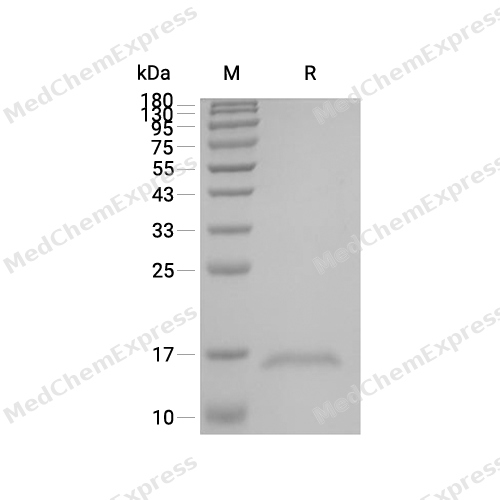
Purity - SDS-PAGE
-
Bioactivity - Cell-Based Assay
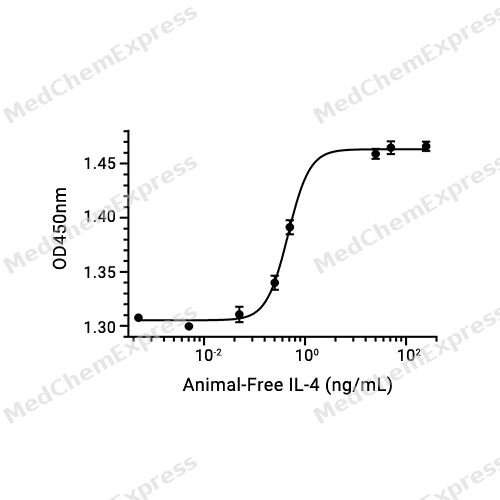
Bioactivity - Cell-Based Assay


Technical Parameters
-
Species Mouse
-
Source E. coli
-
Tag C-6*His
-
Accession
P07750 (H21-S140)
-
Molecular Construction
-
N-term
-
IL-4 (H21-S140)
Accession # P07750 -
6*His
-
C-term
-
-
Protein Length
Extracellular Domain
-
Synonyms
IL4; B_cell Stimulatory Factor 1; Interleukin 4; B-Cell Stimulatory Factor 1; IL-4; B Cell Growth Factor 1; Lymphocyte Stimulatory Factor 1; Binetrakin; Interleukin-4; Pitrakinra; BCGF-1; MGC79402; BCGF1; BSF-1; BSF1
-
AA Sequence
HIHGCDKNHLREIIGILNEVTGEGTPCTEMDVPNVLTATKNTTESELVCRASKVLRIFYLKHGKTPCLKKNSSVLMELQRLFRAFRCLDSSISCTMNESKSTSLKDFLESLKSIMQMDYS
-
Predicted Molecular Mass
14.5 kDa
-
Molecular Weight
Approximately 14 kDa, based on SDS-PAGE under reducing conditions.
-
Purity
≥ 95%, as determined by reducing SDS-PAGE.


Product Properties
Lyophilized powder
Lyophilized from a 0.22 μm filtered solution of PBS, pH 7.4 or PBS, pH 7.4, 8% trehalose.
<0.1 EU/μg, determined by LAL method.
It is recommended to reconstitute to a concentration of 100-200 μg/mL in ddH2O. For long term storage it is recommended to add a carrier protein (0.1% BSA, 5% HSA, 10% FBS or 5% Trehalose).
Stored at -20°C for 2 years from date of receipt. After reconstitution, it is stable at 4°C for 1 week or -20°C for longer (with carrier protein). It is recommended to freeze aliquots at -20°C or -80°C for extended storage.
Room temperature in continental US; may vary elsewhere.


Documentation
-
Data Sheet (237 KB)
-
SDS (251 KB)
- English - EN (251 KB)
- Français - FR (251 KB)
- Deutsch - DE (251 KB)
- Norwegian - NO (251 KB)
- Español - ES (251 KB)
- Swedish - SV (251 KB)
- Italian - IT (251 KB)
- Korean - KR (251 KB)
- Portuguese - PT (251 KB)
-
Handling Instructions (2659 KB)

Calculators
Concentration (start) × Volume (start) = Concentration (final) × Volume (final)


 Powered by Bioz

