



EphA4 Protein, Rat (HEK293, His)
Based on 1 Customer Validation
EphA4 Protein, a receptor tyrosine kinase, engages in contact-dependent bidirectional signaling with ephrin-A and ephrin-B ligands. Activated by GPI-anchored EFNA and transmembrane EFNB, EphA4 regulates cell morphology, integrin-dependent adhesion, and GTPase activity. Crucial in nervous system development, it guides axonal projections, segregates motor and sensory axons, and influences synaptic plasticity. In injury repair and angiogenesis, EphA4 inhibits axonal regeneration and contributes to vascular formation. Its promiscuity extends to thymic epithelium development, cochlear organ of Corti formation, and phosphorylation of CAPRIN1 for membraneless compartment formation. EphA4 Protein, Rat (HEK293, His) is the recombinant rat-derived EphA4 protein, expressed by HEK293 , with C-His labeled tag.
- Species: Rat
- Source: HEK293
-
Storage:Stored at -20°C for 2 years from date of receipt. After reconstitution, it is stable at 4°C for 1 week or -20°C for longer (with carrier protein). It is recommended to freeze aliquots at -20°C or -80°C for extended storage.


To place orders, for customer services and technical support, please contact: MedChemExpress USA
Tel: 609-228-6898 E-mail: [email protected] [email protected]


-
 Biological Activity
-
Technical Parameters
-
Product Properties
- Documentation
- Help & FAQs




Biological Activity
Description
EphA4 Protein, a receptor tyrosine kinase, engages in contact-dependent bidirectional signaling with ephrin-A and ephrin-B ligands. Activated by GPI-anchored EFNA and transmembrane EFNB, EphA4 regulates cell morphology, integrin-dependent adhesion, and GTPase activity. Crucial in nervous system development, it guides axonal projections, segregates motor and sensory axons, and influences synaptic plasticity. In injury repair and angiogenesis, EphA4 inhibits axonal regeneration and contributes to vascular formation. Its promiscuity extends to thymic epithelium development, cochlear organ of Corti formation, and phosphorylation of CAPRIN1 for membraneless compartment formation. EphA4 Protein, Rat (HEK293, His) is the recombinant rat-derived EphA4 protein, expressed by HEK293 , with C-His labeled tag.
Background
EphA4, a receptor tyrosine kinase, engages in contact-dependent bidirectional signaling with membrane-bound ephrin family ligands on adjacent cells. Distinguished by its high promiscuity, EphA4 uniquely binds and is physiologically activated by both GPI-anchored ephrin-A and transmembrane ephrin-B ligands, including EFNA1 and EFNB3. Upon activation by ephrin ligands, EphA4 modulates cell morphology and integrin-dependent cell adhesion through the regulation of Rac, Rap, and Rho GTPases activity. Crucial in the development of the nervous system, EphA4 controls various steps of axonal guidance, including the establishment of corticospinal projections and the segregation of motor and sensory axons during neuromuscular circuit development. In synaptic plasticity, EphA4 participates by phosphorylating CDK5 at 'Tyr-15,' leading to the regulation of RHOA and dendritic spine morphogenesis. Furthermore, EphA4 plays roles in repair after injury by preventing axonal regeneration and in angiogenesis, contributing to central nervous system vascular formation. Its promiscuity extends its involvement in various cell-cell signaling processes, regulating the development of the thymic epithelium and, during the development of the cochlear organ of Corti, facilitating pillar cell separation through the formation of a ternary complex with ADAM10 and CADH1, leading to the cleavage of CADH1 and disruption of adherens junctions. EphA4 also phosphorylates CAPRIN1, promoting CAPRIN1-dependent formation of a membraneless compartment[1][2][3][4].
Verified Bioactivity
1.This product does not contain protein kinase domain.
2.Immobilized recombinant Rat EPHA4 Protein at 2 µg/mL (100 μL/well) can bind Recombinant rat EFNA5, The ED50 for this effect is 35.43 ng/mL.
MCE Validation Data
-
Purity - SDS-PAGE
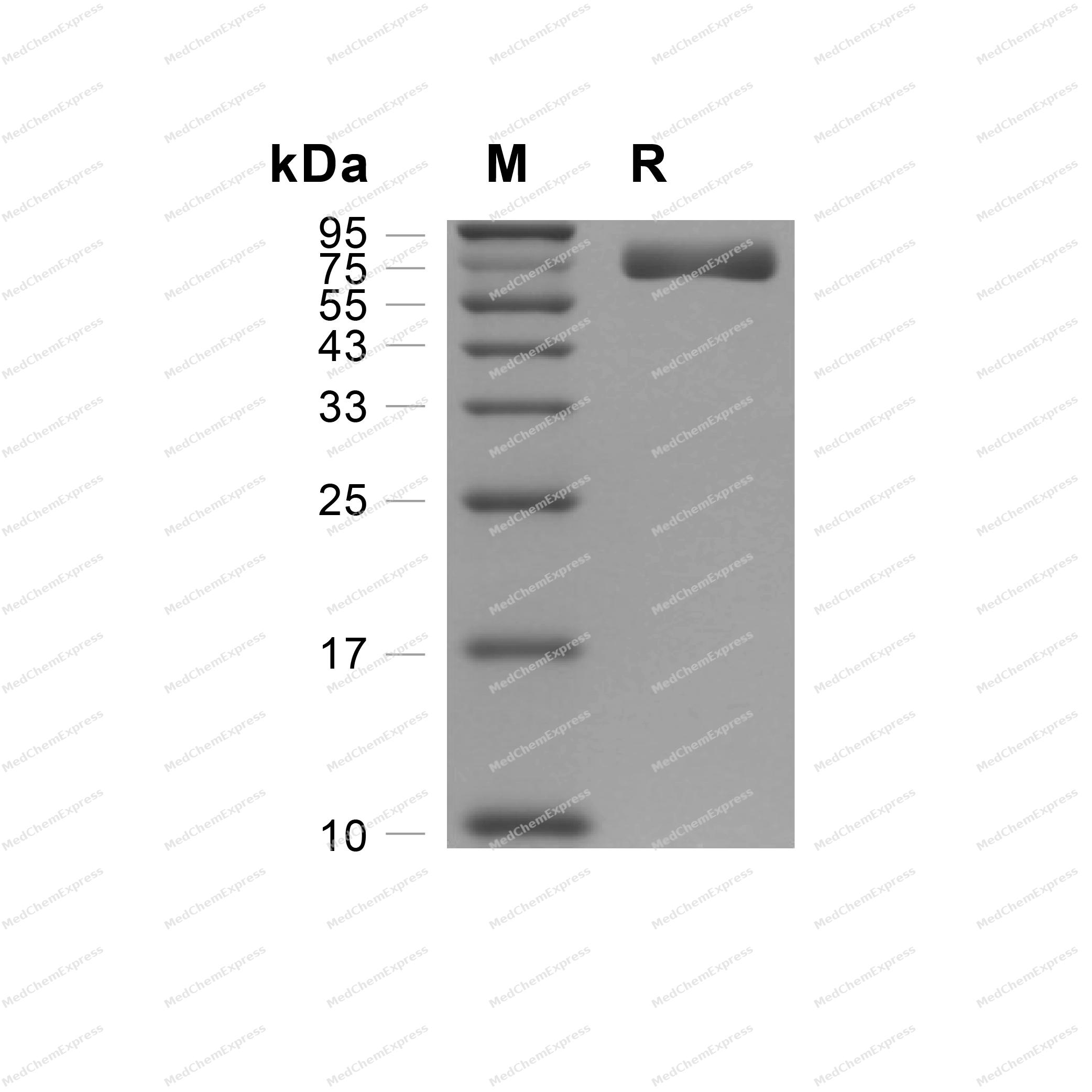
Purity - SDS-PAGE
-
Bioactivity - ELISA
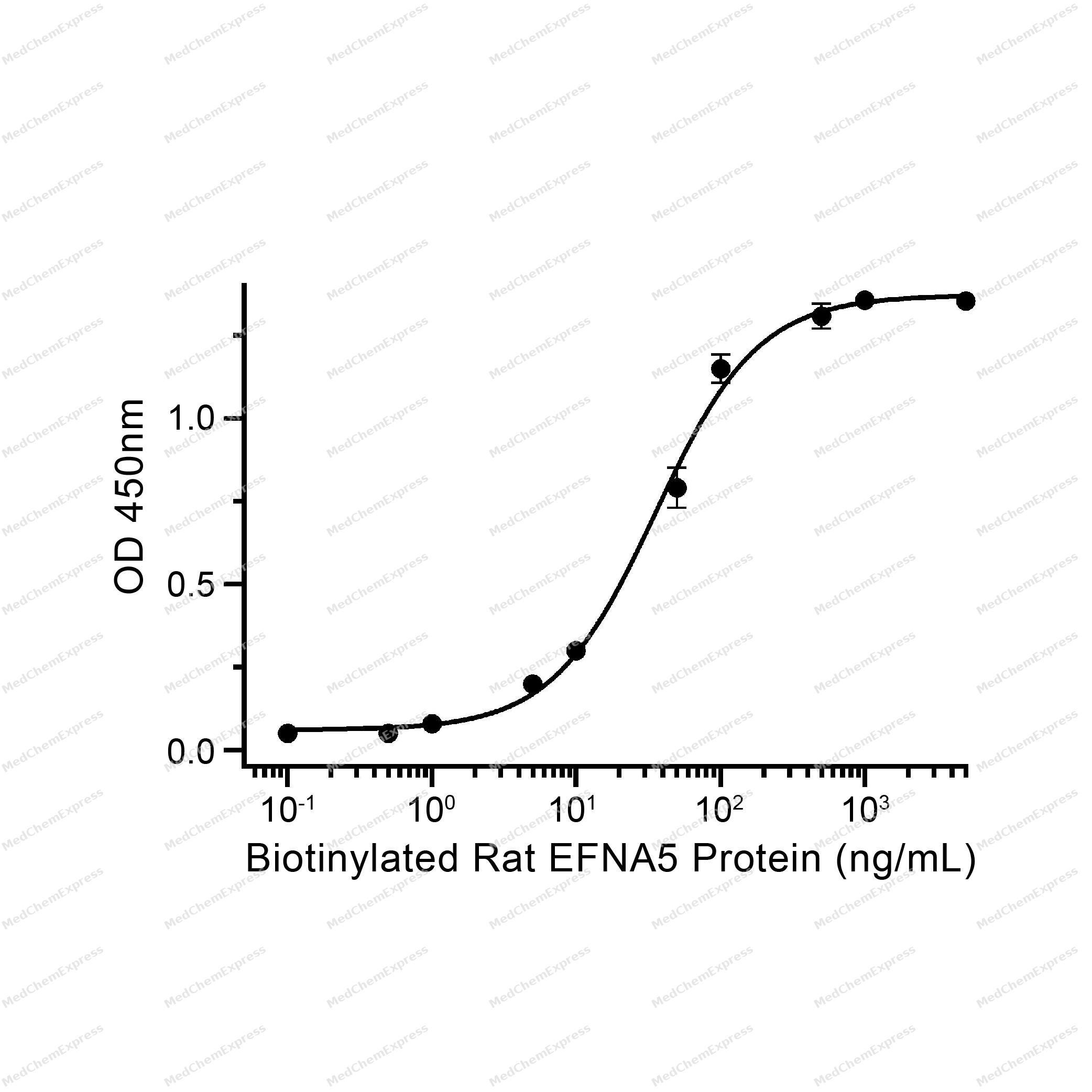
Bioactivity - ELISA


Technical Parameters
-
Species Rat
-
Source HEK293
-
Tag C-His
-
Accession
D3ZZK3 (V20-T547)
-
Molecular Construction
-
N-term
-
EphA4 (V20-T547)
Accession # D3ZZK3 -
His
-
C-term
-
-
Protein Length
Partial
-
Synonyms
EPHA4; EK8; Prev. TYRO1; Receptor Protein-Tyrosine Kinase HEK8; Hek8; Receptor Protein-Tyrosine Kinase; Tyrosine-Protein Kinase Receptor SEK; TYRO1 Protein Tyrosine Kinase; Tyrosine-Protein Kinase TYRO1; EphA4; Ephrin Type-A Receptor 4; HEK8; EPH-Like Kin
-
AA Sequence
VTGSRVYPANEVTLLDSRSVQGELGWIASPLEGGWEEVSIMDEKNTPIRTYQVCNVMEASQNNWLRTDWITREGAQRVYIEIKFTLRDCNSLPGVMGTCKETFNLYYYESDNDKERFIRESQFGKIDTIAADESFTQVDIGDRIMKLNTEIRDVGPLSKKGFYLAFQDVGACIALVSVRVFYKKCPLTVRNLAQFPDTITGADTSSLVEVRGSCVNNSEEKDVPKMYCGADGEWLVPIGNCLCNAGHEEQNGECQACKIGYYKALSTDATCAKCPPHSYSVWEGATSCTCDRGFFRADNDAASMPCTRPPSAPLNLISNVNETSVNLEWSSPQNTGGRQDISYNVVCKKCGAGDPSKCRPCGSGVHYTPQQNGLKTTRVSITDLLAHTNYTFEIWAVNGVSKYNPSPDQSVSVTVTTNQAAPSSIALVQAKEVTRYSVALAWLEPDRPNGVILEYEVKYYEKDQNERSYRIVRTAARNTDIKGLNPLTSYVFHVRARTAAGYGDFSEPLEVTTNTVPSRIIGDGANST
-
Molecular Weight
Approximately 71 kDa, based on SDS-PAGE under reducing conditions, due to the glycosylation.
-
Purity
≥ 95%, as determined by reducing SDS-PAGE.


Product Properties
Lyophilized powder.
Lyophilized from a 0.2 μm filtered solution of PBS, pH 7.4. Normally 5 % - 8 % trehalose, mannitol and 0.01% Tween 80 are added as protectants before lyophilization.
<1 EU/μg, determined by LAL method.
It is not recommended to reconstitute to a concentration less than 100 μg/mL in ddH2O.
Stored at -20°C for 2 years from date of receipt. After reconstitution, it is stable at 4°C for 1 week or -20°C for longer (with carrier protein). It is recommended to freeze aliquots at -20°C or -80°C for extended storage.
Room temperature in continental US; may vary elsewhere.


Documentation
-
Data Sheet (239 KB)
-
SDS (254 KB)
- English - EN (254 KB)
- Français - FR (254 KB)
- Deutsch - DE (254 KB)
- Norwegian - NO (254 KB)
- Español - ES (254 KB)
- Swedish - SV (254 KB)
- Italian - IT (254 KB)
- Korean - KR (254 KB)
- Portuguese - PT (254 KB)
-
Handling Instructions (2659 KB)

Calculators
Concentration (start) × Volume (start) = Concentration (final) × Volume (final)


 Powered by Bioz

