



IL-36 alpha/IL-1F6 Protein, Human
Based on 1 publication(s) in Google Scholar
IL-36 alpha (IL-1F6), a subform of IL-36 family, belongs to IL-1 superfamily. IL-36 alpha mediates inflammatory response. IL-36 alpha binds to IL-36R and activates NF-κB and MAPK signaling pathways, but the activation requires N-terminal cleavage by neutrophil granule-derived proteases. IL-36 alpha also binds to IL-1Rrp2 and recruit IL-1RAcP. IL-36 alpha activats the MAPK, Erk1/2 and JNK through IL-36R/IL-1RAcP. IL-36 alpha/IL-1F6 Protein, Human is a recombinant human IL-36 alpha without any tag, which is produced in E. coli.
- Species: Human
- Source: E. coli
-
Storage:Stored at -20°C for 2 years from date of receipt. After reconstitution, it is stable at 4°C for 1 week or -20°C for longer (with carrier protein). It is recommended to freeze aliquots at -20°C or -80°C for extended storage.


To place orders, for customer services and technical support, please contact: MedChemExpress USA
Tel: 609-228-6898 E-mail: [email protected] [email protected]


-
 Biological Activity
-
Technical Parameters
-
Product Properties
- Documentation
- References
- Help & FAQs




Biological Activity
Description
IL-36 alpha (IL-1F6), a subform of IL-36 family, belongs to IL-1 superfamily. IL-36 alpha mediates inflammatory response. IL-36 alpha binds to IL-36R and activates NF-κB and MAPK signaling pathways, but the activation requires N-terminal cleavage by neutrophil granule-derived proteases[1]. IL-36 alpha also binds to IL-1Rrp2 and recruit IL-1RAcP. IL-36 alpha activats the MAPK, Erk1/2 and JNK through IL-36R/IL-1RAcP[2]. IL-36 alpha/IL-1F6 Protein, Human is a recombinant human IL-36 alpha without any tag, which is produced in E. coli.
Background
IL-36 alpha, a subform of IL-36 family, belongs to IL-1 superfamily. IL-36 alpha is expressed in monocytes, T/B-lymphocytes, spleen, bone-marrow tonsils, lymph nodes and skin[2]. IL-36 alpha is up-regulated in injured kidney. IL-36 alpha is associated with the development of renal pathologies, as well as hepatocellular carcinoma, and some inflammatory/immune diseases including colitis and psoriasis[3].
The sequence of amino acids in IL-36 alpha differs in different species. Human IL-36 alpha shares <55% aa sequence identity with mouse.
IL-36 alpha binds to IL-36R and activates NF-κB and MAPK signaling pathways, thereby mediating inflammatory response. But the activation requires N-terminal cleavage by neutrophil granule-derived proteases, such as cathepsin G, elastase and proteinase-3[1]. IL-36 alpha can also bind IL-1Rrp2 and recruit IL-1RAcP. IL-36 alpha activats the MAPK, Erk1/2 and JNK through IL-36R/IL-1RAcP[2].
IL-36 alpha is a pro-inflammatory factor. IL-36 alpha mediates inflammatory response through the activation of NF-κB and MAPK signaling pathway[1].
In Vitro
IL-36 alpha (human) (10 ng/mL, 48 h) stimulates the production of TNF-α and IL-1β in HCECs[4].
IL-36 alpha (human) (500 ng/mL, 48 h) induces maturation of human MDDCs[5].
IL-36 alpha (human) inhibits proliferation, migration, and invasion of both OV2008 and SKOV-3 cells[6].
Verified Bioactivity
1.Measured by its ability to induce IL-8 secretion by A431 mouse embryonic fibroblast cells. The ED50 for this effect is ≤21.61 ng/mL. Corresponding to a specific activity is ≥4.63×10⁴ U/mg.
2.Measured by its ability to induce IL-8 secretion in A431 human epithelial carcinoma cells. The ED50 for this effect is 0.84-1.24 ng/mL.
MCE Validation Data
-
Bioactivity - Cell-Based Assay
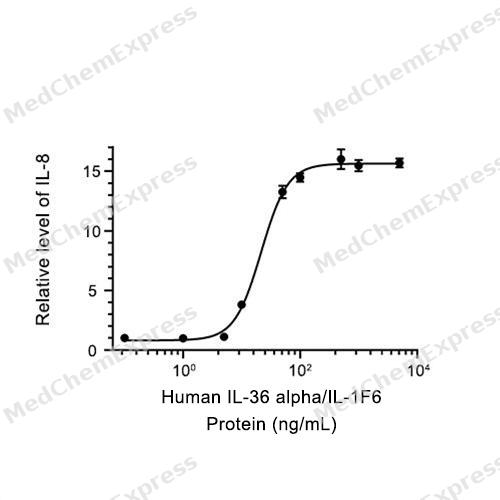
Bioactivity - Cell-Based Assay


Publications (1)
-
Journal Impact Factor
-
Most Recent
-
Cell Death Dis
RIPK3 promotes skin inflammation by enhancing IL-36α signaling and necroptosis in keratinocytes. [Abstract]2025 Oct 24;16(1):759. PMID: 41136377


Technical Parameters
-
Species Human
-
Source E. coli
-
Tag Tag Free
-
Accession
Q9UHA7 (K6-F158)
-
Protein Length
Full Length of Mature Protein
-
Synonyms
IL36A; Interleukin-1 Epsilon; Prev. IL1F6; FIL1 Epsilon; IL-1F6; IL-1 Epsilon; FIL1E; MGC129553; IL1(EPSILON); MGC129552; FIL1; IL-1F6 (FIL-1-Epsilon); Interleukin 1 Family, Member 6 (Epsilon); FIL1(EPSILON); Interleukin-1 Family Member 6; IL1E; Interleuk
-
AA Sequence
KIDTPQQGSIQDINHRVWVLQDQTLIAVPRKDRMSPVTIALISCRHVETLEKDRGNPIYLGLNGLNLCLMCAKVGDQPTLQLKEKDIMDLYNQPEPVKSFLFYHSQSGRNSTFESVAFPGWFIAVSSEGGCPLILTQELGKANTTDFGLTMLF
-
Predicted Molecular Mass
17.1 kDa
-
Molecular Weight
Approximately 17 kDa, based on SDS-PAGE under reducing conditions.
-
Purity
≥ 95%, as determined by reducing SDS-PAGE.


Product Properties
Lyophilized powder
1.Lyophilized from a 0.22 μm filtered solution of 50 mM Tris-HCl, 150 mM NaCl, 1 mM EDTA, 0.02% Tween 20, pH 8.0.
2.Lyophilized from a 0.22 μm filtered solution of 20 mM PB, 6% trehalose, 5mM EDTA, 0.05% Tween 80, pH 7.4.
Please refer to the lot-specific COA for specific buffer information.
Note: For SPR assay, please replace the buffer. Primary amine components (e.g., Tris, imidazole) can affect protein-coupled chips.
<1 EU/μg, determined by LAL method.
It is not recommended to reconstitute to a concentration less than 100 μg/mL in ddH2O. For long term storage it is recommended to add a carrier protein (0.1% BSA, 5% HSA, 10% FBS or 5% Trehalose).
Stored at -20°C for 2 years from date of receipt. After reconstitution, it is stable at 4°C for 1 week or -20°C for longer (with carrier protein). It is recommended to freeze aliquots at -20°C or -80°C for extended storage.
Room temperature in continental US; may vary elsewhere.


Documentation
-
Data Sheet (265 KB)
-
SDS (252 KB)
- English - EN (252 KB)
- Français - FR (252 KB)
- Deutsch - DE (252 KB)
- Norwegian - NO (252 KB)
- Español - ES (252 KB)
- Swedish - SV (252 KB)
- Italian - IT (252 KB)
- Korean - KR (252 KB)
- Portuguese - PT (252 KB)
-
Handling Instructions (2659 KB)


References
[1]. Zhou L,et al. Interleukin-36: Structure, Signaling and Function. Adv Exp Med Biol. 2021;21:191-210. [Content Brief]
[2]. Gresnigt MS, et al. Biology of IL-36 cytokines and their role in disease. Semin Immunol. 2013 Dec 15;25(6):458-65. [Content Brief]
[3]. Murrieta-Coxca JM, et al. IL-36 Cytokines: Regulators of Inflammatory Responses and Their Emerging Role in Immunology of Reproduction. Int J Mol Sci. 2019 Apr 3;20(7):1649. [Content Brief]
[4]. Li JM, et al. IL-36α/IL-36RA/IL-38 signaling mediates inflammation and barrier disruption in human corneal epithelial cells under hyperosmotic stress. Ocul Surf. 2021 Oct;22:163-171. [Content Brief]
[5]. Higgins J, et al. IL-36α induces maturation of Th1-inducing human MDDC and synergises with IFN-γ to induce high surface expression of CD14 and CD11c. Hum Immunol. 2015 Apr;76(4):245-53. [Content Brief]
[6]. Chang L, et al. IL-36α suppresses proliferation of ovarian cancer cells. Tumour Biol. 2017 Jun;39(6):1010428317706918. [Content Brief]

Calculators
Concentration (start) × Volume (start) = Concentration (final) × Volume (final)


 Powered by Bioz

