



MCP-2/CCL8 Protein, Human
Based on 2 publication(s) in Google Scholar
MCP-2/CCL8 Protein, Human is a CC chemokine that interacts with CCR1, CCR2B, CCR3, and CCR5 to mediate host inflammatory immune responses, tumorigenesis, and antiviral infections. MCP-2/CCL8 Protein, Human is a recombinant human MCP-2/CCL8 (Q24-P99) protein expressed by E. coli.
- Species: Human
- Source: E. coli
-
Storage:Stored at -20°C for 2 years from date of receipt. After reconstitution, it is stable at 4°C for 1 week or -20°C for longer (with carrier protein). It is recommended to freeze aliquots at -20°C or -80°C for extended storage.


To place orders, for customer services and technical support, please contact: MedChemExpress USA
Tel: 609-228-6898 E-mail: [email protected] [email protected]


-
 Biological Activity
-
Technical Parameters
-
Product Properties
- Documentation
- References
- Help & FAQs




Biological Activity
Description
MCP-2/CCL8 Protein, Human is a CC chemokine that interacts with CCR1, CCR2B, CCR3, and CCR5 to mediate host inflammatory immune responses, tumorigenesis, and antiviral infections. MCP-2/CCL8 Protein, Human is a recombinant human MCP-2/CCL8 (Q24-P99) protein expressed by E. coli[1][2].
Background
CCL8, also known as monocyte chemotactic protein 2 ( MCP2), is a small cell factor belonging to the CC chemokine family. First identified in human osteosarcoma cells, it is a protein encoded by the CCL8 gene located on human chromosome 17. CCL8 is mainly expressed in small intestine and peripheral blood cells. CCL8 can bind to several different chemokine cell surface receptors, such as CCR1, CCR2B, CCR3 and CCR5. CCL8 can act as a chemoattractant, attracting chemokines such as monocytes, lymphocytes, basophils and eosinophils to mediate inflammatory host responses. On the one hand, CCL8 contributes to the spread of breast cancer and promotes the migration and invasion of esophageal squamous cell carcinoma. On the other hand, it has also been reported that CCL8 inhibits cervical cancer tumor growth and exhibits anti-tumor metastatic effects in melanoma. cCL8 significantly activates ERK1/2 phosphorylation in glioblastoma cells and significantly reduces the invasiveness of glioma cells by neutralizing antibody blockade of tama-secreted CCL8. At the same time, CCL8 can act as a potent HIV1 inhibitor with high affinity for the receptor CCR5, which is one of the major co-receptors for HIV1[1][2].
In Vitro
MCP2/CCL8 (100 ng/mL, 48 h) can induce Epithelial-Mesenchymal Transition (EMT) by activation NF-κB signal pathway in human ESCC cell line Eca109 and promote migration and invasion of ESCC cells[3].
Verified Bioactivity
1.ED50<0.5 μg/mL, measured by
the FLIPR assay using CHO cells transfected with
human CCR5, the receptor of human CCL8, corre-
sponding to a specific activity of > 2 x 10³ units/mg.
2.Measured by its ability to chemoattract THP-1 human acute monocytic leukemia cells. The ED50 this effect is 0.1015 μg/mL, corresponding to a specific activity is 9852.217 U/mg.
MCE Validation Data
-
Purity - SDS-PAGE
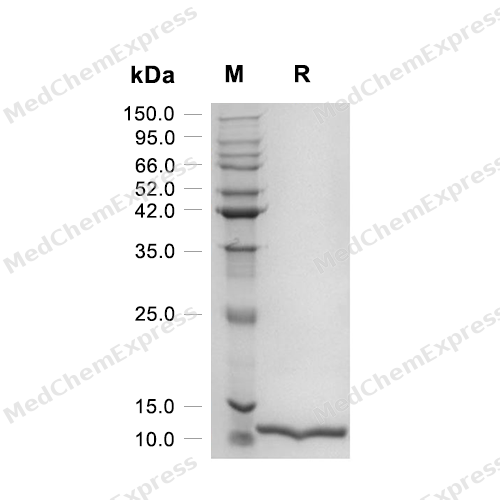
Purity - SDS-PAGE
-
Bioactivity - Cell-Based Assay
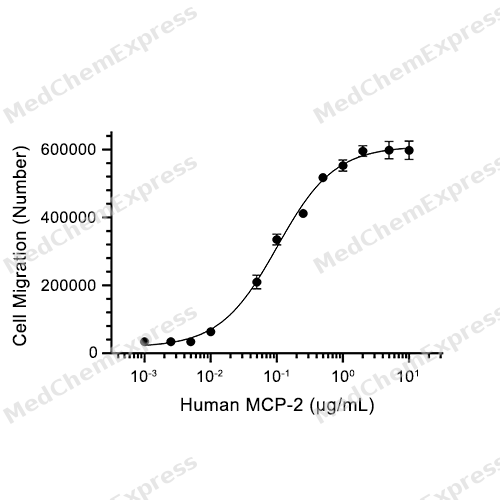
Bioactivity - Cell-Based Assay


Publications (2)
-
Journal Impact Factor
-
Most Recent
-
Nat Methods
Genetically encoded biosensor for monitoring spatiotemporal dynamics of CCR2 ligands in culture and in vivo. [Abstract]2025 Aug;22(8):1731-1741. PMID: 40665002 -
Cancer Lett
Targeting C/EBPβ/SCD1/C16:1 loop-driven macrophage M2 polarization by Bruceine D improves anti-PD-1 immunotherapy in colorectal cancer. [Abstract]2026 Sep 28:656:218655. PMID: 42250753


Technical Parameters
-
Species Human
-
Source E. coli
-
Tag Tag Free
-
Accession
P80075 (Q24-P99)
-
Molecular Construction
-
N-term
-
CCL8 (Q24-P99)
Accession # P80075 -
C-term
-
-
Protein Length
Full Length of C-C motif chemokine 8 Chain
-
Synonyms
CCL8; Chemokine (C-C Motif) Ligand 8; Prev. SCYA8; Small-Inducible Cytokine A8; MCP-2; C-C Motif Chemokine 8; HC14; SCYA10; Small Inducible Cytokine Subfamily A (Cys-Cys), Member 8 (Monocyte Chemotactic Protein 2); MCP2; Monocyte Chemoattractant Protein 2
-
AA Sequence
QPDSVSIPITCCFNVINRKIPIQRLESYTRITNIQCPKEAVIFKTKRGKEVCADPKERWVRDSMKHLDQIFQNLKP
-
Predicted Molecular Mass
8.9 kDa
-
Molecular Weight
Approximately 10 kDa, based on SDS-PAGE under reducing conditions.
-
Purity
≥ 95%, as determined by reducing SDS-PAGE.


Product Properties
Lyophilized powder.
Lyophilized from a 0.22 μm filtered solution of 20 mM PB, 150 mM NaCl, pH 6.8.
<1 EU/μg, determined by LAL method.
It is not recommended to reconstitute to a concentration less than 100 μg/mL in ddH2O. For long term storage it is recommended to add a carrier protein (0.1% BSA, 5% HSA, 10% FBS or 5% Trehalose).
Stored at -20°C for 2 years from date of receipt. After reconstitution, it is stable at 4°C for 1 week or -20°C for longer (with carrier protein). It is recommended to freeze aliquots at -20°C or -80°C for extended storage.
Room temperature in continental US; may vary elsewhere.


Documentation
-
Data Sheet (263 KB)
-
SDS (252 KB)
- English - EN (252 KB)
- Français - FR (252 KB)
- Deutsch - DE (252 KB)
- Norwegian - NO (252 KB)
- Español - ES (252 KB)
- Swedish - SV (252 KB)
- Italian - IT (252 KB)
- Korean - KR (252 KB)
- Portuguese - PT (252 KB)
-
Handling Instructions (2659 KB)


References
[1]. Xiang Zhang, et al. CCL8 secreted by tumor-associated macrophages promotes invasion and stemness of glioblastoma cells via ERK1/2 signaling. Lab Invest. 2020 Apr;100(4):619-629. [Content Brief]
[2]. Jan Korbecki, et al. CC Chemokines in a Tumor: A Review of Pro-Cancer and Anti-Cancer Properties of the Ligands of Receptors CCR1, CCR2, CCR3, and CCR4. Int J Mol Sci. 2020 Nov 9;21(21):8412. [Content Brief]
[3]. Jian Zhou, et al. MCP2 activates NF-κB signaling pathway promoting the migration and invasion of ESCC cells. Cell Biol Int. 2018 Mar;42(3):365-372. [Content Brief]

Calculators
Concentration (start) × Volume (start) = Concentration (final) × Volume (final)


 Powered by Bioz

