Search Result
Results for "
(±)-Carnitine chloride (Standard)
" in MedChemExpress (MCE) Product Catalog:
2
Biochemical Assay Reagents
| Cat. No. |
Product Name |
Target |
Research Areas |
Chemical Structure |
-
- HY-B0399R
-
|
(R)-Carnitine (Standard); LevoCarnitine (Standard)
|
Reference Standards
Endogenous Metabolite
|
Neurological Disease
Cancer
|
|
L-Carnitine (Standard) is the analytical standard of L-Carnitine. This product is intended for research and analytical applications. L-Carnitine ((R)-Carnitine), a highly polar, small zwitterion, is an essential co-factor for the mitochondrial β-oxidation pathway. L-Carnitine functions to transport long chain fatty acyl-CoAs into the mitochondria for degradation by β-oxidation. L-Carnitine is an antioxidant. L-Carnitine can ameliorate metabolic imbalances in many inborn errors of metabolism .
|
-

-
- HY-N0197R
-
-

-
- HY-113408R
-
|
|
Reference Standards
Endogenous Metabolite
|
Metabolic Disease
|
|
Tiglyl carnitine (Standard) is the analytical standard of Tiglyl carnitine. This product is intended for research and analytical applications. Tiglyl carnitine is found to be associated with celiac disease and mitochondrial acetoacetyl-CoA thiolase (T2) deficiency.
|
-

-
- HY-B1836R
-
|
MET-88 (Standard); Quaterin (Standard)
|
Mitochondrial Metabolism
Reference Standards
|
Cardiovascular Disease
Metabolic Disease
|
|
Meldonium (Standard) is the analytical standard of Meldonium. This product is intended for research and analytical applications. Meldonium (MET-88) functions as a cardioprotective agent by cpmpetetively inhibiting γ-butyrobetaine hydroxylase (BBOX) and carnitine/organic cation transporter type 2 (OCTN2). Mildronate (Meldonium) exhibits IC50 values of 34-62 μM for human recombinant BBOX and an EC50 of 21 μM for human OCTN2. Meldonium is a fatty acid oxidation inhibitor .
|
-

-
- HY-113270AR
-
|
γ-Butyrobetaine chloride (Standard); DeoxyCarnitine chloride (Standard)
|
Endogenous Metabolite
Reference Standards
|
Cardiovascular Disease
Metabolic Disease
|
|
Actinine (chloride) (Standard) is the analytical standard of Actinine (chloride). This product is intended for research and analytical applications. Actinine (γ-Butyrobetaine) chloride is angiopathic substance produced as an intermediary metabolite by gut microbiota that feed on carnitine in dietary red meat.
|
-

-
- HY-B1880R
-
|
|
Herbicide
Reference Standards
Cytochrome P450
|
Neurological Disease
Metabolic Disease
|
|
Oxadiazon (Standard) is the analytical standard of Oxadiazon (HY-B1880). This product is intended for research and analytical applications. Oxadiazon is an orally active herbicide. Oxadiazon reduces hepatic cytochrome P450 levels. Oxadiazon increases palmitoyl CoA oxidase, acetyl carnitine transferase, and hepatic ALAS activity. Oxadiazon induces hepatomegaly and experimental porphyria. Oxadiazon controls weeds. Oxadiazon may be used in neurodegenerative disease research .
|
-

-
- HY-113201R
-
|
|
Reference Standards
Endogenous Metabolite
|
Metabolic Disease
|
|
Tetradecanoylcarnitine (Standard) is the analytical standard of Tetradecanoylcarnitine. This product is intended for research and analytical applications. Tetradecanoylcarnitine is a human carnitine involved in β-oxidation of long-chain fatty acids.
|
-

-
- HY-B2246R
-
|
(R)-Carnitine hydrochloride (Standard); LevoCarnitine hydrochloride (Standard)
|
Reference Standards
Endogenous Metabolite
|
Metabolic Disease
Cancer
|
|
L-Carnitine (hydrochloride) (Standard) is the analytical standard of L-Carnitine (hydrochloride). This product is intended for research and analytical applications. L-Carnitine hydrochloride ((R)-Carnitine hydrochloride), a highly polar, small zwitterion, is an essential co-factor for the mitochondrial β-oxidation pathway. L-Carnitine hydrochloride functions to transport long chain fatty acyl-CoAs into the mitochondria for degradation by β-oxidation. L-Carnitine hydrochloride is an antioxidant. L-Carnitine hydrochloride can ameliorate metabolic imbalances in many inborn errors of metabolism .
|
-

-
- HY-W012550R
-
|
|
Reference Standards
Parasite
|
Infection
|
|
D-Carnitine (Standard) is the analytical standard of D-Carnitine. This product is intended for research and analytical applications. D-Carnitine is an orally available isomer of the essential nutrient L-carnitine that promotes long-chain fatty acid transport into the mitochondrial matrix for beta-oxidation. D-Carnitine has antiparasitic activity .
|
-

-
- HY-113165AR
-
|
|
Endogenous Metabolite
Reference Standards
|
Metabolic Disease
|
|
Isobutyryl-L-carnitine (chloride) (Standard) is the analytical standard of Isobutyryl-L-carnitine (chloride). This product is intended for research and analytical applications. Isobutyryl-L-carnitine chloride is a product of the acyl-CoA dehydrogenases .
|
-

-
- HY-50202R
-
|
(R)-(+)-Etomoxir (Standard)
|
Carnitine Palmitoyltransferase (CPT)
Apoptosis
Reference Standards
|
Metabolic Disease
Cancer
|
|
Etomoxir (Standard) is the analytical standard of Etomoxir. This product is intended for research and analytical applications. Etomoxir ((R)-(+)-Etomoxir) is an irreversible inhibitor of carnitine palmitoyltransferase 1a (CPT-1a), inhibits fatty acid oxidation (FAO) through CPT-1a and inhibits palmitate β-oxidation in human, rat and guinea pig.
|
-

-
- HY-135170R
-
|
|
Amino Acid Derivatives
Reference Standards
|
Others
|
|
Myristoyl-L-carnitine chloride (Standard) is the analytical standard of Myristoyl-L-carnitine chloride (HY-135170). This product is intended for research and analytical applications. Myristoyl-L-Carnitine Chloride is a natural long-chain glycoline, amino acid derivative.
|
-

-
- HY-130466R
-
|
|
Endogenous Metabolite
GlyT
|
Metabolic Disease
|
|
Stearoyl-L-carnitine (chloride) (Standard) is the analytical standard of Stearoyl-L-carnitine (chloride). This product is intended for research and analytical applications. Stearoyl-L-carnitine chloride is an endogenous long-chain acylcarnitine. Stearoyl-L-carnitine chloride is a less potent inhibitor of GlyT2. Stearoyl-L-carnitine chloride inhibits glycine responses by 16.8% at concentrations up 3 μM .
|
-

-
- HY-135035R
-
|
(-)-DecanoylCarnitine (Standard)
|
Endogenous Metabolite
Reference Standards
|
Metabolic Disease
Cancer
|
|
Decanoyl-L-carnitine ((-)-Decanoylcarnitine) (Standard) is the analytical standard of Decanoyl-L-carnitine (HY-135035). This product is intended for research and analytical applications. Decanoyl-L-carnitine is an endogenous metabolite. Decanoyl-L-carnitine can be used as a serum metabolic biomarkers as indicators in the progression of intravenous leiomyomatosis .
|
-

-
- HY-W105518R
-
|
|
Reference Standards
Endogenous Metabolite
|
Neurological Disease
|
|
L-Carnitine (tartrate) (Standard) is the analytical standard of L-Carnitine (tartrate). This product is intended for research and analytical applications. L-Carnitine tartrate is a highly polar, small zwitterion. L-Carnitine tartrate is an essential co-factor for the mitochondrial β-oxidation pathway. L-Carnitine tartrate functions to transport long chain fatty acyl-CoAs into the mitochondria for degradation by β-oxidation. L-Carnitine tartrate is an antioxidant. L-Carnitine tartrate can ameliorate metabolic imbalances in many inborn errors of metabolism [3] .
|
-

-
- HY-B0762R
-
|
O-Acetyl-L-Carnitine hydrochloride (Standard); ALCAR hydrochloride (Standard)
|
Endogenous Metabolite
Caspase
Reference Standards
Apoptosis
|
Neurological Disease
|
|
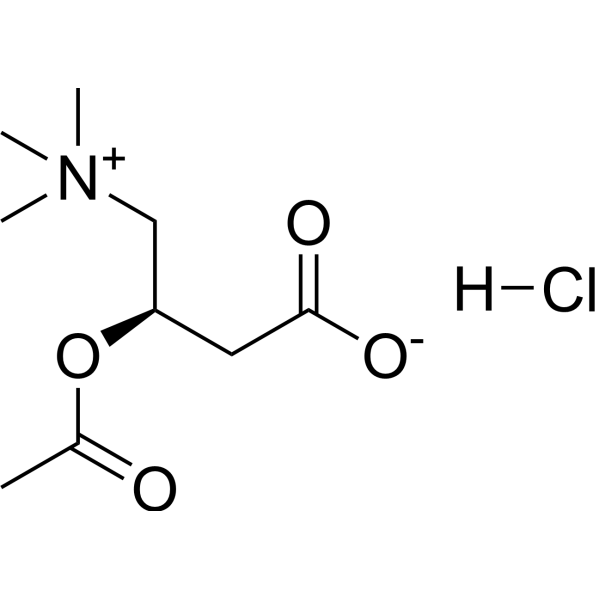
Acetyl-L-carnitine hydrochloride (Standard) is the analytical standard of Acetyl-L-carnitine hydrochloride. This product is intended for research and analytical applications. Acetyl-L-carnitine (O-Acetyl-L-carnitine; ALCAR) hydrochloride is an orally active mitochondrial energy metabolism regulator and neuroprotectant that can penetrate the blood-brain barrier. Acetyl-L-carnitine hydrochloride selectively enters cells and the brain through the organic cation transporter OCTN2. Acetyl-L-carnitine hydrochloride can participate in fatty acid β-oxidation, promote acetylcholine synthesis, regulate mitochondrial function and inhibit oxidative stress as an acetyl donor. Acetyl-L-carnitine hydrochloride exerts its activity by enhancing energy metabolism, protecting neurons and improving synaptic plasticity. Acetyl-L-carnitine hydrochloride is mainly used in the study of neurodegenerative diseases and metabolic disorder-related diseases such as neonatal hypoxic-ischemic brain damage, Alzheimer's disease, and depression .
|
-
-
- HY-B1836AR
-
|
MET-88 dihydrate (Standard); Quaterin dihydrate (Standard)
|
Reference Standards
Mitochondrial Metabolism
|
Cardiovascular Disease
Neurological Disease
Metabolic Disease
|
|
Meldonium (dihydrate) (Standard) is the analytical standard of Meldonium (dihydrate). This product is intended for research and analytical applications. Meldonium (MET-88) dihydrate functions as a cardioprotective agent by cpmpetetively inhibiting γ-butyrobetaine hydroxylase (BBOX) and carnitine/organic cation transporter type 2 (OCTN2). Mildronate dihydrate exhibits IC50 values of 34-62 μM for human recombinant BBOX and an EC50 of 21 μM for human OCTN2. Meldonium dihydrate is a fatty acid oxidation inhibitor .
|
-

-
- HY-B1453R
-
|
DL-Carnitine chloride (Standard); DL-LevoCarnitine chloride (Standard)
|
Reference Standards
Reactive Oxygen Species (ROS)
|
Metabolic Disease
|
|
Benoxaprofen (Standard) is the analytical standard of Benoxaprofen. This product is intended for research and analytical applications. Benoxaprofen (LRCL 3794) is a potent and long-acting anti-inflammatory and antipyretic compound. Benoxaprofen is a relatively weak inhibitor of cyclooxygenase in in vitro systems, inhibits lipoxygenase in other systems, and inhibits monocyte migration in some animal models of inflammation .
|
-

-
- HY-145534
-
|
CAR 8:1; C8:1 Carnitine; L-Carnitine trans-2-octenoyl ester
|
Biochemical Assay Reagents
|
Others
|
|
trans-2-Octenoyl-L-carnitine is a synthetic carnitine. It has been used as a standard for the detection of carnitines in human urine.
|
-

-
- HY-N11200R
-
|
|
Endogenous Metabolite
Reference Standards
|
Metabolic Disease
|
|
3-Hydroxyisovalerylcarnitine (Standard) is the analytical standard of 3-Hydroxyisovalerylcarnitine. This product is intended for research and analytical applications. 3-Hydroxyisovalerylcarnitine is a carnitine derivative. 3-Hydroxyisovaleryl carnitine in plasma may serve as a novel biomarker of biotin deficiency in humans, with its concentration increasing with biotin deficiency. Biotin deficiency reduces the activity of biotin-dependent 3-methylcrotonyl-CoA carboxylase, hinders the conversion of 3-methylcrotonyl-CoA into 3-methylglutaconyl-CoA, and impairs the leucine catabolism pathway; resulting in plasma 3-Hydroxyisovalerylcarnitine concentrations rise .
|
-

-
- HY-101018R
-
|
|
Reference Standards
Endogenous Metabolite
|
Inflammation/Immunology
|
|
Propionyl-DL-carnitine (chloride) (Standard) is the analytical standard of Propionyl-DL-carnitine (chloride). This product is intended for research and analytical applications. Propionyl-DL-carnitine chloride is a carnitine derivative. Propionyl-DL-carnitine chloride can be used for the research of inflammation .
|
-

-
- HY-W014787R
-
|
Sebacic acid (Standard)
|
Reference Standards
Endogenous Metabolite
|
Metabolic Disease
|
|
Decanedioic acid (Standard) is the analytical standard of Decanedioic acid (HY-W014787). This product is intended for research and analytical applications. Decanedioic acid is a straight-chain dicarboxylic acid. Dodecanedioic acid overcomes metabolic inflexibility in type 2 diabetes. Decanedioic acid prevents and reverses metabolic-associated liver disease and obesity. Decanedioic acid is associated with carnitine-acylcarnitine translocase deficiency and medium chain acyl-CoA dehydrogenase deficiency .
|
-

-
- HY-B2004R
-
|
|
Reference Standards
Fungal
Mitochondrial Metabolism
|
Infection
|
|
Thifluzamide (Standard) is the analytical standard of Thifluzamide. This product is intended for research and analytical applications. Thifluzamide is a fungicide that inhibits fungal respiration by blocking the ubiquinone-binding site in mitochondrial complex II. Thifluzamide exhibits significant activity against Basidiomycota pathogens (such as Rhizoctonia cerealis, Ustilago and Puccinia genera) and is commonly used in studies on wheat sharp eyespot. Thifluzamide displays a dual mechanism in regulating lipid metabolism: it reduces fatty acid synthase activity to inhibit endogenous fatty acid synthesis, and increases carnitine palmitoyltransferase-I activity to accelerate fatty acid β-oxidation, thereby reducing total cholesterol and triglyceride levels in the liver. Thifluzamide also induces hepatotoxicity in zebrafish models and carries a risk of developmental toxicity. Thifluzamide inhibition of Rhizoctonia cerealis may result in low to moderate levels of drug resistance, leading to the generation of stable drug-resistant mutants .
|
-

-
- HY-113166R
-
|
(-)-LauroylCarnitine (Standard)
|
Reference Standards
Endogenous Metabolite
|
Metabolic Disease
Inflammation/Immunology
|
|
Dodecanoylcarnitine (Standard) is the analytical standard of Dodecanoylcarnitine (HY-113166). This product is intended for research and analytical applications. Dodecanoylcarnitine ((-)-Lauroylcarnitine) is a medium long-chain acylcarnitine, an intermediate product in key energy metabolic pathways of fatty acid β-oxidation and amino acids catabolism. The abnormal decrease in the Dodecanoylcarnitine levels indicats that mitochondrial fuel metabolism, including fatty acid oxidation is significantly disturbed. Changes in plasma concentrations of Dodecanoylcarnitine are not only associated with type II diabetes, but also with pre-diabetes status. Dodecanoylcarnitine is present in fatty acid oxidation disorders such as long-chain acyl CoA dehydrogenase deficiency, carnitine palmitoyltransferase I/II deficiency, and is also associated with celiac disease. Dodecanoylcarnitine deomonstrates high sensitivities and specificities in predicting asthma. Combined model of Decanoylcarnitine (HY-113069), Dodecanoylcarnitine, PC (16:0/0:0), and Asp Arg Pro can be used as a potential biomarker for the diagnosis of Yin-deficiency-heat syndrome .
|
-

| Cat. No. |
Product Name |
Type |
-
- HY-W012550R
-
|
|
Biochemical Assay Reagents
|
|
D-Carnitine (Standard) is the analytical standard of D-Carnitine. This product is intended for research and analytical applications. D-Carnitine is an orally available isomer of the essential nutrient L-carnitine that promotes long-chain fatty acid transport into the mitochondrial matrix for beta-oxidation. D-Carnitine has antiparasitic activity .
|
-
- HY-W105518R
-
|
|
Biochemical Assay Reagents
|
|
L-Carnitine (tartrate) (Standard) is the analytical standard of L-Carnitine (tartrate). This product is intended for research and analytical applications. L-Carnitine tartrate is a highly polar, small zwitterion. L-Carnitine tartrate is an essential co-factor for the mitochondrial β-oxidation pathway. L-Carnitine tartrate functions to transport long chain fatty acyl-CoAs into the mitochondria for degradation by β-oxidation. L-Carnitine tartrate is an antioxidant. L-Carnitine tartrate can ameliorate metabolic imbalances in many inborn errors of metabolism [3] .
|
| Cat. No. |
Product Name |
Category |
Target |
Chemical Structure |
-
- HY-B0399R
-
-
-
- HY-N0197R
-
-
-
- HY-113408R
-
-
-
- HY-113270AR
-
-
-
- HY-113201R
-
-
-
- HY-B2246R
-
|
(R)-Carnitine hydrochloride (Standard); LevoCarnitine hydrochloride (Standard)
|
Structural Classification
Ketones, Aldehydes, Acids
Endogenous metabolite
Source Classification
|
Reference Standards
Endogenous Metabolite
|
|
L-Carnitine (hydrochloride) (Standard) is the analytical standard of L-Carnitine (hydrochloride). This product is intended for research and analytical applications. L-Carnitine hydrochloride ((R)-Carnitine hydrochloride), a highly polar, small zwitterion, is an essential co-factor for the mitochondrial β-oxidation pathway. L-Carnitine hydrochloride functions to transport long chain fatty acyl-CoAs into the mitochondria for degradation by β-oxidation. L-Carnitine hydrochloride is an antioxidant. L-Carnitine hydrochloride can ameliorate metabolic imbalances in many inborn errors of metabolism .
|
-
-
- HY-113165AR
-
-
-
- HY-130466R
-
|
|
Ketones, Aldehydes, Acids
Endogenous metabolite
Source Classification
|
Endogenous Metabolite
GlyT
|
|
Stearoyl-L-carnitine (chloride) (Standard) is the analytical standard of Stearoyl-L-carnitine (chloride). This product is intended for research and analytical applications. Stearoyl-L-carnitine chloride is an endogenous long-chain acylcarnitine. Stearoyl-L-carnitine chloride is a less potent inhibitor of GlyT2. Stearoyl-L-carnitine chloride inhibits glycine responses by 16.8% at concentrations up 3 μM .
|
-
-
- HY-B0762R
-
|
O-Acetyl-L-Carnitine hydrochloride (Standard); ALCAR hydrochloride (Standard)
|
Structural Classification
Alkaloids
Other Alkaloids
Endogenous metabolite
Source Classification
|
Endogenous Metabolite
Caspase
Reference Standards
Apoptosis
|
|
Acetyl-L-carnitine hydrochloride (Standard) is the analytical standard of Acetyl-L-carnitine hydrochloride. This product is intended for research and analytical applications. Acetyl-L-carnitine (O-Acetyl-L-carnitine; ALCAR) hydrochloride is an orally active mitochondrial energy metabolism regulator and neuroprotectant that can penetrate the blood-brain barrier. Acetyl-L-carnitine hydrochloride selectively enters cells and the brain through the organic cation transporter OCTN2. Acetyl-L-carnitine hydrochloride can participate in fatty acid β-oxidation, promote acetylcholine synthesis, regulate mitochondrial function and inhibit oxidative stress as an acetyl donor. Acetyl-L-carnitine hydrochloride exerts its activity by enhancing energy metabolism, protecting neurons and improving synaptic plasticity. Acetyl-L-carnitine hydrochloride is mainly used in the study of neurodegenerative diseases and metabolic disorder-related diseases such as neonatal hypoxic-ischemic brain damage, Alzheimer's disease, and depression .
|
-
-
- HY-B1453R
-
-
-
- HY-N11200R
-
|
|
Natural Products
Microorganisms
Source Classification
|
Endogenous Metabolite
Reference Standards
|
|
3-Hydroxyisovalerylcarnitine (Standard) is the analytical standard of 3-Hydroxyisovalerylcarnitine. This product is intended for research and analytical applications. 3-Hydroxyisovalerylcarnitine is a carnitine derivative. 3-Hydroxyisovaleryl carnitine in plasma may serve as a novel biomarker of biotin deficiency in humans, with its concentration increasing with biotin deficiency. Biotin deficiency reduces the activity of biotin-dependent 3-methylcrotonyl-CoA carboxylase, hinders the conversion of 3-methylcrotonyl-CoA into 3-methylglutaconyl-CoA, and impairs the leucine catabolism pathway; resulting in plasma 3-Hydroxyisovalerylcarnitine concentrations rise .
|
-
-
- HY-101018R
-
-
-
- HY-W014787R
-
-
-
- HY-113166R
-
|
(-)-LauroylCarnitine (Standard)
|
Structural Classification
Immune System Disorder
Microorganisms
Ketones, Aldehydes, Acids
Disease markers
Endocrine diseases
Endogenous metabolite
Source Classification
|
Reference Standards
Endogenous Metabolite
|
|
Dodecanoylcarnitine (Standard) is the analytical standard of Dodecanoylcarnitine (HY-113166). This product is intended for research and analytical applications. Dodecanoylcarnitine ((-)-Lauroylcarnitine) is a medium long-chain acylcarnitine, an intermediate product in key energy metabolic pathways of fatty acid β-oxidation and amino acids catabolism. The abnormal decrease in the Dodecanoylcarnitine levels indicats that mitochondrial fuel metabolism, including fatty acid oxidation is significantly disturbed. Changes in plasma concentrations of Dodecanoylcarnitine are not only associated with type II diabetes, but also with pre-diabetes status. Dodecanoylcarnitine is present in fatty acid oxidation disorders such as long-chain acyl CoA dehydrogenase deficiency, carnitine palmitoyltransferase I/II deficiency, and is also associated with celiac disease. Dodecanoylcarnitine deomonstrates high sensitivities and specificities in predicting asthma. Combined model of Decanoylcarnitine (HY-113069), Dodecanoylcarnitine, PC (16:0/0:0), and Asp Arg Pro can be used as a potential biomarker for the diagnosis of Yin-deficiency-heat syndrome .
|
-
Your information is safe with us. * Required Fields.
Inquiry Information
- Product Name:
- Cat. No.:
- Quantity:
- MCE Japan Authorized Agent:








