14 Results for "

LPA Receptor Activator

" in MedChemExpress (MCE) Product Catalog:
Products (14)

14 Results for "LPA Receptor Activator" in MCE Product Catalog:

11
11 Publications Verification
Cat. No.: HY-13285
CAS No.: 355025-24-0
Purity:  98.88%
Synonyms: Debio 0719
Target:  

LPL Receptor YAP

Research Areas:  

Neurological Disease Cancer

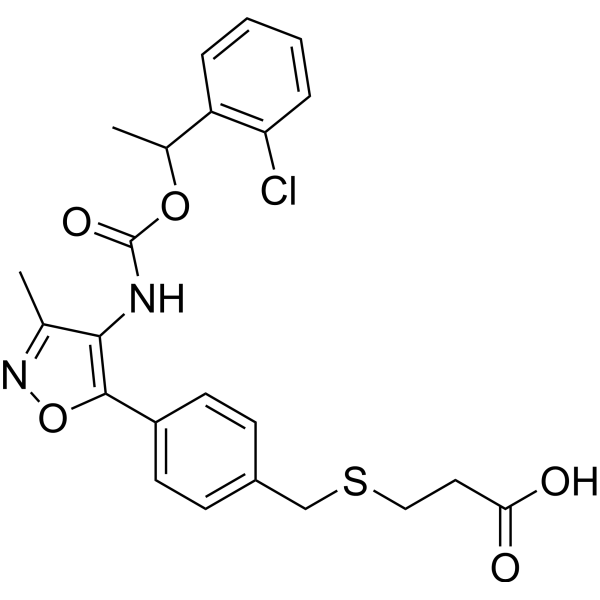
Ki16425 (Debio 0719) is a subtype-selective, competitive antagonist of the EDG-family receptors, LPA1 and LPA3 with Kis of 0.34 μM and 0.93 μM, respectively. Ki16425 (Debio 0719) reduces the LPA-induced activation of p42/p44 MAPK . Ki16425 can also inhibit LPA-induced dephosphorylation of Yes-associated protein (YAP)/TAZ in HEK293A cells .
loading...
    loading...
3
3 Cited Publications
Cat. No.: HY-107614
CAS No.: 325465-93-8
Purity:  99.80%
Synonyms: 1-Oleoyl-sn-glycero-3-phosphate sodium; 1-Oleoyl-LPA sodium
Target:  

LPL Receptor Mitosis

Research Areas:  

Neurological Disease

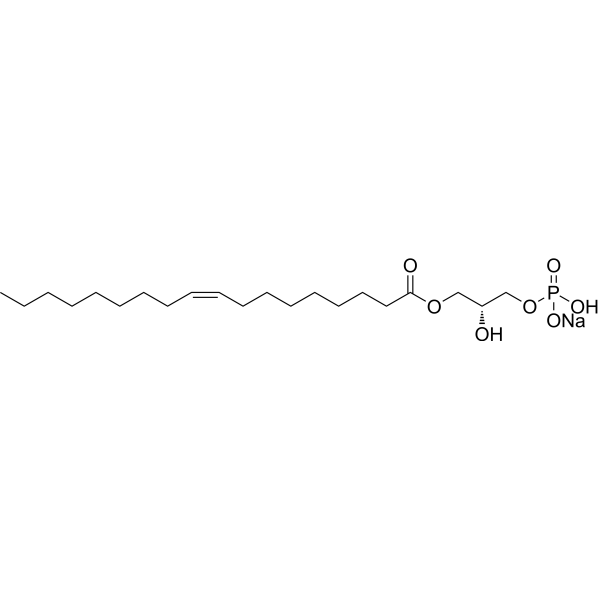
1-Oleoyl lysophosphatidic acid (1-Oleoyl-sn-glycero-3-phosphate) sodium, a potent bioactive phospholipid, is a LPA receptor activator. 1-Oleoyl lysophosphatidic acid sodium can promote mitosis by inducing DNA synthesis. 1-Oleoyl lysophosphatidic acid sodium is also involved in normal and pathological emotional responses, including anxiety and depression .
loading...
    loading...
3
3 Cited Publications
Cat. No.: HY-137862
CAS No.: 65528-98-5
Purity:  99.90%
Synonyms: 1-Oleoyl-sn-glycero-3-phosphate; 1-Oleoyl-LPA
Target:  

LPL Receptor

Research Areas:  

Neurological Disease

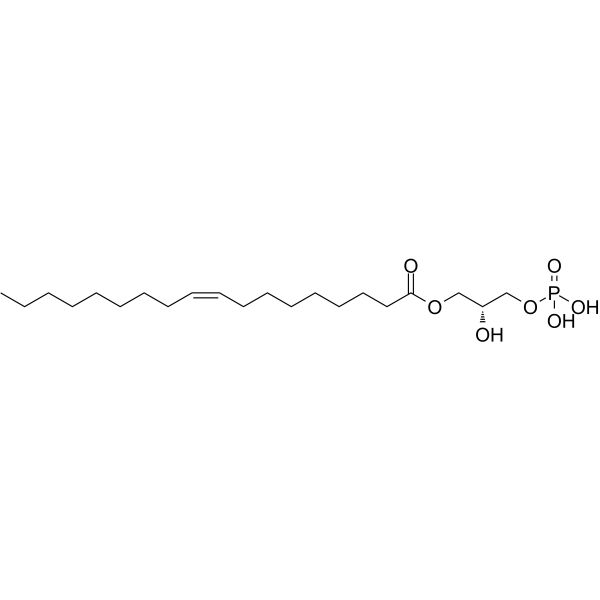
1-Oleoyl lysophosphatidic acid (1-Oleoyl-sn-glycero-3-phosphate) is an abundant lysophosphatidic acid (LPA) species with high biological activity due to its strong affinity for the LPA receptors. 1-Oleoyl lysophosphatidic acid is commonly used in most laboratories as a reagent for LPA receptor activation . 1-Oleoyl lysophosphatidic acid increases SRE-driven β-galactosidase activity .
loading...
    loading...
Cat. No.: HY-157693
CAS No.: 799268-69-2
Target:  

Endogenous Metabolite

Research Areas:  

Cancer

C18:1 Cyclic LPA is a naturally occurring analog of the growth factor-like phospholipid mediator, lysophosphatidic acid (LPA), characterized by the formation of a 5-membered ring between its sn-2 hydroxy group and the sn-3 phosphate. This unique structure allows C18:1 Cyclic LPA to influence a variety of cellular functions, such as inhibiting cell cycle progression, promoting the formation of stress fibers, curtailing tumor cell invasiveness and metastasis, and modulating the differentiation and survival of neuronal cells. Notably, many of these cellular effects elicited by C18:1 Cyclic LPA appear to counter those induced by LPA, despite the activation of seemingly similar receptor populations.
loading...
    loading...
Cat. No.: HY-120967
CAS No.: 1217471-69-6
Purity:  ≥99.0%
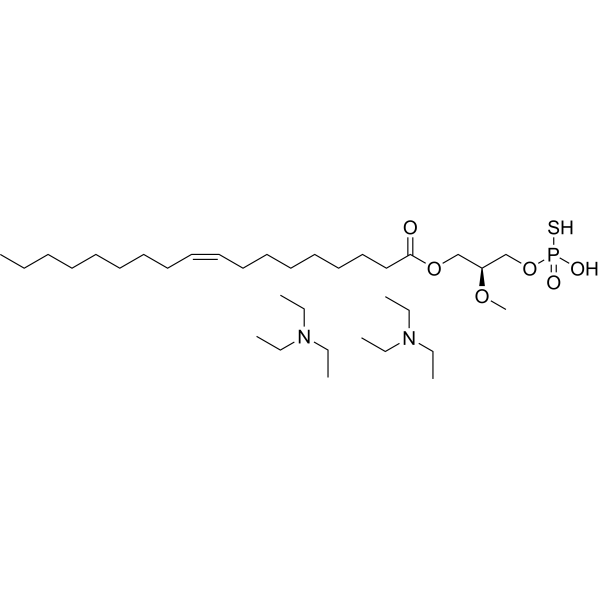
(2S)-OMPT (triethylamine), in ethanol:chloroform (1:1), 98%, Lysophosphatidic acid analogue, is a LPA3 G-protein-coupled receptor agonist. (2S)-OMPT (triethylamine), in ethanol:chloroform (1:1), 98% selectively activates LPA3 G-protein-coupled receptor to trigger downstream cellular signaling events. (2S)-OMPT (triethylamine), in ethanol:chloroform (1:1), 98% induces calcium, IL-6 release in cancer cells and activates MAPK and Akt signaling pathways. (2S)-OMPT (triethylamine), in ethanol:chloroform (1:1), 98% can be used for the research of ovarian cancer .
loading...
    loading...
Cat. No.: HY-120967A
CAS No.: 645408-61-3
Research Areas:  

Cancer

(2S)-OMPT, Lysophosphatidic acid analogue, is a LPA3 G-protein-coupled receptor agonist. (2S)-OMPT selectively activates LPA3 G-protein-coupled receptor to trigger downstream cellular signaling events. (2S)-OMPT induces calcium, IL-6 release in cancer cells and activates MAPK and Akt signaling pathways. (2S)-OMPT can be used for the research of ovarian cancer .
loading...
    loading...
Cat. No.: HY-137862A
CAS No.: 22002-87-5
Synonyms: (Rac)-1-Oleoyl-sn-glycero-3-phosphate; (Rac)-1-Oleoyl-LPA
Research Areas:  

Neurological Disease

(Rac)-1-Oleoyl lysophosphatidic acid is an isomer of 1-Oleoyl lysophosphatidic acid sodium (HY-107614). 1-Oleoyl lysophosphatidic acid sodium is a bioactive lipid that can activate the LPA receptors .
loading...
    loading...
Cat. No.: HY-N15794
CAS No.: 2389048-52-4
Target:  

LPL Receptor

Research Areas:  

Neurological Disease

AzoLPA ammonium is a photoswitchable lipid that activates the Lysophosphatidic acid 1-5 (LPA1-5) receptors signaling .
loading...
    loading...
Cat. No.: HY-W040176
CAS No.: 799268-45-4
Synonyms: N-Palmitoyl-tyrosine phosphoric acid ammonium
N-PTyrosine PA (N-Palmitoyl-tyrosine phosphoric acid) ammonium is a lysophosphatidic acid (LPA) receptor modulator, which exhibits weak inhibitory activity against LPA1 and partial agonist properties towards LPA5. N-PTyrosine PA ammonium inhibits the activation of LPA receptors and downstream responses by competing with agonists for binding sites. N-PTyrosine PA ammonium can induce morphological changes and aggregation, and also inhibit LPA-induced morphological changes through receptor desensitization caused by pre-incubation. N-PTyrosine PA ammonium can be used in the research of related diseases such as atherosclerosis and acute ischemic syndromes (e.g., unstable angina, myocardial infarction, stroke) .
loading...
    loading...
Cat. No.: HY-175084
Synonyms: 1-Hexadecyl LPA sodium; 1-Palmityl LPA sodium; LPA O-16:0 sodium
Target:  

LPL Receptor

Research Areas:  

Metabolic Disease

1-Hexadecyl lysophosphatidic acid (1-Hexadecyl LPA) sodium, an ether analog of lysophosphatidic acid (LPA), is a LPA receptor activator .
loading...
    loading...
Cat. No.: HY-W923661
CAS No.: 52977-29-4
Synonyms: PA(O-18:0/0:0); 1-Oleyl LPA; 1-Octadecyl LPA
Target:  

LPL Receptor

Research Areas:  

Others

1-Octadecyl lysophosphatidic acid (compound 10) is a GPR92 receptor (LPA5) activator with potential flavoring effects .
loading...
    loading...
Cat. No.: HY-13285R
CAS No.: 355025-24-0
Synonyms: Debio 0719 (Standard)
Ki16425 (Standard) is the analytical standard of Ki16425. This product is intended for research and analytical applications. Ki16425 (Debio 0719) is a subtype-selective, competitive antagonist of the EDG-family receptors, LPA1 and LPA3 with Kis of 0.34 μM and 0.93 μM, respectively. Ki16425 (Debio 0719) reduces the LPA-induced activation of p42/p44 MAPK . Ki16425 can also inhibit LPA-induced dephosphorylation of Yes-associated protein (YAP)/TAZ in HEK293A cells .
loading...
    loading...
Cat. No.: HY-119013
CAS No.: 717110-61-7
Target:  

Endogenous Metabolite

Research Areas:  

Cardiovascular Disease

VPC32183 is a competitive antagonist of LPA1 and LPA3 receptors. The activity of VPC32183 can inhibit lipid phosphatase 1 (LPP1), thereby preventing the activation of ERK(1/2) by dioctanoic acid diglyceride (DGPP 8:0). By reducing the expression of LPP1, VPC32183 can further reduce DGPP 8:0-induced ERK(1/2) activation. The effects of VPC32183 suggest that it may have a positive regulatory function in cell signaling processes .
loading...
    loading...
Cat. No.: HY-107614R
CAS No.: 325465-93-8
Synonyms: 1-Oleoyl-sn-glycero-3-phosphate sodium (Standard); 1-Oleoyl-LPA sodium (Standard)
1-Oleoyl lysophosphatidic acid sodium (Standard) is the analytical standard of 1-Oleoyl lysophosphatidic acid (sodium) (HY-107614). This product is intended for research and analytical applications. 1-Oleoyl lysophosphatidic acid (1-Oleoyl-sn-glycero-3-phosphate) sodium, a potent bioactive phospholipid, is a LPA receptor activator. 1-Oleoyl lysophosphatidic acid sodium can promote mitosis by inducing DNA synthesis. 1-Oleoyl lysophosphatidic acid sodium is also involved in normal and pathological emotional responses, including anxiety and depression .
loading...
    loading...
  • 1

