


1. Search Result
Search Result
Results for "

PD-L1-IN-2

" in MedChemExpress (MCE) Product Catalog:

17

Inhibitors & Agonists

6

Inhibitory Antibodies

Cat. No. Product Name Target Research Areas Chemical Structure
  • HY-P99144

    PD-1/PD-L1 Inflammation/Immunology
    Anti-Mouse PD-1 Antibody (RMP1-14) is an anti-mouse PD-1 IgG2a antibody. Anti-Mouse PD-1 Antibody (RMP1-14) can be used for the study of colon carcinoma .
    Anti-Mouse PD-1 Antibody (RMP1-14)
  • HY-P9902A
    Pembrolizumab (anti-PD-1)
    5 Publications Verification

    MK-3475 (anti-PD-1); Lambrolizumab (anti-PD-1)

    PD-1/PD-L1 Cancer
    Pembrolizumab (anti-PD-1) is a humanized IgG4 antibody and PD-1 inhibitor. Pembrolizumab produces PD-1 blockade, preventing PD-L1 and PD-L2 from connecting to PD-1. This avoids the uncontrolled regulation of T cells on cells that normally express PD-1 .
    Pembrolizumab (anti-PD-1)
  • HY-101093
    CA-170
    2 Publications Verification

    PD-1/PD-L1 Inflammation/Immunology Cancer
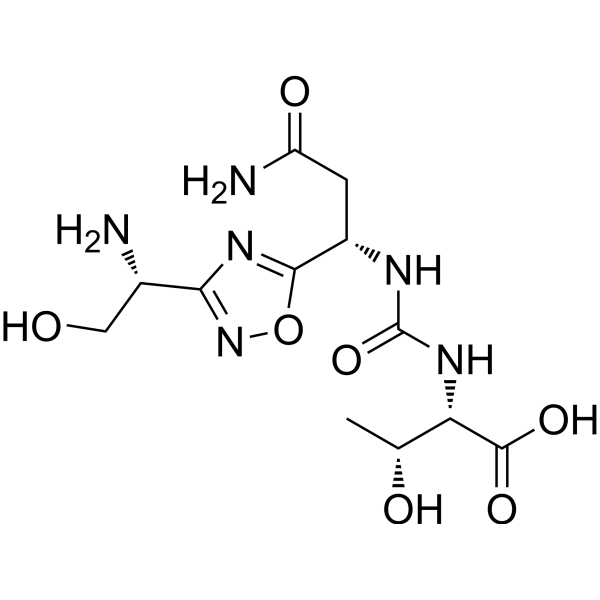
    CA-170 is an orally delivered dual inhibitor of VISTA and PD-L1. CA-170 exhibits potent rescue of proliferation and effector functions of T cells inhibited by PD-L1/L2 and VISTA with selectivity over other immune checkpoint proteins as well as a broad panel of receptors and enzymes .
    CA-170
  • HY-149830
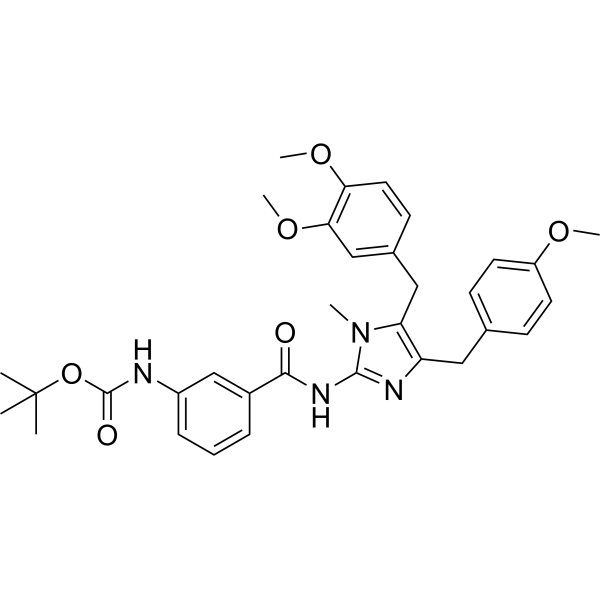
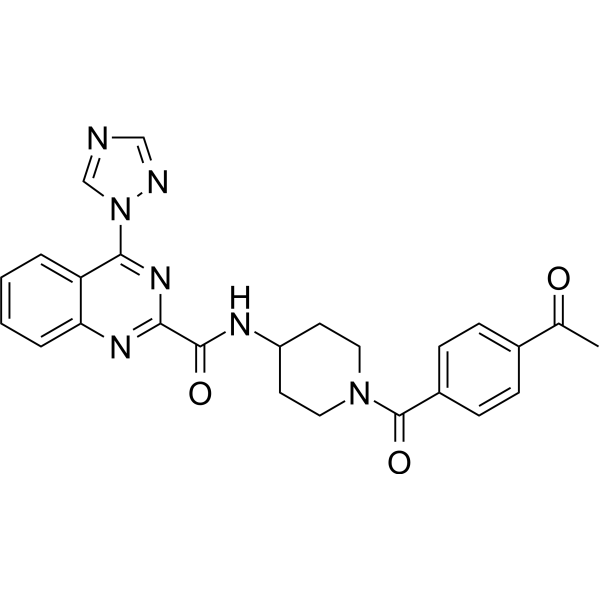
    PD-L1-IN-2
    1 Publications Verification

    PD-1/PD-L1 Cancer
    PD-L1-IN-2 is a potential tumor immunological agent by inhibiting PD-L1. PD-L1-IN-2 is a Naamidine J derivative and exerts antitumor effects in vivo by reducing PD-L1 expression and enhancing tumor-infiltrating T-cell immunity. PD-L1-IN-2 is used for colorectal cancer research .
    PD-L1-IN-2
  • HY-P99641

    PD-1/PD-L1 Cancer
    Gilvetmab is a potent caninized anti-PD-1 monoclonal antibody. Gilvetmab blocks the interaction between PD-1 and its ligand PD-L1/L2. Gilvetmab can be used in malignant melanoma and mast cell tumor research .
    Gilvetmab
  • HY-P99106

    PD-1/PD-L1 Cancer
    Acrixolimab a humanized IgG4-κ antibody, targeting to PD-1 .
    Acrixolimab
  • HY-162972

    PROTACs PD-1/PD-L1 Cancer
    PROTAC PD-L1 degrader-2 (Compound 9i) is a PROTAC degrader for PD-L1, that inhibits PD-L1 with an IC50 of 197.4 nM and exhibits an affinity with PD-L1 with a Kd of 301 nM. PROTAC PD-L1 degrader-2 promotes the internalization of PD-L1 on the cell membrane, and induces PD-L1 degradation via the synergistic effect of the proteasome and lysosomal pathways. PROTAC PD-L1 degrader-2 can activate the immune system, and exhibits antitumor efficacy in MC38 C57BL/6 mouse model .
    PROTAC PD-L1 degrader-2
  • HY-169363

    PD-1/PD-L1 Autophagy AUTACs Cancer
    PD-L1 degrader-2 (Compound B3) is an orally active AUTAC degrader, that degrades PD-L1 through autophagy-lysosome pathway with a DC50 of 0.5 μM. PD-L1 degrader-2 exhibits inhibitory activity against PD-1/PD-L1 interaction with an IC50 of 22.8 nM. PD-L1 degrader-2 upregulates the expressions of Atg9b, Lamp1 and Mitf, and activates the autophagy lysosome system. PD-L1 degrader- exhibits antitumor efficacy in CT26 mouse model . (Pink: autophagy-lysosome activator (HY-159894); Black: linker (HY-W015088); Blue: PD-L1 ligand (HY-169365))
    PDL1 degrader-2
  • HY-P99639

    Genolimzumab; APL-501; CBT-501; GB-226

    PD-1/PD-L1 Cancer
    Geptanolimab (CBT-501) is a humanized IgG4k monoclonal antibody against programmed death-1 (PD-1). Siplizumab inhibits the binding of PD-L1/L2 to PD-1 through a competitive action. Siplizumab can be used in research of cancer .
    Geptanolimab
  • HY-156150

    Fungal Cytochrome P450 PD-1/PD-L1 Infection
    CYP51/PD-L1-IN-2 (compound L20) is a quinazoline compound with antifungal activity. CYP51/PD-L1-IN-2 is a dual inhibitor of CYP51 (IC50: 0.263 μM) and PD-L1 (IC50: 0.017 μM), which can induce early apoptosis of fungal cells in the cell cycle. CYP51/PD-L1-IN-2 also significantly reduced intracellular IL-2, NLRP3, and NF-κBp65 protein levels, induced mitochondrial damage and ROS accumulation, and ultimately led to fungal lysis and death .
    CYP51/PD-L1-IN-2
  • HY-162841

    Ligands for Target Protein for PROTAC Cancer
    HPK1 ligand 1 is a PROTAC target protein ligand (Ligands for Target Protein for PROTACs). HPK1 ligand 1 can be used for synthesis PROTAC PD-L1 degrader-2 (HY-162816) .
    HPK1 ligand 1
  • HY-162840

    E3 Ligase Ligand-Linker Conjugates Cancer
    Thalidomide-azetidin-3-one is an E3 Ligase Ligand-Linker Conjugate. Thalidomide-azetidin-3-one can be used to synthesize PROTAC PD-L1 degrader-2 (HY-162816) .
    Thalidomide-azetidin-3-one
  • HY-182959

    Hsp-targeting Chimeras LYTACs PD-1/PD-L1 HSP Cancer
    Hsp70TAC PD-1 Degrader-2 is a PD-L1 Hsp70TAC (Hsp70-targeting Chimeras) degrader with Kd values of 0.36 μM. Hsp70TAC PD-1 Degrader-2 forms a ternary complex with Hsp70 and PD-L1 to drive PD-L1 degradation. Hsp70TAC PD-1 Degrader-2 induces degradation of mature membrane-bound PD-L1 in an Hsp70-dependent manner and via caveolin-mediated endocytosis and lysosomal trafficking. Hsp70TAC PD-1 Degrader-2 accumulates preferentially in tumor cells with elevated Hsp70 expression for tumor-selective PD-L1 degradation. Hsp70TAC PD-1 Degrader-2 can be used for the research of cancer, such as breast invasive carcinoma, glioblastoma multiforme, diffuse large b-cell lymphoma . (Pink: PD-1/PD-L1 ligand (HY-19745A); Blue: Hsp70 ligand (HY-182979); Black: linker (HY-182982)).
    Hsp70TAC PD-1 Degrader-2
  • HY-162842

    Ligands for Target Protein for PROTAC Cancer
    HPK1-IN-51 is a PROTAC target protein ligand (Ligands for Target Protein for PROTACs). HPK1-IN-51 can be used for synthesis PROTAC PD-L1 degrader-2 (HY-162816) .
    HPK1-IN-51
  • HY-182979

    HSP Cancer
    HSP70 ligand 2 is an HSP70 ligand and serves as a ligand for PROTAC target proteins. HSP70 ligand 2 can be used to synthesize Hsp70TAC BRD4 Degrader-1 (HY-182958) and Hsp70TAC PD-1 Degrader-2 (HY-182959) .
    HSP70 ligand 2
  • HY-101093R

    PD-1/PD-L1 Reference Standards Inflammation/Immunology Cancer
    CA-170 (Standard) is the analytical standard of CA-170 (HY-101093). This product is intended for research and analytical applications. CA-170 is an orally delivered dual inhibitor of VISTA and PD-L1. CA-170 exhibits potent rescue of proliferation and effector functions of T cells inhibited by PD-L1/L2 and VISTA with selectivity over other immune checkpoint proteins as well as a broad panel of receptors and enzymes .
    CA-170 (Standard)
  • HY-P992062

    PD-1/PD-L1 Inflammation/Immunology
    Anti-Mouse CD80 Antibody (TKMG48) is an antibody that targets mouse CD80. By specifically binding to and disrupting the CD80:PD-L1 complex to release PD-L1, Anti-Mouse CD80 Antibody (TKMG48) functions as an indirect PD-1 agonist without blocking CD28 co-stimulation or CD80-CTLA4 binding. Anti-Mouse CD80 Antibody (TKMG48) inhibits T cell activation, reduces T cell effector functions and antigen-specific CD8 + T cell populations, and does not interfere with the differentiation, migration, antigen presentation or surface marker expression of dendritic cells. Anti-Mouse CD80 Antibody (TKMG48) significantly attenuates disease severity in mouse models of arthritis, spondyloarthritis, multiple sclerosis and Sjögren's syndrome, and its activity depends on the expression of PD-1 and PD-L1 .
    Anti-Mouse CD80 Antibody (TKMG48)

Inquiry Online

Your information is safe with us. * Required Fields.

Salutation


Country or Region *

Applicant Name *


Organization Name *

Department *


Email Address *


Product Name *

Cat. No.


Requested quantity *

Phone Number *


Remarks

Inquiry Online

Inquiry Information

Product Name:
Cat. No.:
Quantity:
MCE Japan Authorized Agent:

