
1. Search Result
Search Result
Pathways Recommended: Protein Tyrosine Kinase/RTK
Results for "

Tyrosine decarboxylase

" in MedChemExpress (MCE) Product Catalog:

6

Inhibitors & Agonists

2

Natural
Products

2

Recombinant Proteins

Cat. No. Product Name Target Research Areas Chemical Structure
  • HY-P2825

    TDC; TyrDC

    Endogenous Metabolite Others
    Tyrosine decarboxylase, Microorganism (TDC) is a tyrosine decarboxylase produced by microorganisms. Tyrosine decarboxylase is a PLP-dependent enzyme that catalyzes the decarboxylation of L-tyrosine, L-phenylalanine, and L-dopa to produce tyramine, 2-phenethylamine, and dopamine, respectively. Tyrosine decarboxylase mediates acid stress resistance, maintains intracellular pH homeostasis, and generates proton motive force .
    Tyrosine decarboxylase, Microorganism
  • HY-N7512

    Dopamine Receptor 5-HT Receptor Parasite Infection Cancer
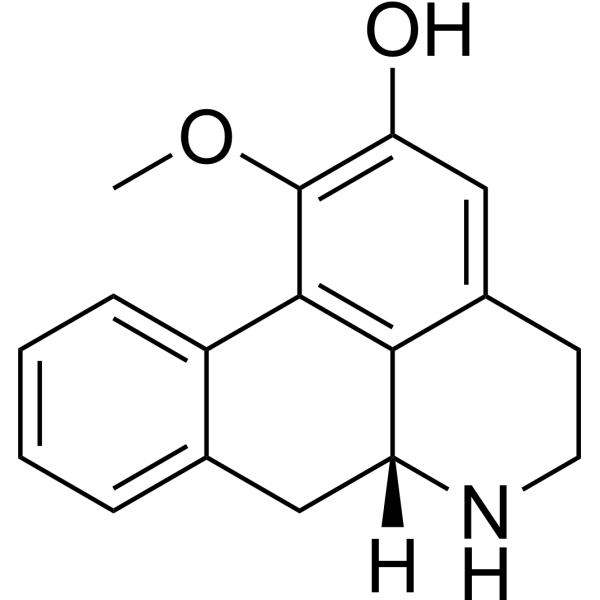
    Asimilobine is an aporphine isoquinoline alkaloid isolated from plant species of Magnolia obobata Thun. Asimilobine is a dopamine biosynthesis inhibitor and a serotonergic receptor antagonist. Asimilobine shows an antimalarial and anti-cancer activity .
    Asimilobine
  • HY-W012264

    3-Methoxy-L-Tyrosine monohydrate; 3-O-Methyl-L-DOPA monohydrate

    COMT Neurological Disease
    3-O-Methyldopa monohydrate (3-Methoxy-L-tyrosine monohydrate) is a significant metabolite of L-DOPA produced through the action of catechol O-methyltransferase (COMT). Unlike its precursor, 3-O-Methyldopa does not serve as a substrate or inhibitor of L-amino acid decarboxylase activity. Additionally, the inhibition of COMT can amplify the anti-Parkinson effects of L-DOPA.
    3-O-Methyldopa monohydrate
  • HY-P2825A

    Endogenous Metabolite Metabolic Disease
    L-Tyrosine Decarboxylase, Streptococcus faecalis (EC 4.1.1.25), is a carboxyl lyase capable of cleaving carbon-carbon bonds. L-Tyrosine Decarboxylase Apoenzyme participates in tyrosine metabolism and alkaloid biosynthesis. L-Tyrosine Decarboxylase Apoenzyme uses a cofactor—pyridoxal phosphate. L-Tyrosine Decarboxylase Apoenzyme has one substrate, L-tyrosine, and two products: tyramine and carbon dioxide.
    L-Tyrosine Decarboxylase, Streptococcus faecalis
  • HY-E70938

    Endogenous Metabolite Metabolic Disease
    L-Tyrosine Decarboxylase Apoenzyme, Streptococcus faecalis (EC 4.1.1.25), is a carboxyl lyase capable of cleaving carbon-carbon bonds. L-Tyrosine Decarboxylase Apoenzyme participates in tyrosine metabolism and alkaloid biosynthesis. L-Tyrosine Decarboxylase Apoenzyme uses a cofactor—pyridoxal phosphate. L-Tyrosine Decarboxylase Apoenzyme has one substrate, L-tyrosine, and two products: tyramine and carbon dioxide.
    L-Tyrosine Decarboxylase Apoenzyme, Streptococcus faecalis
  • HY-N3548

    NF-κB Inflammation/Immunology
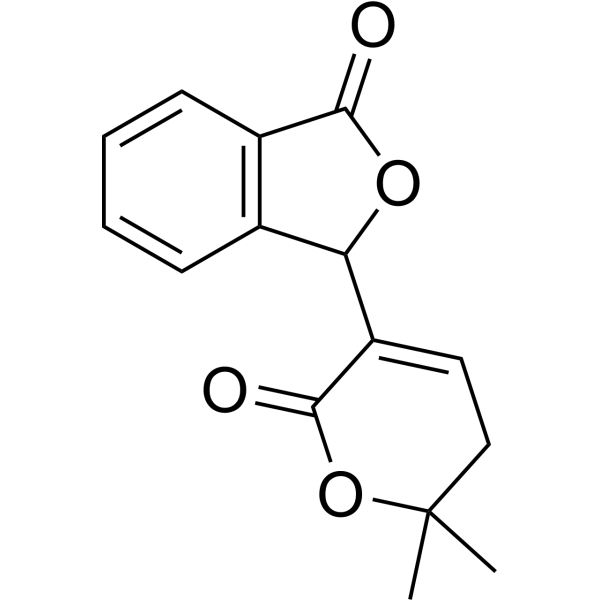
    Catalpalactone has anti-inflammatory effect. Catalpalactone inhibits LPS-induced NO production and iNOS expression in RAW264.7 cells, and also inhibits IRF3, NF-κB, and IFN-β/STAT-1 activation. Catalpalactone also inhibits dopamine biosynthesis by reducing tyrosine hydroxylase (TH) and aromatic-l-amino acid decarboxylase (AADC) activities .
    Catalpalactone

Inquiry Online

Your information is safe with us. * Required Fields.

Salutation


Country or Region *

Applicant Name *


Organization Name *

Department *


Email Address *


Product Name *

Cat. No.


Requested quantity *

Phone Number *


Remarks

Inquiry Online

Inquiry Information

Product Name:
Cat. No.:
Quantity:
MCE Japan Authorized Agent:

