

10 Results for "

chronic hepatitis D

" in MedChemExpress (MCE) Product Catalog:
Products (10)

10 Results for "chronic hepatitis D" in MCE Product Catalog:

1
1 Cited Publications
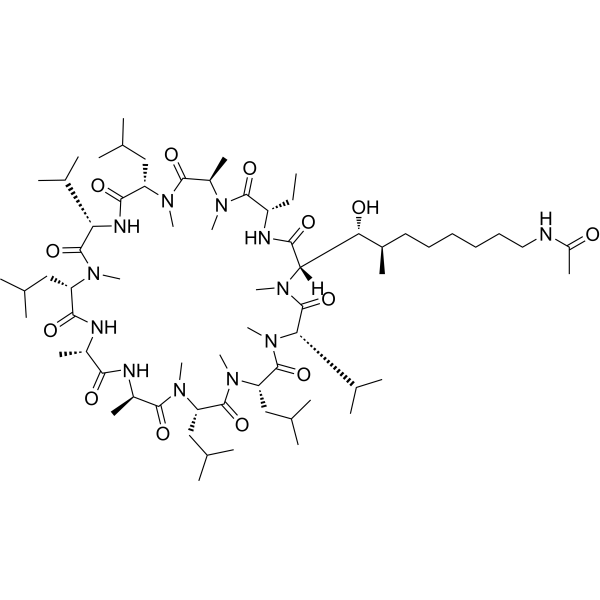
Cat. No.: HY-135644
CAS No.: 1383420-08-3
Purity:  90.29%
Synonyms: CRV431
Rencofilstat (CRV431) is an orally active pan-cyclophilin inhibitor with IC50 values of 2.5 nM, 3.1 nM, 2.8 nM, 7.3 nM for Cyp A, CypB, Cyp D and Cyp G, respectively. Rencofilstat reduces fibrosis and tumor growth in models of chronic liver disease. Rencofilstat can be used for the study of nonalcoholic steatohepatitis (NASH), hepatocellular carcinoma and viral hepatitis-induced liver disease .
loading...
    loading...
Cat. No.: HY-P991200

Target:  

HCV Claudin

Research Areas:  

Infection

OM-7D3-B3 is an antibody-based antiviral agent targeting the tight junction protein CLDN1 (Kd=4 nM). By binding to the first extracellular domain of CLDN1, OM-7D3-B3 disrupts the formation of the CLDN1-CD81 co-receptor complex, thereby effectively inhibiting the entry of hepatitis C virus (HCV). OM-7D3-B3 not only prevents de novo and chronic HCV infections in humanized liver chimeric mice and uPA-SCID mice transplanted with human livers, but also exhibits favorable safety with no toxic effects observed. OM-7D3-B3 serves as a critical tool for research on HCV infection mechanisms and antiviral drug development .
loading...
    loading...
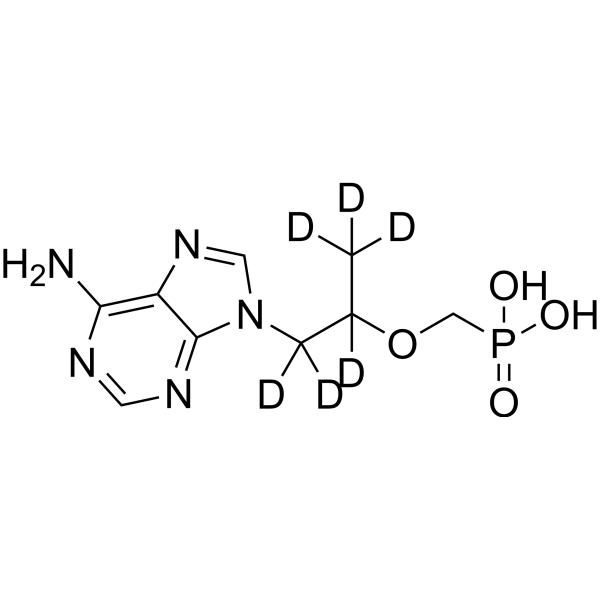
Cat. No.: HY-113904S
CAS No.: 1020719-94-1
Purity:  99.82%
(Rac)-Tenofovir-d6 is a labelled racemic Tenofovir. Tenofovir (GS 1278) is a nucleotide reverse transcriptase inhibitor to treat HIV and chronic Hepatitis B (HBV) .
loading...
    loading...
Cat. No.: HY-147266
Purity:  95.83%
Synonyms: VIR-2218 sodium
Research Areas:  

Infection

Elebsiran (VIR-2218) sodium is a siRNA that targets and degrades hepatitis B virus (HBV) and hepatitis D virus (HDV) RNA transcripts. Elebsiran sodium leads to a significant decrease in HBV surface antigen (HBsAg) and a reduction in viral load. Elebsiran sodium binds to the sialic acid-depleted glycoprotein receptor (ASGPR) on the surface of liver cells through the GalNAc ligand, achieving liver-targeted delivery and demonstrating improved liver safety. Elebsiran sodium can be used for the study of chronic HBV/HDV infections .
loading...
    loading...
Cat. No.: HY-P991674
CAS No.: 3033337-14-0
Synonyms: BJT-778

Target:  

HBV

Research Areas:  

Infection Inflammation/Immunology

Brelovitug (BJT-778) is a humanized IgG1 neutralizing monoclonal antibody targeting hepatitis B surface antigen (HBsAg). Brelovitug binds with high affinity to HBsAg purified from HBV serotypes ad and ay, with Kd values of 0.22 nM and 0.39 nM, respectively. Brelovitug binds with high affinity to HBsAg of HBV genotypes A, B, C and D, with IC50 values of 0.07, 0.02, 0.02 and 0.07 nM, respectively. Brelovitug can be used in research related to chronic hepatitis B and chronic hepatitis D .
loading...
    loading...
Cat. No.: HY-147266A
CAS No.: 2648009-64-5
Synonyms: VIR-2218
Research Areas:  

Infection

Elebsiran (VIR-2218) is a siRNA that targets and degrades hepatitis B virus (HBV) and hepatitis D virus (HDV) RNA transcripts. Elebsiran leads to a significant decrease in HBV surface antigen (HBsAg) and a reduction in viral load. Elebsiran binds to the sialic acid-depleted glycoprotein receptor (ASGPR) on the surface of liver cells through the GalNAc ligand, achieving liver-targeted delivery and demonstrating improved liver safety. Elebsiran can be used for the study of chronic HBV/HDV infections .
loading...
    loading...
Cat. No.: HY-165069
CAS No.: 94359-12-3
Synonyms: Sphingomyelin (d18:1 C22:0)
Target:  

Others

Research Areas:  

Others

N-Docosanoyl-D-erythro-sphingosylphosphorylcholine (Sphingomyelin (d18:1 C22:0)) is a compound that appears in the plasma sphingolipid profile after chronic hepatitis C virus infection. The level of this substance in plasma is associated with hepatic steatosis and may be an independent factor of hepatic steatosis.
loading...
    loading...
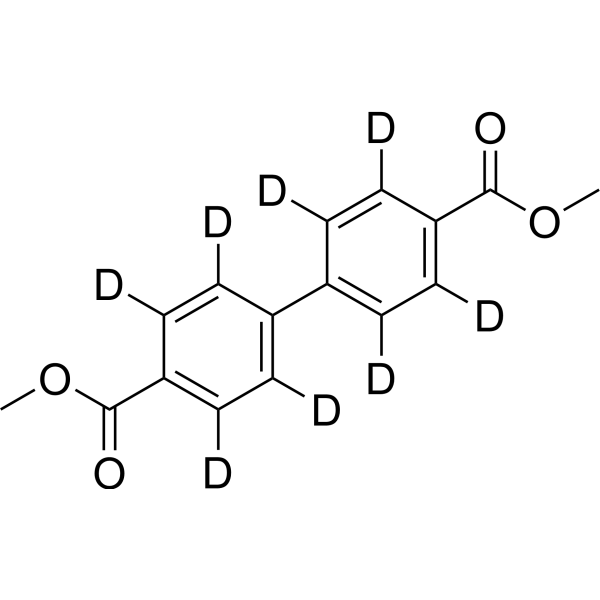
Cat. No.: HY-128854S
CAS No.: 1219803-50-5
Dimethyl biphenyl-4,4'-dicarboxylate-d8 is the d8-labeled Dimethyl biphenyl-4,4'-dicarboxylate (HY-128854). Dimethyl biphenyl-4,4'-dicarboxylate (Biphenyl dimethyl dicarboxylate) is a hepatoprotective agent. Dimethyl biphenyl-4,4'-dicarboxylate stimulates the Jak/Stat signaling pathway and induces the expression of IFN-α-stimulated genes, particularly 6-16 and ISG12. Dimethyl biphenyl-4,4'-dicarboxylate inhibits the replication of pregenomic RNA and HBeAg. Polymer micelles loaded with Dimethyl biphenyl-4,4'-dicarboxylate can serve as carriers for the compound. Dimethyl biphenyl-4,4'-dicarboxylate can be used as an auxiliary improving agent for chronic hepatitis. Dimethyl biphenyl-4,4'-dicarboxylate is applicable to research related to chronic hepatitis B .
loading...
    loading...
Cat. No.: HY-W744577
Synonyms: Dexamethasone 21-acetate-d5; Hexadecadrol acetate-d5
Dexamethasone acetate-d5 (Dexamethasone 21-acetate-d5; Hexadecadrol acetate-d5) is the deuterium labeled Dexamethasone acetate (HY-14648A). Dexamethasone acetate (Dexamethasone 21-acetate) is the acetate form of the glucocorticoid Dexamethasone (HY-14648). Dexamethasone acetate has a longer duration of action than Dexamethasone. Dexamethasone acetate can accumulate at inflammatory sites, in mouse liver and mouse lung via nanostructured lipid carriers. Dexamethasone acetate can be used to prepare topical formulations for studies related to sensorineural hearing loss, γ-carrageenan-induced paw edema, chronic active hepatitis, pulmonary diseases, and inflammation after vitreoretinal surgery.
loading...
    loading...
Cat. No.: HY-15790S
Synonyms: A 3309-d5; AZD 7806-d5
Elobixibat-d5 is the deuterium labeled Elobixibat (HY-15790). Elobixibat (A 3309; AZD 7806) is orally active, bile acid transporter (IBAT) inhibitor with IC50 values ??of 0.53 nM (human IBAT), 0.13 nM (mouse IBAT), and 5.8 nM (canine IBAT). Elobixibat can lower LDL cholesterol, increase serum GLP-1, promote colonic motility, and has the potential to treat metabolic syndrome. Elobixibat can be used in the study of chronic functional constipation (CIC), dyslipidemia, non-alcoholic hepatitis, and liver tumors in the elderly .
loading...
    loading...

