
6 Results for "

delayed neurotoxicity

" in MedChemExpress (MCE) Product Catalog:
Products (6)

6 Results for "delayed neurotoxicity" in MCE Product Catalog:

Cat. No.: HY-P10019
CAS No.: 2243292-26-2
Synonyms: NLY01
Target:  

GCGR

Pegsebrenatide (NLY01) is a blood-brain barrier-penetrant GLP-1R agonist. Pegsebrenatide alleviates retinal inflammation and neuronal death secondary to ocular hypertension . Pegsebrenatide significantly delays onset and reduces disease severity in experimental autoimmune encephalomyelitis . Pegsebrenatide inhibits the formation of A1 reactive astrocytes in nerve cells and reduces the loss of retinal ganglion cells and dopaminergic neurons. Pegsebrenatide exerts neuroprotective effects in a mouse model of Parkinson's disease by directly preventing microglia-mediated conversion of astrocytes to the A1 neurotoxic phenotype. Pegsebrenatide can be used for research on glaucoma, Parkinson's disease, and multiple sclerosis .
loading...
    loading...
Cat. No.: HY-N12622
CAS No.: 3032028-08-0
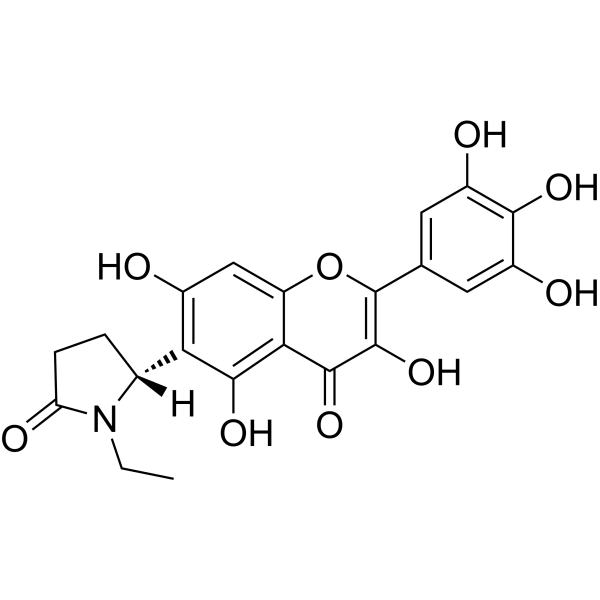
AChE-IN-58 (Compound 3) is an acetylcholinesterase (AChE) inhibitor. AChE-IN-58 can extend the mean lifespan, delay the Aβ1-42-induced paralysis, enhanc the locomotion, and alleviate glutamic acid (Glu)-induced neurotoxicity of CL4176 worms .
loading...
    loading...
Cat. No.: HY-120131
CAS No.: 13067-93-1
Research Areas:  

Neurological Disease

Cyanofenphos is an orally active organophosphate insecticide and brain AChE inhibitor with neurotoxicity. Cyanofenphos induces delayed neurotoxicity such as ataxia and paralysis. Cyanofenphos also causes symptoms including somnolence, reduced feed intake and weight loss in hens. Cyanofenphos has a unique self-antagonistic effect: repeated low-dose pre-treatment not only reduces subsequent acute toxicity, but also exacerbates delayed neurotoxicity and attenuates enzyme inhibition, with the protective effect peaking at 24 h after the last pre-treatment. Cyanofenphos is commonly used in studies related to delayed neurotoxicity .
loading...
    loading...
Cat. No.: HY-W714853
CAS No.: 65732-07-2
(+)-Theta-cypermethrin is a stereoisomer of Cypermethrin (HY-B0829) that possesses blood-brain barrier penetration ability and binds to AKT1, SRC, STAT3 and EGFR with high affinity. (+)-Theta-cypermethrin reduces the amplitude of delayed rectifier potassium channel currents, shifts the steady-state activation curve to negative potentials, and shifts the steady-state inactivation curve to negative potentials at higher concentrations. (+)-Theta-cypermethrin induces abnormal electrical activity in rat hippocampal neurons. (+)-Theta-cypermethrin causes chronic respiratory system damage and exhibits neurotoxicity .
loading...
    loading...
Cat. No.: HY-178276
CAS No.: 1394328-54-1
Target:  

α-synuclein

Research Areas:  

Neurological Disease

α-Synuclein-IN-18 (Compound Mol D) is an inhibitor of the autocatalytic proliferation of α-Synuclein aggregate. α-Synuclein-IN-18 can specifically bind to the conserved binding pocket on the surface of α-synuclein fibrils. α-Synuclein-IN-18 can delay the aggregation process of α-synuclein, extend the aggregation T1/2 by three times. α-Synuclein-IN-18 can reduce the generation flux of α-synuclein toxic oligomers, thereby alleviating the neurotoxicity. α-Synuclein-IN-18 can be used for research of Parkinson’sdisease .
loading...
    loading...
Cat. No.: HY-114811
CAS No.: 25006-32-0
Leptophos oxon, a metabolite of leptophos, is a GABAA receptor chloride channel inhibitor with an IC50 values of 89.6 μM. Leptophos oxon inhibits GABA-induced chloride influx, binds to GABAA receptor-associated TBPS sites, and inhibits TBPS binding to voltage-dependent chloride channels. Leptophos oxon is a insecticide. Leptophos oxon can be used for the research of neurological disease .
loading...
    loading...

