10 Results for "

normal human plasma

" in MedChemExpress (MCE) Product Catalog:
Products (10)

10 Results for "normal human plasma" in MCE Product Catalog:

Cat. No.: HY-Y0202
CAS No.: 303-38-8
Synonyms: Catecholcarboxylic acid; NSC 27435
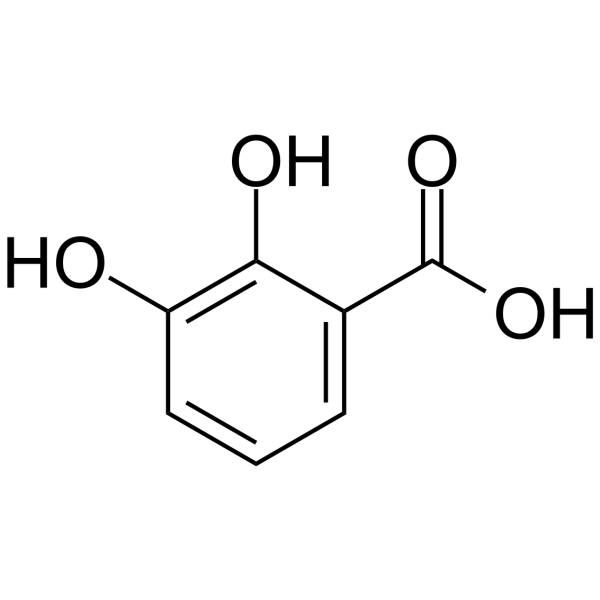
Pyrocatechuic acid is a normal human benzoic acid metabolite found in plasma, and has increased levels after aspirin ingestion.
loading...
    loading...
Cat. No.: HY-Y0202R
CAS No.: 303-38-8
Synonyms: Catecholcarboxylic acid (Standard); NSC 27435 (Standard)
Pyrocatechuic acid (Standard) is the analytical standard of Pyrocatechuic acid. This product is intended for research and analytical applications. Pyrocatechuic acid is a normal human benzoic acid metabolite found in plasma, and has increased levels after aspirin ingestion.
loading...
    loading...
Cat. No.: HY-131579R
CAS No.: 83881-54-3
Pyrocatechuic acid (Standard) is the analytical standard of Pyrocatechuic acid. This product is intended for research and analytical applications. Pyrocatechuic acid is a normal human benzoic acid metabolite found in plasma, and has increased levels after aspirin ingestion.
loading...
    loading...
Cat. No.: HY-170606
CAS No.: 3068686-30-3
Target:  

Glycosidase

Research Areas:  

Metabolic Disease

α-Glucosidase-IN-79 (Compound 4d9) is a non-competitive α-Glucosidase inhibitor with an IC50 of 2.11 μM, which is more potent than existing α-Glucosidase inhibitors such as Acarbose (HY-B0089) (IC50 of 327.0 μM) and HXH8r (IC50 of 15.32 μM). α-Glucosidase-IN-79 is non-cytotoxic to human normal hepatocyte (LO2) cells and shows good metabolic stability in rat plasma. α-Glucosidase-IN-79 holds promise for research into type 2 diabetes .
loading...
    loading...
Cat. No.: HY-123599
CAS No.: 1884209-98-6
Target:  

DNA/RNA Synthesis

Research Areas:  

Cancer

IACS-4619 (compound 4) is a highly selective 2-aminopyrimidine-based MTH1 (MutT homolog 1) inhibitor (IC50=0.2 nM). IACS-4619 inhibits MTH1 by blocking its hydrolysis of oxidized purine nucleotides such as 8-oxo-dGTP, thereby preventing MTH1 from inhibiting the incorporation of oxidized nucleotides into DNA. IACS-4619 significantly inhibits endogenous MTH1 activity in MTH1-overexpressing U2OS cells, but without antiproliferative or cytotoxic effects on various human cancer and normal cell lines. IACS-4619 can be used in oncology research related to the MTH1 target .
loading...
    loading...
Cat. No.: HY-N17623
CAS No.: 1714097-11-6
Ainsliaeasin C, a 7-hydroxycoumarin derivative, is an orally active anticoagulant agent that can be found in Ainsliaea fragrans. Ainsliaeasin C exerts anticoagulant activity both in vitro and in vivo. Ainsliaeasin C can be used for the research on thrombotic disorders .
loading...
    loading...
Cat. No.: HY-165180
CAS No.: 70005-46-8
Synonyms: Psychosine 3′-O-sulfate sodium; Psychosine 3′-sulfate sodium
Research Areas:  

Metabolic Disease

Lyso-sulfatide (bovine) sodium is a phospholipid component derived from sphingolipid catabolism and a potent factor Xa inhibitor and anticoagulant. Lyso-sulfatide (bovine) sodium binds directly to factor Xa and inhibits prothrombin activation mediated by the prothrombinase complex, thereby prolonging factor Xa-induced plasma clotting time and suppressing thrombin generation. Lyso-sulfatide (bovine) sodium serves as a reliable lipid membrane mimic for studying cell membrane structure, function, and molecular interactions .
loading...
    loading...
Cat. No.: HY-181931
CAS No.: 3058084-21-9
Autotaxin-IN-8 (Compound 14E) is an orally active Autotaxin inhibitor with an IC50 of 14.2 nM against hAutotaxin. Autotaxin-IN-8 inhibits Autotaxin activity, MAPK activation, LPAR1 and p-ERK1/2. Autotaxin-IN-8 reduces the phosphorylation levels of JNK and p38. Autotaxin-IN-8 decreases collagen deposition in a mouse model of pulmonary fibrosis. Autotaxin-IN-8 can be used in research related to pulmonary fibrosis .
loading...
    loading...
Cat. No.: HY-L150
7,077 compounds

Membrane receptors, also known cell surface receptors or transmembrane receptors, are transmembrane proteins embedded into the plasma membrane which play an essential role in maintaining communication between the internal processes within the cell and various types of extracellular signals. They act in cell signaling by receiving (binding to) extracellular molecules, which are also called ligands. These extracellular molecules include hormones, cytokines, growth factors, neurotransmitters, lipophilic signaling molecules such as prostaglandins, and cell recognition molecules.

There are three kinds of membrane receptors: ion channel-linked receptors, enzyme-linked receptors and G-protein-linked receptors. They play important roles in keeping human normal physiologic processes. GPCRs and ion channels are important drug targets in drug discovery.

MCE provides a unique collection of 7,077 compounds targeting a variety of membrane receptors. MCE Membrane reeptor-targeted Compound Library can be used for membrane receptor-focused screening and drug discovery.

Cat. No.: HY-187206
Target:  

Cytochrome P450

Research Areas:  

Cancer

CYP1B1-IN-15 is a CYP1B1 inhibitor with an IC50 of 1.47 nM, and it exhibits high selectivity against six major CYP subtypes. CYP1B1-IN-15 exerts competitive inhibitory effects by competing with substrates for binding to the active site of CYP1B1. CYP1B1-IN-15 enhances the inhibitory effect of Paclitaxel (HY-B0015) on the proliferation of paclitaxel-resistant cancer cells, and inhibits the migration and invasion of paclitaxel-resistant cancer cells. CYP1B1-IN-15 can be used in studies related to paclitaxel-resistant non-small cell lung cancer .
loading...
    loading...

