



Asteraceae
-
- Adenostemma lavenia (L.) Kuntze (7)
- Distephanus angulifolius (DC.) H.Rob. & B.Kahn (6)
- Pulicaria salviifolia Bunge (6)
- Aucklandia costus Falc. (5)
- Saussurea involucrata (Kar. et Kir.) Sch.-Bip. (4)
- Tithonia diversifolia (Hemsl.) A. Gray (4)
- Leontopodium brachyactis Gand. (3)
- Ligularia virgaurea (Maxim.) Mattf. (3)
- Nouelia insignis Franch. (3)
- Rhaponticum uniflorum (L.) DC. (3)
- Vernonia volkameriifolia DC. (3)
- Acmella oleracea (L.) R. K. Jansen (2)
- Artemisia ludoviciana Nutt. (2)
- Artemisia myriantha Wall. ex Besser (2)
- Carphephorus paniculatus (J.F.Gmel.) H.J.-C.Hebert (2)
- Centaurea cyanus L. (2)
- Centaurea solstitialis L. (2)
- Chamaemelum nobile (L.) All. (2)
- Chromolaena glaberrima (DC.) R.M.King & H.Rob. (2)
- Chromolaena odorata (L.) R. M. King & H. Rob. (2)
- Jacobaea argunensis (Turcz.) B. Nord. (2)
- Jacobaea vulgaris Gaertn. (2)
- Lactuca sativa var. angustana Irish (2)
- Ligularia cymbulifera (W. W. Sm.) Hand.-Mazz. (2)
- Ligularia japonica (Thunb.) Less. (2)
- Mikania micrantha Kunth (2)
- Senecio aegyptius L. (2)
- Sonchus erzincanicusV.A.Matthews (2)
- Vickifunkia songarica (Fisch.) C. Ren, Long Wang, I. D. Illar. & Q. E. Yang (2)
- Wedelia trilobata (L.) Hitchc. (2)
- Anvillea garcinii (Burm.f.) DC. (1)
- Artemisia afra Jacq. (1)
- Artemisia austroyunnanensis Y. Ling & Y. R. Ling (1)
- Artemisia glutinosa J.Gay ex Besser (1)
- Artemisia selengnesis Turcz (1)
- Artemisia sphaerocephala Krasch. (1)
- Aster glehnii F.Schmidt (1)
- Aster himalaicus C. B. Clarke (1)
- Aster pekinensis (Hance) F. H. Chen (1)
- Atractylodes koreana (Nakai) Kitam. (1)
- Baccharis dracunculifolia DC. (1)
- Blumea eriantha DC. (1)
- Brickellia betonicifolia A.Gray (1)
- Calea prunifolia Kunth (1)
- Cassinia longifolia R.Br. (1)
- Centaurea furfuracea Coss. & Durieu (1)
- Centaurea omphalotricha (1)
- Chrysoma pauciflosculosa Greene (1)
- Chrysothamnus humilis Greene (1)
- Cirsium arvense var. integrifolium Wimm. & Grab. (1)
- Doronicum macrophyllum Fisch. (1)
- Eupatorium glehni F. Schmidt ex Trautv. (1)
- Eupatorium perfoliatum L. (1)
- Eupatorium purpureum Lour. (1)
- Eupatorium semiserratum DC. (1)
- Eupatorium triplinerve (1)
- Gymnanthemum extensum (Wall.) Steetz (1)
- Gynura nepalensis DC. (1)
- Helichrysum zivojini Cernjavski & Soska (1)
- Heliopsis helianthoides (L.) Sweet (1)
- Heliopsis longipes S.F.Blake (1)
- Heterotheca inuloides Cass. (1)
- Inula linariifolia Turcz. (1)
- Kleinia pendula DC. (1)
- Lactuca inermis Forssk. (1)
- Lactuca sativa var. capitata DC. (1)
- Laennecia schiedeana (Less.) G.L.Nesom (1)
- Leibnitzia anandria (L.) Turcz. (1)
- Leyssera gnaphaloides (1)
- Ligularia intermedia Nakai (1)
- Parasenecio roborowskii (Maxim.) Y. L. Chen (1)
- Parthenium argentatum A. Gray (1)
- Pechuel-loeschea leubnitziae (Kuntze) O.Hoffm. (1)
- Pseudognaphalium adnatum (DC.) Y. S. Chen (1)
- Pterocaulon balansae Chodat (1)
- Pterocaulon sphacelatum (Labill.) Benth. & Hook.f. ex F.Muell. (1)
- Pulicaria canariensis Bolle (1)
- Pulicaria jaubertii E.Gamal-Eldin (1)
- Saussurea uniflora (DC.) Wall. ex Sch. Bip. (1)
- Scorzonera latifolia (Fisch. & C.A.Mey.) DC. (1)
- Senecio iodanthus Greenm. (1)
- Senecio leptolobus DC. (1)
- Senecio nemorensis L. (1)
- Sphaeranthus indicus L. (1)
- Stevia lucida Lag. (1)
- Tanacetum punctatum (Desr.) Grierson (1)
- Taraxacum coreanum Nakai (1)
- Taraxacum officinale F. H. Wigg. (1)
- Taraxacum portentosum Kirschner & tepánek (1)
- Tolpis barbata (L.) Gaertn. (1)
- Vernonia cinerascens (1)
- Vernonia diffusa (1)
- Vickifunkia narynensis (C. Winkl.) C. Ren, Long Wang, I. D. Illar. & Q. E. Yang (1)
- Vickifunkia thyrsoidea (Ledeb.) C. Ren, Long Wang, I. D. Illar. & Q. E. Yang (1)
- Warionia saharae Benth. & Coss. (1)
- Wedelia paludosa (1)
- Zinnia peruviana L. (1)
-
Asteraceae (158)

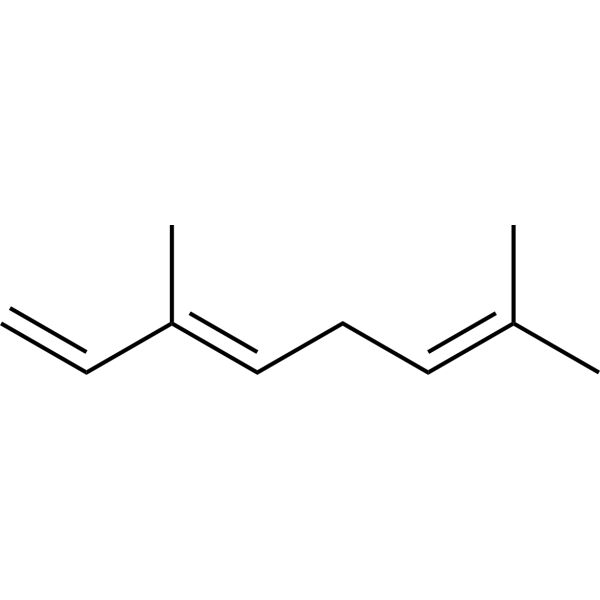
- Formula: C10H16
- Molecular Weight: 136.23
Beta-Ocimene is a naturally occurring organic compound that belongs to the terpene family. β-Ocimene exists as a mixture of two isomers: cis-β-ocimene and trans-β-ocimene. Possessing a pleasant, sweet, and herbaceous aroma, β-ocimene is found in many plants, including mint, basil, parsley, and kumquat. Due to its distinctive scent and flavor, β-ocimene is widely used in the fragrance and flavor industries. It also holds potential applications in agriculture as a natural insect repellent and as a pheromone that attracts beneficial insects. Additionally, β-ocimene exhibits potential anti-inflammatory and anti-cancer activities.

- Formula: C13H20O
- Molecular Weight: 192.30
α-Ionone (alpha-Ionone) is an activator of the olfactory receptor OR10A6. α-Ionone induces apoptosis by activating OR10A6 and increasing the phosphorylation of the LATS-YAP-TAZ signaling axis in the Hippo pathway. α-Ionone can inhibit tumor formation both in vivo and in vitro.

- Formula: C11H20O
- Molecular Weight: 168.28
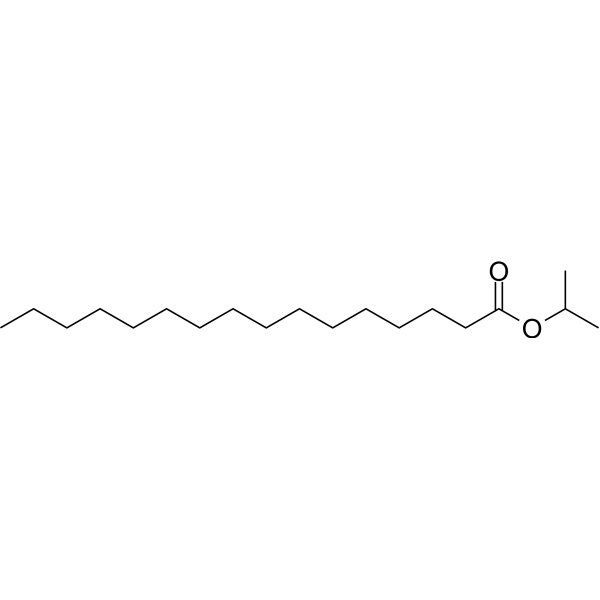
- Formula: C19H38O2
- Molecular Weight: 298.51
Isopropyl palmitate is an fatty acid ester. Isopropyl palmitate can be used for design and characterization of bioactive bilayer films. The bilayer membrane not only has the ability to scavenge free radicals and inhibit lipid peroxidation, but also can inhibit the growth of known foodborne pathogens. Isopropyl palmitate can be used as an excipient, such as lubricant, oily carrier, solvent, controlled-release transdermal film. Pharmaceutical excipients, or pharmaceutical auxiliaries, refer to other chemical substances used in the pharmaceutical process other than pharmaceutical ingredients. Pharmaceutical excipients generally refer to inactive ingredients in pharmaceutical preparations, which can improve the stability, solubility and processability of pharmaceutical preparations. Pharmaceutical excipients also affect the absorption, distribution, metabolism, and elimination (ADME) processes of co-administered drugs.

- Formula: C15H18O
- Molecular Weight: 214.30
Farfugin A (Compound 2) is a benzofuran derivative.


- Formula: C19H38O2
- Molecular Weight: 298.51
Isopropyl palmitate (Standard) is the analytical standard of Isopropyl palmitate. This product is intended for research and analytical applications. Isopropyl palmitate is an fatty acid ester. Isopropyl palmitate can be used for design and characterization of bioactive bilayer films. The bilayer membrane not only has the ability to scavenge free radicals and inhibit lipid peroxidation, but also can inhibit the growth of known foodborne pathogens. Isopropyl palmitate can be used as an excipient, such as lubricant, oily carrier, solvent, controlled-release transdermal film. Pharmaceutical excipients, or pharmaceutical auxiliaries, refer to other chemical substances used in the pharmaceutical process other than pharmaceutical ingredients. Pharmaceutical excipients generally refer to inactive ingredients in pharmaceutical preparations, which can improve the stability, solubility and processability of pharmaceutical preparations. Pharmaceutical excipients also affect the absorption, distribution, metabolism, and elimination (ADME) processes of co-administered drugs.

- Formula: C18H27NO8
- Molecular Weight: 385.41

- Formula: C10H16
- Molecular Weight: 136.23
Alloocimene is a diterpenoid that activates defense genes and induces resistance to Botrytis cinerea in Arabidopsis thaliana.

- Formula: C27H28O14
- Molecular Weight: 576.50
Chamaemeloside is a phenolic compound found in the flower heads of Roman chamomile (Anthemis nobilis, syn. Chamaemelum nobile). Chamaemeloside is not detected in German chamomile (Matricaria recutita) and Chrysanthemum morifolium samples.


- Formula: C19H20O7
- Molecular Weight: 360.36
Vernodalin is an orally active, cytotoxic sesquiterpene lactone with a Kd value of 9.55 μM for p38 MAPK. Vernodalin downregulates the expression of phosphorylated ERK, JNK, AKT, PI3K, mTOR, p38MAPK, FAK, MMP-2, MMP-9, and uPA, while upregulates the expression of TIMP-1 and TIMP-2. Vernodalin increases ROS production, upregulates the expression of Bax and caspase 3, downregulates the expression of Bcl-2, and induces apoptosis (apoptosis), oxidative stress response and cell cycle arrest. Vernodalin inhibits the proliferation, adhesion and metastasis of cancer cells. Vernodalin enhances the activity of VEGF-B, AMPK and eNOS signaling pathways. Vernodalin alleviates myocardial injury and restores hemodynamic parameters. Vernodalin inhibits the growth of Trypanosoma brucei rhodesiense. Vernodalin can be used in research related to various cancers including gastric cancer, colorectal cancer and lung cancer, as well as African human trypanosomiasis and myocardial infarction.

- Formula: C16H18O10
- Molecular Weight: 370.31
Isofraxoside is a coumarin glycoside found in Diervilla lonicera Mill. of the Caprifoliaceae family.

- Formula: C24H22O14
- Molecular Weight: 534.42
2,5-Dicaffeoylglucaric acid is a depside of caffeic acid with glucaric acid that can be found in the dried aerial parts of Eupatorium perfoliatum L. (Asteraceae).

- Formula: C16H20O7
- Molecular Weight: 324.33
2′,3′-Dihydroxypuberulin is a naturally derived inhibitor of the FcεRI β-chain with FcεRI expression inhibitory activity in mast cells. 2′,3′-Dihydroxypuberulin suppresses the mRNA level of the FcεRI β-chain, blocks the assembly of the FcεRI tetramer, and reduces the cell surface expression level of FcεRI. 2′,3′-Dihydroxypuberulin can be used in studies related to type I allergic diseases.

- Formula: C15H22O4
- Molecular Weight: 266.33
Artemisinin B is an orally active sesquiterpene natural product with anti-neuroinflammatory activity, which can be found in Artemisia annua Linn.. Artemisinin B suppresses the TLR4-MyD88-NF-κB signaling pathway by reducing the protein levels of TLR4 and MyD88, as well as inhibiting the mRNA expression of NF-κB p65. Artemisinin B reduces the expression of pro-inflammatory cytokines and attenuates synaptic loss, which can be used for the research of cognitive and behavioral impairments in Alzheimer's disease. Artemisinin B shows no cytotoxicity against human cardiomyocytes and exhibits very weak binding to hERG, suggesting its potential for cardioprotective property research.



