1. Search Result
Search Result
Results for "

rat liver tissue

" in MedChemExpress (MCE) Product Catalog:

8

Inhibitors & Agonists

1

Natural
Products

1

Click Chemistry

2

Oligonucleotides

Cat. No. Product Name Target Research Areas Chemical Structure
  • HY-113256

    Carnitine Palmitoyltransferase (CPT) Endogenous Metabolite Metabolic Disease
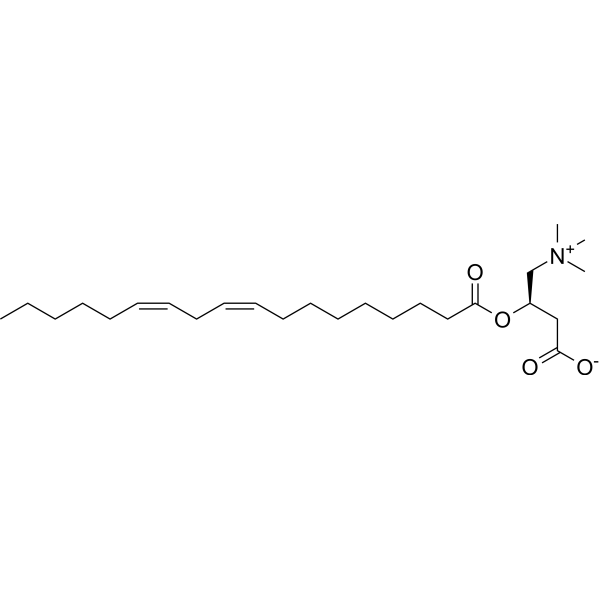
    Linoleyl carnitine is an acylcarnitine and metabolite. Linoleyl carnitine in the liver is negatively correlated with pantothenic acid and citric acid in serum. Linoleyl carnitine accumulates in mitochondrial CPT II deficiency .
    Linoleyl carnitine
  • HY-W011168

    Nucleoside Antimetabolite/Analog DNA/RNA Synthesis Inflammation/Immunology Cancer
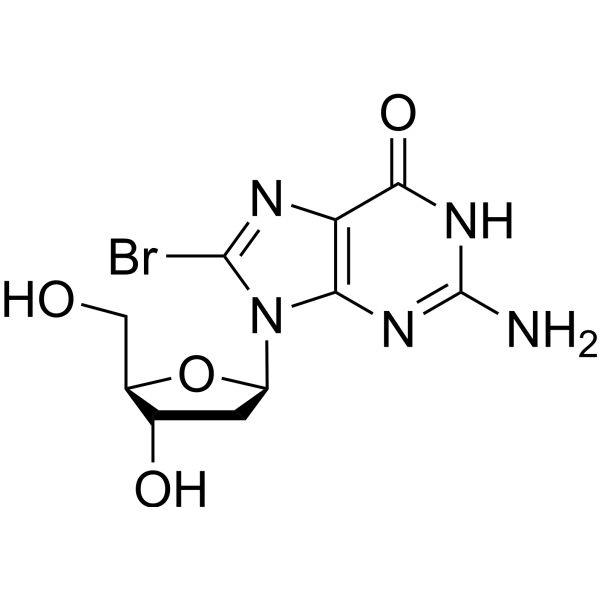
    8-Bromo-2'-deoxyguanosine is an inflammation-related DNA halogenated adduct and an early biomarker of inflammation-induced oxidative tissue damage. The formation of 8-Bromo-2'-deoxyguanosine precedes that of oxidative and nitrative products, and it can be generated via the MPO-H2O2-Cl --Br - system. 8-Bromo-2'-deoxyguanosine serves as the immunogen for preparing the monoclonal antibody mAb8B3, which can be used to detect early DNA modifications in preclinical models; its urinary level also increases significantly in inflammatory disease models. 8-Bromo-2'-deoxyguanosine can also be produced in the dermis of UV-B irradiated mice, and the extract of Coprinus comatus significantly reduces its level. 8-Bromo-2'-deoxyguanosine finds applications in studies related to inflammatory diseases, diabetes, hepatocellular carcinoma, and UV-B induced skin inflammation .
    8-Bromo-2'-deoxyguanosine
  • HY-177608

    Interleukin Related Inflammation/Immunology
    Rat IL-10 mRNA encodes interleukin-10 (IL-10). IL-10 is expressed in tissues/cells such as hepatic stellate cells and is involved in physiological processes including liver fibrosis.
    Rat IL10 mRNA
  • HY-16121

    Cathepsin Others
    CAA-0225 is a tissue protease L inhibitor that inhibits rat liver tissue protease L with a IC50 value of 1.9 nM. CAA-0225 can participate in the degradation of autophagosome membrane markers LC3-II and GABARAP (HY-P72639), improve cardiac function in mice with reperfusion injury, and kill and eliminate Trypanosoma brucei parasites [1][2][3].
    CAA-0225
  • HY-161449

    11β-HSD Metabolic Disease
    JTT-654 is an orally active, potent and selective11β-Hydroxysteroid dehydrogenase type 1 (11β-HSD1) inhibitor. The IC50 of JTT-654 for 11β-HSD1 is 4.65, 0.97, and 0.74 nM in human, rat, and mouse recombinant enzymes, respectively. JTT-654 showed competitive inhibition against human recombinant enzyme. The IC50 value for human 11β-HSD2 is > 30 μM (human 11β-HSD2 is responsible for the reverse reaction against human 11β-HSD1). JTT-654 ameliorates insulin resistance and non-obese type 2 diabetes by inhibiting adipose tissue and liver 11β-HSD1 .
    JTT-654
  • HY-181094

    Glycosidase Metabolic Disease
    α-Glucosidase-IN-110 is a selective and orally active competitive inhibitor of α-Glucosidase with an IC50 of 7.09 μM and a Ki of 6.9 μM. α-Glucosidase-IN-110 can reduce fasting blood glucose levels, improve glucose tolerance, and restore the histomorphology of liver and pancreatic tissues in diabetic rat models. α-Glucosidase-IN-110 can be used for the research of diabetes .
    α-Glucosidase-IN-110
  • HY-119578

    Cytochrome P450 Cancer
    Imiprothrin is an inducer that induces CYP1A2 and metallothionein 1a, with significant genotoxicity and cytotoxicity. In rat hepatocytes, Imiprothrin initiates detoxification responses by triggering the overexpression of these two genes. Imiprothrin induces chromosomal aberrations and micronucleus formation in rat bone marrow cells, and causes DNA damage in hepatocytes. Imiprothrin triggers oxidative stress in rats, leading to lipid peroxidation, excessive reactive oxygen species production and redox imbalance, which in turn impairs liver and kidney functions and causes tissue damage. Imiprothrin inhibits weight gain in mice, and even causes high mortality in female mice at high doses. However, it shows no carcinogenicity in rat experiments; among relevant indicators, aspartate aminotransferase and total protein are identified as sensitive toxicity biomarkers .
    Imiprothrin
  • HY-183709

    Sodium Channel Neurological Disease
    Nav1.8-IN-24 is a voltage-gated sodium channel Nav1.8 inhibitor with pIC50 values of 7.4 (resting state) and 7.5 (inactivated state), and it exhibits high selectivity for NaV1.1-1.7 subtypes. Nav1.8-IN-24 possesses in vitro safety and drug interaction profiles. Nav1.8-IN-24 can be used for the research of acute pain and chronic neuropathic pain .
    Nav1.8-IN-24

Inquiry Online

Your information is safe with us. * Required Fields.

Salutation


Country or Region *

Applicant Name *


Organization Name *

Department *


Email Address *


Product Name *

Cat. No.


Requested quantity *

Phone Number *


Remarks

Inquiry Online

Inquiry Information

Product Name:
Cat. No.:
Quantity:
MCE Japan Authorized Agent:

