



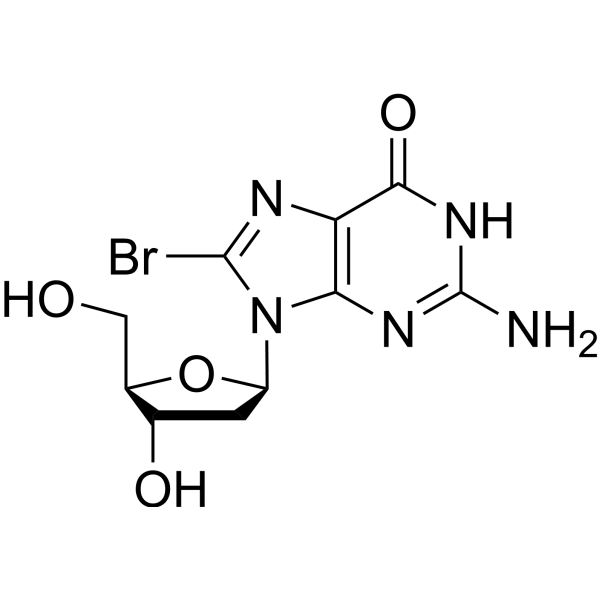
8-Bromo-2'-deoxyguanosine

Based on 1 Customer Validation
8-Bromo-2'-deoxyguanosine is an inflammation-related DNA halogenated adduct and an early biomarker of inflammation-induced oxidative tissue damage. The formation of 8-Bromo-2'-deoxyguanosine precedes that of oxidative and nitrative products, and it can be generated via the MPO-H2O2-Cl--Br- system. 8-Bromo-2'-deoxyguanosine serves as the immunogen for preparing the monoclonal antibody mAb8B3, which can be used to detect early DNA modifications in preclinical models; its urinary level also increases significantly in inflammatory disease models. 8-Bromo-2'-deoxyguanosine can also be produced in the dermis of UV-B irradiated mice, and the extract of Coprinus comatus significantly reduces its level. 8-Bromo-2'-deoxyguanosine finds applications in studies related to inflammatory diseases, diabetes, hepatocellular carcinoma, and UV-B induced skin inflammation.
For research use only. We do not sell to patients.
- Purity : 98.0%
- CAS No.: 13389-03-2
- Formula: C10H12BrN5O4
- Molecular Weight:346.14
-
Storage:Powder -20°C, 3 years , 4°C, 2 years ; In solvent -80°C, 6 months , -20°C, 1 month

To place orders, for customer services and technical support, please contact: MedChemExpress USA
Tel: 609-228-6898 E-mail: [email protected] [email protected]


-
 Biological Activity
-
Chemical Information
-
Solvent & Solubility
- Purity & Documentation
- References
-
 Help & FAQs


All DNA/RNA Synthesis Isoforms
More

Biological Activity
Description
In Vitro
8-Bromo-2'-deoxyguanosine (10-3-100 mM; overnight at 4 °C) exhibits high, specific cross-reactivity with the mAb8B3 monoclonal antibody in competitive indirect ELISA, with a 10-fold greater reactivity toward 8-BrdG than 8-CldG[1].
8-Bromo-2'-deoxyguanosine activity in a myeloperoxidase-mediated inflammatory system is almost completely inhibited by 1,000 μM ergothioneine from Coprinus comatus or 1 mg/mL Coprinus comatus extract[2].
In a cell-free competitive ELISA assay, 8-Bromo-2'-deoxyguanosine is formed by the reaction of 2'-deoxyguanosine and hypobromous acid, and its formation can be inhibited by ergothioneine and Coprinus comatus extract[3].
MedChemExpress (MCE) has not independently confirmed the accuracy of these methods. They are for reference only.
In Vivo
The conjugate of 8-Bromo-2'-deoxyguanosine and keyhole limpet hemocyanin (HY-NP028) (0.2 mg/mL-0.6 mg/mL; administered via intraperitoneal injection or intravenous injection) induces the production of a specific monoclonal antibody (mAb8B3). This antibody shows approximately 10-fold higher reactivity to 8-Bromo-2'-deoxyguanosine (8-BrdG) than to 8-CldG, and exhibits no significant cross-reactivity with 8-bromoguanosine[1].
MedChemExpress (MCE) has not independently confirmed the accuracy of these methods. They are for reference only.
-
Animal Model:BALB/c mice (6-week-old female; immunization model)[1]
-
Dosage:The conjugate of 8-Bromo-2'-deoxyguanosine and keyhole limpet hemocyanin (HY-NP028):
0.6 mg/mL (initial immunization); 0.2 mg/mL (boost); 0.5 mg/mL (final boost) -
Administration:i.p. (initial immunization; boost); i.v. (final boost); 2 weeks interval between initial immunization and boost; 3 days after final boost
-
Result:Generated a monoclonal antibody (mAb8B3) that recognizes both 8-BrdG and 8-CldG, with ~10-fold higher reactivity to 8-BrdG relative to 8-CldG, and shows no significant cross-reactivity to 8-OxodG, 8-bromoguanosine, guanosine, or unmodified deoxyguanosine.


Chemical Information
-
CAS No. 13389-03-2
-
Appearance Solid
-
Molecular Weight 346.14
-
Formula C10H12BrN5O4
-
Color Off-white to light yellow
-
SMILES
OC[C@@H]1[C@@H](O)C[C@H](N2C(Br)=NC3=C2N=C(N)NC3=O)O1
-
Shipping
Room temperature in continental US; may vary elsewhere.
-
Storage
Powder -20°C 3 years 4°C 2 years In solvent -80°C 6 months -20°C 1 month


Solvent & Solubility
In Vitro:
DMSO : ≥ 100 mg/mL (288.90 mM; Hygroscopic DMSO has a significant impact on the solubility of product, please use newly opened DMSO)
* "≥" means soluble, but saturation unknown.
Please refer to the solubility information to select the appropriate solvent. Once prepared, please aliquot and store the solution to prevent product inactivation from repeated freeze-thaw cycles.
Storage method and period of stock solution: -80°C, 6 months; -20°C, 1 month. When stored at -80°C, please use it within 6 months. When stored at -20°C, please use it within 1 month.
Please refer to the solubility information to select the appropriate solvent. Once prepared, please aliquot and store the solution to prevent product inactivation from repeated freeze-thaw cycles.
Storage method and period of stock solution: -80°C, 6 months; -20°C, 1 month. When stored at -80°C, please use it within 6 months. When stored at -20°C, please use it within 1 month.
Concentration (start) × Volume (start) = Concentration (final) × Volume (final)


Purity & Documentation
-
Data Sheet (276 KB)
-
SDS (394 KB)
- English - EN (394 KB)
- Français - FR (394 KB)
- Deutsch - DE (394 KB)
- Norwegian - NO (394 KB)
- Español - ES (394 KB)
- Swedish - SV (394 KB)
- Italian - IT (394 KB)
- Korean - KR (394 KB)
- Portuguese - PT (394 KB)
-
Handling Instructions (2659 KB)
References
[1]. Asahi T, et al. Chemical and immunochemical detection of 8-halogenated deoxyguanosines at early stage inflammation. J Biol Chem. 2010;285(12):9282-9291. [Content Brief]
[2]. Nowakowski P, et al. The two faces of Coprinus comatus-Functional properties and potential hazards. Phytother Res. 2020;34(11):2932-2944. [Content Brief]
[3]. Asahi T, et al. A mushroom-derived amino acid, ergothioneine, is a potential inhibitor of inflammation-related DNA halogenation. Biosci Biotechnol Biochem. 2016;80(2):313-317. [Content Brief]


Complete Stock Solution Preparation Table
Please refer to the solubility information to select the appropriate solvent. Once prepared, please aliquot and store the solution to prevent product inactivation from repeated freeze-thaw cycles.
Storage method and period of stock solution: -80°C, 6 months; -20°C, 1 month. When stored at -80°C, please use it within 6 months. When stored at -20°C, please use it within 1 month.
| Optional Solvent | Concentration Solvent Mass | 1 mg | 5 mg | 10 mg | 25 mg |
|---|---|---|---|---|---|
| DMSO | 1 mM | 2.8890 mL | 14.4450 mL | 28.8900 mL | 72.2251 mL |
| 5 mM | 0.5778 mL | 2.8890 mL | 5.7780 mL | 14.4450 mL | |
| 10 mM | 0.2889 mL | 1.4445 mL | 2.8890 mL | 7.2225 mL | |
| 15 mM | 0.1926 mL | 0.9630 mL | 1.9260 mL | 4.8150 mL | |
| 20 mM | 0.1445 mL | 0.7223 mL | 1.4445 mL | 3.6113 mL | |
| 25 mM | 0.1156 mL | 0.5778 mL | 1.1556 mL | 2.8890 mL | |
| 30 mM | 0.0963 mL | 0.4815 mL | 0.9630 mL | 2.4075 mL | |
| 40 mM | 0.0722 mL | 0.3611 mL | 0.7223 mL | 1.8056 mL | |
| 50 mM | 0.0578 mL | 0.2889 mL | 0.5778 mL | 1.4445 mL | |
| 60 mM | 0.0482 mL | 0.2408 mL | 0.4815 mL | 1.2038 mL | |
| 80 mM | 0.0361 mL | 0.1806 mL | 0.3611 mL | 0.9028 mL | |
| 100 mM | 0.0289 mL | 0.1445 mL | 0.2889 mL | 0.7223 mL |


8-Bromo-2'-deoxyguanosine Related Classifications
HY-W011168 Related Classifications
 Powered by Bioz
Keywords
- 8-Bromo-2'-deoxyguanosine
- 13389-03-2
- Nucleoside Antimetabolite/Analog
- DNA/RNA Synthesis
- ergothioneine
- UV-B-irradiated HR-1 hairless mice
- 8-chloro-2'-deoxyguanosine
- Coprinus comatus extract
- lipopolysaccharide-treated rat liver tissue
- inflammation-derived oxidative tissue damage
- inflammation-related DNA halogenation adduct
- MPO-H2O2-ClBr-system
- lipopolysaccharide-treated rats
- monoclonal antibody mAb8B3
- Inhibitor
- inhibitor
- inhibit