



RNASE L
RNASEL encodes RNase L, an interferon-inducible endoribonuclease that functions as a central effector of the 2′-5′-oligoadenylate synthetase (OAS)-RNase L pathway, a conserved arm of innate antiviral immunity[1][2]. Upon recognition of viral double-stranded RNA, OAS enzymes synthesize 2′-5′-linked oligoadenylates (2-5A), which bind and activate RNase L, leading to the cleavage of cellular and viral RNA and suppression of viral replication[1][3][4]. Mechanistically, RNase L-mediated RNA fragmentation not only restricts pathogen replication but also promotes downstream stress and immune signaling, including activation of ZAKα-dependent ribotoxic stress pathways and antiviral transcriptional programs[2]. Beyond classical antiviral defense, the OAS-RNase L axis regulates inflammatory responses, and genetic defects in this pathway have been linked to severe inflammatory manifestations associated with SARS-CoV-2 infection, highlighting its importance in immune homeostasis[5]. Disease-relevant studies further demonstrate that RNase L participates in tissue-specific biological processes, including the regulation of wound-induced hair follicle neogenesis and epithelial regeneration through modulation of innate immune signaling pathways[6]. Compared with related OAS family members that function primarily as upstream sensors and 2-5A synthetases, RNase L serves as the terminal catalytic effector that directly executes RNA degradation after pathway activation[1][3]. For experimental applications, pharmacological inhibition of RNase L has been achieved using small-molecule inhibitors that block RNase L activity and prevent excessive RNA cleavage, providing useful tools for mechanistic studies of innate immunity, inflammation, and RNA biology[7].
References:
- [1]. Karasik A, et al. The Unusual Role of Ribonuclease L in Innate Immunity. Wiley Interdiscip Rev RNA. 2024 Nov-Dec;15(6):e1878. [Content Brief]
- [2]. Karasik A, et al. Endonucleolytic RNA cleavage drives changes in gene expression during the innate immune response. Cell Rep. 2024 Jun 25;43(6):114287. [Content Brief]
- [3]. Soveg FW, et al. Endomembrane targeting of human OAS1 p46 augments antiviral activity. Elife. 2021 Aug 3;10:e71047. [Content Brief]
- [4]. Ezelle HJ, et al. The Roles of RNase-L in Antimicrobial Immunity and the Cytoskeleton-Associated Innate Response. Int J Mol Sci. 2016 Jan 8;17(1):74. [Content Brief]
- [5]. Lee D, et al. Inborn errors of OAS-RNase L in SARS-CoV-2-related multisystem inflammatory syndrome in children. Science. 2023 Feb 10;379(6632):eabo3627. [Content Brief]
- [6]. Kirby CS, et al. RNase L represses hair follicle regeneration through altered innate immune signaling. J Clin Invest. 2025 Feb 4;135(6):e172595. [Content Brief]
- [7]. Daou S, et al. A phenolic small molecule inhibitor of RNase L prevents cell death from ADAR1 deficiency. Proc Natl Acad Sci U S A. 2020 Oct 6;117(40):24802-24812. [Content Brief]
All Product Categories
-
RNASE L Related Products (14)
Related Products (14)

- 1

-
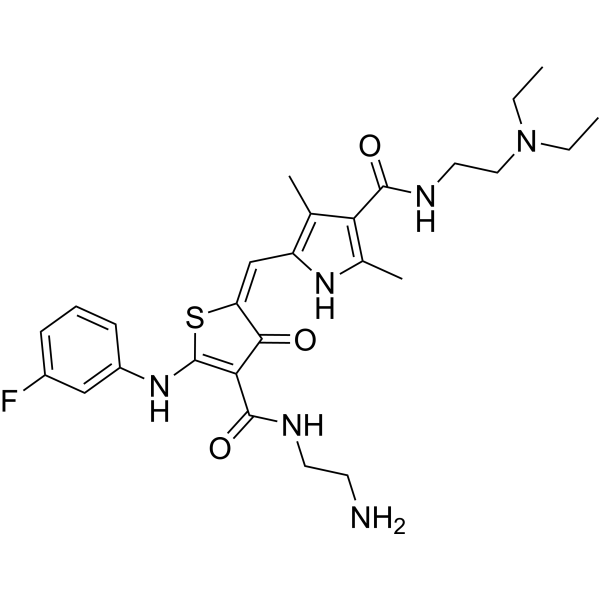
RNase L-IN-1 (trihydrochloride)
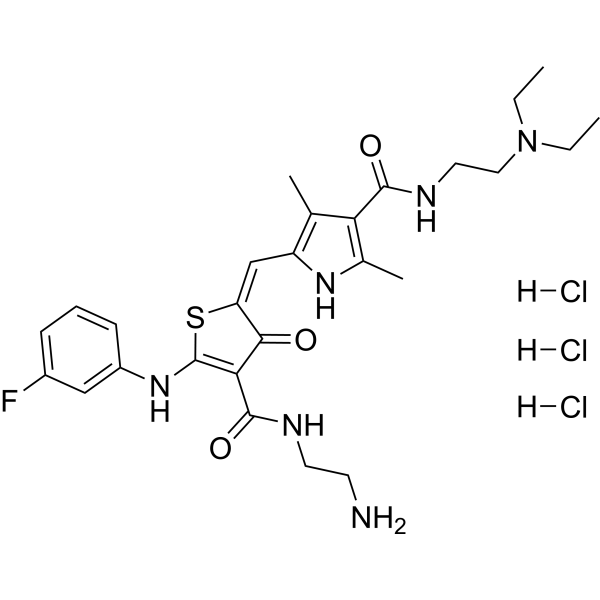 0 ImagesCat. No.: HY-155583APurity: 98.86%
-
2-5A TEA
 0 ImagesCat. No.: HY-173189BCAS No.: 72351-33-8Synonyms: 2′,5′-ApApA TEA; 2′,5′-trioligoadenylate TEA; 5'-O-Triphosphoryladenylyl-(2'→5')-adenylyl-(2'→5')-adenosine TEA2-5A TEA (2′,5′-ApApA TEA) is a 5'-triphosphorylated (2',5') oligoadenylate. When covalently linked to an antisense molecule complementary to the target sequence, 2-5A TEA activates RNase L, which subsequently degrades the target RNA bound to the 2-5A TEA chimera. 2-5A TEA can be used in research related to respiratory syncytial virus infection, colorectal adenocarcinoma and melanoma.
-
2-5A pentasodium solution (100 mM)
 0 ImagesCat. No.: HY-173189ASynonyms: 2′,5′-ApApA pentasodium; 2′,5′-trioligoadenylate pentasodium; 5'-O-Triphosphoryladenylyl-(2'→5')-adenylyl-(2'→5')-adenosine pentasodium2-5A pentasodium solution (100 mM) (2′,5′-ApApA pentasodium solution (100 mM)) is a 5'-triphosphorylated (2',5') oligoadenylate. When covalently linked to an antisense molecule complementary to the target sequence, 2-5A pentasodium solution (100 mM) activates RNase L, which subsequently degrades the target RNA bound to the 2-5A pentasodium solution (100 mM) chimera. 2-5A pentasodium solution (100 mM) can be used in research related to respiratory syncytial virus infection, colorectal adenocarcinoma and melanoma.
-
F1-RIBOTAC
 0 ImagesCat. No.: HY-171148CAS No.: 3019907-96-8
-
RNase L ligand 2
 0 ImagesCat. No.: HY-168457CAS No.: 3025538-34-2RNase L ligand 2 (compound 6) is the Rnase L ligand part of RNAse L RIBOTAC (HY-168455), an RNA-degrading chimera which binds to a four-way RNA helix called SL5 in the 5’ UTR of the SARS-CoV-2 RNA genome and inhibits the virus replication in lung epithelial carcinoma cells. RNase L ligand 2 can be used in the synthesis of RIBOTAC.
-
2-5A
 0 ImagesCat. No.: HY-173189CAS No.: 65954-93-0Synonyms: 2′,5′-ApApA; 2′,5′-trioligoadenylate; 5'-O-Triphosphoryladenylyl-(2'→5')-adenylyl-(2'→5')-adenosine2-5A (2′,5′-ApApA) is a 5'-triphosphorylated (2',5') oligoadenylate. When covalently linked to an antisense molecule complementary to the target sequence, 2-5A activates RNase L, which subsequently degrades the target RNA bound to the 2-5A chimera. 2-5A can be used in research related to respiratory syncytial virus infection, colorectal adenocarcinoma and melanoma.

-
RNase L ligand 3
 0 ImagesCat. No.: HY-177030CAS No.: 3036649-51-8RNase L ligand 3 is a RNase L ligand. RNase L ligand 3 can be used for synthesis of F3-PEG8-RiboTAC (HY-176259).
-
RNAse L RIBOTAC
 0 ImagesCat. No.: HY-168455RNAse L RIBOTAC (compound C64) is an RNA-degrading chimera which binds to a four-way RNA helix called SL5 in the 5’ UTR of the SARS-CoV-2 RNA genome and inhibits the virus replication in lung epithelial carcinoma cells. (Blue: RNA ligand (HY-168456); Black: linker (HY-130591); Pink: Rnase L ligand (HY-168457))
-
RNA recruiter-linker 1
 0 ImagesCat. No.: HY-168458RNA recruiter-linker 1 is the RNA ligand-linker part of RNAse L RIBOTAC (HY-168455), an RNA-degrading chimera which binds to a four-way RNA helix called SL5 in the 5’ UTR of the SARS-CoV-2 RNA genome and inhibits the virus replication in lung epithelial carcinoma cells. RNA recruiter-linker 1 can be utilized in the synthesis of RIBOTAC.
-
GS-646089
 0 ImagesCat. No.: HY-185215CAS No.: 1770840-57-7GS-646089 is a broad-spectrum antiviral nucleoside analog that exhibits significant inhibitory activity against respiratory syncytial virus (RSV), human metapneumovirus (hMPV), rhinovirus (enterovirus) and enteroviruses. The IC50 of GS-646089 targeting RNA-dependent RNA polymerase (RdRp) ranges from 43 to 46 nM. GS-646089 blocks viral replication by being converted into a triphosphate metabolite intracellularly, which competes with ATP for incorporation into nascent RNA strands and acts as an immediate chain terminator. GS-646089 is the parent compound of the double prodrug GS-7682 (HY-161877), and is used in studies of acute respiratory viral infections and infections caused by related pathogens.
-
RNA recruiter 1
 0 ImagesCat. No.: HY-168456RNA recruiter 1 is the RNA ligand of RNAse L RIBOTAC (HY-168456), an RNA-degrading chimera which binds to a four-way RNA helix called SL5 in the 5’ UTR of the SARS-CoV-2 RNA genome and inhibits the virus replication in lung epithelial carcinoma cells. RNA recruiter 1 can be utilized in the synthesis of RIBOTAC.
- 1



