



Respiratory Syncytial Virus Infection
-
Respiratory Syncytial Virus Infection (26)

- 1
- 2
- Molecular Weight: 145.32 kDa

- Molecular Weight: 146.75 kDa
Clesrovimab (MK1654) is a humanized IgG1 monoclonal antibody targeting the respiratory syncytial virus (RSV) protein F. Clesrovimab binds to pre-fusion and post-fusion forms of RSV-A fusion protein with high affinity, with corresponding KD values of 71 pM and 480 pM, respectively. Clesrovimab is applicable for the research of RSV infection.

- Formula: C30H40N15O25P5·xC6H15N
- Molecular Weight: 1165.59 (free base)
2-5A TEA (2′,5′-ApApA TEA) is a 5'-triphosphorylated (2',5') oligoadenylate. When covalently linked to an antisense molecule complementary to the target sequence, 2-5A TEA activates RNase L, which subsequently degrades the target RNA bound to the 2-5A TEA chimera. 2-5A TEA can be used in research related to respiratory syncytial virus infection, colorectal adenocarcinoma and melanoma.

- Formula: C30H40N15O25P5
- Molecular Weight: 1165.59
2-5A (2′,5′-ApApA) is a 5'-triphosphorylated (2',5') oligoadenylate. When covalently linked to an antisense molecule complementary to the target sequence, 2-5A activates RNase L, which subsequently degrades the target RNA bound to the 2-5A chimera. 2-5A can be used in research related to respiratory syncytial virus infection, colorectal adenocarcinoma and melanoma.

- Molecular Weight: 147.09 kDa
RSM-01 is a monoclonal antibody targeting site Ø of the pre-fusion F glycoprotein (Fusion glycoprotein F0) of respiratory syncytial virus (RSV). RSM-01 can be used in studies related to RSV infection.

- Formula: C30H35N15Na5O25P5
- Molecular Weight: 1275.50
2-5A pentasodium solution (100 mM) (2′,5′-ApApA pentasodium solution (100 mM)) is a 5'-triphosphorylated (2',5') oligoadenylate. When covalently linked to an antisense molecule complementary to the target sequence, 2-5A pentasodium solution (100 mM) activates RNase L, which subsequently degrades the target RNA bound to the 2-5A pentasodium solution (100 mM) chimera. 2-5A pentasodium solution (100 mM) can be used in research related to respiratory syncytial virus infection, colorectal adenocarcinoma and melanoma.

- Formula: C22H29N5O3S
- Molecular Weight: 443.56
RSV-IN-14 is an orally active pre-fusion F protein inhibitor of respiratory syncytial virus (RSV), with a Kd of 5.0 μM, and exhibits lung-targeted distribution properties. RSV-IN-14 binds to the central cavity of the trimeric pre-fusion F protein, locks it in the pre-fusion state, and inhibits the conformational changes required for membrane fusion to block viral entry. RSV-IN-14 suppresses respiratory syncytial virus-induced syncytium formation. RSV-IN-14 can be used in studies on respiratory syncytial virus infection.
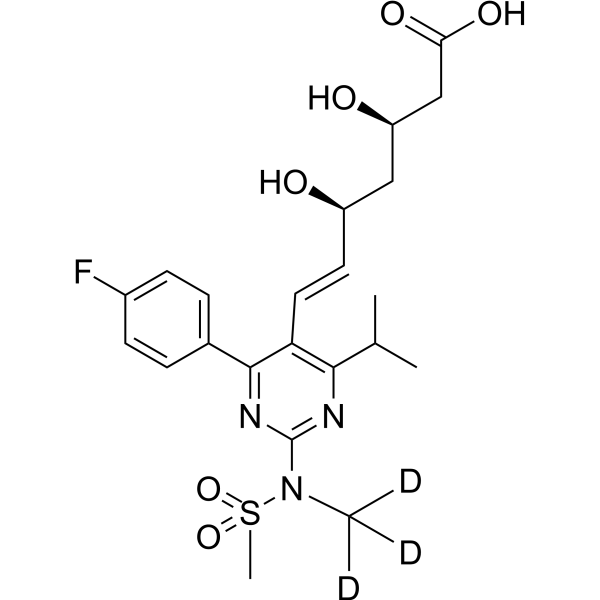
- Formula: C22H25D3FN3O6S
- Molecular Weight: 484.56
Rosuvastatin-d3 is the deuterated-labeled Rosuvastatin (HY-17504A). Rosuvastatin (ZD 4522) is a competitive HMG-CoA reductase inhibitor with an IC50 of 11 nM. Rosuvastatin potently blocks hERG current with an IC50 of 195 nM, delayed cardiac repolarization, and thereby prolonged action potential durations (APDs) and corrected QT interval (QTc) intervals. Rosuvastatin reduces the expression of the mature hERG and the interaction of heat shock protein 70 (Hsp70) with the hERG protein. Rosuvastatin effectively lowers low-density lipoprotein (LDL) cholesterol, triglycerides, and C-reactive protein levels.

- Formula: C10H20O
- Molecular Weight: 156.27
4-Isopropyl-1-methylcyclohexanol is a terpenoid component. 4-Isopropyl-1-methylcyclohexanol can be isolated from extracts of peppermint (Mentha × piperita). 4-Isopropyl-1-methylcyclohexanol reduces the level of mitotic nuclei, exhibits no antibacterial activity against bacteria, and shows no antiviral activity against respiratory syncytial virus.
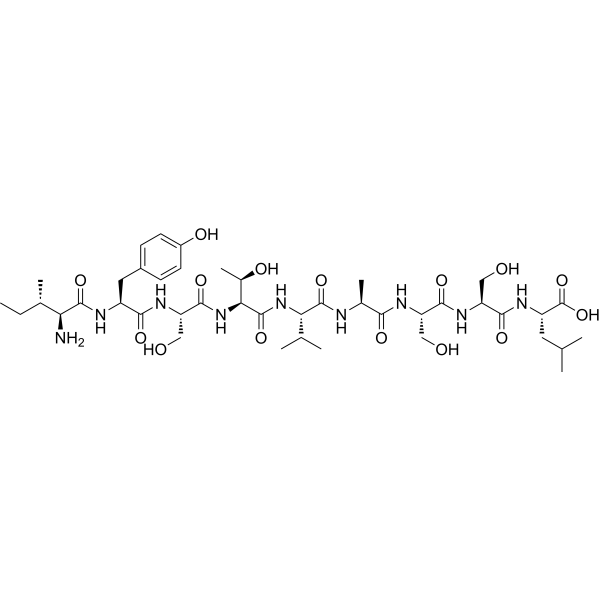
- Formula: C42H69N9O15
- Molecular Weight: 940.05
Influenza HA (518-526) is an H-2d-restricted CTL epitope derived from influenza virus hemagglutinin. Influenza HA (518-526) is highly conserved across various H5N1, some H9N2, and H1N1 strains. Influenza HA (518-526) binds to the mouse MHC class I allele Kd to form a complex, which is then recognized by specific CD8+ T cells. Influenza HA (518-526) is an immunodominant epitope in influenza-infected BALB/c mice, and it stimulates CD8+ T cells to secrete IFN-γ to induce a robust immune response. Currently, Influenza HA (518-526) is widely used in research related to respiratory syncytial virus (RSV), influenza virus, and H5N1 influenza.

- Formula: C9H11FN6O4
- Molecular Weight: 286.22
4'-C-Azido-2'-deoxy-2'-fluorocytidine is an antiviral agent. 4'-C-Azido-2'-deoxy-2'-fluorocytidine potently inhibits RNA synthesis of crude RSV RNP complexes with an IC50 of 0.1 μM. 4'-C-Azido-2'-deoxy-2'-fluorocytidine inhibits RSV replication in a subgenomic RSV replicon system. 4'-C-Azido-2'-deoxy-2'-fluorocytidine can be used for the research of respiratory syncytial virus (RSV) infection.

Anti-RSV F Antibody (R4.C6) is a monoclonal antibody against RSV F, with a Kd of 0.34 nM for the post-fusion RSV F trimer. Anti-RSV F Antibody (R4.C6) recognizes a unique neutralizing epitope spanning epitopes II and IV on both pre-fusion and post-fusion RSV F. Anti-RSV F Antibody (R4.C6) can be used in studies related to respiratory syncytial virus infection.

ADI-14448 is a RSV prefusion fusion glycoprotein inhibitor and HMPV fusion glycoprotein inhibitor, with a Kd of 3.8 × 10⁻¹⁰ M for RSV preF. ADI-14448 binds to epitope III of RSV preF, thereby blocking viral infection. ADI-14448 neutralizes RSV subtype A and HMPV subtype A1. ADI-14448 can be used in studies related to respiratory syncytial virus infection and metapneumovirus infection.

ADI-14359 is an antibody that binds to RSV postF, with a KD value of 387 nM, and exhibits non-neutralizing activity. ADI-14359 binds to antigenic site I on RSV postF through interactions of its conserved CDR H3 motif, germline-encoded IGKV1-39 light chain residues and heavy chain residues, where the light chain mediates preferential binding to postF by conflicting with the rearranged preF region. ADI-14359 can be used in studies related to respiratory syncytial virus (RSV) infection.

NIAID RSVF2-5 is a human monoclonal antibody fragment. NIAID RSVF2-5 binds to conserved, distinct conformational epitopes on RSV fusion glycoprotein, and shows activity against RSV subgroup A and B strains. NIAID RSVF2-5 reduces pulmonary and lung viral titers in RSV-infected rodents. NIAID RSVF2-5 can be used for the research of respiratory syncytial virus infection.

- Formula: C12H11N3S
- Molecular Weight: 229.30
YXX0237 is an orally active anti-hypoxic agent. YXX0237 upregulates mRNA expression of FGF21 and GDF15 via activation of the ISR/ATF4 transcriptional axis. YXX0237 exhibits low cytotoxicity. YXX0237 enhances hypoxic survival in mice. YXX0237 can be used for the research of acute mountain sickness and hypoxia-related diseases.

- Formula: C30H22O11
- Molecular Weight: 558.49
Genkwanol B is a natural flavonoid.

- Formula: C10H16ClFN3O13P3
- Molecular Weight: 533.62
ALS-8112-TP is the 5'-triphosphate metabolite of ALS-8112 (HY-12983). ALS-8112-TP is a potent, selective and competitive respiratory syncytial virus (RSV) RNA polymerase inhibitor, with selectivity against polymerases from host or viruses unrelated to RSV such as hepatitis C virus (HCV). ALS-8112-TP can be efficiently recognized by the recombinant RSV polymerase complex, causing chain termination of RNA synthesis. ALS-8112-TP can be used for RSV-infection research.

- Formula: C17H25NO
- Molecular Weight: 259.39
Foryshiyanine A is a triterpenoid alkaloid. Foryshiyanine A possesses anti-inflammatory activity, inhibiting the release of β-glucuronidase from rat polymorphonuclear leukocytes. Foryshiyanine A exhibits antiviral activity, with an EC50 of 4.5 μM against respiratory syncytial virus (RSV) and an IC50 of 7.3 μM against influenza A virus (H1N1). Foryshiyanine A reduces viral load by disrupting viral replication and entry. Foryshiyanine A may be used for the researches of inflammation and infection.

- Formula: C23H23ClF2N2O4
- Molecular Weight: 464.89
(S)-ZK824859 hydrochloride is a uPA inhibitor and anticoagulant. (S)-ZK824859 hydrochloride can be used for the research of severe acute respiratory syndrome caused by coronavirus and complications thereof .
- 1
- 2



