



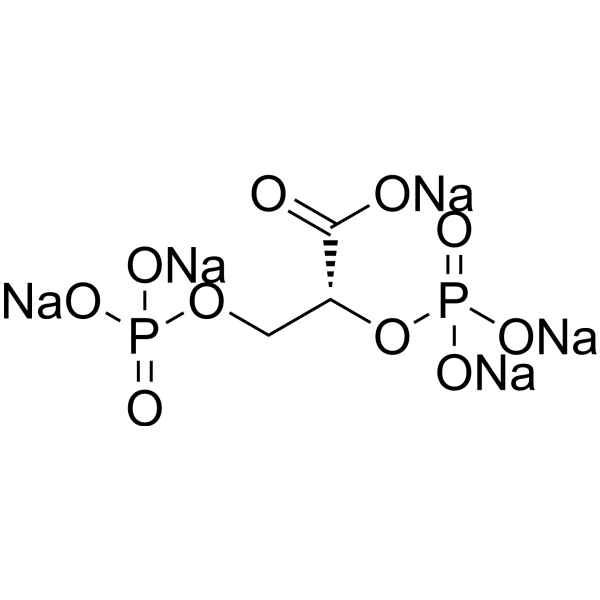
2,3-Diphospho-D-glyceric acid pentasodium salt

Based on 1 Customer Validation
2,3-Diphospho-D-glyceric acid (2,3-DPG) pentasodium salt is a hemoglobin binder and vascular calcification inhibitor that reduces the oxygen affinity of hemoglobin. 2,3-Diphospho-D-glyceric acid pentasodium salt also specifically delays the transformation of colloidal calciprotein particles into crystalline forms, thereby effectively inhibiting vascular smooth muscle cell calcification without affecting the normal formation of osteoid nodules in osteoblast-like cells. 2,3-Diphospho-D-glyceric acid pentasodium salt shows no cytotoxicity to tested cell lines and only weakly interferes with β-hematin formation mediated by glyceryl monopalmitate. 2,3-Diphospho-D-glyceric acid pentasodium salt can be used to study the pathological mechanisms of vascular calcification and malaria-related conditions.
For research use only. We do not sell to patients.
- Purity : 95.0%
- CAS No.: 102783-53-9
- Formula: C3H3Na5O10P2
- Molecular Weight:375.95
-
Storage:
-20°C, sealed storage, away from moisture
* In solvent : -80°C, 6 months; -20°C, 1 month (sealed storage, away from moisture)

To place orders, for customer services and technical support, please contact: MedChemExpress USA
Tel: 609-228-6898 E-mail: [email protected] [email protected]


-
 Biological Activity
-
Chemical Information
-
Solvent & Solubility
- Purity & Documentation
- References
-
 Help & FAQs


All Endogenous Metabolite Isoforms
More

Biological Activity
Description
In Vitro
2,3-Diphospho-D-glyceric acid pentasodium salt (1-81 μM; 1000 min) dose-dependently delays the conversion of CPPIs to CPPIIs in a cell-free serum-free system, with slightly higher potency than IP6; a concentration of 34.5 μM in human serum and 30.5 μM in fetal bovine serum is required to achieve a T50 of 350 min[1].
2,3-Diphospho-D-glyceric acid pentasodium salt (100 μM; 7 d) does not impair the proliferation of MC3T3-E1 osteoblastic cells or MOVAS vascular smooth muscle cells; meanwhile, the LDH release is <5% compared with the control[1].
2,3-Diphospho-D-glyceric acid pentasodium salt (1-100 μM; 72 h) does not alter the morphology of MC3T3-E1 osteoblastic cells or MOVAS vascular smooth muscle cells even at concentrations up to 100 μM following 72 h of incubation[1].
2,3-Diphospho-D-glyceric acid pentasodium salt (1-16 μM; 7 d) potently inhibits CPPII- and Ca2+-induced calcification of MOVAS vascular smooth muscle cells, with an IC50 of 3.8 μM, and achieves complete inhibition at concentrations ≥8 μM after 7 days of incubation[1].
2,3-Diphospho-D-glyceric acid pentasodium salt (16 μM; 10 d) does not inhibit osteogenic calcification in MC3T3-E1 osteoblastic cells[1].
2,3-Diphospho-D-glyceric acid pentasodium salt (4.5 mM; 30 min; 37 °C) exerts only a weak effect on β-heme formation mediated by glyceryl monopalmitate, with a final yield of 70.7%[2].
MedChemExpress (MCE) has not independently confirmed the accuracy of these methods. They are for reference only.
-
Cell Line:Mouse osteoblast-like MC3T3-E1 cells, mouse vascular smooth muscle MOVAS cells
-
Concentration:1-100 μM
-
Incubation Time:72 h
-
Result:Produced morphology of MC3T3-E1 and MOVAS cells similar to non-treated control cells, with preserved cell-cell interactions, flattened morphology, and intact adhesion to the plate surface.


Chemical Information
-
CAS No. 102783-53-9
-
Appearance Solid
-
Molecular Weight 375.95
-
Formula C3H3Na5O10P2
-
Color White to light yellow
-
SMILES
O=P(O[Na])(O[Na])OC[C@H](C(O[Na])=O)OP(O[Na])(O[Na])=O
-
Synonyms
2,3-DPG pentasodium salt
-
Shipping
Room temperature in continental US; may vary elsewhere.
-
Storage
-20°C, sealed storage, away from moisture
* In solvent : -80°C, 6 months; -20°C, 1 month (sealed storage, away from moisture)


Solvent & Solubility
In Vitro:
H2O : 50 mg/mL (133.00 mM; Need ultrasonic)
Please refer to the solubility information to select the appropriate solvent. Once prepared, please aliquot and store the solution to prevent product inactivation from repeated freeze-thaw cycles.
Storage method and period of stock solution: -80°C, 6 months; -20°C, 1 month (sealed storage, away from moisture). When stored at -80°C, please use it within 6 months. When stored at -20°C, please use it within 1 month.
* Note: If you choose water as the stock solution, please dilute it to the working solution, then filter and sterilize it with a 0.22 μm filter before use.
Please refer to the solubility information to select the appropriate solvent. Once prepared, please aliquot and store the solution to prevent product inactivation from repeated freeze-thaw cycles.
Storage method and period of stock solution: -80°C, 6 months; -20°C, 1 month (sealed storage, away from moisture). When stored at -80°C, please use it within 6 months. When stored at -20°C, please use it within 1 month.
* Note: If you choose water as the stock solution, please dilute it to the working solution, then filter and sterilize it with a 0.22 μm filter before use.
Concentration (start) × Volume (start) = Concentration (final) × Volume (final)


Purity & Documentation
-
Data Sheet (278 KB)
-
SDS (252 KB)
- English - EN (252 KB)
- Français - FR (252 KB)
- Deutsch - DE (252 KB)
- Norwegian - NO (252 KB)
- Español - ES (252 KB)
- Swedish - SV (252 KB)
- Italian - IT (252 KB)
- Korean - KR (252 KB)
- Portuguese - PT (252 KB)
-
Handling Instructions (2659 KB)
References


Complete Stock Solution Preparation Table
Please refer to the solubility information to select the appropriate solvent. Once prepared, please aliquot and store the solution to prevent product inactivation from repeated freeze-thaw cycles.
Storage method and period of stock solution: -80°C, 6 months; -20°C, 1 month (sealed storage, away from moisture). When stored at -80°C, please use it within 6 months. When stored at -20°C, please use it within 1 month.
| Optional Solvent | Concentration Solvent Mass | 1 mg | 5 mg | 10 mg | 25 mg |
|---|---|---|---|---|---|
| H2O | 1 mM | 2.6599 mL | 13.2996 mL | 26.5993 mL | 66.4982 mL |
| 5 mM | 0.5320 mL | 2.6599 mL | 5.3199 mL | 13.2996 mL | |
| 10 mM | 0.2660 mL | 1.3300 mL | 2.6599 mL | 6.6498 mL | |
| 15 mM | 0.1773 mL | 0.8866 mL | 1.7733 mL | 4.4332 mL | |
| 20 mM | 0.1330 mL | 0.6650 mL | 1.3300 mL | 3.3249 mL | |
| 25 mM | 0.1064 mL | 0.5320 mL | 1.0640 mL | 2.6599 mL | |
| 30 mM | 0.0887 mL | 0.4433 mL | 0.8866 mL | 2.2166 mL | |
| 40 mM | 0.0665 mL | 0.3325 mL | 0.6650 mL | 1.6625 mL | |
| 50 mM | 0.0532 mL | 0.2660 mL | 0.5320 mL | 1.3300 mL | |
| 60 mM | 0.0443 mL | 0.2217 mL | 0.4433 mL | 1.1083 mL | |
| 80 mM | 0.0332 mL | 0.1662 mL | 0.3325 mL | 0.8312 mL | |
| 100 mM | 0.0266 mL | 0.1330 mL | 0.2660 mL | 0.6650 mL |
* Note: If you choose water as the stock solution, please dilute it to the working solution, then filter and sterilize it with a 0.22 μm filter before use.


2,3-Diphospho-D-glyceric acid pentasodium salt Related Classifications
HY-138822 Related Classifications
 Powered by Bioz
Keywords
- 2,3-Diphospho-D-glyceric acid pentasodium
- 102783-53-9
- 2,3-DPG pentasodium
- Endogenous Metabolite
- vascular calcification
- MC3T3-E1 osteoblast-like cells
- MOVAS vascular smooth muscle cells
- calciprotein particle
- hemoglobin
- malaria
- vascular smooth muscle cell calcification
- vascular smooth muscle cells
- β-haematin
- osteoblast-like cells
- Inhibitor
- inhibitor
- inhibit