



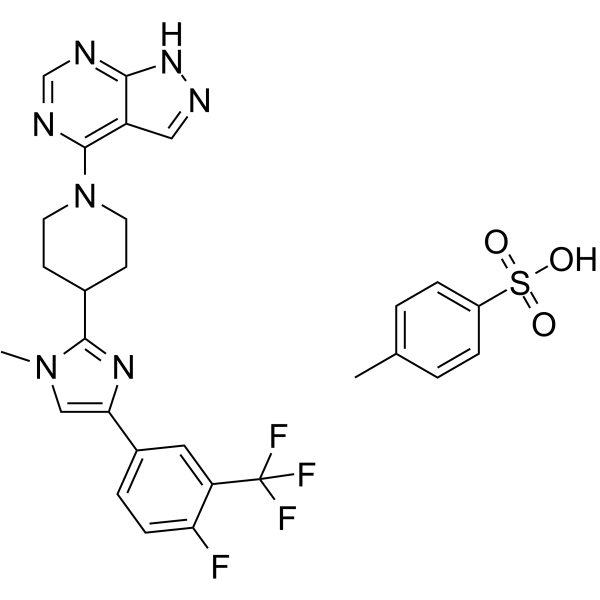
LY-2584702 tosylate salt
Based on 6 publication(s) in Google Scholar
LY-2584702 tosylate salt is a selective ATP competitive inhibitor of p70S6K with an IC50 of 4 nM. In S6K1 enzyme assay, the IC50 of LY-2584702 is 2 nM.
For research use only. We do not sell to patients.
- Purity: 99.50%
- CAS No.: 1082949-68-5
- Formula: C28H27F4N7O3S
- Molecular Weight:617.62
-
Storage:
4°C, sealed storage, away from moisture
* In solvent : -80°C, 1 year; -20°C, 6 months (sealed storage, away from moisture)

To place orders, for customer services and technical support, please contact: MedChemExpress USA
Tel: 609-228-6898 E-mail: [email protected] [email protected]


-
 Biological Activity
-
Chemical Information
-
Solvent & Solubility
- Protocol
- Purity & Documentation
- References
-
 Help & FAQs


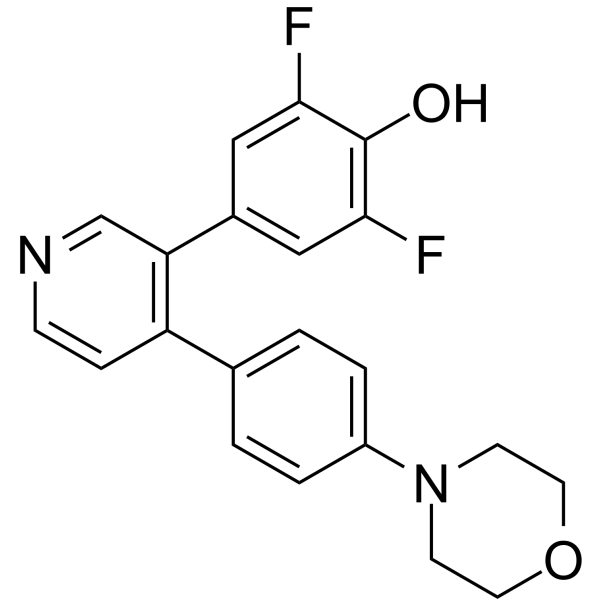
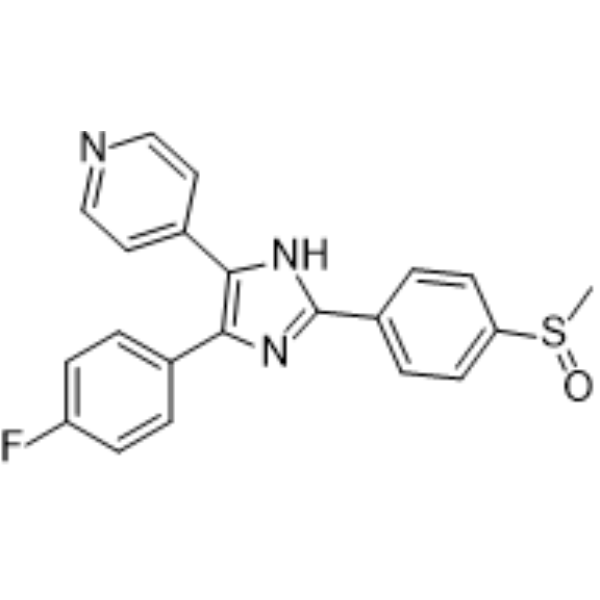
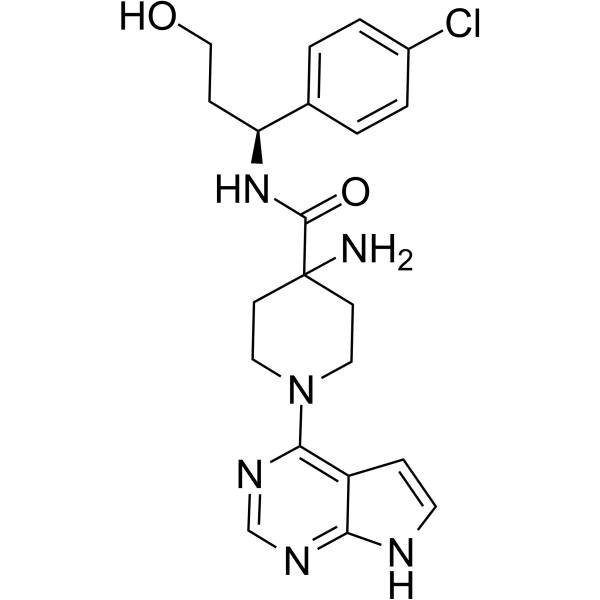
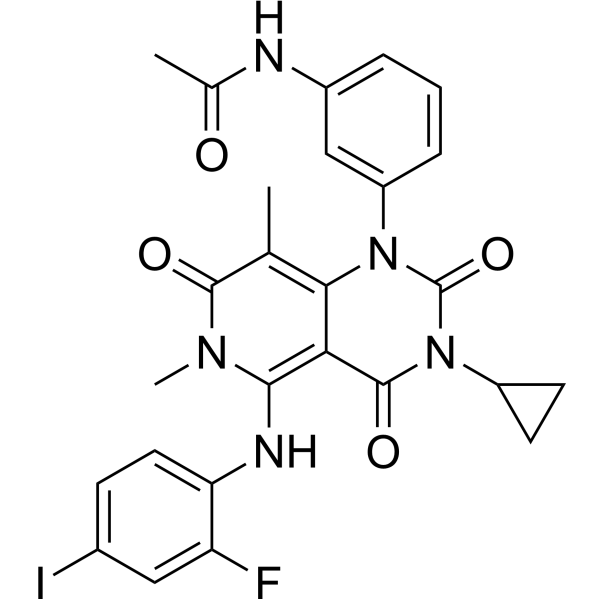
Publications Citing Use of MedChemExpress (MCE) LY-2584702 tosylate salt
More

Biological Activity
Description
|
p70S6K 4 nM (IC50) |
In Vitro
LY-2584702 (LY2584702) inhibits phosphorylation of the S6 ribosomal protein (pS6) in HCT116 colon cancer cells with an IC50 of 0.1-0.24 μM[1]. In S6K1 enzyme assay, the IC50 of LY-2584702 (LY2584702) is 2 nM. For pS6 inhibition in cells, the IC50=100 nM. LY-2584702 has some activity against the S6K-related kinases MSK2 and RSK at high concentrations (enzyme assay IC50=58-176 nM). LY-2584702 inhibits S6K activity in EOMA cells, as determined by the phosphorylation of its downstream effector S6, in a dose-dependent manner[2]. Proliferation of A549 is significantly inhibited by LY-2584702 (LY2584702) treating over 24 h at 0.1 μM (P<0.05); and the trend of decline is more conspicuous with longer treatment and/or with the increased drug concentration (all P<0.05). Similar results are also observed in SK-MES-1, although the obvious inhibition is led by LY-2584702 at 0.6 μM (P<0.05), much higher than that of A549[3].
MedChemExpress (MCE) has not independently confirmed the accuracy of these methods. They are for reference only.
In Vivo
MedChemExpress (MCE) has not independently confirmed the accuracy of these methods. They are for reference only.


Chemical Information
-
CAS No. 1082949-68-5
-
Appearance Solid
-
Molecular Weight 617.62
-
Formula C28H27F4N7O3S
-
Color Light yellow to yellow
-
SMILES
CN1C=C(C2=CC=C(F)C(C(F)(F)F)=C2)N=C1C3CCN(C4=C5C(NN=C5)=NC=N4)CC3.O=S(C6=CC=C(C)C=C6)(O)=O
-
Shipping
Room temperature in continental US; may vary elsewhere.
-
Storage
4°C, sealed storage, away from moisture
* In solvent : -80°C, 1 year; -20°C, 6 months (sealed storage, away from moisture)


Publications (6)
-
Journal Impact Factor
-
Most Recent
-
Immunity
The chemokine CCL1 triggers an AMFR-SPRY1 pathway that promotes differentiation of lung fibroblasts into myofibroblasts and drives pulmonary fibrosis. [Abstract]2021 Sep 14;54(9):2042-2056.e8. PMID: 34407391 -
Hepatology
2023 May 1;77(5):1580-1592. PMID: 36129070 -
Theranostics
Overcoming resistance to EGFR monotherapy in HNSCC by identification and inhibition of individualized cancer processes. [Abstract]2022 Jan 1;12(3):1204-1219. PMID: 35154483 -
Pharmacol Res
Dihydroartemisinin ameliorates retinal vascular dysfunction in diabetes mellitus via the FASN/Kmal-mTOR/SREBP1 feedback loop. [Abstract]2021 Oct 4;105871. PMID: 34619345 -
Dev Cell
2025 Nov 27:S1534-5807(25)00691-4. PMID: 41314217 -
Mol Cell Biochem
MELK inhibits cuproptosis in diffuse large B-cell lymphoma cells via the PI3K/mTOR/S6K-DLAT signaling axis. [Abstract]2026 Jun 2. PMID: 42228272


Solvent & Solubility
In Vitro:
DMSO : 10.25 mg/mL (16.60 mM; Need ultrasonic and warming; Hygroscopic DMSO has a significant impact on the solubility of product, please use newly opened DMSO)
Please refer to the solubility information to select the appropriate solvent. Once prepared, please aliquot and store the solution to prevent product inactivation from repeated freeze-thaw cycles.
Storage method and period of stock solution: -80°C, 1 year; -20°C, 6 months (sealed storage, away from moisture). When stored at -80°C, please use it within 1 year. When stored at -20°C, please use it within 6 months.
Please refer to the solubility information to select the appropriate solvent. Once prepared, please aliquot and store the solution to prevent product inactivation from repeated freeze-thaw cycles.
Storage method and period of stock solution: -80°C, 1 year; -20°C, 6 months (sealed storage, away from moisture). When stored at -80°C, please use it within 1 year. When stored at -20°C, please use it within 6 months.
Concentration (start) × Volume (start) = Concentration (final) × Volume (final)
In Vivo:
Select the appropriate dissolution method based on your experimental animal and administration route.
- For the following dissolution methods, please ensure to first prepare a clear stock solution using an In Vitro approach and then sequentially add co-solvents:
- To ensure reliable experimental results, the clarified stock solution can be appropriately stored based on storage conditions. As for the working solution for In Vivo experiments, it is recommended to prepare freshly and use it on the same day.
- The percentages shown for the solvents indicate their volumetric ratio in the final prepared solution. If precipitation or phase separation occurs during preparation, heat and/or sonication can be used to aid dissolution.
Add each solvent one by one: 10% DMSO 40% PEG300 5% Tween-80 45% Saline
Solubility: ≥ 1 mg/mL (1.62 mM); Clear solution
This protocol yields a clear solution of ≥ 1 mg/mL (saturation unknown).
Taking 1 mL working solution as an example, add 100 μL DMSO stock solution (10.0 mg/mL) to 400 μL PEG300, and mix evenly; then add 50 μL Tween-80 and mix evenly; then add 450 μL Saline to adjust the volume to 1 mL.
Preparation of Saline: Dissolve 0.9 g sodium chloride in ddH₂O and dilute to 100 mL to obtain a clear Saline solution.
Add each solvent one by one: 10% DMSO 90% (20% SBE-β-CD in Saline)
Solubility: 1 mg/mL (1.62 mM); Suspended solution; Need ultrasonic
This protocol yields a suspended solution of 1 mg/mL. Suspended solution can be used for oral and intraperitoneal injection.
Taking 1 mL working solution as an example, add 100 μL DMSO stock solution (10.0 mg/mL) to 900 μL 20% SBE-β-CD in Saline, and mix evenly.
Preparation of 20% SBE-β-CD in Saline (4°C, storage for one week): 2 g SBE-β-CD powder is dissolved in 10 mL Saline, completely dissolve until clear.
In Vivo Dissolution Calculator
Please enter the basic information of animal experiments:
-
-
-
-
Recommended: Prepare an additional quantity of animals to account for potential losses during experiments.
Please enter your animal formula composition:
-
%DMSO +
Recommended: Keep the proportion of DMSO in working solution below 2% if your animal is weak.
-
%+
-
+%Tween-80 + +
-
%Saline +
The co-solvents required include: DMSO, . All of co-solvents are available by MedChemExpress (MCE). , Tween 80. All of co-solvents are available by MedChemExpress (MCE).
Working solution concentration: 0.22 mg/mL
Method for preparing stock solution: mg drug dissolved in μL DMSO. Stock solution concentration: mg/mL. * In solvent : -80°C, 1 year; -20°C, 6 months (sealed storage, away from moisture)
1. Take μL DMSO stock solution;
2. Add μL .
μL , mix evenly;
3. Then add μL Tween 80, mix evenly;
4. Then add μL
Please ensure that the stock solution in the first step is dissolved to a clear state, and add co-solvents in sequence. You can use ultrasonic heating (ultrasonic cleaner, recommended frequency 20-40 kHz), vortexing, etc. to assist dissolution.

Protocol
Cell Assay[3]
LY-2584702 is fully dissolved in 20 mL 10% DMSO and reserved at -80°C. When conducted the experiments in vitro, LY-2584702 is further diluted in 0.5% Tween 80, 5% propylene glycol and 30% PEG400 to reach different DMSO concentrations of 0.1 μM, 0.2 μM, 0.6 μM, and 1.0 μM. Cell Counting Kit-8 (CCK-8) is used to measure the cells proliferation in vitro. Cell lines A549 and SK-MES-1 treated by LY-2584702 for 24 h with different concentrations are seeded in 96-well plates at a density of 5×10³ per well, with six repeats. DMSO treated, or in other words, the concentration of LY-2584702 of 0 is used as negative control. Cells absorbance at 450 nm is detected every 24 h after seeding to measure the proliferative activities[3].
MedChemExpress (MCE) has not independently confirmed the accuracy of these methods. They are for reference only.
Animal Administration[2]
Mice[2]
LY-2584702 is prepared in 0.25% Tween-80 and 0.05% antifoam, and administered orally to mice (12.5 mg/kg twice daily). EOMA cells (0.3×10⁶) are injected subcutaneously in 6- to 8-week-old nu/nu female mice (2 sites/mouse, 4-5 mice/group). Tumor size is measured daily. For drug treatment, when tumors reach 0.01 cm3 in size, the animals are treated with vehicle control or LY-2584702 (12.5 mg/kg twice daily, oral dosing). Tumor size is measured every 3 to 4 days[2].
MedChemExpress (MCE) has not independently confirmed the accuracy of these methods. They are for reference only.


Purity & Documentation
-
Data Sheet (283 KB)
-
SDS (393 KB)
- English - EN (393 KB)
- Français - FR (393 KB)
- Deutsch - DE (393 KB)
- Norwegian - NO (393 KB)
- Español - ES (393 KB)
- Swedish - SV (393 KB)
- Italian - IT (393 KB)
- Korean - KR (393 KB)
- Portuguese - PT (393 KB)
-
Handling Instructions (2659 KB)
References
[1]. Tolcher A, et al. A phase I trial of LY2584702 tosylate, a p70 S6 kinase inhibitor, in patients with advanced solid tumors. Eur J Cancer. 2014 Mar;50(5):867-75. [Content Brief]
[2]. Phung TL, et al. Akt1 and akt3 exert opposing roles in the regulation of vascular tumor growth. Cancer Res. 2015 Jan 1;75(1):40-50. [Content Brief]
[3]. Chen B, et al. Hyperphosphorylation of RPS6KB1, rather than overexpression, predicts worse prognosis in non-small cell lung cancer patients. PLoS One. 2017 Aug 9;12(8):e0182891. [Content Brief]


Complete Stock Solution Preparation Table
Please refer to the solubility information to select the appropriate solvent. Once prepared, please aliquot and store the solution to prevent product inactivation from repeated freeze-thaw cycles.
Storage method and period of stock solution: -80°C, 1 year; -20°C, 6 months (sealed storage, away from moisture). When stored at -80°C, please use it within 1 year. When stored at -20°C, please use it within 6 months.
| Optional Solvent | Concentration Solvent Mass | 1 mg | 5 mg | 10 mg | 25 mg |
|---|---|---|---|---|---|
| DMSO | 1 mM | 1.6191 mL | 8.0956 mL | 16.1912 mL | 40.4780 mL |
| 5 mM | 0.3238 mL | 1.6191 mL | 3.2382 mL | 8.0956 mL | |
| 10 mM | 0.1619 mL | 0.8096 mL | 1.6191 mL | 4.0478 mL | |
| 15 mM | 0.1079 mL | 0.5397 mL | 1.0794 mL | 2.6985 mL |


LY-2584702 tosylate salt Related Classifications
HY-12493A Related Classifications
 Powered by Bioz