



Rutaecarpine
Based on 8 publication(s) in Google Scholar
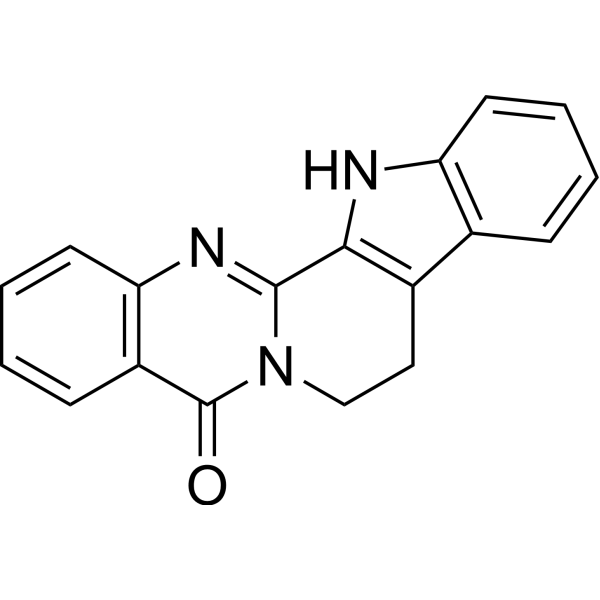
Rutaecarpine, an alkaloid of Evodia rutaecarpa, is an inhibitor of COX-2 with an IC50 value of 0.28 μM. Rutaecarpine can target and activate the NRF2/HO-1 pathway to reduce craniofacial injury. Rutaecarpine sttenuates oxidative stress-induced traumatic brain injury (TBI) and reduces secondary injury via the PGK1/KEAP1/NRF2 signaling pathway. Rutaecarpine can cross the blood-brain barrier (BBB).
For research use only. We do not sell to patients.
- Purity : 99.77%
- CAS No.: 84-26-4
- Formula: C18H13N3O
- Molecular Weight:287.32
-
Storage:Powder -20°C, 3 years , 4°C, 2 years ; In solvent -80°C, 2 years , -20°C, 1 year

To place orders, for customer services and technical support, please contact: MedChemExpress USA
Tel: 609-228-6898 E-mail: [email protected] [email protected]


-
 Biological Activity
-
Chemical Information
-
Solvent & Solubility
- Protocols
- Purity & Documentation
- References
-
 Help & FAQs


-
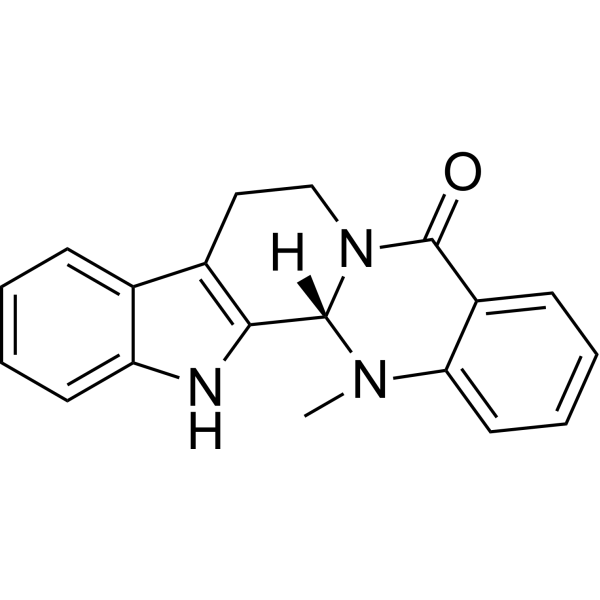
HY-N0114
EvodiamineAlkaloid -
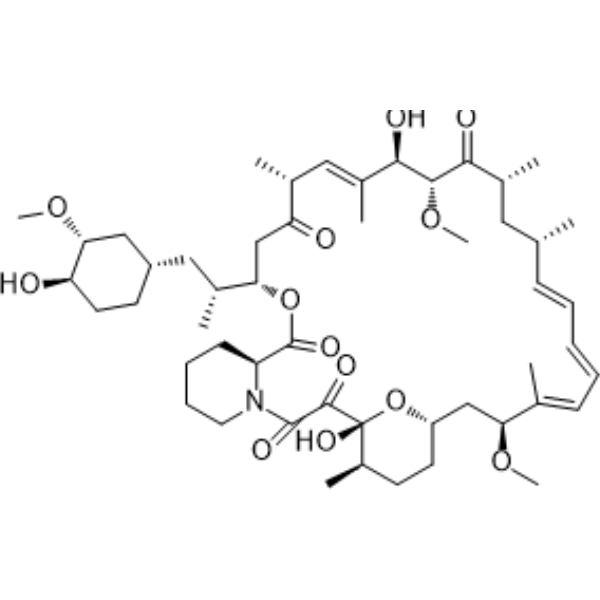
HY-10219
RapamycinmTOR Inhibitor -
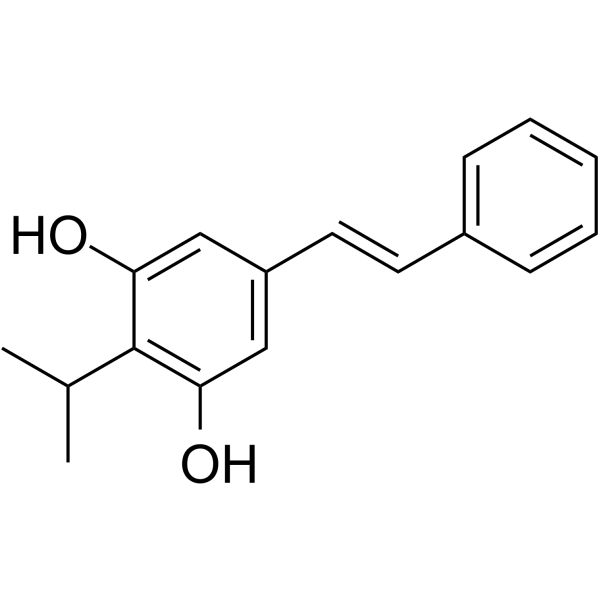
HY-109044
TapinarofAhR Agonist -
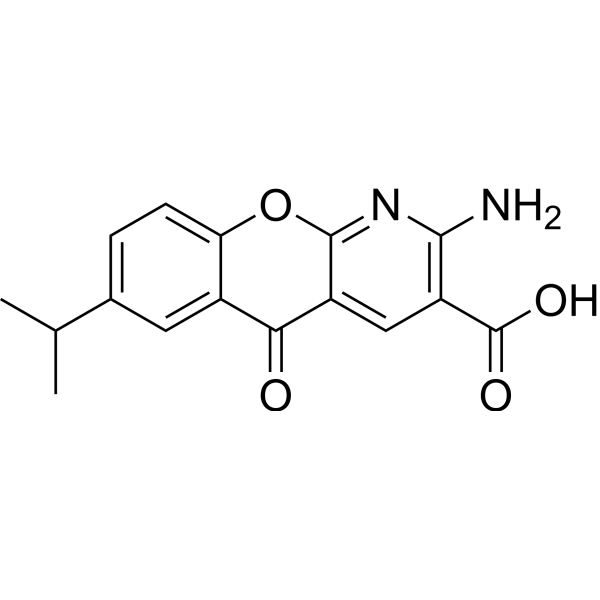
HY-B0713
AmlexanoxIKK Inhibitor -
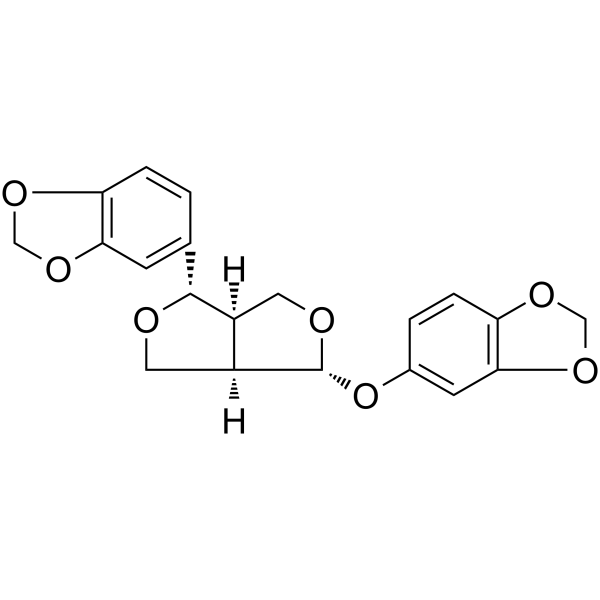
HY-N0809
SesamolinMAPK Inhibitor -

HY-N0147R
Rutaecarpine (Standard)COX Inhibitor -
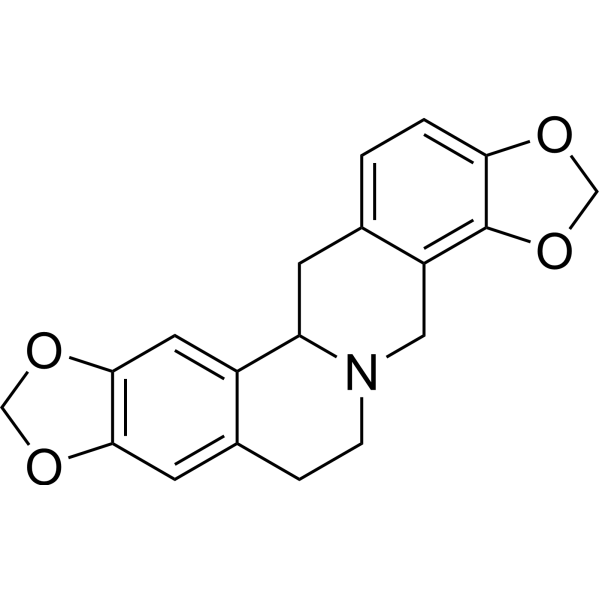
HY-N0924
(±)-StylopineAlkaloid -
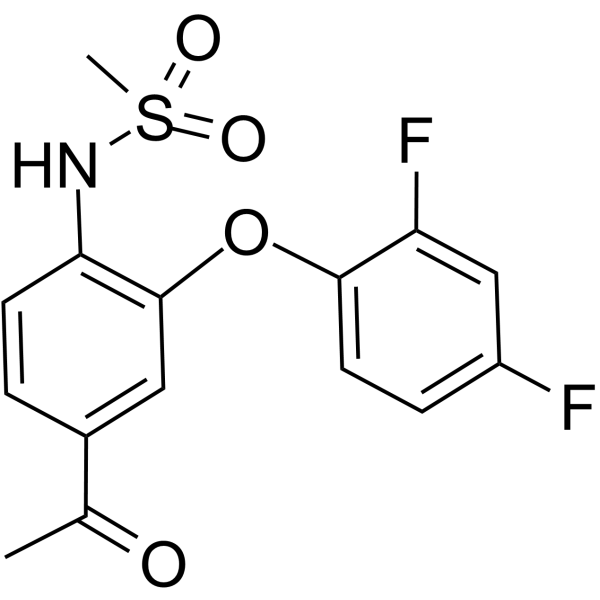
HY-14445
FK 3311Selective COX-2 Inhibitor -
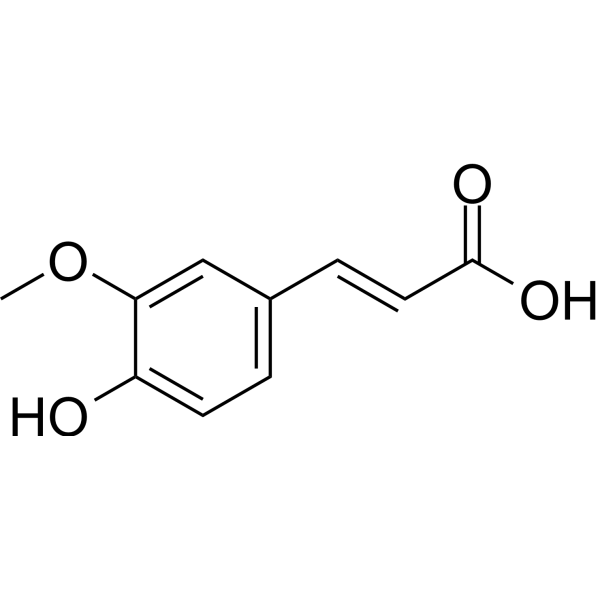
HY-N0060
Ferulic acidFGFR1 Inhibitor -
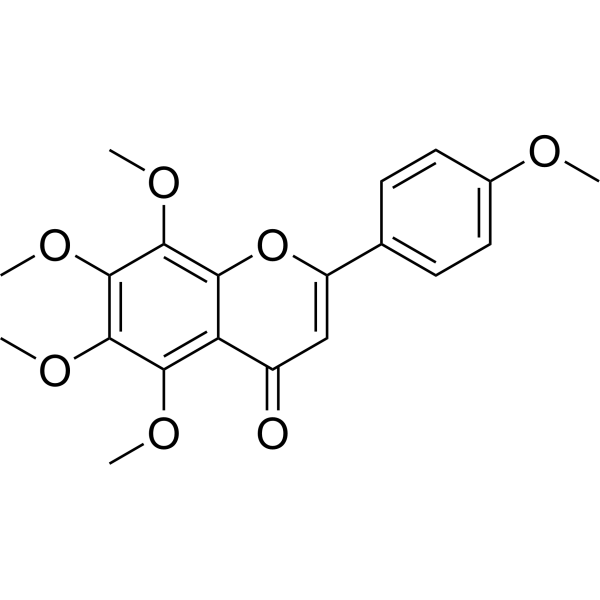
HY-N0133
TangeretinApoptosis Inducer -
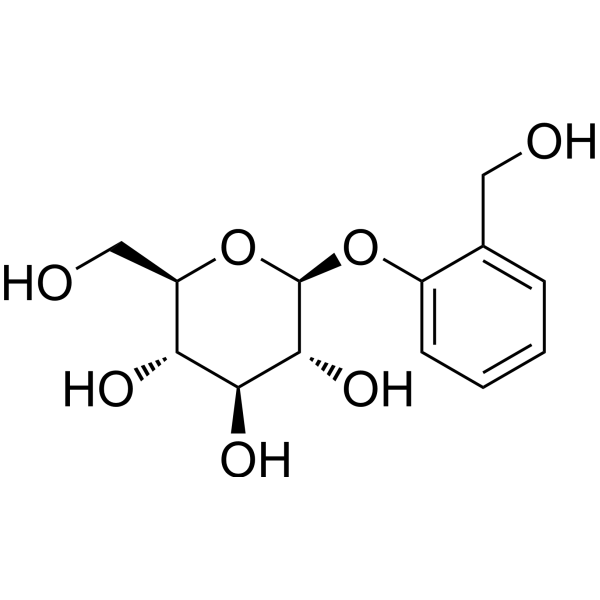
HY-N0149
SalicinAlcoholic β-glucoside -
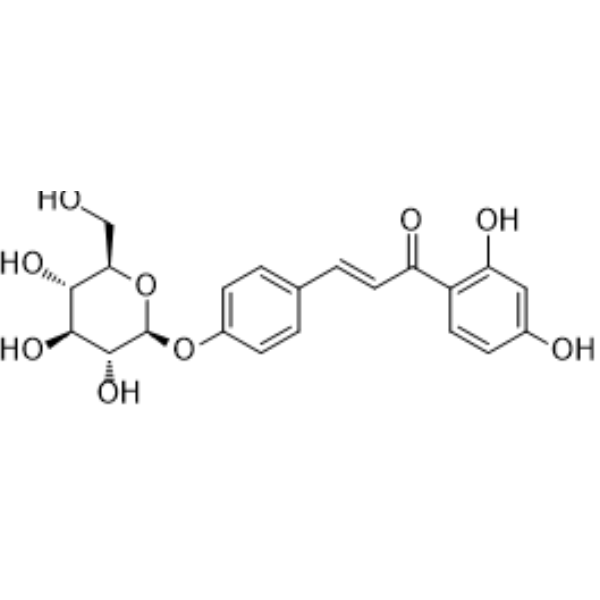
HY-N0765
IsoliquiritinFungal Inhibitor
Publications Citing Use of MedChemExpress (MCE) Rutaecarpine
More- Phytother Res. 2021 Nov;35(11):6472-6485. [Abstract]
- J Ethnopharmacol. 2022 Nov 15:298:115586. [Abstract]
- Anal Chim Acta. 2026 Jun 5;1417:345811.
- Int Immunopharmacol. 2023 Mar:116:109747. [Abstract]
- BMC Complement Med Ther. 2023 Dec 1;23(1):433. [Abstract]
- Arch Pharm (Weinheim). 2022 May;355(5):e2100467. [Abstract]
- Chem Biol Drug Des. 2026 Mar 8;107(3):e70275.
- SSRN. 2026 Apr 30.
 Customer Validation & Images

-
Cell Proliferation/Viability Assay
-
ELISA


Biological Activity
Description
IC50 & Target
[1]|
COX-2 0.28 μM (IC50, in BMMC) |
COX-1 8.7 μM (IC50, in BMMC) |
Cellular Effect
|
Cell Line

|
Type | Value | Description | References |
|---|---|---|---|---|
| A549 | GI50 |
14.5 μM
Compound: 11a
|
Tested for in vitro cytotoxicity against non-small cell lung cancer cell line A549/ATCC
Tested for in vitro cytotoxicity against non-small cell lung cancer cell line A549/ATCC
|
10.1016/0960-894X(95)00046-V |
| A549 | GI50 |
14.5 μM
Compound: 49
|
Growth inhibition of human A549 cells by SRB assay
Growth inhibition of human A549 cells by SRB assay
|
[PMID: 36375335] |
| A549 | IC50 |
>20 μM
Compound: Fig 1A, Cpd 1
|
Antiproliferative activity against human A549 cells assessed as cell growth inhibition incubated for 48 hrs by MTT assay
Antiproliferative activity against human A549 cells assessed as cell growth inhibition incubated for 48 hrs by MTT assay
|
[PMID: 38897138] |
| CCD-18Co | IC50 |
>50 μM
Compound: 1
|
Antiproliferative activity against human CCD-18Co cells assessed as reduction in cell viability measured after 72 hrs by SRB assay
Antiproliferative activity against human CCD-18Co cells assessed as reduction in cell viability measured after 72 hrs by SRB assay
|
[PMID: 35544614] |
| CCD-841CoN | IC50 |
>50 μM
Compound: 1
|
Antiproliferative activity against human CCD-841CoN cells assessed as reduction in cell viability measured after 72 hrs by SRB assay
Antiproliferative activity against human CCD-841CoN cells assessed as reduction in cell viability measured after 72 hrs by SRB assay
|
[PMID: 35544614] |
| CCRF-CEM | GI50 |
18.9 μM
Compound: 11a
|
Tested for in vitro cytotoxicity against leukemia cell line CCRF-CEM
Tested for in vitro cytotoxicity against leukemia cell line CCRF-CEM
|
10.1016/0960-894X(95)00046-V |
| DU-145 | GI50 |
31.65 μM
Compound: 49
|
Growth inhibition of human DU-145 cells incubated for 48 hrs by sulforhodamine B assay
Growth inhibition of human DU-145 cells incubated for 48 hrs by sulforhodamine B assay
|
[PMID: 36375335] |
| HCT-116 | GI50 |
33.89 μM
Compound: 49
|
Anticancer activity against human HCT-116 cells assessed as cell growth inhibition
Anticancer activity against human HCT-116 cells assessed as cell growth inhibition
|
[PMID: 36375335] |
| HCT-116 | IC50 |
31.1 μM
Compound: 1
|
Antiproliferative activity against human HCT-116 cells harboring beta-catenin mutant assessed as reduction in cell viability measured after 72 hrs by SRB assay
Antiproliferative activity against human HCT-116 cells harboring beta-catenin mutant assessed as reduction in cell viability measured after 72 hrs by SRB assay
|
[PMID: 35544614] |
| HCT-15 | IC50 |
>50 μM
Compound: 1
|
Antiproliferative activity against human HCT-15 cells harboring wild type beta-catenin assessed as reduction in cell viability measured after 72 hrs by SRB assay
Antiproliferative activity against human HCT-15 cells harboring wild type beta-catenin assessed as reduction in cell viability measured after 72 hrs by SRB assay
|
[PMID: 35544614] |
| HEK293 | EC50 |
2.06 μM
Compound: 2
|
Agonist activity at rat TRPV1 channel expressed in HEK293 cells assessed as induction of channel current at -60 mV holding potential by whole-cell patch-clamp method
Agonist activity at rat TRPV1 channel expressed in HEK293 cells assessed as induction of channel current at -60 mV holding potential by whole-cell patch-clamp method
|
[PMID: 27159637] |
| HeLa | EC50 |
26.1 μM
Compound: 1a
|
Cytotoxicity against human HeLa cells by MTT assay
Cytotoxicity against human HeLa cells by MTT assay
|
[PMID: 28958621] |
| HeLa | IC50 |
26 μM
Compound: Fig 1A, Cpd 1
|
Antiproliferative activity against human HeLa cells
Antiproliferative activity against human HeLa cells
|
[PMID: 38897138] |
| HL-60 | GI50 |
19.8 μM
Compound: 49
|
Growth inhibition of human HL-60 cells incubated for 4 days by WST assay
Growth inhibition of human HL-60 cells incubated for 4 days by WST assay
|
[PMID: 36375335] |
| Hs-578T | GI50 |
22.6 μM
Compound: 11a
|
Tested for in vitro cytotoxicity against breast cancer cell line Hs 578.T
Tested for in vitro cytotoxicity against breast cancer cell line Hs 578.T
|
10.1016/0960-894X(95)00046-V |
| Hs-578T | GI50 |
22.6 μM
Compound: 49
|
Growth inhibition against human Hs-578T cells incubated for 48 hrs by sulforhodamine B reagent assay
Growth inhibition against human Hs-578T cells incubated for 48 hrs by sulforhodamine B reagent assay
|
[PMID: 36375335] |
| HT-29 | GI50 |
31.6 μM
Compound: 49
|
Growth inhibition of human HT-29 cells by SRB assay
Growth inhibition of human HT-29 cells by SRB assay
|
[PMID: 36375335] |
| HT-29 | IC50 |
118 μM
Compound: 49
|
Cytotoxicity against human HT-29 cells assessed as reduction in cell viability by SRB assay
Cytotoxicity against human HT-29 cells assessed as reduction in cell viability by SRB assay
|
[PMID: 36375335] |
| HUVEC | IC50 |
16.54 μM
Compound: 49
|
Cytotoxicity against HUVEC cells assessed as reduction in cell viability incubated for 48 hrs by MTT assay
Cytotoxicity against HUVEC cells assessed as reduction in cell viability incubated for 48 hrs by MTT assay
|
[PMID: 36375335] |
| K562 | GI50 |
25.77 μM
Compound: 49
|
Growth inhibition of human K562 cells incubated for 48 hrs by sulforhodamine B assay
Growth inhibition of human K562 cells incubated for 48 hrs by sulforhodamine B assay
|
[PMID: 36375335] |
| LS174T | IC50 |
6.1 μM
Compound: 1
|
Antiproliferative activity against human LS174T cells harboring beta-catenin mutant assessed as reduction in cell viability measured after 72 hrs by SRB assay
Antiproliferative activity against human LS174T cells harboring beta-catenin mutant assessed as reduction in cell viability measured after 72 hrs by SRB assay
|
[PMID: 35544614] |
| MCF-10A | IC50 |
>20 μM
Compound: Fig 1A, Cpd 1
|
Antiproliferative activity against human MCF-10A cells assessed as cell growth inhibition incubated for 48 hrs by MTT assay
Antiproliferative activity against human MCF-10A cells assessed as cell growth inhibition incubated for 48 hrs by MTT assay
|
[PMID: 38897138] |
| MCF7 | GI50 |
19.57 μM
Compound: 49
|
Growth inhibition of human MCF7 cells incubated for 48 hrs by SRB assay
Growth inhibition of human MCF7 cells incubated for 48 hrs by SRB assay
|
[PMID: 36375335] |
| MCF7 | IC50 |
>20 μM
Compound: Fig 1A, Cpd 1
|
Antiproliferative activity against human MCF7 cells assessed as cell growth inhibition incubated for 48 hrs by MTT assay
Antiproliferative activity against human MCF7 cells assessed as cell growth inhibition incubated for 48 hrs by MTT assay
|
[PMID: 38897138] |
| MCF7 | IC50 |
74.5 μM
Compound: 49
|
Antiproliferative activity against human MCF7 cells assessed as cell growth inhibition incubated for 48 hrs by MTT assay
Antiproliferative activity against human MCF7 cells assessed as cell growth inhibition incubated for 48 hrs by MTT assay
|
[PMID: 36375335] |
| MDA-MB-231 | IC50 |
117.6 μM
Compound: 49
|
Antiproliferative activity against human MDA-MB-231 cells assessed as reduction in cell viability after 48 hrs by SRB assay
Antiproliferative activity against human MDA-MB-231 cells assessed as reduction in cell viability after 48 hrs by SRB assay
|
[PMID: 36375335] |
| NCI-N87 | GI50 |
8.41 μM
Compound: 49
|
Growth inhibition of human NCI-N87 cells assessed as reduction in cell viability measured after 72 hrs by MTT assay
Growth inhibition of human NCI-N87 cells assessed as reduction in cell viability measured after 72 hrs by MTT assay
|
[PMID: 36375335] |
| OVCAR-4 | GI50 |
18.9 μM
Compound: 11a
|
Tested for in vitro cytotoxicity against ovarian cancer cell line OVCAR-4
Tested for in vitro cytotoxicity against ovarian cancer cell line OVCAR-4
|
10.1016/0960-894X(95)00046-V |
| OVCAR-4 | GI50 |
18.9 μM
Compound: 49
|
Growth inhibition of human OVCAR-4 cells by SRB assay
Growth inhibition of human OVCAR-4 cells by SRB assay
|
[PMID: 36375335] |
| P388 | IC50 |
36.8 μM
Compound: 49
|
Cytotoxicity against mouse P388 cells assessed as inhibition of cell growth incubated for 48 hrs by SRB assay
Cytotoxicity against mouse P388 cells assessed as inhibition of cell growth incubated for 48 hrs by SRB assay
|
[PMID: 36375335] |
| RKO | IC50 |
>50 μM
Compound: 1
|
Antiproliferative activity against human RKO cells harboring wild type beta-catenin assessed as reduction in cell viability measured after 72 hrs by SRB assay
Antiproliferative activity against human RKO cells harboring wild type beta-catenin assessed as reduction in cell viability measured after 72 hrs by SRB assay
|
[PMID: 35544614] |
| SF-295 | GI50 |
14.1 μM
Compound: 49
|
Growth inhibition against human SF-295 cells incubated for 48 hrs by sulforhodamine B assay
Growth inhibition against human SF-295 cells incubated for 48 hrs by sulforhodamine B assay
|
[PMID: 36375335] |
| SMMC-7721 | IC50 |
18.9 μM
Compound: 49
|
Anticancer activity against human SMMC-7721 cells assessed as cell growth inhibition incubated for 48 hrs by CCK8 assay
Anticancer activity against human SMMC-7721 cells assessed as cell growth inhibition incubated for 48 hrs by CCK8 assay
|
[PMID: 36375335] |
| SW480 | IC50 |
>50 μM
Compound: 1
|
Antiproliferative activity against human SW480 cells harboring wild type beta-catenin assessed as reduction in cell viability measured after 72 hrs by SRB assay
Antiproliferative activity against human SW480 cells harboring wild type beta-catenin assessed as reduction in cell viability measured after 72 hrs by SRB assay
|
[PMID: 35544614] |
| U-251 | GI50 |
0.02 μM
Compound: 49
|
Growth inhibition of human U-251 cells by sulforhodamine B assay
Growth inhibition of human U-251 cells by sulforhodamine B assay
|
[PMID: 36375335] |
In Vitro
Rutaecarpine has shown a variety of intriguing biological properties such as anti-thrombotic, anticancer, anti-inflammatory and analgesic, anti-obesity and thermoregulatory, vasorelaxing activity, as well as effects on the cardiovascular and endocrine systems[2]. Rutaecarpine inhibits COX-2 and COX-1 dependent phases of PGD2 generation in BMMC in a concentration-dependent manner with an IC50 of 0.28 μM and 8.7 μM, respectively. It inhibits COX-2-dependent conversion of exogenous arachidonic acid to PGE2 in a dose-dependent manner by the COX-2-transfected HEK293 cells[1].
MedChemExpress (MCE) has not independently confirmed the accuracy of these methods. They are for reference only. Further protocols information, click here.
In Vivo
MedChemExpress (MCE) has not independently confirmed the accuracy of these methods. They are for reference only.


Chemical Information
-
CAS No. 84-26-4
-
Appearance Solid
-
Molecular Weight 287.32
-
Formula C18H13N3O
-
Color Off-white to yellow
-
SMILES
O=C1N2C(C(NC3=C4C=CC=C3)=C4CC2)=NC5=C1C=CC=C5
-
Synonyms
Rutecarpine
-
Structure Classification
-
Initial Source
-
Shipping
Room temperature in continental US; may vary elsewhere.
-
Storage
Powder -20°C 3 years 4°C 2 years In solvent -80°C 2 years -20°C 1 year


Publications (8)
-
Journal Impact Factor
-
Most Recent
-
Phytother Res
Rutaecarpine alleviates acute pancreatitis in mice and AR42J cells by suppressing the MAPK and NF-κB signaling pathways via calcitonin gene-related peptide. [Abstract]2021 Nov;35(11):6472-6485. PMID: 34661951 -
J Ethnopharmacol
Mechanisms of pancreatic tumor suppression mediated by Xiang-lian pill: An integrated in silico exploration and experimental validation. [Abstract]2022 Nov 15:298:115586. PMID: 35931303 -
-
Int Immunopharmacol
Calcitonin gene-related peptide ameliorates sepsis-induced intestinal injury by suppressing NLRP3 inflammasome activation. [Abstract]2023 Mar:116:109747. PMID: 36706592 -
BMC Complement Med Ther
Network pharmacology-based strategy to investigate the bioactive ingredients and molecular mechanism of Evodia rutaecarpa in colorectal cancer. [Abstract]2023 Dec 1;23(1):433. PMID: 38041080
Rutaecarpine purchased from MedChemExpress. Usage Cited in: BMC Complement Med Ther. 2023 Dec 1;23(1):433. [Abstract]
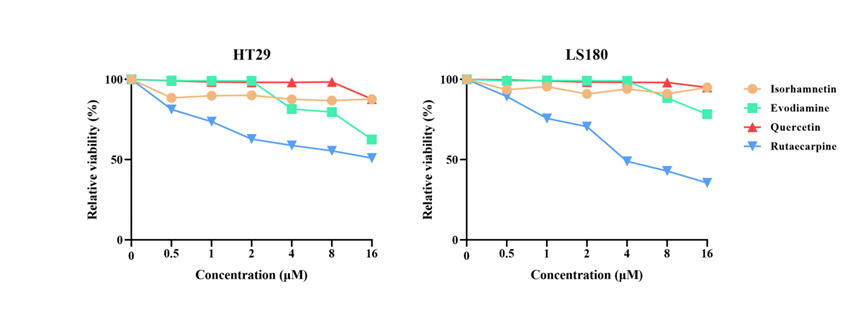
The proliferative ability of HT29 and LS180 cells that disposed in different concentrations of Isorhamnetin, Evodiamine, Quercetin and Rutaecarpine (0.5 µM, 1 µM, 2 µM, 4 µM, 8 µM and 16 µM).
Rutaecarpine purchased from MedChemExpress. Usage Cited in: BMC Complement Med Ther. 2023 Dec 1;23(1):433. [Abstract]
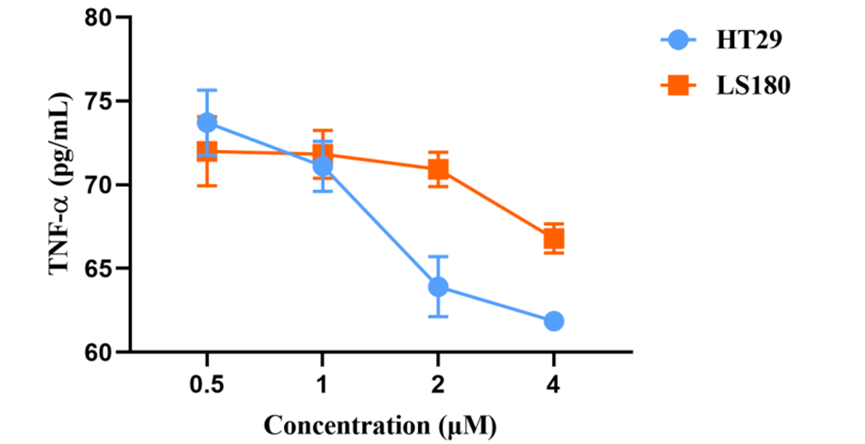
The supernatant concentration of TNF-α after HT29 and LS180 cells pretreating with Rutaecarpine (0.5 µM, 1 µM, 2 µM and 4 µM) by ELISA.
-
Arch Pharm (Weinheim)
Design, synthesis, and characterization of PROTACs targeting the androgen receptor in prostate and lung cancer models. [Abstract]2022 May;355(5):e2100467. PMID: 35128717 -
-


Solvent & Solubility
In Vitro:
DMSO : 50 mg/mL (174.02 mM; Need ultrasonic; Hygroscopic DMSO has a significant impact on the solubility of product, please use newly opened DMSO)
Please refer to the solubility information to select the appropriate solvent. Once prepared, please aliquot and store the solution to prevent product inactivation from repeated freeze-thaw cycles.
Storage method and period of stock solution: -80°C, 2 years; -20°C, 1 year. When stored at -80°C, please use it within 2 years. When stored at -20°C, please use it within 1 year.
Please refer to the solubility information to select the appropriate solvent. Once prepared, please aliquot and store the solution to prevent product inactivation from repeated freeze-thaw cycles.
Storage method and period of stock solution: -80°C, 2 years; -20°C, 1 year. When stored at -80°C, please use it within 2 years. When stored at -20°C, please use it within 1 year.
Concentration (start) × Volume (start) = Concentration (final) × Volume (final)

Protocols
-
Cell Cytotoxicity Assay
Cytotoxicity assays are usually based on the assessment of cell membrane damage, which can also be indirectly detected by measuring cell viability. Detection methods include MTT assay, CKK-8 assay, LDH assay and ATP assay, etc.
-
ROS/oxidative-stress fluorescent staining
ROS/oxidative-stress fluorescent staining uses cell-permeant fluorogenic probes that become fluorescent after oxidation inside cells or tissues; commonly used examples include DCFH-DA/DCFDA for broad cellular oxidant detection, DHE for superoxide-related signal detection, MitoSOX for mitochondrial superoxide-related signal detection, and CellROX probes for oxidative-stress-associated fluorescence readouts. The assay detects probe oxidation rather than a single ROS species unless the probe and analysis method have been chemically validated for that species. DCFH-DA enters cells, is deacetylated by intracellular esterases to DCFH, and produces fluorescent DCF after oxidation, so the readout is used as an operational measure of total cellular oxidative stress rather than a species-specific ROS measurement. DHE and MitoSOX can report superoxide-related oxidation, but red fluorescence alone can include non-specific ethidium-like oxidation products; HPLC or optimized spectral approaches are


Purity & Documentation
-
Data Sheet (283 KB)
-
SDS (254 KB)
- English - EN (254 KB)
- Français - FR (254 KB)
- Deutsch - DE (254 KB)
- Norwegian - NO (254 KB)
- Español - ES (254 KB)
- Swedish - SV (254 KB)
- Italian - IT (254 KB)
- Korean - KR (254 KB)
- Portuguese - PT (254 KB)
-
Handling Instructions (2659 KB)
References
[1]. Moon TC, et al. A new class of COX-2 inhibitor, rutaecarpine from Evodia rutaecarpa. Inflamm Res. 1999 Dec;48(12):621-5. [Content Brief]
[2]. Lee SH, et al. Progress in the studies on rutaecarpine. Molecules. 2008 Feb 6;13(2):272-300. [Content Brief]
[3]. Jeon TW, et al. Immunosuppressive effects of rutaecarpine in female BALB/c mice. Toxicol Lett. 2006 Jul 1;164(2):155-66. [Content Brief]
[4]. Xu M, et al. Rutaecarpine Attenuates Oxidative Stress-Induced Traumatic Brain Injury and Reduces Secondary Injury via the PGK1/KEAP1/NRF2 Signaling Pathway. Front Pharmacol. 2022 Apr 12;13:807125. [Content Brief]


Complete Stock Solution Preparation Table
Please refer to the solubility information to select the appropriate solvent. Once prepared, please aliquot and store the solution to prevent product inactivation from repeated freeze-thaw cycles.
Storage method and period of stock solution: -80°C, 2 years; -20°C, 1 year. When stored at -80°C, please use it within 2 years. When stored at -20°C, please use it within 1 year.
| Optional Solvent | Concentration Solvent Mass | 1 mg | 5 mg | 10 mg | 25 mg |
|---|---|---|---|---|---|
| DMSO | 1 mM | 3.4804 mL | 17.4022 mL | 34.8044 mL | 87.0110 mL |
| 5 mM | 0.6961 mL | 3.4804 mL | 6.9609 mL | 17.4022 mL | |
| 10 mM | 0.3480 mL | 1.7402 mL | 3.4804 mL | 8.7011 mL | |
| 15 mM | 0.2320 mL | 1.1601 mL | 2.3203 mL | 5.8007 mL | |
| 20 mM | 0.1740 mL | 0.8701 mL | 1.7402 mL | 4.3505 mL | |
| 25 mM | 0.1392 mL | 0.6961 mL | 1.3922 mL | 3.4804 mL | |
| 30 mM | 0.1160 mL | 0.5801 mL | 1.1601 mL | 2.9004 mL | |
| 40 mM | 0.0870 mL | 0.4351 mL | 0.8701 mL | 2.1753 mL | |
| 50 mM | 0.0696 mL | 0.3480 mL | 0.6961 mL | 1.7402 mL | |
| 60 mM | 0.0580 mL | 0.2900 mL | 0.5801 mL | 1.4502 mL | |
| 80 mM | 0.0435 mL | 0.2175 mL | 0.4351 mL | 1.0876 mL | |
| 100 mM | 0.0348 mL | 0.1740 mL | 0.3480 mL | 0.8701 mL |


Rutaecarpine Related Classifications
HY-N0147 Related Classifications
 Powered by Bioz