



COX
Cyclooxygenase
Cyclooxygenase (COX), officially known as prostaglandin-endoperoxide synthase (PTGS), is an enzyme that is responsible for formation of important biological mediators called prostanoids, including prostaglandins, prostacyclin and thromboxane. Pharmacological inhibition of COX can provide relief from the symptoms of inflammation and pain. Drugs, like Aspirin, that inhibit cyclooxygenase activity have been available to the public for about 100 years. Two cyclooxygenase isoforms have been identified and are referred to as COX-1 and COX-2. Under many circumstances the COX-1 enzyme is produced constitutively (i.e., gastric mucosa) whereas COX-2 is inducible (i.e., sites of inflammation). Non-steroidal anti-inflammatory drugs (NSAID), such as aspirin and ibuprofen, exert their effects through inhibition of COX. The main COX inhibitors are the non-steroidal anti-inflammatory drugs (NSAIDs).
COX Isoform Specific Products
All Product Categories
-
COX Related Products (1312)
Related Products (1312)

-
Antibodies (6)
-
COX Isoform Comparison
-
COX-1/2-IN-6
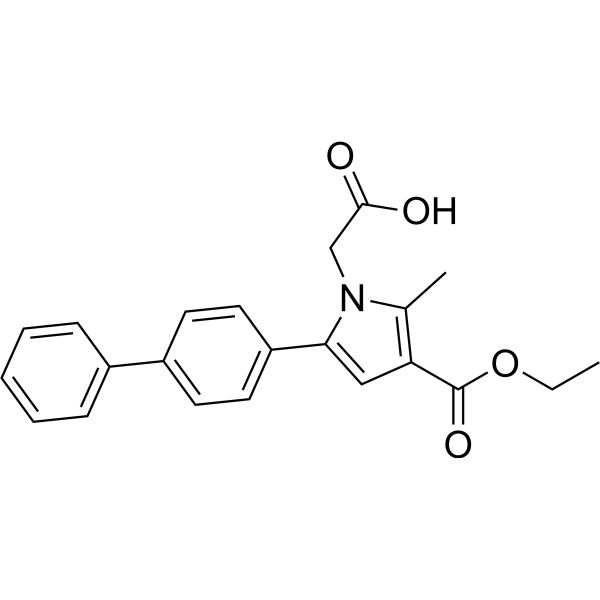 0 ImagesCat. No.: HY-162044CAS No.: 327024-84-0
-
7,4'-Dihydroxyflavone (Standard)
 0 Images7,4'-Dihydroxyflavone (7,4'-DHF) is a flavonoid, which can be isolated from Glycyrrhiza uralensis. 7,4'-Dihydroxyflavone is eotaxin/CCL11 inhibitor and CBR1 inhibitor (IC50=0.28 μM). 7,4'-Dihydroxyflavone has the ability to consistently suppress eotaxin production and prevent dexamethasone (Dex)‐paradoxical adverse effects on eotaxin production. 7,4'-Dihydroxyflavone (7,4'-DHF) inhibits MUC5AC gene expression, mucus production and secretion via regulation of NF-κB, STAT6 and HDAC2.7,4'-Dihydroxyflavone (7,4'-DHF) decreases phorbol 12-myristate 13-acetate (PMA) stimulated NCI-H292 human airway epithelial cell MUC5AC gene expression and mucus production with IC50 value of 1.4 µM.
-
Phenyl β-D-glucopyranoside (Standard)
 0 ImagesPhenyl β-D-glucopyranoside (Standard) is the analytical standard of Phenyl β-D-glucopyranoside (HY-W011849). This product is intended for research and analytical applications. Phenyl β-D-glucopyranoside is a component isolated from Phellodendron amurense, which has anti-inflammatory and anti-tumor activities. Phenyl β-D-glucopyranoside inhibits nitric oxide (NO) production, and the expression of iNOS and COX-2. Phenyl β-D-glucopyranoside also inhibits the nuclear translocation of NF-κB. Phenyl β-D-glucopyranoside inhibits the expression of pro-inflammatory cytokines and related genes.
-
Phenidone (Standard)
 0 ImagesPhenidone, an orally active dual inhibitor of cyclooxygenase (COX) and lipoxygenase (LOX), ameliorates rat paralysis in experimental autoimmune encephalomyelitis. Phenidone is a potent hypotensive agent in the spontaneously hypertensive rat. Phenidone is used as a photographic developer.
-
Indobufen (Standard)
 0 ImagesSynonyms: Ibustrin (Standard)Indobufen (Standard) is the analytical standard of Indobufen. This product is intended for research and analytical applications. Indobufen is a platelet aggregation inhibitor. Indobufen is a reversible platelet cyclooxygenase (Cox) activity inhibitor. Indobufen suppresses thromboxane A2 (TxA2) synthesis. Indobufen down-regulates tissue factor (TF) in monocytes.
-
NS-398 (Standard)
 0 ImagesNS-398 (Standard) is the analytical standard of NS-398. This product is intended for research and analytical applications. NS-398 is a non-steroidal an-inflammatory agent with analgesic and antipyretic effects, and selectively inhibits prostaglandin G/H synthase 2/cyclooxygenase 2 (COX-2) activity, with an IC50 of 3.8 μM, and has no effect on COX-1 at 100 μM.
-
Bromfenac sodium hydrate (Standard)
 0 ImagesSynonyms: Bromfenac monosodium salt sesquihydrate (Standard)Bromfenac (sodium hydrate) (Standard) is the analytical standard of Bromfenac (sodium hydrate). This product is intended for research and analytical applications. Bromfenac sodium hydrate (Bromfenac monosodium salt sesquihydrate) is a potent and orally active inhibitor of COX, with IC50s of 5.56 and 7.45 nM for COX-1 and COX-2, respectively. Bromfenac sodium hydrate can be used in ocular inflammation research.
-
Pectolinarigenin (Standard)
 0 ImagesPectolinarigenin (Standard) is the analytical standard of Pectolinarigenin. This product is intended for research and analytical applications. Pectolinarigenin is an orally active dual inhibitor of COX-2/5-LOX with anti-inflammatory, antioxidant, antitumor and neuroprotective activities. Pectolinarigenin exerts neuroprotective and anti-inflammatory effects on astrocyte inflammation via the NFκB and MAPK pathways. Pectolinarigenin inhibits LPS-induced phosphorylation of ERK1/2, N-FκB and p38MAPK, directly inhibits the enzymatic activity or binding of COX-2, 5-LOX and HIF-1α, and reduces the level of XIAP. Pectolinarigenin modifies Keap1 to promote nuclear accumulation of Nrf2, induces ARE-mediated antioxidant enzyme expression, and possesses direct free radical scavenging activity. Pectolinarigenin reduces the release of NO, proinflammatory mediators and leukotrienes, and increases the level of IL-10. Pectolinarigenin induces G2/M cell cycle arrest, apoptosis (Apoptosis) and autophagy (Autophagy) via the PI3K/AKT/mTOR signaling pathway. Pectolinarigenin reduces renal crystal deposition and inhibits melanin synthesis. Pectolinarigenin inhibits inflammation and alleviates allergy in mouse models of inflammation. Pectolinarigenin alleviates renal injury, inflammation and oxidative stress in mice by inhibiting HIF-1α activity. Pectolinarigenin can be used for the research of neurodegenerative diseases, inflammatory/allergic diseases, calcium oxalate nephrocalcinosis, gastric cancer, melasma, post-inflammatory diseases and chloasma.
-
Nimesulide (Standard)
 0 ImagesSynonyms: R805 (Standard)Nimesulide (Standard) is the analytical standard of Nimesulide. This product is intended for research and analytical applications. Nimesulide is a selective COX-2 inhibitor, with IC50s of 70 nM-70 μM in a time-dependent manner, but it shows no effect on COX-1 (IC50 >100 μM). Nimesulide has potent anti-inflammatory, analgesic and antipyretic properties.
-
Imrecoxib (Standard)
 0 ImagesSynonyms: BAP-909 (Standard)Imrecoxib (Standard) is the analytical standard of Imrecoxib. This product is intended for research and analytical applications. Imrecoxib (BAP-909) is a novel and selective cyclooxygenase 2 (COX-2) inhibitor with an IC50 value of 18 nM, it also inhibits COX1- activity with an IC50 value of 115 nM. Imrecoxib (BAP-909) has anti-inflammatory effect.
-
Fenoprofen (Standard)
 0 ImagesSynonyms: LILLY-53858 (Standard)Fenoprofen (Standard) (LILLY-53858 (Standard)) is the analytical standard of Fenoprofen (HY-B1456A). This product is intended for research and analytical applications. Fenoprofenc is a nonsteroidal anti-inflammatory agent (NSAID) and inhibits cyclooxygenase (COX). Fenoprofen is a melanocortin receptors (MCRs) positive allosteric modulator (PAM). Fenoprofen also increases ERK1/2 activation in HEK293T cells. Fenoprofen has anti-arthritic activities and can be used for the study of rheumatoid arthritis and osteoarthritis.
-
8(9)-EET
 0 ImagesCat. No.: HY-160431CAS No.: 82864-43-58(9)-EET is one of the main metabolites produced by the metabolism of arachidonic acid (HY-109590) through the cytochrome P450 epoxide pathway. 8(9)-EET is an effective substrate for COX-1 and COX-2. 8(9)-EET activates PPARα in HEK293 cells and inhibits the activity of NF-κB induced by IL-1β in a PPARα-dependent and -independent manner. The (8S,9R)-isomer of 8(9)-EET ([(8S,9R)-EET]) causes vasoconstriction, thereby reducing renal plasma flow and glomerular filtration rate.
-
Neosakuranin
 0 ImagesCat. No.: HY-N17699CAS No.: 31187-54-9Neosakuranin is a flavonoid. Neosakuranin can be isolated from Sorbus commixta and the bark of P. cerasus. Neosakuranin exhibits suppressive effects on xanthine oxidase with an IC50 of 157.8 μM. Neosakuranin inhibits COX-l. Neosakuranin can be used in the research of inflammatory diseases.
-
L-651896
 0 ImagesCat. No.: HY-19023CAS No.: 99134-29-9L-651896 is a compound with anti-inflammatory and antiproliferative activities that inhibits 5-lipoxygenase and cyclooxygenase, thereby reducing the production of leukotrienes and prostaglandins. L-651896 can be used in the study of skin diseases and other inflammatory diseases.
-
Balanophonin
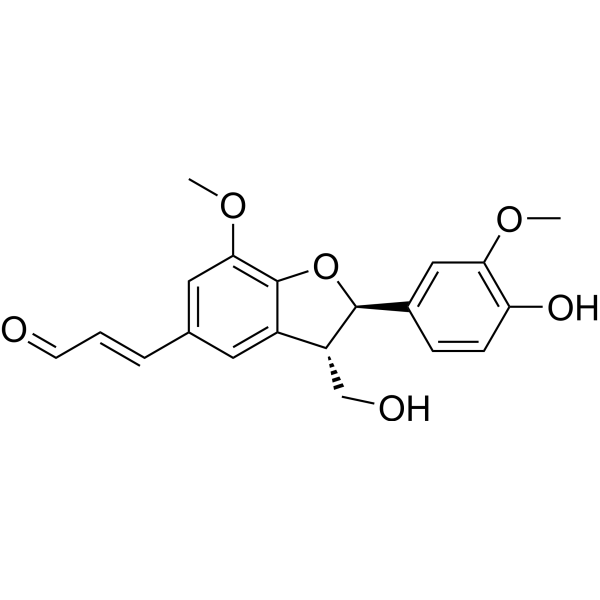 0 ImagesCat. No.: HY-N10782CAS No.: 80286-36-8Balanophonin is an anti-inflammatory and anti-cancer agent. Balanophonin inhibits microglial activation and neurodegeneration via inhibiting activated microglia-induced apoptosis.
-
Indicaxanthin
 0 ImagesCat. No.: HY-W747992CAS No.: 2181-75-1Indicaxanthin is an orally available, blood-brain barrier-permeable bioavailable betalain pigment (Betalain Pigment) found in the fruits of Opuntia ficus-indica. Indicaxanthin exhibits antioxidant, anti-inflammatory, antiproliferative and neuromodulatory activities. Indicaxanthin modulates glutamatergic neurotransmission and inhibits PGE2, TNF-α, IL-1β, iNOS, COX-2 and NF-κB-related inflammatory responses. Indicaxanthin can be used in studies of melanoma, colorectal cancer, acute inflammation, obesity-associated insulin resistance and glutamatergic neuromodulation.
-
HA-29
 0 ImagesCat. No.: HY-187632CAS No.: 142733-19-5HA-29 is an antiplatelet aggregation agent. HA-29 acts as a cyclooxygenase inhibitor and a thromboxane A2/prostaglandin endoperoxide receptor antagonist. HA-29 exerts its effects by inhibiting cyclooxygenase to block the formation of thromboxane A2 (TXA2), while simultaneously blocking the TXA2/prostaglandin endoperoxide receptor on platelets as a non-competitive antagonist. HA-29 can be used in antithrombotic research.
-
Mefenamic acid (Standard)
 0 ImagesMefenamic acid (Standard) is the analytical standard of Mefenamic acid. This product is intended for research and analytical applications. Mefenamic acid is a BBB-permeable non-steroidal anti-inflammatory agent, acting as a competitive inhibitor of hCOX-1 and hCOX-2, with IC50s of 40 nM and 3 μM for hCOX-1 and hCOX-2, respectively.
-
4-Methylamino antipyrine hydrochloride (Standard)
 0 ImagesCat. No.: HY-135731ARCAS No.: 856307-27-24-Methylamino antipyrine (hydrochloride) (Standard) is the analytical standard of 4-Methylamino antipyrine (hydrochloride). This product is intended for research and analytical applications. 4-Methylamino antipyrine hydrochloride is an active metabolite of Metamizole. Metamizole is a pyrazolone non-steroidal anti-inflammatory drug (NSAID) and inhibits COX. Metamizole is an nonopioid analgesic agent and can be used for pain and fever. 4-Methylamino antipyrine hydrochloride has analgesic, antipyretic, and relatively weak antiinflammatory properties.
-
Lornoxicam (Standard)
 0 ImagesSynonyms: Chlortenoxicam (Standard); Ro 13-9297 (Standard)Lornoxicam (Standard) is the analytical standard of Lornoxicam. This product is intended for research and analytical applications. Lornoxicam (Chlortenoxicam) is a highly active COX-1 and COX-2 inhibitor with IC50 of 5 nM and 8 nM respectively. It is a new non-steroidal anti-inflammatory compound.




