



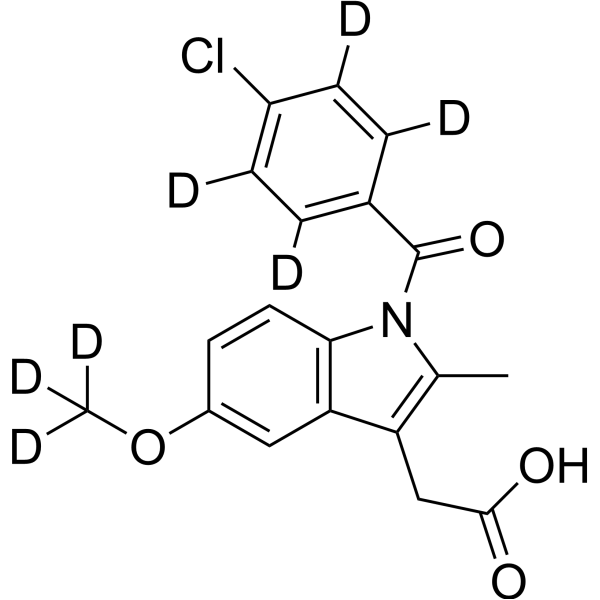
Indometacin-d7
Indometacin-d7 is deuterated labeled Indomethacin (HY-14397). Indomethacin (Indometacin) is a potent, orally active COX1/2 inhibitor with IC50 values of 18 nM and 26 nM for COX-1 and COX-2, respectively. Indomethacin has anticancer activity and anti-infective activity. Indomethacin can be used for cancer, inflammation and viral infection research.
Nos produits utilisent uniquement pour la recherche. Nous ne vendons pas aux patients.
- Formule: C19H9D7ClNO4
- Masse moléculaire:364.83
-
Stockage:
Please store the product under the recommended conditions in the Certificate of Analysis.

To place orders, for customer services and technical support, please contact: MedChemExpress USA
Tel: 609-228-6898 E-mail: [email protected] [email protected]


-
 Activité biologique
-
Chemical Information
- Protocole
- Pureté et documentation
- Références
-
 Help & FAQs


Voir tous les produits spécifiques à Isoform Antibiotic
More

Activité biologique
Description
In Vitro
Stable heavy isotopes of hydrogen, carbon, and other elements have been incorporated into drug molecules, largely as tracers for quantitation during the drug development process. Deuteration has gained attention because of its potential to affect the pharmacokinetic and metabolic profiles of drugs[1].
Indomethacin (Indometacin) (0-150 μM; 24 hours; 3LL-D122 cells) has anticancer activity in vitro[3].
Indomethacin (Indometacin) (0-1000 μM) protects the host cells from damage caused by the virus through activates PKR, resulting in elF2α phosphorylation, and in turn shutting of translation of viral protein and inhibiting replication of the virus (IC50=2μM)[4].
MedChemExpress (MCE) has not independently confirmed the accuracy of these methods. They are for reference only.
Application
1. This compound can be used as a tracer
2. This compound can be used as an internal standard for quantitative analysis by NMR, GC-MS, or LC-MS.


Chemical Information
-
Unlabeled CAS 53-86-1
-
Masse moléculaire 364.83
-
Formule C19H9D7ClNO4
-
SMILES
O=C(CC1=C(C)N(C(C2=C([2H])C([2H])=C(C([2H])=C2[2H])Cl)=O)C3=C1C=C(C=C3)OC([2H])([2H])[2H])O
-
Livraison
Room temperature in continental US; may vary elsewhere.
-
Stockage
Please store the product under the recommended conditions in the Certificate of Analysis.


Pureté et documentation
Références
[1]. Russak EM, et al. Impact of Deuterium Substitution on the Pharmacokinetics of Pharmaceuticals. Ann Pharmacother. 2019 Feb;53(2):211-216. [Content Brief]
[2]. Helleberg L, et, al. Clinical Pharmacokinetics of indomethacin. Clin Pharmacokinet. 1981 Jul-Aug;6(4):245-58. [Content Brief]
[3]. Riendeau D, et, al. Biochemical and pharmacological profile of a tetrasubstituted furanone as a highly selective COX-2 inhibitor. Br J Pharmacol. 1997 May;121(1):105-17. [Content Brief]
[4]. Sabiu S, et, al. Indomethacin-induced gastric ulceration in rats: Protective roles of Spondias mombin a nd Ficus exasperate. Toxicol Rep. 2015 Jan 8:2:261-267. [Content Brief]
[5]. Eli Y, et, al. Comparative effects of indomethacin on cell proliferation and cell cycle progression in tumor cells grown in vitro and in vivo. Biochem Pharmacol. 2001 Mar 1;61(5):565-71. [Content Brief]
[6]. Danisman B, et, al, Carnosic Acid Ameliorates Indomethacin-Induced Gastric Ulceration in Rats by Alleviating Oxidative Stress and Inflammation. Biomedicines. 2023 Mar 9;11(3):829. [Content Brief]
[7]. Amici C, et, al. Inhibition of viral protein translation by indomethacin in vesicular stomatitis virus infection: role of eIF2α kinase PKR. Cell Microbiol. 2015 Sep;17(9):1391-404. [Content Brief]

Calculators
Concentration (start) × Volume (start) = Concentration (final) × Volume (final)


Indometacin-d7 Related Classifications
HY-14397S2 Related Classifications
 Powered by Bioz