



Glycosidase
Glycosidase
Glycosidase are a class of enzymes which catalyze the hydrolysis of glycosidic bonds. In living organisms, Glycosidase are involved in carbohydrate metabolism. They can degrade polysaccharides such as starch and glycogen into monosaccharides, providing energy for cells. Glycosidase also participate in the synthesis and modification of biological macromolecules such as glycoproteins and glycolipids, playing a crucial role in cell recognition and signal transduction. Additionally, in plants and microorganisms, Glycosidase are involved in the metabolism of cell wall polysaccharide components, affecting cell growth, differentiation, and morphogenesis. Gene mutations of Glycosidase can trigger genetic diseases, leading to abnormal metabolism in the body and damage to organ functions. Changes in their activity are associated with various diseases such as diabetes, infectious diseases, and tumors, and can influence the occurrence and development of diseases[1][2].
References:
- [1]. Wang X, et al. Metabolites extracted from microorganisms as potential inhibitors of glycosidases (α-glucosidase and α-amylase): A review. Front Microbiol. 2022 Nov 17;13:1050869.
- [2]. Ohtsubo K, et al. Glycosylation in cellular mechanisms of health and disease. Cell. 2006 Sep 8;126(5):855-67. [Content Brief]
All Product Categories
-
Glycosidase Inhibitors
(455)
View all products
-
Glycosidase Antagonist
(1)
View all products
-
Glycosidase Activators
(20)
View all products
-
Glycosidase Modulators
(8)
View all products
-
Glycosidase Chemical
(1)
View all products
-
Glycosidase Inducers
(2)
View all products
-
Glycosidase Degrader
(1)
View all products
-
Glycosidase Controls
(6)
View all products
-
Glycosidase Substrates
(25)
View all products
-
Glycosidase Ligands
(3)
View all products
-
Glycosidase Related Products (696)
Related Products (696)

-
Antibodies (3)
-
2,3-Indolobetulonic acid
 0 ImagesCat. No.: HY-134960CAS No.: 905837-93-62,3-Indolobetulonic acid (compound 2), a triterpenoid, is α-glucosidase inhibitor with an IC50 of 1.8 µM.

-
CHI3L1-IN-4
 0 ImagesCat. No.: HY-175781CAS No.: 1258696-85-3CHI3L1-IN-4 (Compound 8) is a Chitinase-3-Like Protein 1 (CHI3L1) inhibitor with a Kd of 6.8 μM. CHI3L1-IN-4 significantly reduces glioblastoma (GBM) spheroids viability and attenuates phospho-STAT3 levels by disrupting CHI3L1 pathway. CHI3L1-IN-4 can be used for GBM research.


-
(±)7(8)-DiHDTE
 0 ImagesCat. No.: HY-172832(±)7(8)-DiHDTE is a metabolite of Docosapentaenoic acid (22n-3) (HY-113159). Docosapentaenoic acid (22n-3) is a component of phospholipids. Docosapentaenoic acid 22n-3 has inhibitory activity against α-amylase and α-glucosidase with IC50s of 17 and 22 μg/mL, respectively. Docosapentaenoic acid 22n-3 increases cell vitality. Docosapentaenoic acid 22n-3 has a weak anti-inflammatory effect.

-
Terrestrimine
 0 ImagesCat. No.: HY-N15280CAS No.: 1778735-31-1Terrestrimine is a potent inhibitor of α-Glycosidase, with the IC50 of 225.83 μM. Terrestrimine plays an important role in metabolic disease research.

-
β-Xylosidase, Lactobacillus brevis
 0 ImagesCat. No.: HY-E70889Bβ-Xylosidase, Lactobacillus brevis (EC 3.2.1.37) can release reducing sugars from birch xylan and catalyze the hydrolysis of 4-methylumbelliferone-β-D-cellobiose and 4-methylumbelliferone-β-D-glucopyranoside. β-Xylosidase does not possess endoxylanase, arabinoxylanase, or β-glucanase activity. β-Xylosidase undergoes post-translational glycosylation modification.
-
α-Glucosidase-IN-58
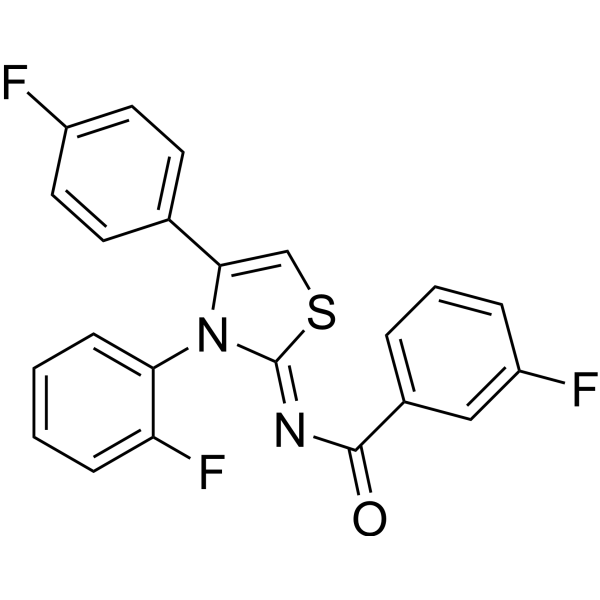 0 ImagesCat. No.: HY-162395CAS No.: 3032460-97-9α-Glucosidase-IN-58 (Compound 6d) is an inhibitor for α-glucosidase with IC50 of 1.47 μM.

-
Terphenyllin (Standard)
 0 ImagesCat. No.: HY-119821RCAS No.: 52452-60-5Thiamiprine (Standard) is the analytical standard of Thiamiprine. This product is intended for research and analytical applications. Thiamiprine (BW 57-323) is a compound related to azathioprine. Its nucleoside forms are similar to the parent compound in terms of cytotoxicity in vitro (except for the arabinoside). In the rat adjuvant arthritis model in vivo, its riboside and 2'-deoxyriboside are less active than the parent compound. The arabinoside is inactive and nontoxic. It has similar potency to the other parent compounds tested, but has a different safety profile.
-
Galacto-PUGNAc
 0 ImagesCat. No.: HY-108241ACAS No.: 1145878-98-3Galacto-PUGNAc is a selective competitive inhibitor of lysosomal β-hexosaminidases (HEX), with Ki values of 51 and 18 nM, for hHEXA and hHEXB, respectively. Galacto-PUGNAc elevates GM2 ganglioside levels in neuroblastoma cells. Galacto-PUGNAc can be used for the research of neurodegenerative disorders.
-
(-)-Adenophorine
 0 ImagesCat. No.: HY-17666CAS No.: 616215-43-1(-)-Adenophorine (Compound 7c) is a glycosidase inhibitor. (-)-Adenophorine inhibits α-L-fucosidase with an IC50 of 72 μM.

-
β-Glucosidase 1A, Caldicellulosiruptor saccharolyticus
 0 ImagesCat. No.: HY-E71305Aβ-Glucosidase 1A, Caldicellulosiruptor saccharolyticus (EC 3.2.1.21) is a glucosidase enzyme that acts upon β1->4 bonds linking two glucose or glucose-substituted molecules (i.e., the disaccharide cellobiose) . β-Glucosidase is one of the cellulases, enzymes involved in the decomposition of cellulose and related polysaccharides; more specifically, an exocellulase with specificity for a variety of beta-D-glycoside substrates. It catalyzes the hydrolysis of terminal non-reducing residues in beta-D-glucosides with release of glucose.
-
Glucocerebrosidase-IN-2
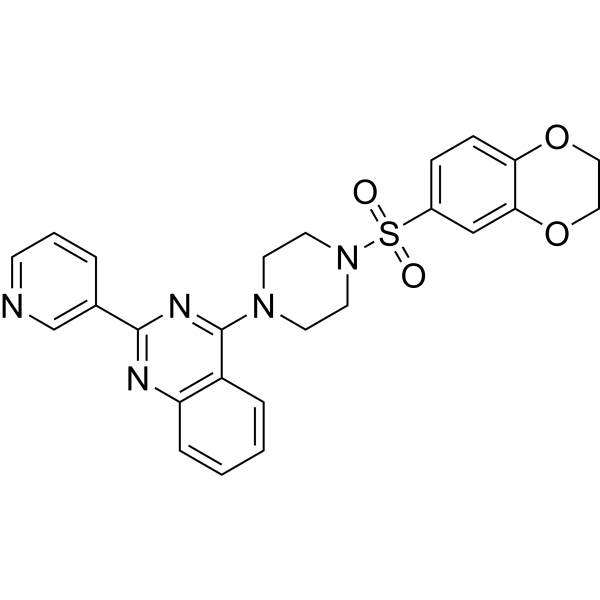 0 ImagesCat. No.: HY-156020CAS No.: 851185-20-1Glucocerebrosidase-IN-2 (compound 12) is a quinazoline analogue and an inhibitor of glucocerebrosidase (GC). Glucocerebrosidase-IN-2 has the potential to improve GC translocation to lysosomes in Gaucher disease patient-derived cells (mostly carrying the N370S mutation). Glucocerebrosidase-IN-2 inhibits the hydrolysis of 4-methylumbelliferone β-D-glucopyranoside (4MU) and fluorescent glycosylceramide (FlourGC) in N370S mutant tissues with an AC50 of 25.29 μM.
-
Eumenitin
 0 ImagesCat. No.: HY-P11163CAS No.: 255720-68-4Eumenitin is an antibacterial peptide with strong membrane activity, broad-spectrum antibacterial activity, and almost no hemolytic toxicity. Eumenitin has inhibitory effects on various Gram positive and Gram negative bacteria. Eumenitin can induce the release of β-hexosaminidase from rat peritoneal mast cells and RBL-2H3 cells. Eumenitin can be used in the research of infectious conditions.
-
oligo-α-1,6-Glucosidase, Bacillus cereus ATCC7064
 0 Imagesoligo-α-1,6-Glucosidase, Bacillus cereus ATCC7064 is a hydrolase that mainly hydrolyzes oligosaccharides with α-1,6-glycosidic bonds. oligo-α-1,6-Glucosidase, Bacillus cereus ATCC7064 can catalyzes the exo hydrolysis of α-1,6-glucoside bonds from the nonreducing ends of panose, palatinose, α-limit dextrins, and isomaltooligosaccharides. oligo-α-1,6-Glucosidase, Bacillus cereus ATCC7064 participates in the degradation pathway of starch and glycogen, assisting enzymes such as α-amylase to completely hydrolyzes amylopectin.




