



Carnitine Palmitoyltransferase (CPT)
Carnitine O-palmitoyltransferase
Carnitine palmitoyltransferase (CPT) is the central rate-limiting enzyme system for mitochondrial fatty acid β-oxidation, capable of converting palmitoyl-CoA into palmitoylcarnitine[1][2]. CPT transports long-chain acyl-CoA into the mitochondrial matrix, where it undergoes a transesterification reaction with free carnitine to generate acylcarnitine—the sole form in which long-chain fatty acids can traverse the mitochondrial inner membrane. The complete carnitine cycle is cooperatively executed by CPT1 on the mitochondrial outer membrane, CPT2 on the inner face of the inner membrane, and carnitine-acylcarnitine translocase (CACT), which mediates the exchange of acylcarnitine and free carnitine across the inner membrane. The activity of CPT directly determines the efficiency of cellular fatty acid oxidation[3][4].
The CPT1 enzyme system comprises three major isoforms: CPT1A (liver isoform), CPT1B (muscle isoform), and CPT1C (brain isoform). These isoforms exhibit significant differences in tissue distribution, functional regulation, and physiological and pathological roles, collectively constituting a complex metabolic regulatory network. In metabolic diseases (such as non-alcoholic steatohepatitis and obesity), the downregulation of CPT1A expression impairs fatty acid oxidation, thereby triggering lipid accumulation; conversely, in various malignancies, CPT1A is frequently overexpressed, providing energy for tumor cell proliferation and mediating drug resistance, thus serving as a critical node in metabolic reprogramming[3][4]. CPT1A activity is primarily subject to physiological inhibition by malonyl-CoA; however, under pathological conditions, it is subject to transcriptional regulation by various signaling pathways, including JAK2/STAT3 and AMPK. Furthermore, recent studies have revealed that CPT1A possesses non-metabolic functions, such as the regulation of histone acetylation. Intervention strategies targeting CPT vary markedly depending on the specific disease context: in metabolic disorders, activating CPT1A is required to enhance fatty acid oxidation—a process that can be upregulated, for instance, by the traditional Chinese medicine compound *Qushi Huayu* formula; conversely, in anti-tumor research, inhibiting CPT1A may be necessary to disrupt the energy supply, with inhibitors such as DHP-B having already demonstrated promising anti-tumor efficacy[1][2]. The CPT system has emerged as a pivotal molecular link connecting lipid metabolism with cell fate, positioning itself at the nexus—and as a major research hotspot—across diverse fields including metabolism, signal transduction, epigenetics, immunology, tumor biology, and precision medicine[1][2][3][4].
References:
- [1]. Sun Q, et al. Qushi Huayu decoction attenuated hepatic lipid accumulation via JAK2/STAT3/CPT-1A-related fatty acid β-oxidation in mice with non-alcoholic steatohepatitis. Pharm Biol. 2022 Dec;60(1):2124-2133. [Content Brief]
- [2]. Hu A, et al. A novel CPT1A covalent inhibitor modulates fatty acid oxidation and CPT1A-VDAC1 axis with therapeutic potential for colorectal cancer. Redox Biol. 2023 Dec;68:102959. [Content Brief]
- [3]. Qu Q, et al. Fatty acid oxidation and carnitine palmitoyltransferase I: emerging therapeutic targets in cancer. Cell Death Dis. 2016 May 19;7(5):e2226. [Content Brief]
- [4]. Carnitine Palmitoyltransferase Overview. subject area: Medicine and Dentistry. Sciencedirect Topic.
All Product Categories
-
Carnitine Palmitoyltransferase (CPT) Related Products (54)
Related Products (54)

-
Alisol A 24-acetate
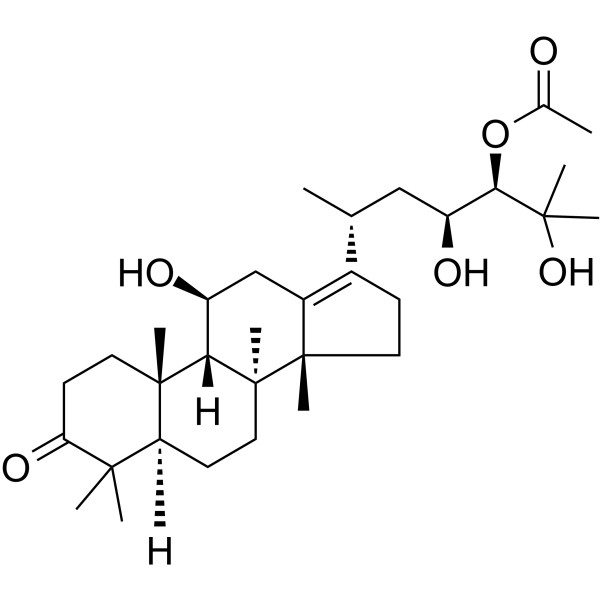 0 ImagesSynonyms: Alisol A 24-monoacetate; Alisol A monoacetateAlisol A 24-acetate (Alisol A monoacetate) is an orally active derivative of protostane-type tetracyclic triterpenoid. Alisol A 24-acetate upregulates the expression of adiponectin, AMPKα, CPT1, and ACOX1; downregulates the expression of SREBP-1c, ACC, FAS, Bcl-2, Bcl-xl, PPAR-γ, perilipin A, and NFATc1; inhibits the activity of PI3K/Akt/mTOR and HMGR; and activates the PKA and ERK signaling pathways. Alisol A 24-acetate regulates cell apoptosis (apoptosis), autophagy (Autophagy, hepatic lipid accumulation, inflammatory response, neuroprotection, MRSA membrane integrity, and osteoclast differentiation. Alisol A 24-acetate can be used in research related to non-alcoholic fatty liver disease, nephrotoxicity, obesity, global cerebral ischemia-reperfusion injury, bacterial infection, and osteoporosis.
-
McN3716
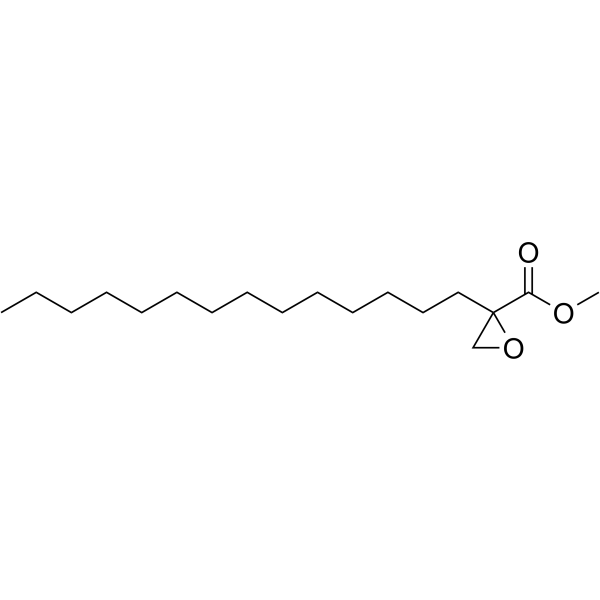 0 ImagesSynonyms: Methyl palmoxirate; NSC359682McN3716 is a carnitine palmitoyltransferase I (CPT-1) inhibitor.
-
(S)-(+)-Etomoxir
 0 Images(S)-(+)-Etomoxir is the S enantiomer of Etomoxir (HY-50202). Etomoxir is an irreversible inhibitor of carnitine palmitoyltransferase 1a (CPT-1a), inhibits fatty acid oxidation (FAO) through CPT-1a and inhibits palmitate β-oxidation in human, rat and guinea pig.
-
2,6-Didehydropeperomin B
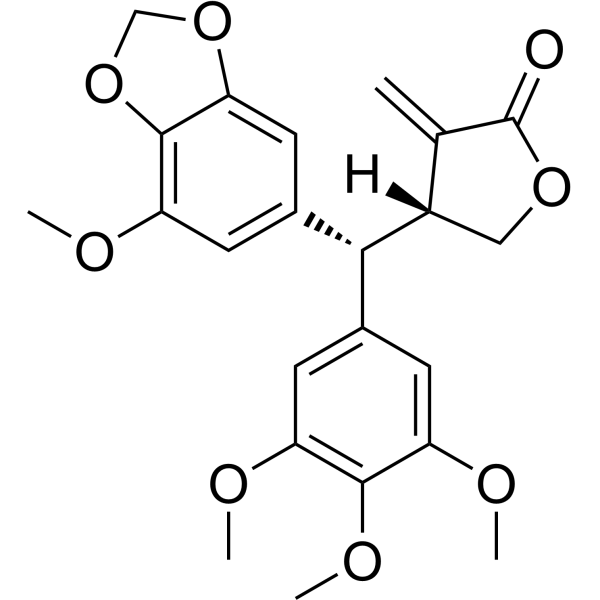 0 ImagesCat. No.: HY-161027CAS No.: 1186292-00-1DHP-B is an Ecolignan-type compound and covalent, selective CPT1A inhibitor with a Kd of 1.62 μM. DHP-B can be isolated from the plant Peperomia dindygulensis. DHP-B covalently binds to Cys96 of CPT1A, blocks FAO, and disrupts the mitochondrial CPT1A-VDAC1 interaction. DHP-B triggers Apoptosis. DHP-B exhibits anti-CRC activity.
-
9(S)-HOTrE
 0 Images9(S)-HOTrE is a PPARα activator and an inducer of apolipoprotein A-I (apoA-I) mRNA expression. 9(S)-HOTrE upregulates the expression of PPARα target gene CPT1α. 9(S)-HOTrE can be used in the research of cardiovascular diseases.
-
Etomoxir (Standard)
 0 ImagesSynonyms: (R)-(+)-Etomoxir (Standard)Etomoxir (Standard) is the analytical standard of Etomoxir. This product is intended for research and analytical applications. Etomoxir ((R)-(+)-Etomoxir) is an irreversible inhibitor of carnitine palmitoyltransferase 1a (CPT-1a), inhibits fatty acid oxidation (FAO) through CPT-1a and inhibits palmitate β-oxidation in human, rat and guinea pig.
-
Docosahexaenoyl-L-carnitine chloride
 0 ImagesCat. No.: HY-172548Docosahexaenoyl-L-carnitine chloride is a long-chain acylcarnitine composed of Docosahexaenoic acid (HY-B2167) and L-carnitine (HY-B0399). Docosahexaenoyl-L-carnitine chloride is transported into mitochondria for β -oxidation and decomposition under the action of carnitine palmitoyltransferase I (CPT I) and others. Docosahexaenoyl-L-carnitine chloride is promising for research of diseases related to fatty acid metabolism.
-
Cpt2 Rat Pre-designed siRNA Set A
 0 ImagesCat. No.: HY-RS23907Cpt2 Rat Pre-designed siRNA Set A contains three designed siRNAs for Cpt2 gene (Rat), as well as a negative control, a positive control, and a FAM-labeled negative control.
-
Cpt1a Mouse Pre-designed siRNA Set A
 0 ImagesCat. No.: HY-RS16248
Cpt1a Mouse Pre-designed siRNA Set A contains three designed siRNAs for Cpt1a gene (Mouse), as well as a negative control, a positive control, and a FAM-labeled negative control.
-
CPT2 Human Pre-designed siRNA Set A
 0 ImagesCat. No.: HY-RS03125
CPT2 Human Pre-designed siRNA Set A contains three designed siRNAs for CPT2 gene (Human), as well as a negative control, a positive control, and a FAM-labeled negative control.
-
SDZ-CPI 975
 0 ImagesCat. No.: HY-16149CAS No.: 157244-53-6Synonyms: CPI-975SDZ-CPI-975 is a novel, reversible, and selective CPT I inhibitor. SDZ-CPI-975 effectively inhibits fatty acid oxidation and lowers blood glucose levels.
-
1,3-Palmitin-2-docosahexaenoin
 0 ImagesCat. No.: HY-149545CAS No.: 214038-32-1Synonyms: 1,3-Dipalmitoyl-2-docosahexaenoyl glycerol1,3-Palmitin-2-docosahexaenoin (1,3-Dipalmitoyl-2-docosahexaenoyl glycerol) is the isomer of triacylglycerol (TAG), in which docosahexaenoic acid (DHA) is located at the β position (sn-2) of the glycerol backbone. 1,3-Palmitin-2-docosahexaenoin inhibits fatty acid synthase and cholesterol metabolism enzymes, activates carnitine palmitoyltransferase (CPT) in liver mitochondria and promotes β-oxidation of fatty acids. 1,3-Palmitin-2-docosahexaenoin exhibits lipid metabolism regulating activity.
-
CPT1B Human Pre-designed siRNA Set A
 0 ImagesCat. No.: HY-RS03123
CPT1B Human Pre-designed siRNA Set A contains three designed siRNAs for CPT1B gene (Human), as well as a negative control, a positive control, and a FAM-labeled negative control.
-
XJ-4-85
 0 ImagesCat. No.: HY-189236CAS No.: 3111620-80-2XJ-4-85 is a covalent activator and precursor compound targeting PFKL (EC50=56 μM in human PFKL). XJ-4-85 activates glycolysis, increases FBP production and glycolytic flux, and enhances LPS-stimulated proinflammatory cytokine release in macrophages. XJ-4-85 causes long-chain acylcarnitine accumulation, metabolic stress, and cytotoxicity through the release of the active payload XJ-4-119 targeting CPT2. XJ-4-85 exhibits broad and selective cytotoxicity across multiple cancer cell lines and is useful for melanoma research.
-
W1307
 0 ImagesCat. No.: HY-184891CAS No.: 3028770-95-5W1307 is a selective STAT3 inhibitor with a KD value of 1.74 μM. W1307 inhibits STAT3 Tyr705 phosphorylation, disrupts STAT3 dimerization, and suppresses STAT3 transcriptional activity. W1307 downregulates the expression of STAT3 downstream targets c-Myc, Mcl-1 and Bcl-2. W1307 transcriptionally inhibits SREBP1 and CPT2 expression to disrupt lipid homeostasis. W1307 shows potent anti-leukemic activity and synergizes with Cytarabine (Ara-C) (HY-13605) to overcome chemoresistance in acute myeloid leukemia (AML).
-
CPT1C Human Pre-designed siRNA Set A
 0 ImagesCat. No.: HY-RS03124
CPT1C Human Pre-designed siRNA Set A contains three designed siRNAs for CPT1C gene (Human), as well as a negative control, a positive control, and a FAM-labeled negative control.
-
(−)-C75
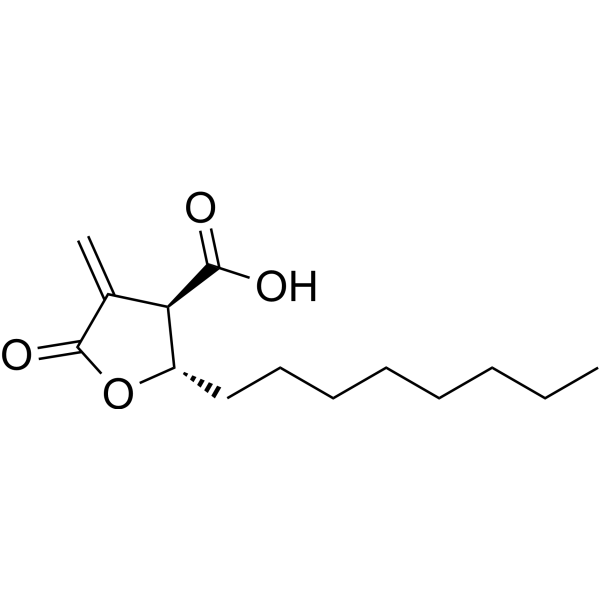 0 ImagesCat. No.: HY-12364BCAS No.: 1234694-22-4( )-C75 is a isoform of C75 (HY-12364), which is a synthetic fatty-acid synthase (FASN) inhibitor; inhibits prostate cancer cells PC3 with an IC50 of 35 μM. C75 is a potent CPT1A activator.
-
Malonyl CoA tetralithium
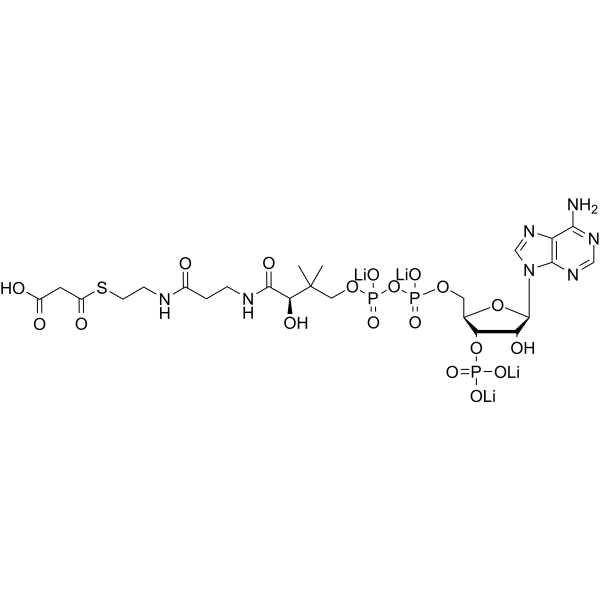 0 ImagesCat. No.: HY-141473CAS No.: 116928-84-8Synonyms: Malonyl coenzyme A tetralithiumMalonyl CoA (Malonyl coenzyme A) tetralithium is a substrate for fatty acid biosynthesis and an inhibitor of fatty acid oxidation. Malonyl CoA tetralithium is also a reversible inhibitor of mitochondrial carnitine palmitoyltransferase (CPT) 1.
-
LCB-2151
 0 ImagesCat. No.: HY-175673CAS No.: 2211175-99-2LCB-2151 (Compound 2), a nucleoside analogue, is an anticancer agent. LCB-2151 disrupts the two primary sources of ATP production (glycolysis and mitochondrial oxidative phosphorylation), reducing the bioenergetic capacity of KRAS-mutated pancreatic cancer cells and inducing ROS formation. LCB-2151 effectively inhibits key enzymes (such as CACT and CPT2) in glycolysis, the TCA cycle and fatty acid β-oxidation. LCB-2151 has significant cytotoxicity and induces cells apoptosis. LCB-2151 can be used for radiation therapy of cancers research.
-
Teglicar chloride
 0 ImagesCat. No.: HY-182248CAS No.: 908566-80-3Synonyms: ST1326 chlorideTeglicar chloride (ST1326 chloride) is an orally active, reversible, mixed-type, selective inhibitor of hepatic carnitine palmitoyltransferase I (L-CPT I), with an IC50 of 1.1 μM against rat L-CPT I. Teglicar chloride reduces serum glucose levels. Teglicar chloride exhibits antiketotic activity in normal fasted rats. Teglicar chloride can be used in research related to type 2 diabetes and ketoacidosis.



